St. Petersburg has around 200 museums, so you have to make choices. In this article I tell you which are the must-see museums in the city —starting with the Hermitage—, how much tickets cost today and how to buy them as a foreigner (because there’s a catch: Visa and Mastercard cards issued outside Russia no longer work in the country). I’ve organised them by theme so you can choose based on what you like most: art, palace-museums, history, literature and music, or science.
And in case you were looking into it: there are two tourist cards, the St. Petersburg Card and the St. Petersburg CityPass, which no longer work in Russia.
Before you go: what you need to know to visit museums in St. Petersburg
There are several practical things worth being clear about before you plan your visits, because they have changed quite a bit in recent years.
How much tickets cost (and the foreigner rate)
Prices range from around 200 ₽ in the smaller museums up to 1,000 ₽ or more in the big palace-museums, like the Catherine Palace. To give you an idea, 1 € is worth about 100 ₽, so we’re talking tickets of roughly 2 to 12 €. Watch out for one important detail: many state museums (the Hermitage, the Russian Museum…) have one rate for Russian citizens and another, higher one, for foreigners. As a tourist you’ll pay the general rate. For example, the Hermitage ticket for foreigners is around 700-800 ₽.
How to buy tickets as a foreigner
This is the part that raises the most questions. Since 2022, Visa and Mastercard cards issued outside Russia don’t work in the country, so you usually won’t be able to buy tickets online on the museum’s website (they require a Russian card). You have three options that do work:
- Pay in cash (rubles) at the museum box office. It’s the simplest and always works; bring small notes. I explain where and how to change money in my guide on where to exchange rubles.
- Pay with a Russian MIR card, which you can get as a foreigner inside Russia (for example, from T-Bank). I walk you through it step by step in my guide to the MIR card for foreigners.
- Book a guided tour with an agency that accepts foreign cards. As a bonus, you skip the queues. Here you’ll find my guided tours in St. Petersburg.
Opening hours and closing days
Museums usually open from 10am to 6pm and close one day a week, but the day varies from one museum to another: the Hermitage closes on Mondays, the Russian Museum on Tuesdays, the Peter and Paul Fortress on Wednesdays… Some, like the Hermitage, extend their hours until 9pm on Wednesdays and Fridays. And many also close one specific day a month (the last Friday, the last Wednesday…). Before you go, always check the official website.
Photos, language and accessibility
Some museums charge a small supplement for taking photos, and flash and tripods are almost always forbidden. Many signs are only in Russian, although the big museums increasingly offer explanations in English (Google Translate with your phone’s camera will save you in more than one room). The big museums are generally wheelchair accessible, though some historic palaces are not.
The must-see museums of St. Petersburg
If it’s your first time and you’re short on time, these are the ones I wouldn’t miss.
1. The Hermitage

The most important museum in the city and one of the largest in the world. It’s both an art museum and an imperial palace: it occupies six buildings on the banks of the Neva, with the Winter Palace (the tsars’ residence) as the crown jewel. The collection, started by Catherine the Great, exceeds three million works. It runs on timed slots and three visiting routes; give it at least a couple of hours.
- Price: around 700-800 ₽ for foreigners (the flexible ticket, valid any day and time over three days, costs more, about 1,200 ₽). Admission is free for everyone four days a year (23 February, 8 March, 18 May and 7 December) and always for under-14s.
- More info: I cover the routes, the must-see works, the opening hours and how to buy tickets as a foreigner in my complete guide to the Hermitage.
2. The Russian Museum

The largest museum of Russian art in the world (alongside the Tretyakov Gallery in Moscow). Over 400,000 works spanning all of Russian art from the 10th century to today: icons, painting, sculpture and graphic arts. It’s housed in the beautiful Mikhailovsky Palace, right in the centre. A must if you’re more interested in Russian art than in the European art of the Hermitage.
- Price: around 500-700 ₽ (foreigner rate).
- Official website: rusmuseum.ru
3. Peterhof, the «Russian Versailles»

A complex of palaces and gardens on the shore of the Gulf of Finland (about 30 km from the city), the tsars’ summer residence and a UNESCO World Heritage Site. The most spectacular feature is its more than 150 fountains, especially the Grand Cascade. It’s worth devoting half a day to it and getting there by hydrofoil (the “meteor”) from the centre.
- Price: the Lower Park (where the fountains are) is around 700-1,000 ₽; the Grand Palace is paid separately.
- More info: how to get there, what to see and how to buy tickets in my guide to Peterhof.
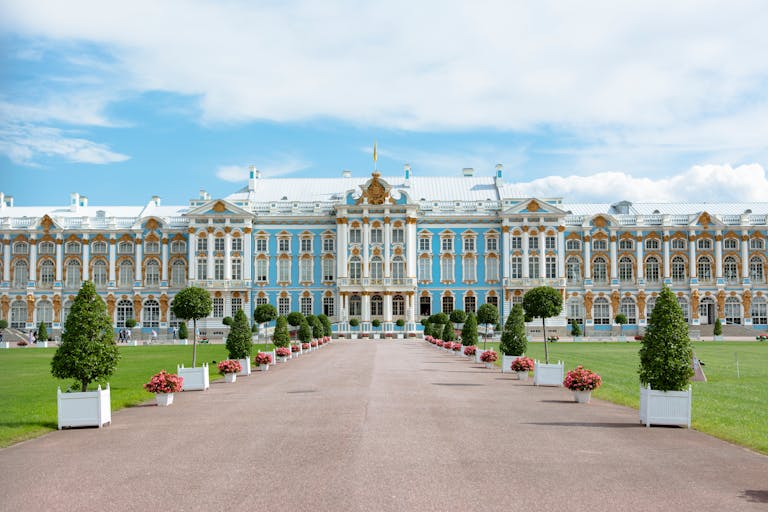
4. The Catherine Palace and the Amber Room

The other great palace-museum on the outskirts, in the town of Pushkin (the former Tsarskoye Selo), about 25 km away. It was the tsars’ summer residence and its most famous room is the legendary Amber Room, rebuilt after disappearing during the Second World War. In summer it gets packed, so it’s best to arrive early.
- Price: visiting the palace is around 1,000-1,500 ₽; the park, much less.
- More info: how to get there and how to get a ticket in my guide to the Catherine Palace.
5. The Fabergé Museum
In an elegant neoclassical palace beside the Fontanka river, it holds the world’s largest collection of Fabergé eggs, the famous imperial Easter eggs. A short but dazzling visit, ideal to combine with a stroll through the centre.
- Price: around 500-700 ₽.
- More info: what to see and how to visit it in my guide to the Fabergé Museum.
6. The Peter and Paul Fortress
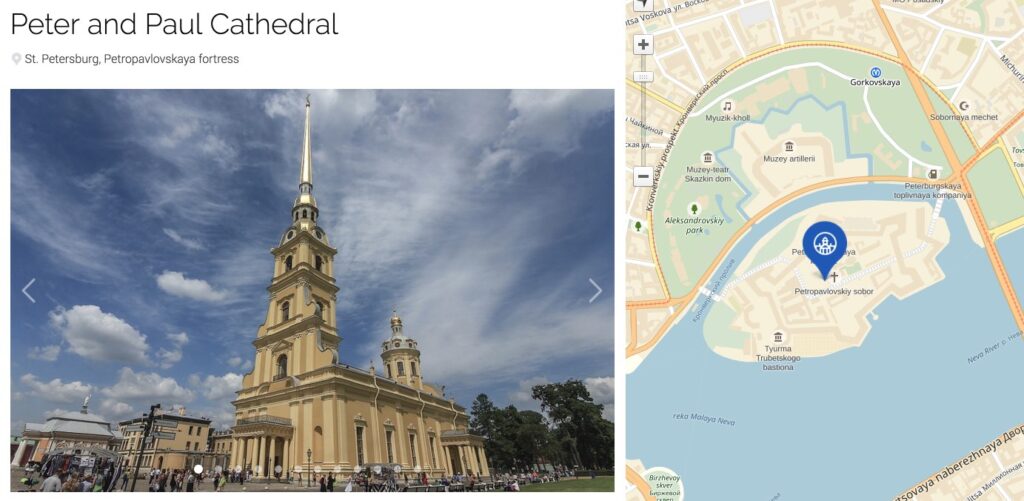
The citadel where St. Petersburg was born in 1703. Inside is the Peter and Paul Cathedral, where the tsars from Peter the Great to Nicholas II and his family are buried, along with several museums on the city’s history. The combined ticket is worth it.
- Price: the combined ticket is around 700-900 ₽ and gives access to the cathedral and the fortress museums.
- More info: what to see and how to organise your visit in my guide to the Peter and Paul Fortress.
More St. Petersburg museums by theme
If you’re left wanting more, here’s a broad selection organised by theme. Prices usually range between 200 and 600 ₽; I’ve left each one’s official website so you can check the up-to-date price and hours before you go.
Art and culture

- Menshikov Palace. The palace of the city’s first governor, today a branch of the Hermitage with Russian art from the 17th and 18th centuries. The general Hermitage ticket includes it.
- Erarta Museum. The largest private museum of contemporary art in Russia, with over 2,300 works. (erarta.com)
- Stroganov Palace. A baroque palace by Rastrelli, a branch of the Russian Museum, with restored interiors.
History and politics
- Museum of the Siege of Leningrad. Dedicated to the nearly 900 days of Nazi siege (1941-1944), one of the city’s most tragic episodes.
- Museum of the Political History of Russia. An overview of the labour movement and Russia’s 20th-century leaders (Lenin, Stalin, Gorbachev…). (polithistory.ru)
- Museum of the Russian Political Police. About the tsarist secret police and the Soviet KGB; it’s part of the previous museum.
Literature and music

- Pushkin Apartment Museum. The poet’s last residence, where he died in 1837 after a duel. (museumpushkin.ru)
- Dostoevsky Museum. The apartment where the author of Crime and Punishment lived and died, with original furniture and objects.
- Nabokov Museum. The birthplace of the author of Lolita. Free admission.
- Anna Akhmatova Museum. Dedicated to the poet, in the Sheremetev Palace, where she lived for over 30 years.
- Museum of Music. Also in the Sheremetev Palace, with a unique collection of around 3,000 instruments.
Science and technology

- Zoological Museum. One of the largest natural history museums in the world, with a mummified baby mammoth over 40,000 years old. (zin.ru)
- Railway Museum. Considered the oldest railway museum in the world, with models and historic trains.
- Russian Museum of Ethnography. Costumes and culture of the peoples of Russia, created by decree of Nicholas II. (ethnomuseum.ru)
- Artillery Museum. Military history and a large collection of weapons, opposite the Peter and Paul Fortress.
- Museum of Soviet Arcade Machines. Old Soviet arcade machines you can actually play on.

Cathedrals turned into museums
Two of the city’s most photographed landmarks operate as museums and are paid separately: St. Isaac’s Cathedral (with its impressive colonnade) and the Church of the Savior on Spilled Blood, the one with the colourful domes. I tell you all about them in my guide to the cathedrals and churches of St. Petersburg.
Are the St. Petersburg Card and CityPass worth it?
In St. Petersburg there used to be two tourist cards, the St. Petersburg Card and the St. Petersburg CityPass, which for a single price gave access to dozens of museums and tours. But today they’re no longer a realistic option: the St. Petersburg Card website has shut down (its domain is even up for sale) and the CityPass one has been down for a while.
My advice: buy the tickets separately and, if you want to skip the queues or have an English-speaking guide, book a guided tour. And for transport, instead of the tourist card you’re better off with a Podorozhnik card or a tourist pass.
Which museums to choose based on your time
To help you make a quick plan:
- 1 day: Hermitage + Church of the Savior on Spilled Blood + a stroll around Palace Square.
- 2-3 days: add Peterhof and the Catherine Palace (one day for the outskirts) plus the Russian Museum or the Fabergé Museum.
- 4 days or more: add the Peter and Paul Fortress, the Yusupov Palace and a museum from whichever theme appeals to you most (Erarta, writers’ houses…).
If you want to fit it all in with the rest of the city, I’ll leave you my St. Petersburg itineraries day by day and the complete guide to St. Petersburg.
Frequently asked questions
How much do tickets to the museums of St. Petersburg cost?
Between around 200 ₽ in the smaller museums and 1,000 ₽ or more in the big palace-museums, like the Catherine Palace. The Hermitage is around 700-800 ₽ for foreigners. Many state museums charge foreigners a higher rate than Russian residents.
Can I pay for tickets with a foreign card?
No. Visa and Mastercard cards issued outside Russia haven’t worked since 2022, so you won’t be able to buy online on the museum’s website. Pay in cash in rubles, with a Russian MIR card, or book a guided tour with an agency that accepts foreign cards.
What is the most important museum in St. Petersburg?
The Hermitage, one of the largest art museums in the world, in the Winter Palace. If you can only see one, make it that one. Book a timed slot and give it at least a couple of hours.
Are the St. Petersburg Card and CityPass worth it?
Not anymore: the St. Petersburg Card website has shut down and the CityPass one is down, so they’re no longer a realistic option today. Besides, when they existed they rarely paid off for a foreign tourist. The best thing is to buy the tickets separately.
What day do the museums of St. Petersburg close?
It depends on the museum: the Hermitage closes on Mondays, the Russian Museum on Tuesdays, the Peter and Paul Fortress on Wednesdays… Many also close one specific day a month. It’s best to check the official website before you go.
Do you need to buy Hermitage tickets in advance?
In high season (May to September) it’s advisable, because the museum runs on timed slots and fills up. As a foreigner you can’t pay online with a foreign card, so buy it at the box office in cash on the day or book a tour.