
Peterhof: what to see, how to get there & tickets from St. Petersburg
 By Irena Domingo
Updated on
In This Article
Peterhof is the day trip you absolutely have to do from St. Petersburg. It sits 30 km west of the city, on the shore of the Gulf of Finland, and brings together the largest collection of fountains in the world, several palaces, French-style formal gardens and English-style romantic parks. The summer residence of the tsars was declared a UNESCO World Heritage Site and is known as the “Russian Versailles” — though Peter the Great was far more obsessed with water than Louis XIV ever was.
In this guide I’ll walk you through what to see, how to get there (by sea or by land), how much tickets cost in 2026, how to plan the visit to avoid lines and where to eat. It’s designed to make the most of a full day at Peterhof.
This is step 5 of my guide to planning a trip to Russia in 10 steps, where you’ll find everything else in order.

Peterhof at a glance: the practical facts
- Distance from St. Petersburg: 30 km west, on the shore of the Gulf of Finland.
- Time you’ll need: a full day (leave your hotel around 9–10 a.m. and head back at sunset).
- Best season: late April to mid-October, when the fountains are running. The 2026 season opened on April 25.
- Best way to get there: by hydrofoil (Meteor) from the Hermitage pier. 45 minutes, spectacular views, and it drops you right at the gardens.
- Lower Park ticket (where the fountains are): 1,500 ₽ for foreigners during fountain season. Free in winter.
- Closed in 2026: the Monplaisir and Marly palaces remain under restoration.
- Language: staff barely speak English. Bring an offline translator or hire a guided tour.
What to see at Peterhof: a map of the main highlights
Peterhof isn’t just a single palace — it’s a huge complex with three distinct areas: the Upper Garden (free), the Lower Park (where the great fountains are) and Alexandria Park (more romantic and almost always empty). Before going into each one, here’s a map with everything important so you can get your bearings:
Interactive map of Peterhof: drag, zoom and click each marker for details.
The Lower Park: the main event
If you’re only going to set foot in Peterhof once in your life, this is the place to head for. The Lower Park stretches 2.5 km along the Gulf of Finland and brings together more than 150 fountains and four great cascades, all fed by gravity from the springs of the Ropsha hills. The canal system runs 96 km and doesn’t use a single pump: the water arrives and is distributed naturally at 1,100 liters per second. Peter the Great designed all of this in 1714, drawing inspiration from Versailles after his visit to the court of Louis XIV, and became obsessed with outdoing the original in water and movement.

The Grand Cascade and the Samson Fountain
It’s the postcard image of Peterhof and probably the one you’ve already seen in photos. The Grand Cascade tumbles down from the north façade of the Grand Palace to the Sea Canal, with 64 jets, 200 statues and gilded bas-reliefs that gleam in the sunlight. At its center, the fountain of Samson tearing open the lion’s jaws shoots a single jet of water about 20 meters into the air — the highest in the entire complex. It’s a political allegory: Peter the Great defeating Sweden in the Great Northern War (the lion is the Swedish coat of arms).
The official switch-on of the fountains takes place every morning at 11:00 a.m. with solemn music and a sizable crowd. If you want to watch it from the best spot, get there at least 20 minutes early and stand on the balustrade of the Grand Palace facing the sea. The fountains keep running until the park closes and are switched off all together in the evening.
The trick fountains: the highlight you can’t skip if you’re traveling with kids
One of the most fun things about Peterhof are the so-called shutikhi, or trick fountains, dreamed up by Peter the Great with a rather peculiar sense of humor. They’re hidden fountains that activate when someone steps on a specific tile or sits down on an innocent-looking bench, soaking the visitor. The ones running in 2026:
- The Umbrella (Zontik): a small pavilion with a Chinese parasol roof. When you step underneath to take shelter, water shoots out around the entire rim.
- The Oak (Dubok): an artificial tree with metal tulips. Step near it and the whole tree turns into a jet of water.
- The Water Path (Vodyanaya doroga): a path with hidden sprinklers that activate when you walk on them.
- The Little Benches (Divanchiki): marble benches that look like a perfect place to rest… until you sit down.
- The Fir Trees (Yelochki): three metal fir trees that spray water from their branches at anyone who gets too close.
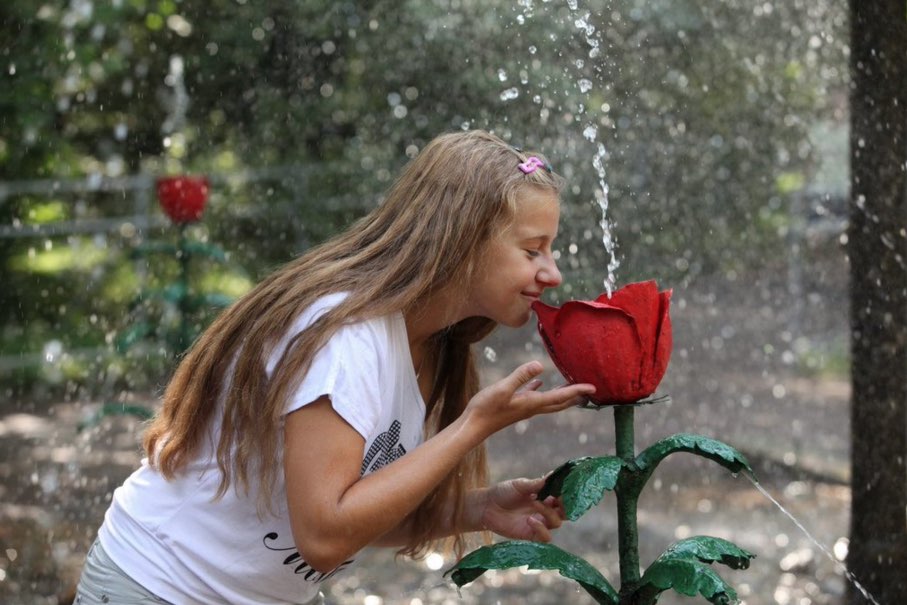
If you’re going with kids, bring a change of clothes and shoes because they will end up soaking wet. And if you’re going without kids, get ready to laugh: grown-ups fall for it too.
Other fountains and cascades worth your time
- Chess Hill Cascade (Shakhmatnaya gora): four steps decorated like a chessboard with three wooden dragons spitting water. It’s on the eastern side and tends to be less crowded.
- Roman Fountains: two twin marble fountains inspired by those in St. Peter’s Square in the Vatican, right opposite the Chess Hill Cascade.
- Pyramid: 505 jets forming a perfect water pyramid. It’s understated but technically brilliant.
- Sun (Solntse): a rotating fountain that draws a radiant sun with its jets. Constantly changing shape.
- Adam and Eve: two identical fountains at opposite crossings of the main axis, very photogenic.
- Golden Hill Cascade (Zolotaya gora): the other great cascade in the park, at the western end. More intimate than the Grand Cascade, with steps coated in gold leaf.
- Lion Cascade: 14 marble columns and bronze lions. Restored a few years ago and almost always quiet.
The Grand Palace: is the interior worth it?
The Grand Palace is the central architectural piece, a yellow-and-white Baroque building with 30 rooms decorated in Rococo style by Bartolomeo Rastrelli (the same architect behind the Winter Palace and Tsarskoye Selo). The Nazis completely destroyed it in 1944 and what you see today is a painstaking restoration that’s still ongoing.
My honest take: if you only have one day and you’ve never seen an imperial Russian palace before, yes, it’s worth it. But if you’ve already seen Catherine Palace or the Winter Palace at the Hermitage, the Grand Palace at Peterhof falls a bit short by comparison. The fountains are what’s truly unique here, not the interior.
Practical info for visiting:
- Open from 10:30 a.m. to 7:00 p.m. (Saturdays until 9:00 p.m.). Closed on Mondays and the last Tuesday of the month.
- Foreigner ticket: 2,000 ₽ (includes a guided tour in Russian, not English).
- In high season (May–September) online ticket sales are restricted: in-person purchases and the lines can be very long, especially between noon and 2:00 p.m. Better to go in after 4:00 p.m.
- If you do visit the palace, do it after walking through the fountains: when you come back outside you’ll still have time for the rest of the Lower Park.
The Upper Garden, free and almost always underrated
The Upper Garden lies south of the Grand Palace, and it’s the first area you set foot in if you arrive by bus, with free entry. It doesn’t have the spectacle of the Lower Park, but its symmetrical layout from the era of Empress Elizabeth and its five fountains — with Neptune as the centerpiece, cast in Nuremberg in 1660 and therefore 50 years older than Peterhof itself — make for a nice warm-up before moving on to the great fountains.
Heads-up: if you enter the Lower Park and then leave to go back to the Upper Garden, they won’t let you re-enter the Lower Park with the same ticket. You’d have to pay again. So it makes sense to see the Upper Garden first and save the Lower Park for the main block of your visit.
Alexandria Park: the plan B if you have time to spare
Alexandria Park sits next to the Lower Park on the eastern side, and this year, 2026, marks its 200th anniversary. It’s a romantic English-style park that Nicholas I gave to his wife Alexandra Fyodorovna, and it has a very different feel: woodland, winding paths, century-old trees and three curious buildings — the Cottage Palace (English Gothic style), the Farmer’s Palace and the Gothic Chapel. There are barely any tourists and admission costs 300 ₽.
My advice: only visit it if you have an extra hour or two at the end of the day. The priority is always the Lower Park.
What you WON’T be able to visit in 2026
Two important heads-ups so you don’t end up disappointed:
- Monplaisir Palace: Peter the Great’s favorite residence, right by the sea and home to the first painting gallery in Russia, is closed for restoration in 2026. It’s a shame because it’s lovely and very personal, but you can’t go in.
- Marly Palace: the small palace at the western end, also closed for restoration.
- Imperial Yachts Museum and Aviaries: closed during winter. If you go in July or August, both are open.
The status of the palaces does change: before traveling I’d recommend double-checking on the museum’s official website (en.peterhofmuseum.ru) in case anything new opens or closes.
How to get to Peterhof from St. Petersburg
For tourists there are really two options: by sea (hydrofoil/Meteor) or by land (metro + bus, train + bus, or taxi). Each has its upsides, and my recommendation is to combine them: go by sea and come back by land, or the other way around. Let me walk you through each.
St. Petersburg → Peterhof: sea route in blue (hydrofoil, 45 min) and land route in red (metro + bus, ~1 h 15).
By sea: the hydrofoil (Meteor)
This is the fastest, most scenic and most comfortable way to get there. The hydrofoils — Russians call them Meteor — leave from the pier next to the Hermitage (Dvortsovaya naberezhnaya), sail along the Neva out into the Gulf of Finland and drop passengers at the Peterhof pier, right at the start of the Sea Canal, 200 meters from the Grand Cascade.

- Travel time: 35–45 minutes.
- Frequency: roughly every 30 minutes, from 10:00 a.m. to 6:30 p.m.
- Price: from 1,290 ₽ for a one-way ticket in 2026.
- Where to buy: at the pier ticket office on the day, or in advance online.
- Important: the hydrofoil ticket does not include entry to the Lower Park. You’ll have to pay that separately on arrival.
- Operators: there are two main companies (Peterhof Express and Russian Cruises). The service is essentially identical.
To book ahead from outside Russia, the easiest option is to buy your hydrofoil ticket from abroad with a foreign card: in the cruises guide I list the operator that takes international Visa/Mastercard and PayPal, so you don’t have to fight with the Russian website that rejects foreign cards. If you’d rather buy on the spot, you can also pay in cash (rubles) at the pier ticket offices.
The service only runs from late April to mid-October, in line with the fountain season. Outside that window, the hydrofoil isn’t operating and the only option is to go by land.
By land: Lastochka train, metro+bus or taxi
It’s cheaper but takes longer. Three options:
1. Metro + bus (the option most locals use). You take the metro to whichever station works best for you and from there a city bus runs about 40 minutes to Peterhof. The final stops are “Fontany” (Pravlenskaya Street) or “Razvodnaya ulitsa”, a 5-minute walk from the Upper Garden. The verified routes for 2026:
- From the Avtovo metro station (red line, single exit): buses 200, 204 and 210. This is the best option because the bus stop is 50 meters from the metro exit.
- From Prospekt Veteranov (the end of the red line): buses 103 and 343, plus the minibus (marshrutka) K-639B.

To pay for the bus you’ll need a Podorozhnik card (St. Petersburg’s transport card) or pay the driver with a MIR card or cash. If you don’t have a Podorozhnik yet, I’d recommend picking one up as soon as you arrive in the city: I explain how in the St. Petersburg public transport guide.
2. Lastochka train + bus. This is the most comfortable option in terms of seating and the least sensitive to traffic. From Baltiysky Station (metro Baltiyskaya, red line) the elektrichka train runs to Novy Peterhof station in about 35–40 minutes. From there you can walk 20 minutes through Proletarsky Park or catch bus 351A, 351Б, 352, 356, 463 or 489 to the fountains in 10 minutes.
3. Private taxi. The most comfortable option if there are 3 or 4 of you: door-to-door in about 45 minutes for around 1,500–2,500 ₽ (depending on traffic and time of day). In Russia people use Yandex Go or Maxim — but heads up, those apps don’t accept foreign cards. If you’d rather book your transfer from home with a card from your own country, take a look at the transfers in Russia with a foreign card page.
My practical recommendation
If you’re visiting Peterhof between May and September, the ideal plan is to go by sea and come back by land (or the other way around, whichever you prefer): the hydrofoil gives you the spectacular views of the Neva and the Gulf, and going back by land saves you from queuing for the boat at the end of the day, when everyone wants to head back at the same time and the pier gets seriously crowded.
If you go in winter, the fountains are switched off, the hydrofoil isn’t running and entry to the Lower Park is free. It has its own melancholic charm, but it isn’t the “complete” Peterhof.
Tickets and prices in 2026: what it costs and where to buy
Let me start with what matters: at Peterhof, foreigners pay more than Russians to enter the museums. That’s how it is. The difference is roughly two to three times in some cases. Here are the official 2026 prices for foreigners (foreign citizens):
| Attraction | Foreigner price | Notes |
|---|---|---|
| Lower Park (the fountains) | 1,500 ₽ | Only during fountain season (Apr–Oct). Free in winter. |
| Grand Palace of Peterhof | 2,000 ₽ | Includes guided tour in Russian. Closed Mondays and the last Tuesday of the month. |
| Alexandria Park | 300 ₽ | Free at sunrise and during reduced hours. |
| Upper Garden | Free | Open access all year round. |
| Hermitage Pavilion | from 500 ₽ | Mini-museum in the middle of the park. |
| Treasury (Osobaya kladovaya) | from 700 ₽ | Imperial jewelry and tableware. |
| Children under 16 | Free | ID showing age required. |
| Audio guide in English | 300–500 ₽ + 3,000 ₽ deposit | Only in some museums. Cash deposit. |
Can you buy tickets online from outside Russia?
Here’s the catch. The museum’s official website (tickets.peterhofmuseum.ru) does, in theory, allow you to buy tickets online, but since 2022 Russian payment gateways have been rejecting Visa, Mastercard and American Express cards issued outside Russia. That means if you try from London, New York, Paris or any other country with your usual card, the payment won’t go through. Only Russian MIR cards, Russian payment systems like SBP, or Chinese UnionPay cards in some cases will work.
So what are your alternatives if you don’t want to wait at the ticket office?
- Get there early. Before 11:00 a.m. the lines are usually manageable (15–30 minutes). After noon they explode.
- Use the automated terminals the museum installs in Palace Square, Razvodnaya Square and other areas of the park. They take cash and Russian cards — useful if you have a MIR card.
- Get a Russian MIR card before your trip — it does work on the museum website. It’s relatively easy if you’re traveling to Russia with some lead time: I explain how in the MIR card for foreigners guide.
- Book a guided tour that already includes admission. It’s the most convenient option and the one I recommend to most travelers visiting Russia for the first time (I’ll go into this in the next section).
How to plan your visit and avoid the lines
Peterhof has a reputation for being a beautiful place with so-so logistics. The most common complaints are the very long lines and slow ticket offices. If you plan the day well, you’ll skip most of the headache:
- Go on a weekday. Saturdays and Sundays fill up with local tourists, especially when the weather’s good.
- Avoid Mondays for the Grand Palace: it’s closed. But Mondays are actually one of the best days to visit the Lower Park, because with the palace closed the tour groups divert to other excursions and the park is much quieter.
- Get there before 11:00 a.m.. If you catch the first hydrofoil (10:00 a.m. from the Hermitage) you arrive just in time for the solemn switch-on of the Grand Cascade and then have the park half-empty for an hour.
- Visit the Grand Palace in the afternoon: between noon and 2:00 p.m. the worst lines for the palace build up. After 4:00 p.m. there are fewer people.
- Time your day carefully: the fountains run from 10:00 a.m. to 7:30 p.m. (the Grand Cascade kicks off with a ceremony at 11:00 a.m.). The Lower Park closes at 9:00 p.m. (Saturdays at 10:00 p.m.). The last hydrofoil back leaves around 7:00 p.m., so don’t lose track of time.
- Special festivals: in 2026 there’s a “Pianissimo” music festival at the Grand Palace from June 28 to August 2. And the closing-of-the-fountains festival (mid-September) packs the park to capacity — it’s beautiful but bring patience.

Guided tour in English: the most practical solution for foreigners
Peterhof’s staff speak very little English, the information signs are almost all in Russian, the official audio guides require a 3,000 ₽ cash deposit, and buying tickets with a foreign card simply doesn’t work. If you’re only going to be in St. Petersburg for a few days and you want to make the most of your visit, an English-language guided tour solves all these problems in one go.
The Russian platform Sputnik8 has the best catalogue for Peterhof: it offers half-day and full-day tours in English (and other languages), with a native or English-speaking guide, transport from the center of St. Petersburg (by bus or hydrofoil) and admission included. It doesn’t accept foreign Visa or Mastercard cards, but you can book with the option to pay on the day of the visit.
Take a look at the up-to-date catalogue at Sputnik8 to compare prices and times. To see every platform and how you pay on each one, it’s all summed up in guided tours in Russia.

The museum also runs official guided tours of the Lower Park in Russian (4,000 ₽ for groups of up to 10 people, 1.5 hours, online booking). Useful if you understand Russian or you’re traveling with someone who can translate; otherwise, I wouldn’t recommend it.
Where to eat at Peterhof
You’re going to spend many hours at the complex and you’re going to need to refuel. My most useful tip: prices inside the Lower Park are clearly marked up compared to central St. Petersburg. The options, ranked from best to worst value for money:
- Pack a picnic from St. Petersburg. My favorite. There are picnic areas in the Lower Park (especially on the western side, toward the Golden Hill Cascade) and eating by the Gulf of Finland with the fountains in the background is one of the memories you’ll take home from the trip. Pick up supplies at a Pyaterochka or Magnit supermarket before catching the hydrofoil: bread, Russian cold cuts, fruit, water.
- Official museum restaurants: inside the park there are several kiosks and two main restaurants run by the complex: Shtandart (near the pier, Russian cuisine with views of the canal) and the Orangerie (in the Grand Greenhouse, more formal). Expect 2,000–3,500 ₽ per person.
- Casual cafés in the park: pirozhki, soups, blini, hot drinks. 500–900 ₽. Usually a line at lunchtime.
- Outside the park: Sankt-Peterburgsky Prospekt, next to the Upper Garden, has a dozen cafés, bakeries and quick-bite spots with better prices. If you head out to eat (remember: with the Lower Park ticket you can’t re-enter, so eat before going in or at the end of the day).

Practical tips for your visit
- Genuinely comfortable shoes. You’ll walk between 8 and 12 km in a day. What looks short on a map is a lot on foot over sand, gravel and cobblestones.
- Change of clothes if you’re with kids. The trick fountains do exactly what their name suggests.
- Sunscreen and water in summer. The jets cool the air, but the sun over the Gulf in July is fierce when the skies are clear.
- Light rain jacket the rest of the year. Weather over the Gulf of Finland changes quickly and the museum closes areas during heavy rain (in fact, this April they closed the Lower Park for a day because of bad weather).
- Cash in rubles. Even though the museum and restaurants accept MIR cards, payment terminals don’t always work and staff don’t understand why your Visa won’t go through. Bring 5,000–7,000 ₽ per person in cash for the day.
- Passport on you at all times. They may ask for it to confirm the “foreigner” price or to give the free admission to under-16s. No passport, no discount.
- Free Wi-Fi in the Lower Park. It works reasonably well near the major pavilions.
- Mobile data: if you want internet of your own without relying on park Wi-Fi, get an eSIM with data in Russia activated before leaving home. It’s cheap and activates with a QR code.
- Accessibility: wheelchairs are available for rent at the ticket office, but the terrain has gravel and significant slopes. It isn’t an especially easy site for limited mobility.
- Official app: the museum has a free app (“Peterhof Guide”) that works offline with audio and a map. Better than the physical audio guides with cash deposits.
Frequently asked questions about Peterhof
How much time do I need to visit Peterhof?
Plan for a full day. Just the round-trip travel from St. Petersburg takes between 1.5 and 3 hours (depending on how you go), and the Lower Park with its fountains needs at least 4–5 hours to enjoy without rushing. If you also want to visit the Grand Palace and Alexandria Park, you’re looking at 8–9 hours total.
What’s the best time of year to visit Peterhof?
Late May to early September, when the fountains are running at full power and there are more daylight hours. June overlaps with the White Nights (days with almost no darkness), but also the heaviest Russian tourist crowds. May and September have fewer people and milder temperatures. In winter the fountains are switched off and the Lower Park is free, but the complex loses much of its magic.
Can I buy tickets online from the US, UK or another country?
Not on the museum’s official website, because since 2022 Russian payment gateways reject Visa and Mastercard cards issued outside Russia. You can, however, buy the hydrofoil ticket online with a foreign card or PayPal through platforms that accept both.
How much do tickets cost for foreigners?
In 2026, the Lower Park with the fountains costs 1,500 ₽ for foreigners during high season, and the Grand Palace of Peterhof another 2,000 ₽. The Upper Garden is free. Children under 16 enter free with ID confirming their age. Prices are roughly double those for residents in Russia.
Is it better to go by land or by sea?
By sea is faster (45 min) and much more scenic for the views, but more expensive (from 1,290 ₽ one way). By land is cheap (200–400 ₽ with metro and bus) but takes 1 h 15 to 1 h 30. My recommendation is to mix it up: take the hydrofoil in the morning and come back by land at the end of the day, that way you skip the line for the return hydrofoil and enjoy the views on the way out.
Which palaces are closed in 2026?
In 2026 the Monplaisir and Marly palaces remain closed for restoration, both inside the Lower Park. The Grand Palace is open as normal (except Mondays and the last Tuesday of the month). The Hermitage Pavilion, the Treasury and the Chess Hill Cascade can all be visited. Before traveling it’s worth confirming on the museum’s official website in case anything new opens or closes.
Is Peterhof worth it if I’m traveling with kids?
Very much so. In fact, it’s probably the day trip they’ll enjoy most out of everything in St. Petersburg, thanks to the trick fountains, the open spaces and the hydrofoil ride. Bring a change of clothes because they will end up wet, comfortable shoes, and snacks or a packed lunch to power through the day. Children under 16 enter the park and the palace for free (with ID showing age).
And once you’re back in St. Petersburg…
If you’ve spent the day at Peterhof, you’ll probably want to see more imperial gardens and palaces. Pushkin (Tsarskoye Selo) with the Catherine Palace and the Amber Room is the other essential day trip from St. Petersburg. And inside the city itself, don’t miss the Hermitage, the Church of the Savior on Spilled Blood and a boat ride along the canals.
In This Article
Was this useful? I'll tell you when something changes in Russia
One short email a month with what has changed for travellers (visas, payments, border crossings, apps), based on what readers report to me from Russia. More than 4,000 of us already. No spam: if you ever lose interest, unsubscribing is one click.
Irena DomingoAbout Me
I was born in Russia. I grew up between two worlds: my father was Russian, my mother Spanish — a descendant of the "Children of Russia", the Basque children evacuated to the USSR during the Spanish Civil War. I've worked as a translator, interpreter and Russian teacher for over 30 years, and since 2013 I've been writing this blog to help travelers discover Russia with practical, always up-to-date information. Author of the Russiable Guide. If this blog has helped you plan your trip, you can buy me a coffee ❤️.
 The Museums of St. Petersburg: Which to Visit, Prices and Tickets
 Russian Food: Typical Dishes, Drinks and Where to Eat
 Russian Souvenirs: What to Buy, Where and How Much They Cost