
The Peter and Paul Fortress: practical guide to visit it in 2026
 By Irena DomingoUpdated on The essentials in 1 minute
In this article
The Peter and Paul Fortress is the place where St. Petersburg was born. Peter the Great laid the first stone here on May 27, 1703, on a small marshy island full of hares (Zayachy Island, or “Hare Island”), and from that moment on everything that is the city today grew around it. That’s why, if you’re visiting St. Petersburg, this is one of the first places you should go: here you understand where everything else comes from.
Entry to the grounds is free, but inside there are eight different exhibitions and museums, a cathedral with the tombs of almost all the Romanov tsars (including Nicholas II), a sinister political prison, a cosmonautics museum, and several walls and bastions you can walk along. The most practical option, unless you only want to see it from the outside, is to buy the combined ticket (Единый билет, Yediny bilet): it costs 1,500 rubles for adults and gives you access to everything important for three days.
In this article I’ll explain how to plan your visit, how much each thing costs, what the opening hours are, how to get there and, above all, what to see so you don’t miss anything truly interesting.
The birth of a city: why this fortress matters so much
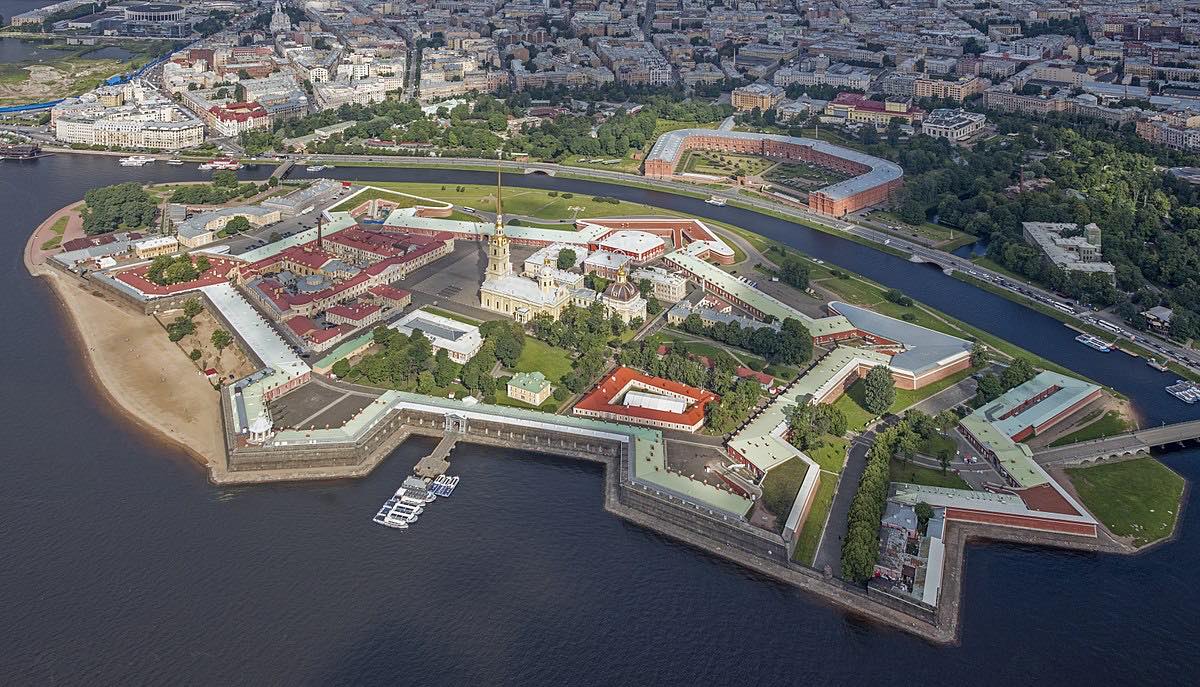
St. Petersburg was the capital of the Russian Empire for more than two centuries, from its founding until 1918. And it all started right here, on a small island in the Neva river where, in the middle of the Great Northern War against Sweden, Peter the Great ordered a defensive fortress built on May 27, 1703.
Today the area is surrounded by a huge city with around 800 bridges connecting its islands and canals (some of which are drawbridges in summer), which is why it’s known as “the Venice of the North”. But at the beginning there was practically nothing here: a marshy island, water as far as the eye could see, and lots of hares running around in the reeds. Hence the name of the island: Zayachy, “Hare Island”. You’ll see hares and rabbits sculpted all over the grounds as a nod to that origin.
Peter commissioned the design to the Swiss architect Domenico Trezzini, his right-hand man, who also signed the cathedral inside the grounds. The layout turned out hexagonal, in the shape of a six-pointed star, with a bastion at each corner. The six bastions are named after the men who supervised their construction: Peter himself (Gosudarev, “of the Sovereign”), Naryshkin, Trubetskoy, Zotov, Golovkin and Menshikov.
Curiously, the fortress was never actually attacked militarily. It ended up serving a much more sinister purpose: being one of the most feared political prisons of the empire. But I’ll get to that below.
One curious detail: the silhouette of the fortress with its golden spire appears in the background of the 50-ruble banknote. Look out for it next time you have one in your hand.

How to get to the fortress
The fortress sits on Zayachy Island, in the Petrogradsky district. You have several options to get there:
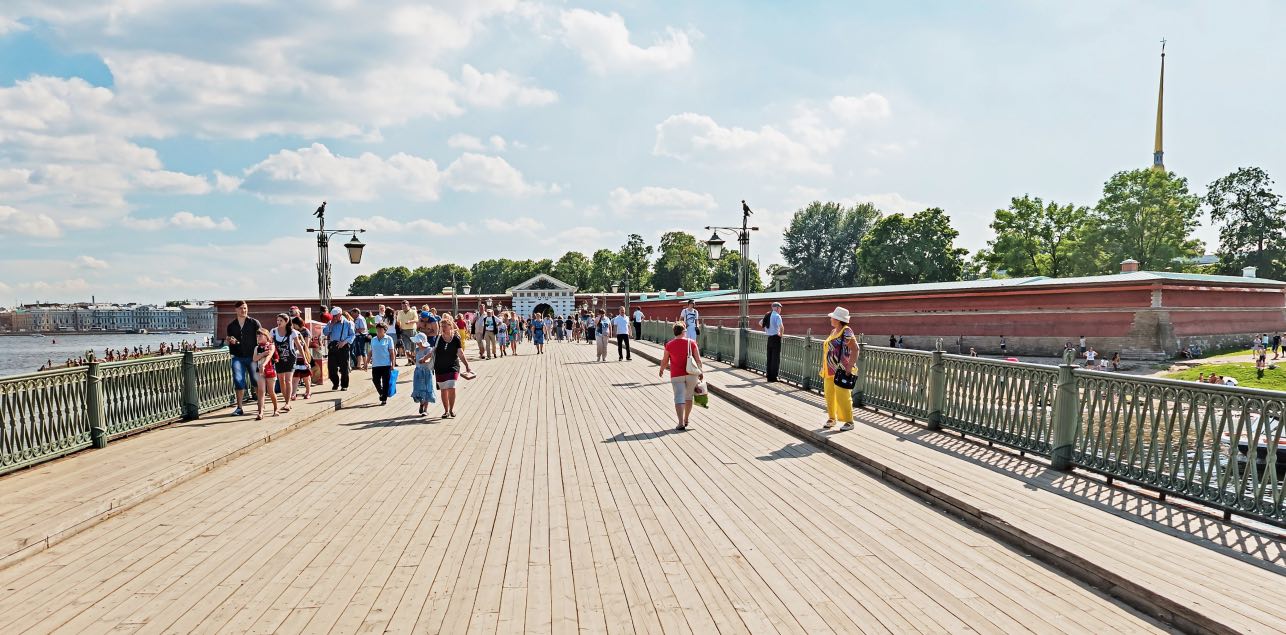
- By metro: the closest station is Gorkovskaya (line 2, blue), about a 5–7 minute walk from the main bridge (Ioannovsky). Another option is to get off at Sportivnaya (line 5, purple) and cross the Kronverksky bridge from the other side. Here’s my guide to St. Petersburg’s public transport with everything you need to know about the Podorozhnik card.
- On foot from the center: if you fancy a walk, you can cross the Trinitatis bridge (Troitsky most) and then the Ioannovsky bridge. It takes about 25–30 minutes from Palace Square.
- By boat: in summer there are canal and Neva tours that stop at the fortress. If you arrive this way, you’ll enter via the pier and the Neva Gate.
Opening hours: when you can go in
You need to distinguish between three things: Zayachy Island (the outer space), the fortress grounds (inside the walls) and the museums and exhibitions.
- Zayachy Island (streets, walkways, piers): open from 6:00 to 22:00 every day, year-round. Free entry.
- Walled fortress grounds: open from 9:30 to 21:00 every day. Free entry to the grounds.
- Peter and Paul Cathedral and Trubetskoy Prison: open every day from 10:00 to 18:00 (Tuesdays close at 17:00).
- Other museums and exhibitions (Cosmonautics, History of St. Petersburg, Architectural Ceramics, etc.): from 11:00 to 19:00, Tuesdays until 18:00, and closed on Wednesdays.
- Ticket offices close one hour earlier than the exhibitions.
Heads up: there are specific days when hours change because of special events (Museum Night in May, public holidays like May 9, or the City Day on May 27). Before you go, it’s a good idea to check the official website of the State Museum of the History of St. Petersburg.
Updated tickets and prices
This is the key part, because with so many things to see, the tickets are a bit of a puzzle. Let me simplify it for you.
The combined ticket (Единый билет): the best-value option
For 1,500 rubles (adults) you get access to the eight main attractions of the fortress over three calendar days. This ticket includes:
- Peter and Paul Cathedral and Grand Ducal Mausoleum
- Trubetskoy Bastion Prison
- V. P. Glushko Museum of Cosmonautics and Rocket Technology
- Exhibition “History of St. Petersburg – Petrograd. 1703 – 1918” (Commandant’s House)
- Exhibition “History of the Peter and Paul Fortress”
- Exhibition “Museum of Architectural Ceramics” (Керамарх / Keramarkh)
- Exhibition “World of Art Nouveau Objects”
- Underground gallery and casemate of the Gosudarev Bastion
What the combined ticket doesn’t include: the climb up the cathedral bell tower and the “Невская панорама” (Nevskaya Panorama) walkway along the Neva wall. Those two are sold separately.
Prices:
- Adults: 1,500 ₽
- Russian students: 800 ₽
- Russian pensioners: 700 ₽
The combined ticket also includes a free 1.5-hour guided tour in Russian of the fortress and the cathedral, with departures every hour from 11:00 to 17:00 (last tour at 16:30 on Tuesdays and the days before public holidays). Groups gather at the Information Center of the Ioannovsky Ravelin. The tour uses headsets and they ask for a 1,000 ₽ cash deposit for each device, which you get back at the end.
Individual tickets
If you’re only interested in one specific thing, you can buy single tickets. These are the current prices:
| Attraction | Adult | Russian Student | Russian Pensioner |
|---|---|---|---|
| Cathedral + Grand Ducal Mausoleum | 1,000 ₽ | 600 ₽ | 500 ₽ |
| Trubetskoy Prison | 500 ₽ | 400 ₽ | 400 ₽ |
| Cosmonautics Museum | 400 ₽ | 250 ₽ | 250 ₽ |
| Exhibition “History of St. Petersburg – Petrograd 1703-1918” | 450 ₽ | 300 ₽ | 300 ₽ |
| Other exhibitions (each) | 350 ₽ | 250 ₽ | 250 ₽ |
| Bell tower (with guide) | 500 ₽ | 400 ₽ | 400 ₽ |
| “Невская панорама” walkway | 400 ₽ | 300 ₽ | 300 ₽ |
My recommendation: if you’re going to enter the cathedral and the prison, the combined ticket pays off. Those two alone already add up to 1,500 ₽ and the combined ticket includes six more things.
Where to buy tickets

Tickets are bought at the box office. There are three main points:
- Ioannovsky Ravelin (main entrance via the Ioannovsky bridge): this is the first ticket office you’ll see after crossing the bridge, on the left as you pass the gate. It also works as an information center, with maps in several languages.
- Boat House (Ботный дом, Botny dom), next to the cathedral. It’s a small pavilion with a curious history: it was built between 1762 and 1766 to house a boat nicknamed “the grandfather of the Russian fleet”, the first one of Peter’s navy. The original is now at the Naval Museum of St. Petersburg, but inside the Boat House there’s a wooden replica.
- Additional ticket offices at the Trubetskoy Prison and the Cosmonautics Museum, in case you go straight into one of those attractions.
Clicking loads Yandex Maps, which may set cookies. Open in Yandex Maps

Important detail about payment: if you’re paying in cash (rubles), perfect. If you’re paying by card, make sure it’s a Russian MIR card. Visa or Mastercard cards issued outside Russia don’t work in the country since 2022. If you’re going to spend several days in Russia, you might want to get a MIR card.
Toilets: there’s a dedicated building inside the fortress, in the old carriage house (Каретник, Karetnik), with public toilets for 50 rubles.
Map: how to find your way around the fortress
The fortress is quite a bit bigger than it looks, and the first time it’s easy to get lost. This is the official map with the museums (numbers in red) and the architectural structures (numbers in green):


To orient yourself: the main entrance is on the east side (Ioannovsky bridge); the cathedral is roughly in the center of the island; the Trubetskoy Prison is on the western side; the Cosmonautics Museum is in the Ioannovsky Ravelin, right next to the entrance; and the beach is on the south side, along the Neva wall.
What to see: museums and exhibitions
Now let me walk you through the most interesting things to visit.
1. The Peter and Paul Cathedral and the Grand Ducal Mausoleum

Without a doubt the most important thing inside the fortress. The cathedral was built between 1712 and 1733, also by Domenico Trezzini, and its golden spire of 122.5 meters (40 meters of which are the spire itself, topped by an angel holding a cross) made it for centuries the tallest building in St. Petersburg. Today the tallest building in the city is the Lakhta Center (462 meters, Gazprom’s headquarters and the tallest skyscraper in Europe), but the cathedral’s spire is still one of the most recognizable visual symbols of the city.
The style is Petrine baroque, very different from the typical Russian “onion-dome” style. Inside, the gilded iconostasis, the large windows and, above all, the tombs are striking.

Buried here are almost all the tsars of the Romanov dynasty, starting with Peter I the Great (died 1725). You’ll also find the tombs of Catherine the Great, Alexander I, Nicholas I, Alexander II (the liberator tsar, with a particularly beautiful tomb in green jasper), Alexander III…

And, particularly moving: the tombs of Nicholas II, Tsarina Alexandra and three of their daughters (Olga, Tatiana and Anastasia), along with Dr. Botkin and other servants murdered with them in Yekaterinburg in July 1918. Their remains were transferred here on July 17, 1998, exactly eighty years after the murder, at an official ceremony attended by Boris Yeltsin. They’re buried in a side chapel (the St. Catherine Chapel), not in the main nave, because the Russian Orthodox Church raised doubts about the authenticity of the remains. The remains of Tsarevich Alexei and Grand Duchess Maria were found later, in 2007, and have not yet been buried here.
A curious fact: there were so many tombs by the end of the 19th century that the cathedral ran out of space. To solve it, the Grand Ducal Mausoleum was built next door between 1896 and 1908, connected to the cathedral by a corridor, with room for 60 more tombs of dukes and duchesses.
Important for your visit: out of respect for worship, there are no benches inside and you can’t sit down. The cathedral still holds religious services (resumed in 2000 after a pause since 1924) and on Sundays it opens an hour later.
Clicking loads Yandex Maps, which may set cookies. Open in Yandex Maps
The bell tower is separate: if you go up (guided tour, 500 rubles), you’ll see 51 bells, a Flemish carillon installed in 2001 that’s used for concerts in summer, and spectacular views of the city center. Access is by guided tour only and in very small groups, so it’s worth booking on site in advance.
2. The Trubetskoy Bastion Prison

The other highlight, along with the cathedral. The Trubetskoy Bastion was rebuilt in the 1870s to house the most feared political prison of the empire. Although the fortress already had important prisoners in the 18th century (the first “guest” was Peter the Great’s own son, Tsarevich Alexei, locked up by his father and dead under interrogation in 1718), it was here that political repression concentrated from the late 19th century onwards.
Among many others, its cells held:
- Fyodor Dostoyevsky (1849, sentenced to death and then to Siberia)
- Mikhail Bakunin (the father of Russian anarchism)
- Maxim Gorky
- Leon Trotsky (1905, a brief stay)
- Josip Broz “Tito” (yes, the future leader of Yugoslavia)
- Pyotr Kropotkin (anarchist) was the only one who managed to escape from the prison, in 1876, and he became famous for it.
The prison kept operating briefly after the Revolution of 1917 (paradoxically, now locking up former tsarist ministers) and in 1924 it was closed and turned into a museum.
The visit is pretty impactful. You can walk through the cells preserved almost exactly as they were, see the bathhouse where prisoners were humiliated, read the biographies of the best-known inmates and look out at the courtyard where they were brought out for a few minutes a day to “stretch”. Plan on 40–60 minutes.
3. V. P. Glushko Museum of Cosmonautics and Rocket Technology

Opened in 1973, it’s devoted to the Soviet space program. The curious thing is that it sits right where, between 1932 and 1933, one of the country’s first rocket engine design facilities operated (the GDL, Газодинамическая лаборатория), which produced parts later used in rockets like the R-7 that sent Sputnik and Gagarin into space.
Inside you’ll find:
- Scale replicas of the Sputnik satellites, the Vostok, Voskhod and Soyuz spacecraft
- Original spacesuits
- Models of the International Space Station
- Engines, real rocket parts and aerospace engineering items
- A section dedicated to Valentin Glushko, who gives the museum its name and designed many of the engines that took Russia into space
If you’ve already visited the Memorial Museum of Cosmonautics in Moscow, this one will feel more modest. But if you’re into the topic or traveling with kids, it’s worth it.
Practical tip: on April 12, World Cosmonautics Day (anniversary of Gagarin’s flight in 1961), entry to the museum is usually free.
4. Exhibition “History of St. Petersburg – Petrograd 1703-1918” (Commandant’s House)
A permanent exhibition devoted to everyday life in the city in the 18th and 19th centuries. Maps, paintings, archaeological finds, day-to-day objects: trade, transport, fashion, food, housing, leisure. It’s the largest exhibition on the grounds (of those covered by the combined ticket) and the best one to understand the historical context of St. Petersburg. Remember that the city was called St. Petersburg until 1914, Petrograd from 1914 to 1924, Leningrad from 1924 to 1991, and St. Petersburg again from 1991 onwards.
5. Exhibition “History of the Peter and Paul Fortress” (Neva Wall)
Smaller than the previous one, devoted to the construction and evolution of the fortress itself over the centuries. You’ll see old blueprints, photographs, maps and engravings showing how it has changed. Very interesting for military architecture enthusiasts.
6. Museum of Architectural Ceramics “Керамарх”
One of the more recent additions to the complex. It shows the history of Russian decorative ceramics from the 18th to the early 20th century: tiles, ceramic friezes and traditional Russian stoves (печь, pech), many of them recovered from demolished buildings. If you’re interested in the details of Russian interior architecture, it’s a fascinating spot.
7. “World of Art Nouveau Objects” (Предметный мир модерна)
Another relatively recent exhibition, devoted to the Modernist style (Russian Art Nouveau) that’s so present in many St. Petersburg buildings. Furniture, lamps, tableware, glass, everyday objects from the Russian belle époque.
8. Gallery and casemate of the Gosudarev Bastion
The most recent addition to the complex. You can walk through an underground gallery (потерна, poterna) and a casemate of the bastion that gave the grounds its name (Gosudarev = “of the Sovereign”, the first one built, raised in 1703 by Peter himself). It’s a narrow and dark passage, very well restored, where they explain how the fortress worked from a military perspective.
Separate: Museum of the History of Money (Goznak)

This museum is not included in the combined ticket and sits a bit apart, right opposite the Golovkin Bastion, in the Anninsky Kavalier building. It’s run by Goznak, the historic mint that moved from Moscow to the fortress in 1724 and still produces Russian coins, medals and decorations.
- Museum website: museum.goznak.ru
- Opening hours: 10:00 to 20:00 (closed on Thursdays)
- Price: 200 ₽

It’s a fairly little-known museum (renovated in 2016) and very interesting if you like numismatics. It has a really curious shop with replicas and real pieces.
The architectural structures: bastions, gates and statues
Beyond the museums, walking around the walls and courtyards is one of the best things to do here. Don’t miss:
The noon cannon shot

One of the best-known traditions in St. Petersburg: every day, exactly at noon, a cannon is fired from the Naryshkin Bastion. The custom started in 1730, was regulated as a daily routine from 1873, was interrupted in 1934 and resumed in 1957. In Peter the Great’s time, the cannon marked the start and end of the working day and warned of floods.
If you’re passing by the fortress around noon, head over to the Naryshkin Bastion (the one facing the Neva, right across from the Hermitage on the other side of the river) to see it. And get ready: the noise is very loud and always catches some tourist by surprise.
Every May 27, City Day (anniversary of the founding of St. Petersburg), there’s a special commemorative shot and the bastion flies the imperial flag. On Saturdays, during the summer season, there’s also a changing of the guard ceremony that’s worth watching.
The “Невская панорама” walkway

If you love views, don’t miss the walk along the Neva wall. The “Невская панорама” (Nevskaya Panorama) walkway lets you walk on a wooden platform along the walls, with spectacular views of the historic center of St. Petersburg, the Winter Palace and the Hermitage on the other side of the river. It runs along several bastions (Gosudarev, Menshikov, Naryshkin, Golovkin) and takes about 20–30 minutes.
- Hours: 10:00 to 19:30
- Price: 400 ₽ (not included in the combined ticket)

My tip: do it at the end of the day, just before closing, to catch the golden light and, in summer, watch the sky change colors during the White Nights.
The entrance gates

The Peter Gate (Петровские ворота, Petrovskie vorota) is the official entrance. It’s a small triumphal arch from 1708 commemorating the Russian victory over Sweden. Look at the bas-relief on the upper part: it shows the fall of Simon Magus, a metaphor Peter used to identify with (himself as the apostle Peter, the Swedes as Simon). Above the gate hangs a two-headed bronze eagle weighing more than 1,000 kilos: the Soviets tried to remove it in the 1930s and didn’t manage it.

The Neva Gate (the one facing the pier, also called the “Death Gate” because condemned prisoners were taken out this way) is the other one worth seeing. It’s the access point if you arrive by boat.
The statue of Peter the Great

In the middle of the grounds you’ll find a statue of Peter the Great seated, with his body disproportionately large compared to his head. It was installed in 1991 and is the work of sculptor Mikhail Shemyakin, who lived in exile in the United States and returned to Russia with this controversial piece. Petersburgers like to sit next to it for a photo: they say touching Peter’s finger (worn and shiny from so much handling) brings good luck.
Hares and rabbits everywhere

You’ll find sculptures of hares and rabbits all over the fortress, as a tribute to the name of the island. The most famous one is Arseniy, a small bronze sculpture sitting on a pile of the Ioannovsky bridge, in the water. Tradition says that if you throw a coin and hit him, your wish will come true. If you stop for a few minutes on the bridge, you’ll see other tourists (and Russian kids) throwing coins.


The beach and where to eat (Koryushka restaurant)
Something not everyone knows: the fortress has a fine sand beach on the south side, along the Neva wall, which is quite popular in summer with Petersburgers who come to sunbathe and even swim (with the Neva being pretty cold, it has to be said). In winter, in contrast, the river freezes and you’ll find polar bathing enthusiasts and ice sculptures.
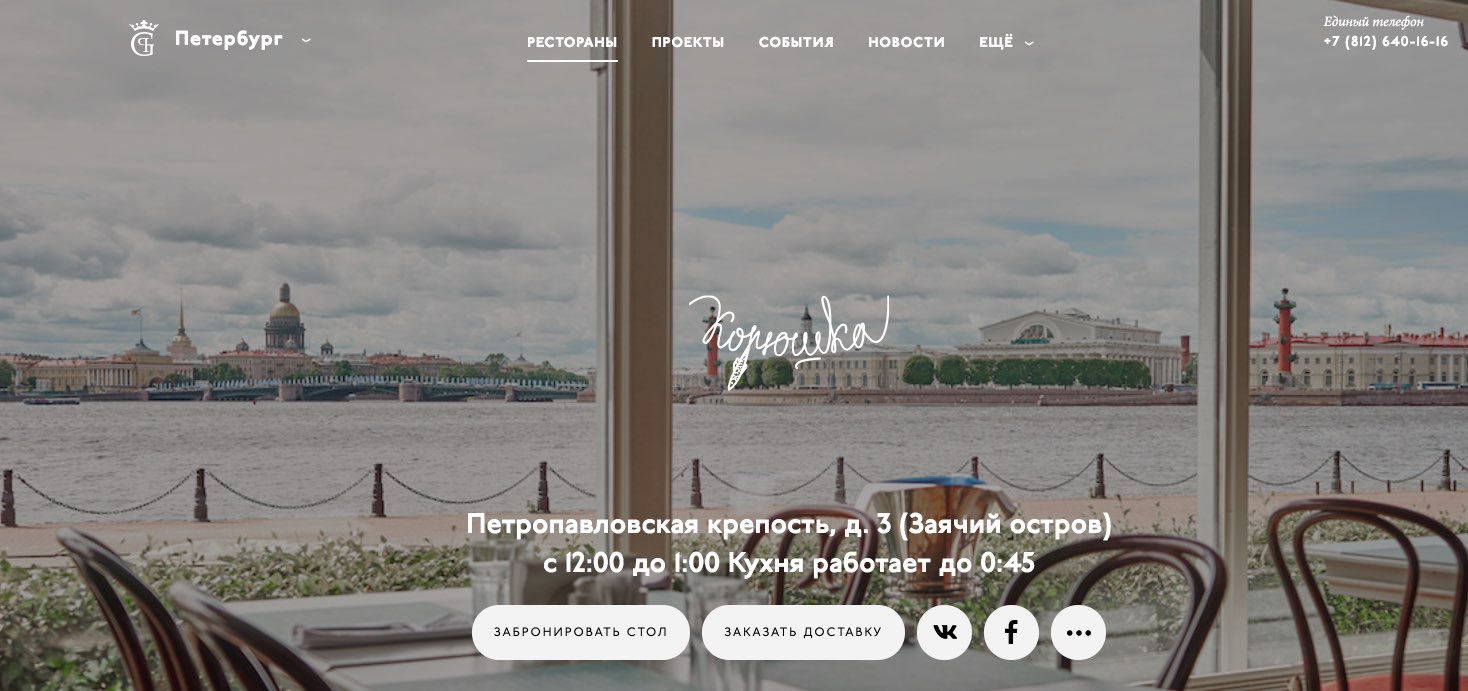
Right next to the beach, outside the walled grounds but still on the island, is the Koryushka restaurant (Корюшка): one of the best places to eat near the fortress, with good views, elegant decor and modern Russian cuisine. You can eat for around 2,500–3,000 rubles on average. They accept reservations on their website, and in high season it’s strongly recommended to book ahead.
If you prefer something cheaper, inside the fortress there are a couple of cafés and fast food kiosks. They’re nothing to write home about, but they’ll do for a snack.
By the way, корюшка (koryushka) is the name of a small fish typical of the Neva that in spring has a very peculiar smell (like fresh cucumber) and that Petersburgers wait for every year as a seasonal delicacy. Try it if you’re there in May.
Guided tours and helicopter flights
If you’d rather visit the fortress with a guide in English or Spanish, several local agencies offer tours. Since international platforms like GetYourGuide or Viator haven’t worked in Russia since 2022, you have to book through Russian operators. I explain how to do that in my guide on guided tours in St. Petersburg, with the platforms that do work and how to pay.

For the more adventurous: from the fortress itself (the Naryshkin Bastion area, next to the Neva) several local companies run sightseeing helicopter flights over the city. Prices start at around 7,000 rubles per person on weekends from May to October, on flights of about 15 minutes over the historic center. It’s a different experience and, if the day is clear, the views are absolutely worth it.
Other useful details
- Right opposite the fortress, across the Kronverksky bridge, is the Museum of Artillery, Engineers and Signal Corps (http://www.artillery-museum.ru/). It’s a huge museum with cannons from the time of Peter the Great to Soviet missiles, including a room dedicated to the Kalashnikov AK-47 rifle. If you like military topics, you can chain it on after the fortress.
- Concerts and festivals: in summer, the cathedral square hosts open-air concerts. On May 27 (City Day) there are special celebrations with parades, music and a commemorative cannon shot.
- Museum Night: every year, in May, the fortress takes part in Museum Night with special hours until late at night. It’s worth checking the exact dates on the museum’s website.
How much time to spend on your visit
It depends a lot on what you want to see:
- Quick visit (just cathedral + walk): 1.5 to 2 hours.
- Cathedral + Trubetskoy + walk along the walls: 2.5 to 3 hours (my recommendation if you only have a short day in St. Petersburg).
- Full visit with all the museums, Nevskaya Panorama and lunch: half a day / 4–5 hours.
Remember that the museums close on Wednesdays (except the cathedral and the Trubetskoy prison). And in the height of summer it’s crowded, so it’s worth going early or last thing.
How it fits into your St. Petersburg itinerary
The fortress is practically a must on any visit to the city. If you have 3 or 4 days, you can combine it in one morning with a walk along Nevsky Avenue and Palace Square on the other side of the river. If you only have 2 days, put it on the first morning to understand the city from its origins, and save the Hermitage, Saint Isaac’s Cathedral, the Church of the Savior on Spilled Blood, and the suburban palaces like Peterhof or the Catherine Palace for later…
If you want to plan your whole trip, take a look at my guide on how many days to spend in Moscow and St. Petersburg.
Frequently asked questions
Is entry to the Peter and Paul Fortress free?
Access to the walled grounds and Zayachy Island is completely free. You only pay to enter the museums and exhibitions inside (cathedral, Trubetskoy prison, cosmonautics museum, etc.).
How much does the combined ticket cost?
1,500 rubles per adult. It’s the best-value option: it includes access to the 8 main attractions (cathedral, prison, cosmonautics museum and five more exhibitions), is valid for 3 days and includes a free 1.5-hour guided tour in Russian.
What day does the fortress close?
The island and the grounds are open every day of the year. The cathedral and the Trubetskoy prison also open every day (with reduced hours on Tuesdays). The rest of the museums and exhibitions close on Wednesdays, so if you want to see them all, avoid that day.
What time is the fortress cannon shot?
At 12:00 sharp every day from the Naryshkin Bastion. It’s very loud, so don’t let it catch you by surprise. Arrive a few minutes early if you want to see it properly.
Where are the Romanovs buried?
In the Peter and Paul Cathedral. Most of the tsars from Peter the Great to Alexander III have their tombs here. Nicholas II, Tsarina Alexandra and three of their daughters (Olga, Tatiana and Anastasia) were buried in the St. Catherine Chapel, on the southwest side, on July 17, 1998, eighty years after their murder in Yekaterinburg.
Can I buy tickets online?
Yes, you can, but for a normal visit to the fortress the tickets can be bought at the box office without issue. The two main ticket offices are in the Ioannovsky Ravelin (main entrance) and the Boat House (next to the cathedral).
Does my Visa or Mastercard work to pay?
No. Since 2022, Visa or Mastercard cards issued outside Russia don’t work in the country. Bring rubles in cash or get a Russian MIR card.
How much time do I need to visit it?
The minimum recommended is 2 hours (cathedral and walk). If you want to see the cathedral, the Trubetskoy prison and walk along the walls, plan on 3 hours. For a full visit with all the museums and the Nevskaya Panorama walkway, half a day (4–5 hours).
You’ve finished this stop 5. Experiences
Real Traveller Experiences in Russia
Real accounts from travellers just back from Russia: cards, cash, accommodation, safety... What travelling to Russia is really like now, from those who've been.
Go to 5. ExperiencesBack to the start of this stage: 4. Destinations
Was this useful? I'll tell you when something changes in Russia
One short email a month with what has changed for travellers (visas, payments, border crossings, apps), based on what readers report to me from Russia. More than 4,000 of us already. No spam: if you ever lose interest, unsubscribing is one click.
Irena DomingoAbout Me
I was born in Russia. I grew up between two worlds: my father was Russian, my mother Spanish — a descendant of the "Children of Russia", the Basque children evacuated to the USSR during the Spanish Civil War. I've worked as a translator, interpreter and Russian teacher for over 30 years, and since 2013 I've been writing this blog to help travellers discover Russia with practical, always up-to-date information. Author of the Russiable Guide. If this blog has helped you plan your trip, you can buy me a coffee ❤️.
More on St. Petersburg
 Destinations · Saint PetersburgSt. Petersburg Metro and Public Transport in 2026: Fares, Cards & Tips2026 fares for the St. Petersburg metro, the Podorozhnik card, buses, Pulkovo airport, and taxi apps. Everything you need to get around the city.
 Preparations · MuseumsThe Hermitage in Saint Petersburg: the complete guide to your visitHow to buy Hermitage tickets in 2026 as a foreigner, the 3 official routes, must-see masterpieces and tips to skip the queues.
 Preparations · MuseumsPeterhof: what to see, how to get there & tickets from St. PetersburgWarning: the official site won't take foreign cards. Here's how to visit Peterhof in 2026: what to see, prices, map and how to skip the lines.