
The Hermitage in Saint Petersburg: the complete guide to your visit
 By Irena Domingo
Updated on
In This Article
The Hermitage in Saint Petersburg is one of the world’s great museums and the must-see if you’re visiting this city. In this article I explain how to buy tickets as a foreign tourist (with the whole card mess), the museum’s three official routes, the current opening hours, the masterpieces you can’t miss, how to get there and all the tricks to avoid queues and make the most of your visit.
This is step 5 of my guide to planning a trip to Russia in 10 steps, where you’ll find everything else in order.

1. What is the Hermitage and why you have to visit it
The Hermitage is both an art museum and an imperial palace. The collection, started by Catherine the Great in 1764, holds more than 3 million works and is spread across six buildings in the historic centre of Saint Petersburg. By exhibition surface (over 233,000 m²) it is the largest art museum in the world, and it rivals the Louvre or the Prado in both the quantity and the quality of its works.
People say that if you wanted to spend just one minute in front of each piece, you’d need over eleven years to see them all. Since that’s not realistic, what really matters is going in with a plan: knowing which route you’re going to do, which works you want to see and, above all, arriving with your ticket already bought. I’ll walk you through everything below.
2. The buildings that make up the museum
The Hermitage is not a single building but a complex of several. Knowing this helps you understand the ticketing system (each one has its own).
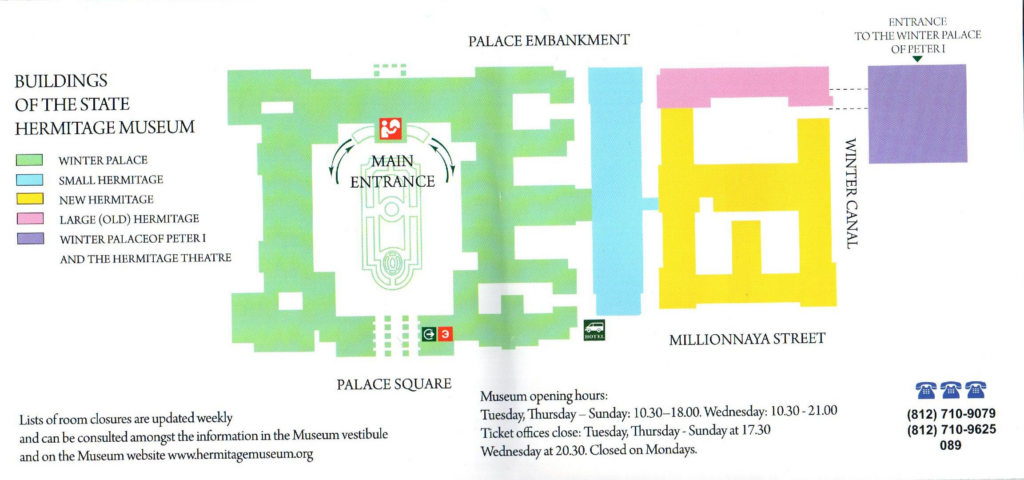
Main Complex (Palace Square, 2). This is where 90% of what people want to see is located. It’s made up of five interconnected buildings that you walk through almost without noticing:
- Winter Palace: the former official residence of the tsars, with its state rooms. It’s the main building and the one you see in every postcard.
- Small Hermitage: home to the Pavilion Hall and the famous Peacock Clock.
- Great (Old) Hermitage: Renaissance picture gallery (Leonardo, Titian, Raphael).
- New Hermitage: Rembrandt, Rubens, Caravaggio, classical antiquities and the famous Portico of the Atlantes on Millionnaya Street.
- Hermitage Theatre: a small court theatre with occasional concerts and ballet performances.
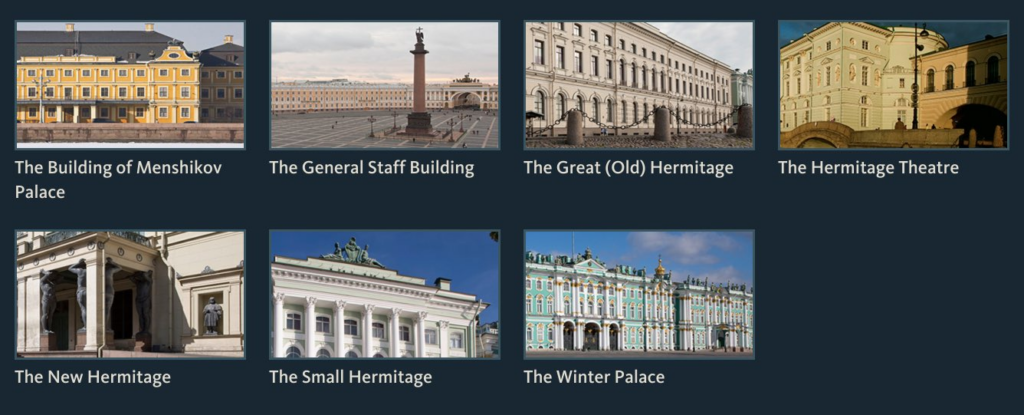
General Staff Building (Palace Square, 6–8). Right opposite the Winter Palace, on the other side of the square. This is where the Impressionists and Post-Impressionists live (Monet, Van Gogh, Gauguin, Matisse, Picasso) along with the Fabergé collection. If you’re into modern art, this is the gem.
Menshikov Palace (Universitetskaya 15, Vasilyevsky Island). The former palace of Saint Petersburg’s first governor, with interiors from the time of Peter the Great. Visits are by Russian-language guided tour only.
Imperial Porcelain Factory Museum (Prospekt Obukhovskoi Oborony, 151). More than 30,000 pieces of porcelain, glass and decorative objects. It’s outside the centre and only worth the trip if you have time and you’re a real enthusiast.
Staraya Derevnya Centre: a restoration depot-museum. Visits are by guided tour only and it’s really for serious aficionados.
3. The three official routes: which one to choose
Since 2020 the Hermitage has organised entry through predefined routes with timed sessions every 30 minutes. Each session lasts about 2 hours. When you buy your ticket you’ll need to pick one of these three options:
Route 1: Jordan Staircase (the classic)
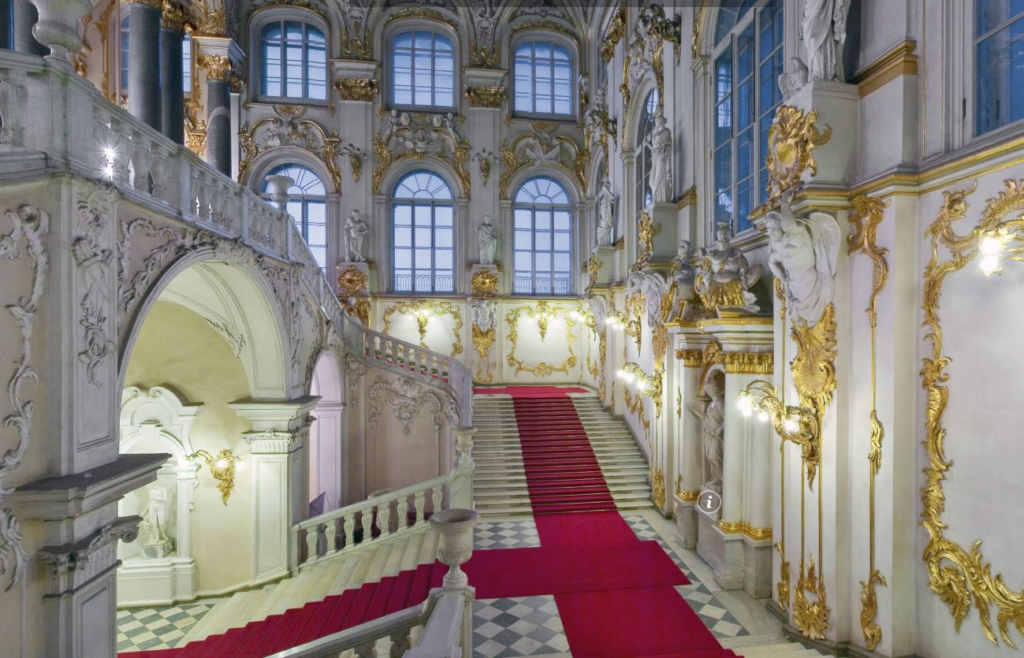
The most recommended route if it’s your first time. It starts at the spectacular Jordan Staircase (marble, granite and gold) and walks you through the imperial state rooms of the Winter Palace (St. George’s Throne Room, the 1812 War Gallery, the Armorial Hall), the Pavilion Hall with the Peacock Clock, the Raphael Loggias, the Leonardo, Rubens and Rembrandt rooms and the classical antiquities. It’s also the only route that’s accessible for visitors with reduced mobility, since the others have no lifts.
Route 2: Church Staircase
Longer and less touristy. It takes you through the private apartments of the imperial family (Malachite Room, Gothic Library, Pompeian Dining Room, Nicholas II’s library) and the rooms of Russian, Oriental and 18th-century French art. Ideal if you’ve already been to the Hermitage before, or if you’re more interested in the palace than in the paintings. There are no lifts on this route, so be ready to climb plenty of stairs.
Route 3: General Staff Building
It’s in the building opposite, on the other side of Palace Square. You buy a separate ticket for it. This is where the great names of 19th- and 20th-century art live: Matisse, Picasso, Monet, Van Gogh, Gauguin, Cézanne, Renoir, Kandinsky, Malevich, the Fabergé rooms… If you love the Impressionists, this is your route. Practical tip: most people head for the Winter Palace first, so starting here saves you queues.
If you only have a single day and you’re not really into modern art, my advice is to go for Route 1. If you have two days, combine it with Route 3 (General Staff Building). I’d save Route 2 for a second visit.
4. Opening hours and when to go
The museum is open Tuesday to Sunday. It’s closed on Mondays and on two days a year (1 January and 9 May). The current hours of the Main Complex and the General Staff Building are:
| Days | Hours | Last session |
|---|---|---|
| Tuesday, Friday and Saturday | 11:00 – 20:00 | 18:00 |
| Wednesday, Thursday and Sunday | 11:00 – 18:00 | 16:00 |
| Monday | Closed | |
Menshikov Palace opens 11:00–18:00 (last guided tour at 16:00). The physical ticket offices close one hour before the museum.
Best time to go
My clear recommendation:
- Day: Tuesday, Friday or Saturday, because the museum stays open until 20:00 and you have more breathing room.
- Time: the first morning sessions (11:00–11:30) or, if you’d rather not get up early, after lunch (15:00–16:00) when the tourist groups have already left.
- Days to avoid: summer weekends, Russian school holidays (first week of November, first week of January), and the days when entry is free for all citizens: 23 February, 8 March, 18 May and 7 December. The museum is packed on those days.
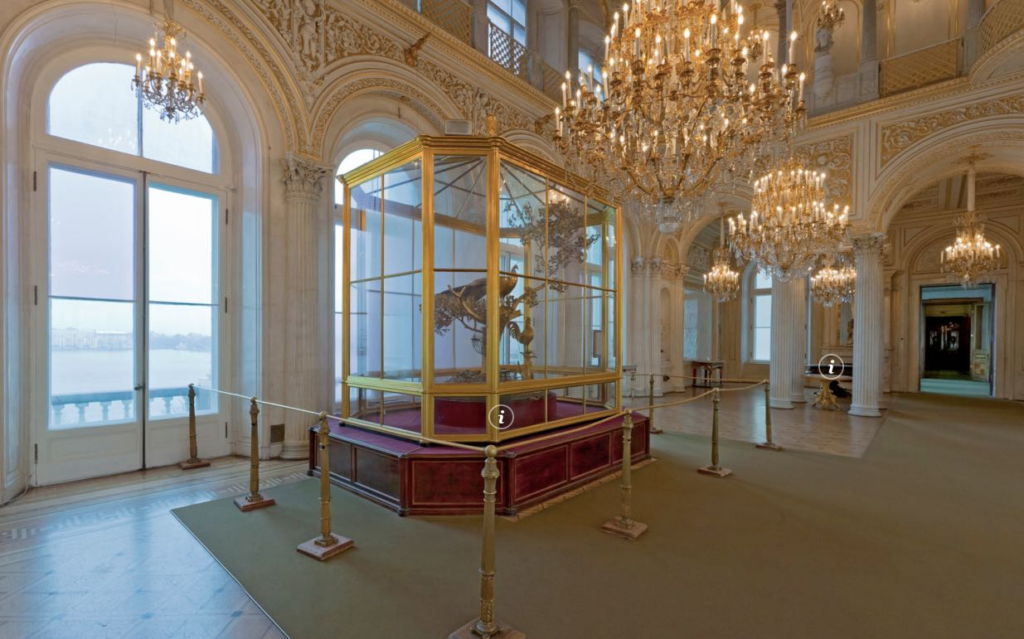
In case you’re looking for it: the famous Peacock Clock in the Pavilion Hall is only set in motion once a week (traditionally on Wednesdays, although the time can change). Ask at the entrance on the day of your visit if you want to see it running.
5. How much it costs and how to buy tickets
These are the current official prices (in rubles, not counting discounts for Russian citizens):
| Ticket | Price |
|---|---|
| Main Complex (fixed session) | 500 ₽ |
| Main Complex (open date, valid for 3 days) | 1,200 ₽ |
| General Staff Building (fixed session) | 500 ₽ |
| General Staff Building (open date, 3 days) | 1,200 ₽ |
| Winter Palace of Peter I (with guided tour) | 700 ₽ |
| Menshikov Palace (with guided tour) | 700 ₽ |
| Treasure Gallery: Gold Room or Diamond Room (group guided tour) | 1,500 ₽ |
| Imperial Porcelain Factory Museum | 300 ₽ |
| Children under 14 | Free |
At the current exchange rate, the standard Main Complex ticket comes to about €5–6 (around US$ 5.50–6.50) and the General Staff Building costs roughly the same. For most foreign tourists it remains one of the cheapest top museums in the world.
The problem with foreign cards
Here’s the part that matters to you as a foreign tourist. The official Hermitage website does not accept foreign Visa, MasterCard, American Express or JCB cards because of international sanctions. So buying directly online at hermitagemuseum.org is not really an option unless you have a Russian card.
You have three realistic options to get your ticket:
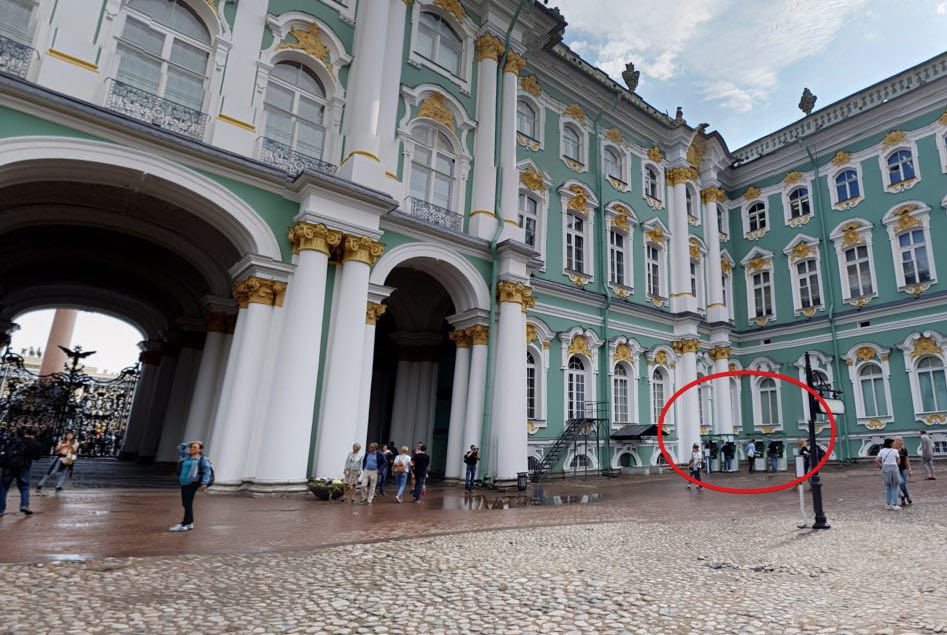
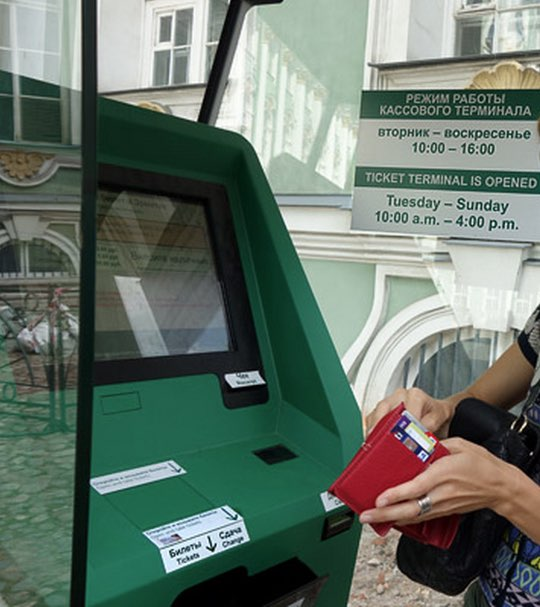
- Buy at the museum on the day of your visit. In the Winter Palace courtyard there are ticket offices and self-service machines (in Russian and English) where you can pay in cash in rubles. The machines usually have shorter queues than the manned offices, so head straight for them. This is the simplest option for most foreigners.
- Pay online with a Russian MIR card. If you’re going to spend several days in Russia and you’d rather have everything sorted in advance, you can get a Russian MIR card for foreigners before your trip. With one of those, the official website accepts your payment.
- Book through a third-party platform (in English, with a foreign card and a guide if you want one). It’s more expensive, but it removes the payment headache and locks in your time slot. I cover this in section 8.
For a wider look at how to pay in Russia as a foreigner, here’s my up-to-date guide: How to pay in Russia: cash, bank cards and real options for foreigners.
6. How to get to the Hermitage
The main entrance is on Palace Square no. 2, in the very heart of historic Saint Petersburg. Palace Square is the most important square in the city and it’s fully pedestrianised, so however you arrive, the last few metres will be on foot.
By metro
- Admiralteyskaya (line 5, purple): the closest, 700 metres away. The fastest option.
- Nevsky Prospekt (line 2, blue) or Gostiny Dvor (line 3, green): 900 m and 1.3 km respectively. You walk along Nevsky Prospekt, which is worth doing for its own sake.
By bus or trolleybus
To the Dvortsovaya Ploshchad (Palace Square) stop, 300 m from the entrance, you can take buses 7, 10, 24 and 191, or trolleybuses 1, 7, 10 and 11.
Map of the buildings and access points
On the map, the red markers are the Hermitage buildings and the blue ones are public transport stops. Click on each one to see the address.
7. What to see: the must-see masterpieces
If you only have one visit, don’t try to see everything. You’ll burn out and enjoy nothing. Here’s what I wouldn’t skip:
In the Winter Palace (Route 1)
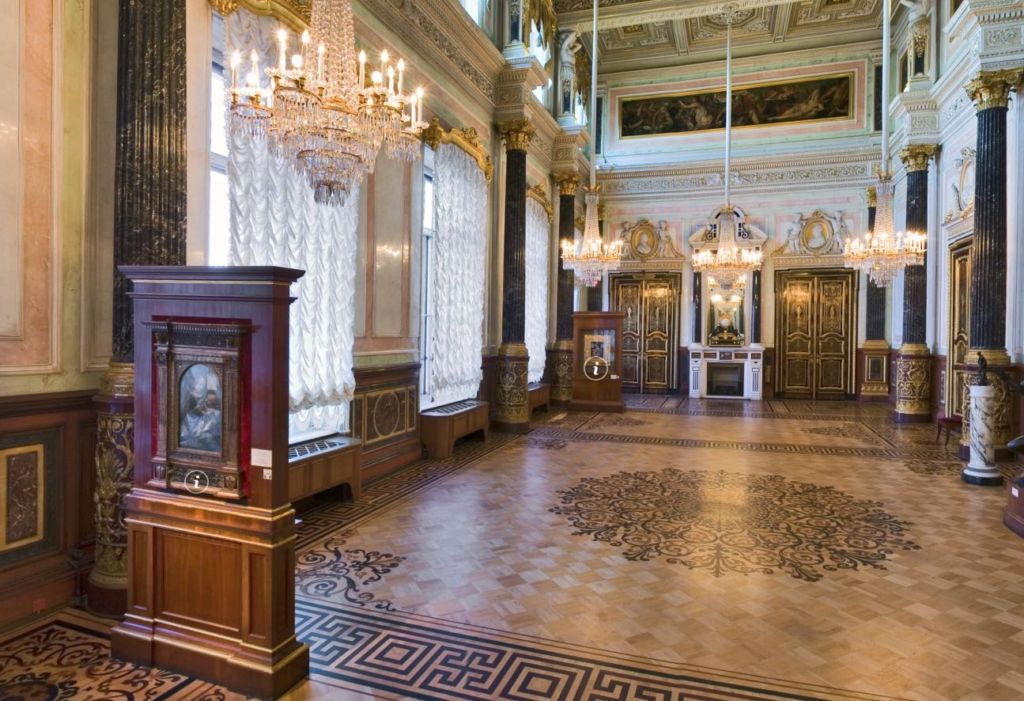
- Jordan Staircase: the entrance alone is worth the visit. White marble, columns, gold and a painted ceiling.
- Great Throne Room (St. George Hall): the room used by the tsars for official receptions.
- 1812 War Gallery: 332 portraits of the Russian generals who fought against Napoleon.
- Malachite Room: columns and fireplaces made entirely of malachite.
- Pavilion Hall: home to the Peacock Clock, the largest 18th-century mechanical automaton in the world still in working order.
Paintings: the rooms I wouldn’t miss
- Room 214 (Leonardo da Vinci): the Madonna Benois and the Madonna Litta. Only about a dozen Leonardo works are firmly attributed to him in the world, and you have two of them right here.
- Room 229 (Raphael): the Conestabile Madonna and the Holy Family. Right next door are the Raphael Loggias, full-size copies of the Vatican frescoes.
- Room 230: Michelangelo’s Crouching Boy, his only sculpture in Russia.
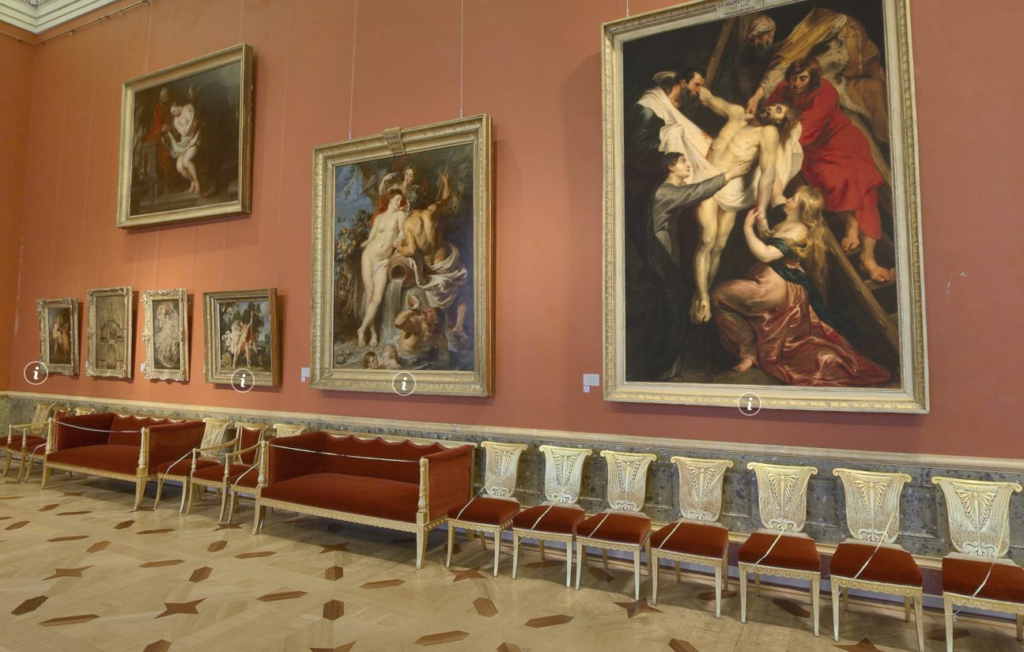
- Room 247 (Rubens): more than 40 works by the Flemish master.
- Room 254 (Rembrandt): The Return of the Prodigal Son and the controversial Danaë. The Rembrandt room hits hard.
- Spanish rooms: El Greco, Velázquez, Murillo and Goya. Small but excellent.
- Room 243: The Lute Player by Caravaggio.
Other curious stops
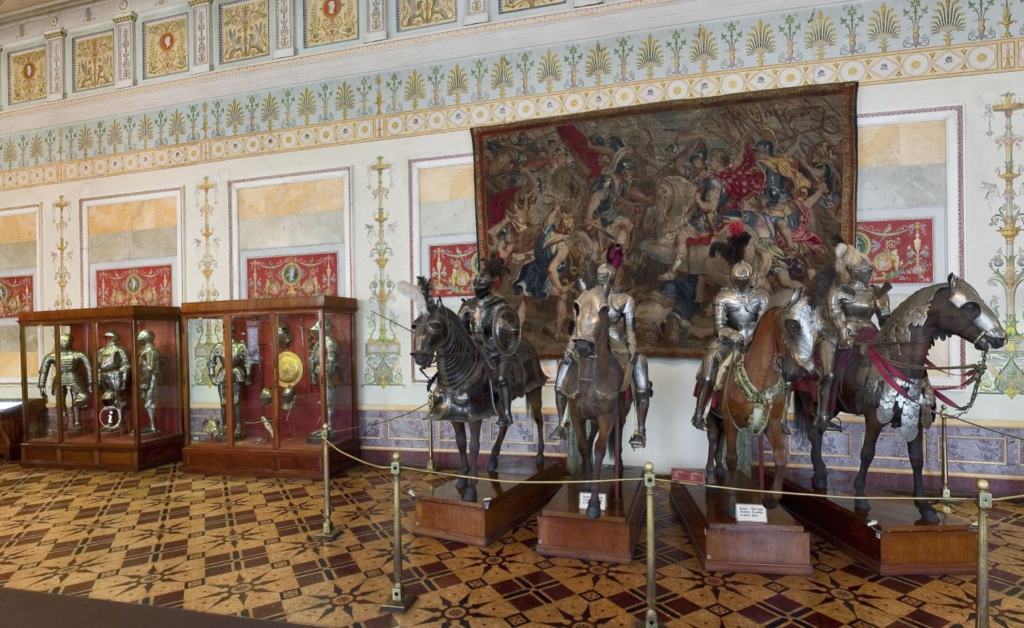
- Knights’ Hall: medieval armour mounted on horseback. If you’re travelling with kids, they’ll love it.
- Egyptian rooms: mummies, sarcophagi and the goddess Sekhmet in black stone.
- Greek and Roman antiquities: featuring the enormous Kolyvan Vase, carved from green jasper.
In the General Staff Building (Route 3)
This is a separate ticket, but very much worth it if you like 19th- and 20th-century art. This is where the Shchukin and Morozov collections live, with masterpieces by Monet, Renoir, Cézanne, Van Gogh, Gauguin, Matisse and Picasso. Matisse’s The Dance and Music, for example, are here. There are also the Fabergé rooms and works by Malevich and Kandinsky.
8. Rules and practical tips
- Arrive 15 minutes early for your session. If you arrive more than 30 minutes late, your ticket is cancelled with no refund.
- Large backpacks and suitcases aren’t allowed inside: leave them in the free cloakroom at the entrance. No food or drink either (security will take it). Small handbags and tote bags are fine.
- Photos yes, flash no. You can take pictures and videos with your phone in the permanent exhibitions. In the temporary ones it’s usually banned.
- Audio guides are available in English, Spanish, French, German, Italian, Chinese, Japanese and Korean. You pick them up at the entrance (Jordan Staircase) or at the General Staff Building entrance.
- Wheelchair access: the Main Complex, the General Staff Building, Staraya Derevnya and the Imperial Porcelain Factory are accessible. The Winter Palace of Peter I and the Menshikov Palace are not.
- Free map: grab one as soon as you go in. The paper version is easier to read than the one on your phone for navigating the rooms.
- Comfortable shoes: a normal visit means walking 4 to 6 km on marble and parquet floors. You’ll thank yourself later.
- Watch out in summer: it gets hot inside. If you’re wearing a coat, leave it in the cloakroom.
- The Atlantes trick: on Millionnaya Street, next to the Portico of the Atlantes at the New Hermitage, there’s a local tradition. Touching the big toe of the Atlantes statue on the right (the one facing the Field of Mars) is said to bring luck. You touch it from outside; the portico is on the street, so you don’t need a museum ticket.

To get yourself in the mood before going, I recommend watching Russian Ark (2002), a film shot inside the Hermitage in a single 96-minute take. Mind-blowing.
9. Where to eat
Inside the museum there’s a cafeteria on the ground floor of the Winter Palace (Rastrelli Gallery) with sandwiches, drinks and basic pastries. It’s nothing special, prices are high for what you get and it gets crowded in summer. It’s only worth it if you’re spending the whole day inside and don’t want to leave and come back (re-entry on the same ticket is not allowed).
Much better to eat nearby. Here are three options a few minutes’ walk away:
- Yat Restaurant (Moika River Embankment, 16). Traditional Russian cuisine, period décor, mid-range prices (1,000–1,500 ₽). Five minutes from Palace Square. My favourite around here for lunch.
- Bellevue Brasserie (Moika Embankment, 22, on the rooftop of the Kempinski Hotel). French-Russian cuisine with spectacular views of the Hermitage and the Neva river. The pricey option, but the view earns it.
- Stolovaya no. 1 (Nevsky Avenue, 5). Self-service Russian cafeteria, very cheap (300–500 ₽). Nothing fancy, but you eat well and quickly. There are several branches around the city.
If you want to dig deeper into the area and other options, here’s my full guide to the Palace Square: what to see and where to eat.
10. Guided tour in English
The Hermitage is a huge museum and, honestly, going in with a guide who tells you the story behind the works and the inner workings of the palace changes the visit completely. The museum’s official guided tours are in Russian only, so the only way to do it in English is with a private guide hired on your own or through a specialised platform.
Booking through a platform has a triple advantage: your ticket is included (you skip the card problem) and you skip the queue. In my article on guided tours in Saint Petersburg I explain which platforms accept foreign cards and how to book.

Frequently asked questions
How much time do you need to visit the Hermitage?
Your current ticket gives you a 2-hour session for the Main Complex (Route 1 or 2) and another 2 hours if you also enter the General Staff Building. If you want to see the highlights without rushing, plan half a day per building. For a more thorough visit, dedicate a full day to the Main Complex and another morning to the General Staff Building.
Can I buy tickets online with a foreign Visa or MasterCard?
On the official Hermitage website, no. They only accept Russian cards and, unreliably, UnionPay. Your options are: buy at the ticket office or self-service machines on the day of your visit and pay in cash, get a Russian MIR card before your trip, or book through a third-party platform that does accept foreign cards.
Are there days when admission to the Hermitage is free?
Yes. Admission is free for all visitors (foreigners included) on four days of the year: 23 February, 8 March, 18 May (International Museum Day) and 7 December (Saint Catherine’s Day). The museum is packed on those days, so be ready for queues and crowding. Children under 14 always enter for free, regardless of nationality.
Which Hermitage route is best if it’s my first visit?
Route 1 (Jordan Staircase). It’s the most complete: it takes you through the imperial state rooms of the Winter Palace, the Peacock Clock, the Raphael Loggias and the rooms with Leonardo, Rembrandt, Rubens and the classical antiquities. It’s also the only route that’s accessible for visitors with reduced mobility.
Can you take photos inside the Hermitage?
Yes, in the permanent exhibitions you can take photos and videos with your phone, no flash. In temporary exhibitions it’s usually forbidden. If you want to use a tripod or a professional camera you need a special permit.
Is the General Staff Building worth visiting?
Yes, especially if you like 19th- and 20th-century art. This is where the Shchukin and Morozov collections live, with works by Matisse, Picasso, Monet, Van Gogh, Gauguin and Cézanne, plus Fabergé and the Russian avant-garde. It’s usually less crowded than the Winter Palace and starting your day there is a good trick to avoid the morning queues.
In This Article
Was this useful? I'll tell you when something changes in Russia
One short email a month with what has changed for travellers (visas, payments, border crossings, apps), based on what readers report to me from Russia. More than 4,000 of us already. No spam: if you ever lose interest, unsubscribing is one click.
Irena DomingoAbout Me
I was born in Russia. I grew up between two worlds: my father was Russian, my mother Spanish — a descendant of the "Children of Russia", the Basque children evacuated to the USSR during the Spanish Civil War. I've worked as a translator, interpreter and Russian teacher for over 30 years, and since 2013 I've been writing this blog to help travelers discover Russia with practical, always up-to-date information. Author of the Russiable Guide. If this blog has helped you plan your trip, you can buy me a coffee ❤️.
 Catherine Palace in St. Petersburg: what to see, how to get there & tickets
 Peterhof: what to see, how to get there & tickets from St. Petersburg
 Cruises on the Rivers and Canals of St. Petersburg: How and Where to Book