
The Must-See Churches and Cathedrals of St. Petersburg: Tickets, Hours and Prices
 By Irena Domingo
Updated on
In This Article
St. Petersburg has more than 200 churches, but as a traveller there are really only five you need to care about: the Church of the Savior on Spilled Blood and St. Isaac’s Cathedral (550 rubles each), the Cathedral of St. Peter and St. Paul (1,000 rubles, with the Romanov tsars buried inside), Kazan Cathedral (free) and the Kronstadt Naval Cathedral (free).
The first four are right in the city centre and the fifth is in Kronstadt, on Kotlin Island, about 30 kilometres away. You can comfortably see all of them in two days. At the end of the article I also tell you about other, far less touristy churches that are well worth it if you have more time: Smolny, St. Nicholas of the Sailors, the Trinity Cathedral, the Alexander Nevsky Lavra and the curious Chesme Church.

Before you start: how you pay for tickets
I’m telling you this first because it changes the whole way you plan. Since 2022, Visa and Mastercard cards issued outside Russia no longer work in the country: not at the ticket offices and not on the ticket-sales websites. The official online booking pages (isaak.ticketnet.ru for St. Isaac’s and the Savior, spbmuseum.ru for the Peter and Paul Fortress) in practice only process Russian cards.
So what do you do? You have two options: pay at the ticket office in cash with rubles (the simplest route and, except in the thick of July or August, the queues are very manageable) or get yourself a Russian MIR card, which will cover this and everything else during your trip. The good news is that none of these cathedrals require booking ahead the way the Hermitage does in high season: you just turn up at the window, pay and walk in.
1. Church of the Savior on Spilled Blood (550 rubles)
If you’re only going to pay for one ticket in St. Petersburg, make it this one. The Church of the Savior on Spilled Blood (officially the Church of the Resurrection of Christ) is that temple of colourful onion domes that looks like it was lifted straight out of Moscow and breaks completely with the European look of the rest of the city. It stands beside the Griboyedov Canal, a two-minute walk from Nevsky Avenue.
Its name is no accident: it was built on the exact spot where an attack ended the life of Tsar Alexander II on 13 March 1881. Inside, the very stretch of cobblestones and the section of canal railing where the emperor fell wounded are preserved. Construction, led by architect Alfred Parland, ran from 1883 to 1907, and even the measurements carry meaning: the main dome reaches 81 metres, a nod to the year of the assassination.
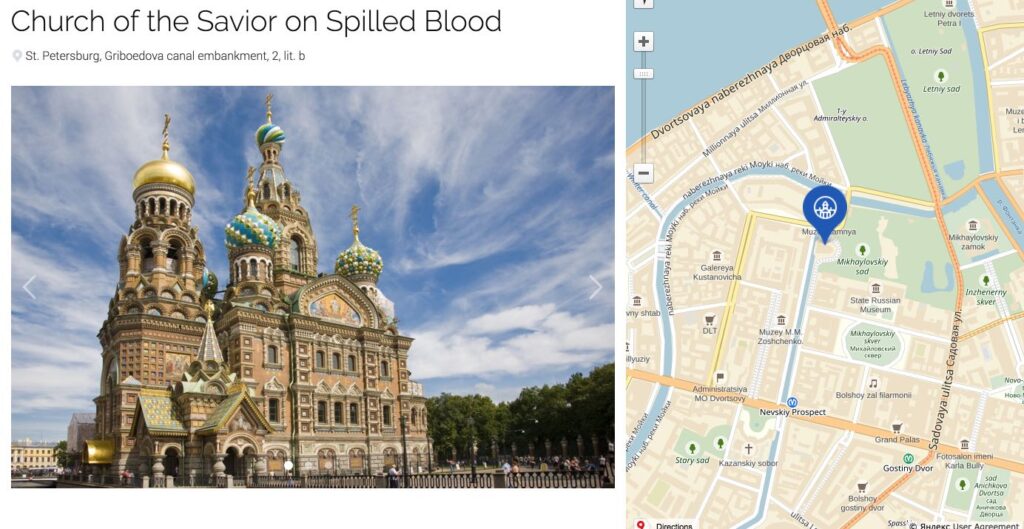
It’s striking from the outside, but what justifies the ticket is inside: more than 7,000 square metres of mosaics cover the walls, columns and domes, one of the largest mosaic collections in Europe. There’s another story I love: during World War II a bomb fell on the main dome and didn’t explode. It sat there for 19 years, until some workers who went up to fix leaks found it and removed it. After decades of restoration, the church reopened as a museum in 1997.

- Hours: 10:00 to 18:00 (ticket offices until 17:30). Closed on Wednesdays and on 1 January. From 1 May to 30 September it also opens in the evening, from 18:00 to 21:30.
- Price: 550 rubles. Ages 7 to 18: 300 rubles. Under 7: free. The summer evening visit costs 700 rubles. Audio guide (available in English): 300 rubles.
- Tickets: at the church’s own ticket offices or at isaak.ticketnet.ru (Russian cards only).
- Official website: cathedral.ru (the same state museum runs both the Savior and St. Isaac’s).
Clicking loads Google Maps, which may set cookies. Open in Google Maps
2. St. Isaac’s Cathedral and its colonnade (550 + 600 rubles)
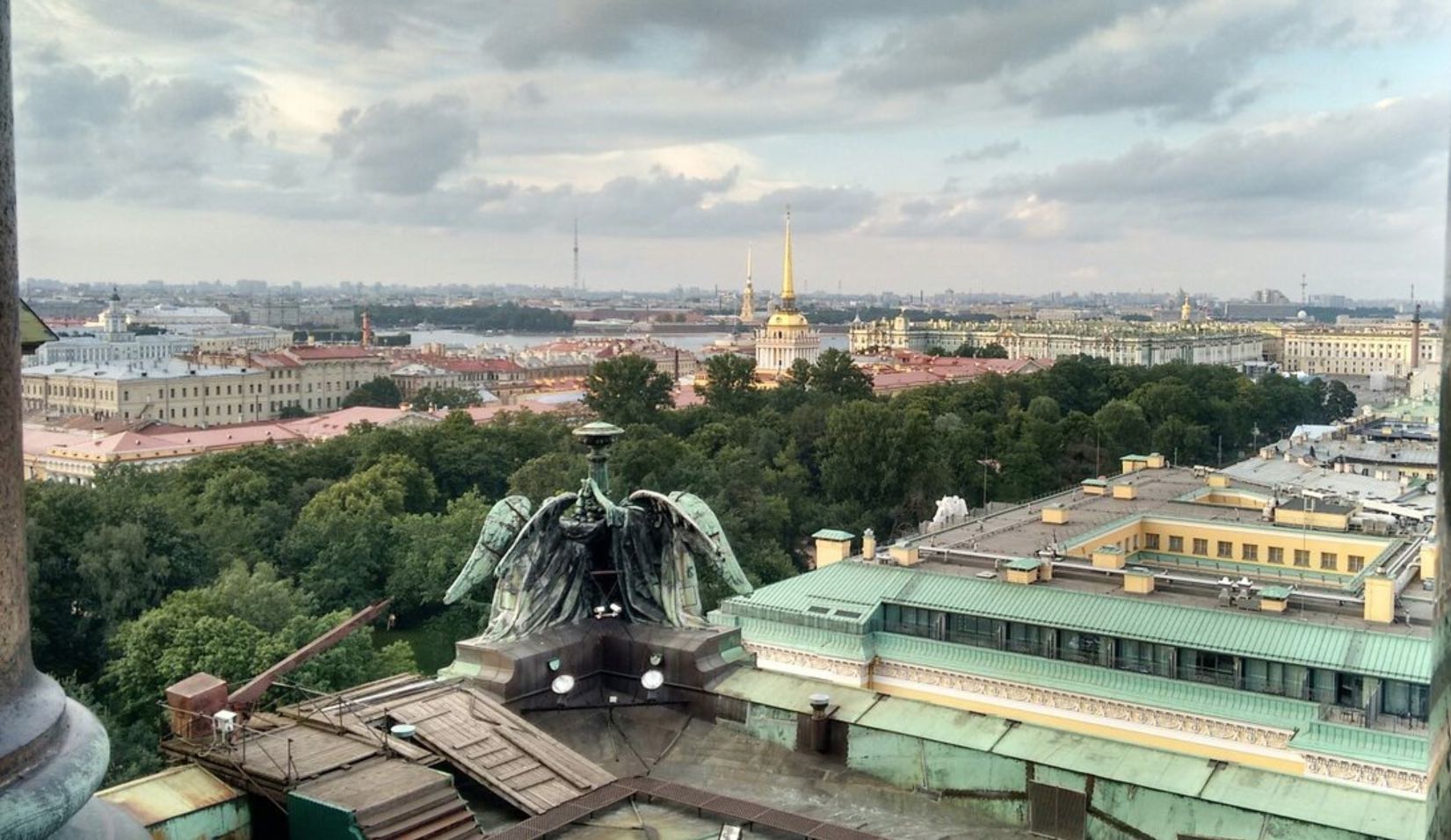
St. Isaac’s Cathedral is the most grandiose temple in the city, and its golden dome dominates the skyline from almost anywhere in the centre. It was raised by the French architect Auguste Montferrand between 1818 and 1858, and here’s a detail I love to point out as a Spaniard: the scaffolding and the mechanisms used to lift the 48 granite columns were designed by the Canary Islands engineer Agustín de Betancourt.
More than 40 different minerals went into its decoration: Russian, Italian and French marble, columns of malachite and lapis lazuli, and around 100 kilos of gold on the dome alone. It has worked as a museum since 1931. During World War II the dome was painted grey so it wouldn’t serve as a landmark for German aircraft.

The other big draw is the colonnade: a walkway that wraps around the base of the dome at 43 metres up, with the best panoramic view of the historic centre. You climb it on foot up a spiral staircase of 262 steps (there’s no lift, so bear that in mind). The colonnade ticket is separate from the cathedral one and has no discounts. In summer you can also go up at night, something really special during the white nights of June.
- Cathedral hours: 10:00 to 18:00 (ticket offices until 17:30). Closed on Wednesdays and on 1 January. From 1 May to 30 September it also opens from 18:00 to 21:30 in the evening.
- Colonnade hours: 10:00 to 18:00. From May to September it opens every day (and at night too, 18:00 to 21:30); from October to April it closes on the third Wednesday of each month.
- Price: cathedral 550 rubles (ages 7 to 18: 300 rubles; under 7: free). Colonnade: 600 rubles, no discounts. Summer evening visits: 700 rubles each. Audio guide in English: 300 rubles.
- Tickets: at the ticket office or at isaak.ticketnet.ru (Russian cards only).
- Official website: cathedral.ru
Clicking loads Google Maps, which may set cookies. Open in Google Maps
3. Cathedral of St. Peter and St. Paul, the Romanov pantheon (from 1,000 rubles)
The Peter and Paul Fortress is where St. Petersburg began: Peter I the Great ordered it built in 1703 on the small island of Zayachy, on the Neva River. Within the grounds, the star building is the Cathedral of St. Peter and St. Paul, raised between 1712 and 1733 by the Swiss architect Domenico Trezzini. Its golden spire, crowned by an angel, reaches 122.5 metres and is still the most recognisable silhouette in the city.
The main reason to go inside is that almost every Russian tsar is buried here, from Peter I the Great to Nicholas II, whose remains (and those of his family, executed in 1918) were moved to the cathedral in 1998. Walking among the tombs of Catherine the Great, Alexander II or Peter I himself is genuinely moving.
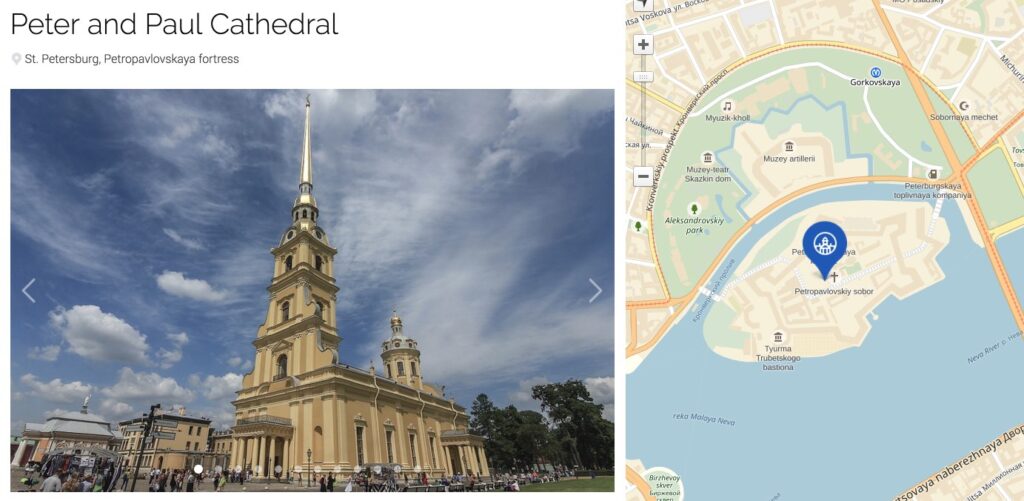
Important: getting into the fortress grounds is free, and you only pay to enter the cathedral and the museums. If all you want is the cathedral with the Grand Ducal Burial Vault, the ticket costs 1,000 rubles. But if you plan to spend half a day there, the 1,500-ruble combined ticket pays off: it’s valid for 3 days and includes the cathedral, the Trubetskoy Bastion prison (where Dostoevsky, Gorky and Lenin’s brother were once held), the cosmonautics museum and several other exhibitions, plus a guided tour in Russian. Heads-up: reduced prices only apply to Russian students and pensioners, so as a foreign tourist you’ll pay the full rate. And if you’re around at midday, don’t miss the noon cannon shot from the Naryshkin Bastion, a daily tradition in the city.
- Cathedral hours: daily from 10:00 to 19:00 (Saturdays until 17:45, Sundays it opens at 11:00). Entry closes 30 minutes before, and hours can change on days with religious services. The island grounds open from 6:00 to 21:30.
- Price: cathedral and Grand Ducal Burial Vault, 1,000 rubles. Fortress combined ticket (cathedral + Trubetskoy prison + the other exhibitions, valid 3 days): 1,500 rubles. Bell-tower climb, guided tour only: 500 rubles.
- Tickets: at the fortress ticket offices or on the official website (same-day online purchase is only available until 16:00 and requires a Russian card).
- Official website: spbmuseum.ru
Clicking loads Google Maps, which may set cookies. Open in Google Maps
4. Cathedral of Our Lady of Kazan (free)
The Kazan Cathedral is the official cathedral of St. Petersburg, seat of the metropolitan, and you’ll recognise it at once by its huge semicircular colonnade of 96 columns that embraces Nevsky Avenue. Emperor Paul I wanted a temple inspired by St. Peter’s Basilica in Rome, and architect Andrei Voronikhin built it in just ten years, from 1801 to 1811.
It ended up as a monument to the victory over Napoleon: this is where Field Marshal Kutuzov prayed before heading to the front in 1812, here he is buried, and the standards captured from the French armies were brought to the cathedral one by one. Inside, the city’s most important icon, the Virgin of Kazan, is venerated. In Soviet times it became the Museum of the History of Religion and Atheism, and in the 1990s it returned to Orthodox worship.

Unlike St. Isaac’s or the Savior, this isn’t a museum but a working church, with daily services. That means free admission, but also respecting the rules: shoulders and knees covered, a headscarf for women, quiet, and no flash photography or photos during services.
- Hours: open daily, roughly 9:00 to 20:00 (on Sundays and major feast days it opens earlier, around 6:30, for the liturgies).
- Price: free admission.
- Official website: kazansky-spb.ru
Clicking loads Google Maps, which may set cookies. Open in Google Maps
5. Kronstadt Naval Cathedral (free)
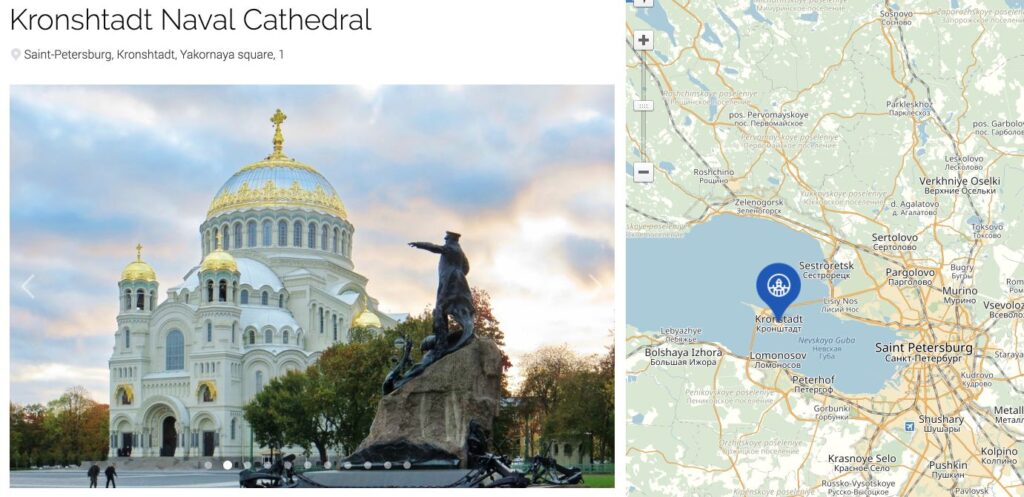
The Naval Cathedral of St. Nicholas in Kronstadt is the great religious day trip from St. Petersburg. It sits in the port city of Kronstadt, on Kotlin Island, about 30 kilometres to the west, and it’s easy to reach by road thanks to the dam-causeway that crosses the Gulf of Finland.
It’s the main church of the Russian Navy and a memorial to every fallen sailor. It was built between 1903 and 1913 to a design by Vasily Kosyakov, in a Neo-Byzantine style inspired by Hagia Sophia in Constantinople, with a dome about 27 metres across decorated with anchors and maritime motifs. After the revolution it served as a cinema, an officers’ club and even a Navy museum; in 2013, exactly a century after its original consecration, it was reconsecrated following a spectacular restoration. The interior, with its black marble plaques bearing the names of sailors who died in service, is the kind that stays with you.
To get there by public transport, the most practical option is bus 101 from Staraya Derevnya metro station or the marshrutkas (minibuses) 405 (from Chyornaya Rechka) and 407 (from Prospekt Prosveshcheniya). The trip takes about an hour to an hour and a quarter depending on traffic. A lot of people combine Kronstadt with Peterhof in a single day, since both lie in the same direction.
- Hours: daily from 10:00 to 19:00 (services at 10:00 and 18:00).
- Price: free admission. It’s a working church: at the entrance they lend out headscarves and skirts to meet the dress code.
- Address: Yakornaya Square 1, Kronstadt.
Clicking loads Google Maps, which may set cookies. Open in Google Maps
More churches worth visiting if you have time
The five above cover the essentials, but St. Petersburg has plenty more to offer. These other five barely see any foreign tourists, all of them are free to enter (except the odd viewpoint) and each one brings something different.
Smolny Cathedral
Bartolomeo Rastrelli’s blue-and-white baroque (the same architect behind the Winter Palace and Catherine Palace) in religious form. It’s a little off the usual circuit, on the bank of the Neva, and that keeps it calm. Entry to the church is free, and for about 300 rubles you can climb the 278 steps of its bell tower, a 50-metre-high viewpoint over the river that few people know about. Official website: smolnyspb.ru
St. Nicholas Naval Cathedral (of the Sailors)
My favourite among the lesser-known ones. Elizabethan baroque in sky blue and gold (the work of Savva Chevakinsky, 1753-1762) in the canal neighbourhood of Kolomna, one of the most charming parts of the city. It has two churches stacked on top of each other, a lower and an upper one, and it keeps its original 18th-century look because it never stopped working as a church, not even in Soviet times. Free admission. Official website: nikolskiysobor.ru
Trinity Cathedral (Izmailovsky)
You’ll spot it from afar by its five enormous deep-blue domes scattered with golden stars. It was built between 1828 and 1835 by Vasily Stasov as the church of the Izmailovsky Regiment, and this is where Dostoevsky married Anna Grigoryevna in 1867. A fire destroyed the main dome in 2006 and the full restoration wasn’t finished until 2017, so today it looks flawless. Free admission. Official website: izmsobor.ru
Alexander Nevsky Lavra
The city’s first monastery, founded by Peter I in 1713 at the far end of Nevsky Avenue, and one of the most serene spots in St. Petersburg. Its Holy Trinity Cathedral holds the relics of Alexander Nevsky, the prince the avenue is named after. Entering the monastery and the cathedral is free; what you do pay for are the historic cemeteries by the entrance, run as a museum, where Dostoevsky, Tchaikovsky, Glinka and Lomonosov are buried. If their graves interest you, it’s one of the most worthwhile paid visits in the city. Official website: lavra.spb.ru
Chesme Church
The most photogenic of them all and the one that looks least Russian: a small pink-and-white neo-Gothic church, with pinnacles and pointed windows, built by Yury Felten between 1777 and 1780 to commemorate the naval victory of Chesme over the Turks. It’s far from the centre, near Moskovskaya metro station, but if you’re heading to or from the airport it’s practically on the way. Free admission. Official website: chesma.spb.ru
Practical tips for visiting the churches of St. Petersburg
- Tell museums and working churches apart. St. Isaac’s, the Savior on Spilled Blood and the Cathedral of St. Peter and St. Paul operate as museums: there’s no strict dress code. Kazan, Kronstadt and the rest are working churches: shoulders and knees covered, a headscarf for women (almost all of them lend one at the entrance) and discretion during services.
- Watch out for Wednesdays: St. Isaac’s and the Savior close that day. Save it for the Peter and Paul Fortress, Kazan or the Kronstadt day trip, which open daily.
- If you’re travelling between May and September, make the most of the evening hours at St. Isaac’s and the Savior. Going up the colonnade at sunset during the white nights is one of the best things you can do in the city.
- Get to the Savior on Spilled Blood early: it’s the most visited church and by mid-morning the tour groups fill it up. Right at 10:00 you can usually see it in peace.
- Photos: generally allowed, but no flash and never during services or of the priests without permission.
- Organise your visits by area: the Savior, Kazan and St. Isaac’s are 15-20 minutes apart on foot and fit perfectly into one day along with the Hermitage. The fortress is on the other side of the Neva, and Kronstadt is a half-day trip. In my article on what to see in St. Petersburg in 1, 2, 3 or 4 days you’ll find the full itineraries.
Frequently asked questions
How much does it cost to visit the cathedrals of St. Petersburg?
The Church of the Savior on Spilled Blood and St. Isaac’s Cathedral cost 550 rubles each (St. Isaac’s colonnade is paid separately, 600 rubles). The Cathedral of St. Peter and St. Paul costs 1,000 rubles, or 1,500 rubles with the combined ticket for the whole fortress. Kazan Cathedral and the Kronstadt Naval Cathedral are free.
Which churches in St. Petersburg are free?
Free to enter are Kazan Cathedral, the Kronstadt Naval Cathedral, St. Nicholas of the Sailors, the Trinity Cathedral, Smolny Cathedral (the bell-tower viewpoint is paid separately), the Alexander Nevsky Lavra and the Chesme Church. Entering the grounds of the Peter and Paul Fortress is also free; you only pay for the cathedral and the museums.
Can I buy tickets online with a foreign card?
No. The official ticket-sales websites only process Russian cards, because foreign Visa and Mastercard cards have not worked in Russia since 2022. Buy your tickets at the ticket office paying in cash rubles or with a Russian MIR card. You do not need to book in advance.
What day do the cathedrals of St. Petersburg close?
St. Isaac’s Cathedral and the Savior on Spilled Blood close on Wednesdays and on 1 January. The Cathedral of St. Peter and St. Paul, Kazan Cathedral and the Kronstadt Naval Cathedral are open every day.
Is it worth going up St. Isaac’s colonnade?
Yes. It costs 600 rubles and you have to climb 262 steps on foot, but it is the best panoramic view of St. Petersburg’s historic centre. From May to September it also opens at night, a fantastic option during the white nights.
In This Article
Was this useful? I'll tell you when something changes in Russia
One short email a month with what has changed for travellers (visas, payments, border crossings, apps), based on what readers report to me from Russia. More than 4,000 of us already. No spam: if you ever lose interest, unsubscribing is one click.
Irena DomingoAbout Me
I was born in Russia. I grew up between two worlds: my father was Russian, my mother Spanish — a descendant of the "Children of Russia", the Basque children evacuated to the USSR during the Spanish Civil War. I've worked as a translator, interpreter and Russian teacher for over 30 years, and since 2013 I've been writing this blog to help travellers discover Russia with practical, always up-to-date information. Author of the Russiable Guide. If this blog has helped you plan your trip, you can buy me a coffee ❤️.
 Drawbridges of Saint Petersburg: 2026 schedules and how to see them on a night cruise
 The Peter and Paul Fortress: practical guide to visit it in 2026
 The Lakhta Center’s observation deck: discover St. Petersburg from above