
The Fabergé Museum in St. Petersburg: the imperial eggs and how to visit
 By Irena Domingo
Updated on
In This Article
The Fabergé Museum in St. Petersburg holds the largest collection of works by the House of Fabergé in the world, with 9 of the famous imperial Easter eggs as its star pieces. It sits in the Shuvalov Palace, five minutes from Nevsky Avenue, opens every day from 10:00 to 20:45 and general admission costs 700 rubles. The visit takes about an hour and, heads up, you go in by sessions with a fixed time slot. In this article I tell you the story of the Fabergé eggs, what you’ll see in each room and how to buy your ticket as a foreigner.

A little jewel of a museum right in the centre
If you ask me which museum in St. Petersburg gives you the most in return for the time it takes, I’ll say without hesitation the Fabergé Museum. It’s a private museum, relatively young (it opened on 19 November 2013), that often ends up in the shadow of the Hermitage, but that wins over almost everyone who visits it: in just over an hour you see jewels that are unique in the world, inside a splendidly restored palace.
It’s right in the heart of the city, in the Shuvalov Palace, on the Fontanka River Embankment 21, right next to Nevsky Avenue and the Anichkov Bridge. Its collection exceeds 4,000 pieces, of which around 1,500 came out of the workshops of the House of Fabergé: it’s the largest collection of Fabergé works in existence. And the big draw is its 15 Easter eggs, including 9 of the imperial eggs that Fabergé created for the last two tsars of Russia.
Who was Carl Fabergé
Peter Carl Fabergé (St. Petersburg, 1846 – Lausanne, Switzerland, 1920) was the most famous jeweller in Russia. In the 1870s he took over the family workshop in St. Petersburg and soon made a name of his own in European goldsmithing. From 1885 he was a supplier to the imperial court of the Romanovs, although he also worked for other royal houses across Europe and for the great millionaires of the day.

The story of the Fabergé eggs
The origin: Easter 1885
In Russia there’s a centuries-old tradition of painting eggs by hand at Easter, taking them to church to be blessed and then giving them to family and friends. In the upper circles of St. Petersburg that custom kept climbing in extravagance until it turned into Easter gifts adorned with jewels.
In 1885 Emperor Alexander III wanted to surprise his wife, Empress Maria Feodorovna, and commissioned Fabergé to make a very special Easter egg. That’s how the first imperial egg was born, the Hen Egg: on the outside, a plain white enamel egg, like a real chicken egg; opening it revealed a golden yolk and, inside that, a golden hen that in turn held a tiny crown set with a ruby (these last pieces, sadly, have been lost).

The gift was such a hit that the tsar decided to commission a new egg from Fabergé every year, with a single condition: that it hide a surprise inside (yes, the same idea as today’s Kinder eggs, but with diamonds). Each egg commemorated some important event in the life or reign of the Romanovs, and making one could take a whole year for a team of craftsmen sworn to absolute secrecy about its contents.
Alexander III gave his wife an egg every Easter. On his death, his son Nicholas II carried on the tradition from 1895 in double: each year he commissioned one egg for his wife, Empress Alexandra Feodorovna, and another for his mother, the dowager Empress Maria Feodorovna.
The tradition came to an abrupt end in 1917 with the Russian Revolution. The Bolsheviks nationalised the House of Fabergé, the family fled the country and Carl Fabergé died in Switzerland in 1920. The treasures from the palaces were confiscated and moved to the Kremlin Armoury on Lenin’s orders. A few years later, from 1927 onwards, Stalin sold many of the eggs abroad to raise foreign currency, and so began their dispersal across half the world.
How many Fabergé eggs are there and where are they?
The House of Fabergé created around 70 Easter eggs between 1885 and 1917 (the exact figure is still debated by experts). Of those, 52 were made for the imperial family, the so-called imperial eggs, of which 48 survive today. The rest were private commissions: the seven eggs of the Kelch family and one-off pieces for the Yusupovs, the Rothschilds, the Nobels and the Vanderbilts.
And where are they now? The Kremlin Armoury in Moscow holds 10 imperial eggs and the Fabergé Museum in St. Petersburg, 9. Another 5 are at the Virginia Museum of Fine Arts (United States) and 3 belong to the British Royal Collection, today King Charles III’s. The Hermitage has displayed since 2014 the Rothschild egg (a private commission, not imperial), which in 2007 sold at auction for 8.9 million pounds, a record for a Fabergé piece at auction. The rest are split between museums and private collections, and the whereabouts of several remain unknown.
The imperial egg that turned up at a flea market
This is my favourite story about the lost eggs. A scrap dealer in the American Midwest bought a golden egg at a flea market for about 13,300 dollars, planning to melt it down and make a profit on the metal. Nobody would buy it from him because they thought it was overpriced, so the egg sat in his kitchen for years. One day in 2012 he googled “egg” and “Vacheron Constantin” (the brand of the watch inside it) and discovered he had at home the Third Imperial Egg of 1887, missing for decades and valued at around 20 million pounds. The London antique dealer Wartski confirmed its authenticity and the piece ended up sold to a private collector.
The Shuvalov Palace, home of the museum
The museum is the work of the Link of Times Foundation, created by Russian billionaire Viktor Vekselberg. Its origin lies in a deal that left the art world speechless: Malcolm Forbes, the publisher of Forbes magazine, had built up over his lifetime (1919-1990) the largest private Fabergé collection, with 9 imperial eggs and close to 200 other objects. His heirs were going to auction it at Sotheby’s in February 2004, but before the bidding began Vekselberg bought the entire lot. In a 2013 BBC documentary he revealed that for the nine eggs alone he paid just over 100 million dollars, and that he acquired them to return them to Russia for their historical and cultural value.
He went on buying pieces by Fabergé and other great Russian goldsmiths across Europe, Asia and America until he passed 4,000 objects, many of them from European royal courts. To house the collection, the foundation took a long-term lease on the Naryshkin-Shuvalov Palace, an elegant late-18th-century building famous for its balls, which served as a hospital during the First World War, suffered serious damage in the Siege of Leningrad and reached the 21st century in a sorry state. After a full seven-year restoration (2006-2013), its 4,700 m² look spectacular: the ticket pays for itself just to see the palace.

How to get there
The address is Fontanka River Embankment, 21. The nearest metro station is Gostiny Dvor: from there it’s about a 10-minute walk along Nevsky Avenue to the Anichkov Bridge, and the palace is right next to it, on the bank of the Fontanka, across from the Russian National Library. Other nearby stations are Mayakovskaya and Ploshchad Vosstaniya, around 15 minutes on foot. Plenty of buses and trolleybuses running along Nevsky Avenue also drop you very close.
Clicking loads Google Maps, which may set cookies. Open in Google Maps
What to see in the museum: room by room
As you go in, the ticket office is on the left. The cloakroom is compulsory for backpacks and coats, and you’ll go through a security check with a metal detector, more than justified by the value of what’s inside. From the lobby, the marble Grand Staircase takes you up to the main floor, where the whole exhibition is spread across a dozen rooms. On the museum’s website you can download the exhibition map as a PDF for free.

Several rooms are named after a colour and decorated to match. The Red Room is devoted to Russian silver; the Gold Room, to the gifts of the tsars and fantasy objects; and other rooms focus on porcelain, enamels, cigarette cases, Russian painting and icons. Even if you’ve come “for the eggs”, don’t breeze past them: there are pieces of goldsmithing that take your breath away.


The Blue Room: the 9 imperial eggs
The crown jewel of the museum is the Blue Room, where the Easter eggs are displayed. The 9 imperial eggs you’ll see are these:
- Hen Egg (1885)
- Renaissance Egg (1894)
- Rosebud Egg (1895)
- Coronation Egg (1897)
- Lilies of the Valley Egg (1898)
- Cockerel Clock Egg (1900)
- Fifteenth Anniversary Egg (1911)
- Bay Tree Egg (1911)
- Order of St. George Egg (1916)

Let me tell you about the ones I like best, starting with the imperial ones. The Renaissance Egg (1894) is an agate casket with gold, enamel and diamond mounts, laid out horizontally. It was Alexander III’s last Easter gift to his wife: the tsar died that same year. The surprise it held has been lost.

Next to it is the Resurrection Egg, a delicate rock-crystal piece showing Christ rising from the tomb. It has no documented date (it’s earlier than 1899) and many experts believe it could be precisely the lost surprise of the Renaissance Egg: it fits perfectly inside it.

The Rosebud Egg (1895) was the first that Nicholas II gave to his wife Alexandra. In strawberry-red enamel and neoclassical style, it opens like a bonbon to reveal a yellow rosebud, in memory of the gardens of Darmstadt, the empress’s hometown.

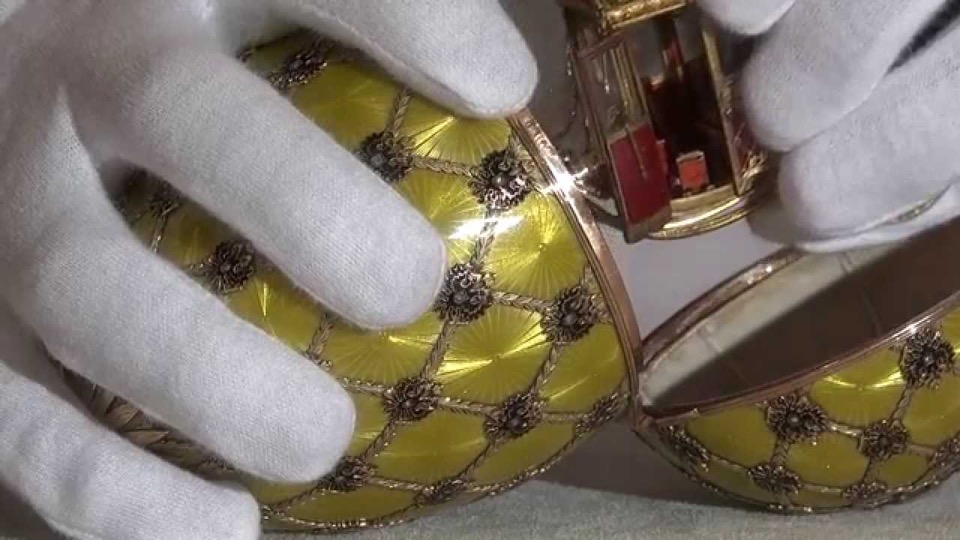
The Coronation Egg (1897) is probably the most famous Fabergé egg of all. In gold and translucent yellow enamel, it hides as a surprise a miniature replica, perfect down to the last detail, of the carriage in which Alexandra Feodorovna arrived at the coronation of Nicholas II.

The Lilies of the Valley Egg (1898), in Art Nouveau style and covered in pearls, is decorated with the empress’s favourite flowers. Turning a pearl raises miniature portraits of Nicholas II and his two eldest daughters, Olga and Tatiana, from inside.

Of the last imperial eggs, my favourite is the story of the Order of St. George Egg (1916), far more austere because it was made in the middle of the First World War: it was the only egg that the dowager Empress Maria Feodorovna took with her when she fled Russia after the revolution.
The room also has top-tier non-imperial eggs. The Kelch Hen Egg (1898), in ruby-red enamel with a band of diamonds, was the first of the seven eggs that millionaire Alexander Kelch commissioned for his wife Varvara. And the Duchess of Marlborough Egg (1902), one of the largest, is a pink-enamel clock egg with a rotating dial in the Louis XVI style, created for Consuelo Vanderbilt, Duchess of Marlborough.


In this video from the museum’s YouTube channel you can get a better look at these masterpieces:
Clicking loads YouTube, which may set cookies. Open in YouTube
As a curious aside, there’s another Fabergé Museum in Baden-Baden (Germany), opened in 2009 by Russian collector Alexander Ivanov, but its collection bears no comparison with the one in St. Petersburg.
Opening hours, prices and tickets in 2026
Here’s the up-to-date practical information, according to the museum’s official website:
- Opening hours: open every day of the year. The exhibition can be visited from 10:00 to 20:45 and the ticket office runs from 9:30 to 20:15.
- Entry by sessions: you go in by sessions with a fixed date and time, printed on your ticket. Be on time: if you’re late for your session they can deny you entry without a refund.
- Price: an individual ticket costs 700 rubles. The reduced rate of 350 rubles applies only to citizens of Russia and Belarus, with two exceptions that do work for foreigners: children under 7 and students of any nationality (with valid ID).
- Guided tour of the museum: 1,300 rubles, in Russian, in groups of up to 15 people and with departures roughly every hour.
- Audio guide: the museum offers an online audio guide in English for 300 rubles that runs on your own phone (bring headphones). It’s the option I’d recommend if you’re visiting on your own.
Where to buy the ticket? The ticket office only sells tickets for the same day and, in high season, sessions can sell out, so the best move is to buy in advance on the museum’s official website (online sales open about a week ahead).
Since 2022, Visa and Mastercard cards issued outside Russia don’t work in the country, neither on Russian websites nor at ticket offices. In practice you have two options: pay at the ticket office in cash (rubles) or pay with a MIR card, which will also come in handy for online purchases and for the rest of your trip.
If you’d rather visit it with a guide in your own language, Western platforms like GetYourGuide no longer operate in Russia, but it’s still possible to book tours with local guides paying with a foreign card: I explain how in the article on guided tours in St. Petersburg.
Practical tips and what to do after the visit
On the ground floor of the palace there’s a very pleasant café where you can have something to drink or a light bite, plus a gift shop with replicas and pieces inspired by Fabergé’s creations, in case you want to take your own “egg” home.
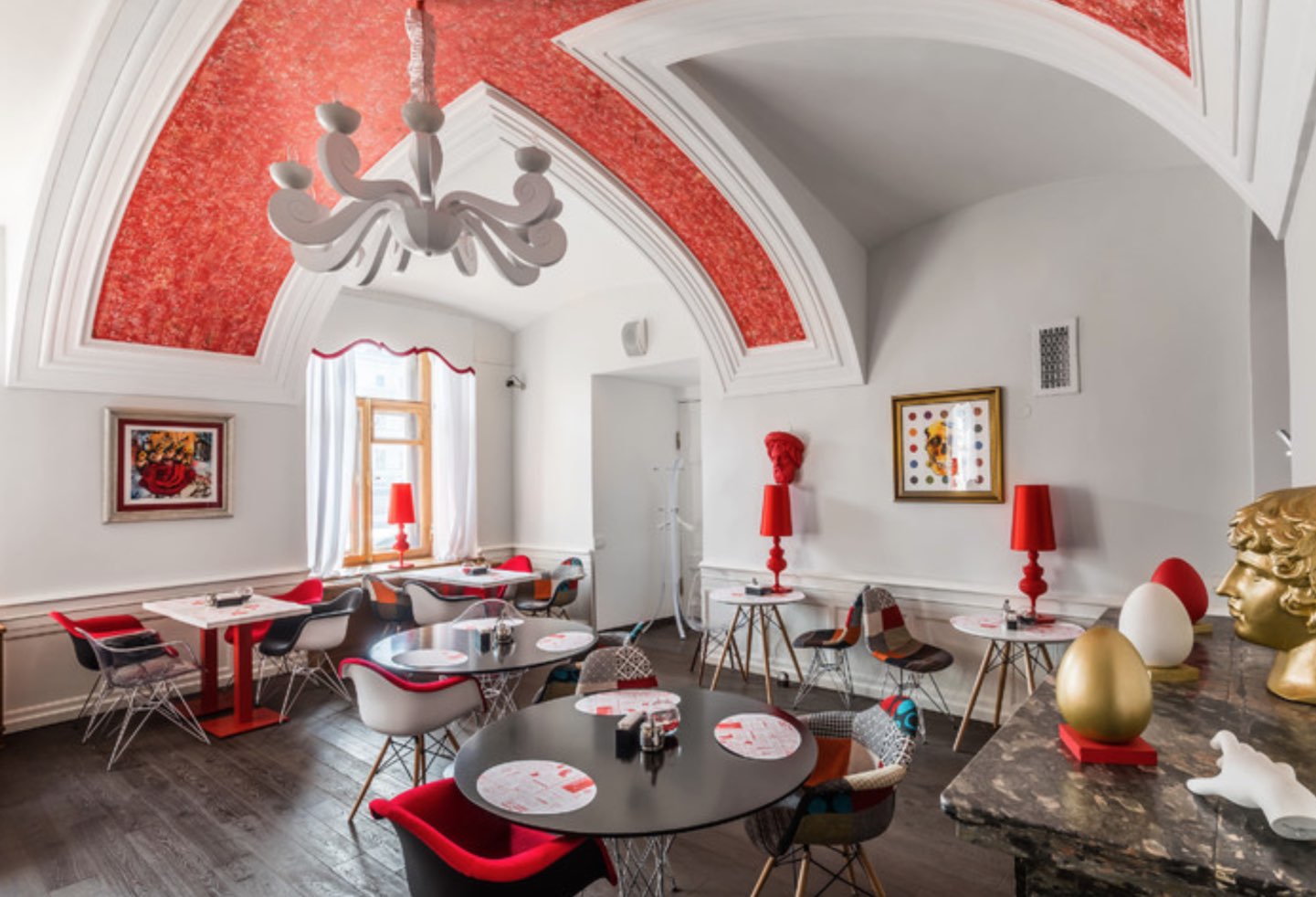
The museum even has its own pier on the Fontanka, opened in 2016, so during the navigation season (spring to autumn) you can combine the visit with a boat ride along the city’s rivers and canals, setting off from its very door.

After the visit you’re in the best possible spot: Nevsky Avenue, with restaurants for every taste and budget. A 15-20 minute walk away you have the Church of the Savior on Spilled Blood and Palace Square with the Hermitage. And if the palace-museums left you wanting more, the Yusupov Palace, where Rasputin was murdered, is the perfect complement. To fit it all in, take a look at the St. Petersburg itineraries from 1 to 4 days.
Frequently asked questions about the Fabergé Museum
How much does admission to the Fabergé Museum cost?
An individual ticket costs 700 rubles. The reduced rate of 350 rubles applies only to citizens of Russia and Belarus, except for two cases that are valid for foreigners: children under 7 and students of any nationality. A guided tour in Russian costs 1,300 rubles and the online audio guide in English, 300 rubles.
How long does a visit to the Fabergé Museum take?
Entry is by sessions with a fixed time and the visit to the main exhibition takes about 1 hour. If you take your time and use the audio guide, allow between 1.5 and 2 hours.
How many Fabergé eggs are in the museum?
The museum displays 15 Easter eggs by the House of Fabergé, of which 9 are imperial eggs, created for tsars Alexander III and Nicholas II. In total the collection exceeds 4,000 pieces, around 1,500 by the House of Fabergé, and it’s the largest collection of Fabergé works in the world.
Where are the other imperial Fabergé eggs?
Of the 48 surviving imperial eggs, 10 are in the Kremlin Armoury in Moscow, 9 in the Fabergé Museum in St. Petersburg, 5 in the Virginia Museum of Fine Arts (United States) and 3 in the British Royal Collection. The rest are split between other museums and private collections.
Is the Fabergé Museum worth visiting?
Yes. In about an hour you see the largest collection of Fabergé works in the world, including 9 imperial eggs, inside a magnificently restored 18th-century palace just five minutes from Nevsky Avenue. It’s one of the best time-to-reward visits in St. Petersburg.
In This Article
Was this useful? I'll tell you when something changes in Russia
One short email a month with what has changed for travellers (visas, payments, border crossings, apps), based on what readers report to me from Russia. More than 4,000 of us already. No spam: if you ever lose interest, unsubscribing is one click.
Irena DomingoAbout Me
I was born in Russia. I grew up between two worlds: my father was Russian, my mother Spanish — a descendant of the "Children of Russia", the Basque children evacuated to the USSR during the Spanish Civil War. I've worked as a translator, interpreter and Russian teacher for over 30 years, and since 2013 I've been writing this blog to help travellers discover Russia with practical, always up-to-date information. Author of the Russiable Guide. If this blog has helped you plan your trip, you can buy me a coffee ❤️.
 What to See in Veliky Novgorod: A Guide to Russia’s Oldest City
 Russian Banya: What It Is and the Best in Moscow and St. Petersburg
 New Holland Island in St. Petersburg: What to See, How to Get There and Opening Hours