
The Russian Border Interview: Who Gets It, What They Ask and How Long It Takes (90+ Reader Accounts)
 By Irena Domingo
Updated on
In This Article
No, the Russian border interview isn’t something everyone gets, and it isn’t pure luck either. A lot depends on who you are: the odds go up sharply if you’re British, American or Canadian, if you have any link to Ukraine or a Russian partner, if you travel to Russia very often, or if you’re the only foreigner on the bus or the flight. And a lot depends on where you cross: at Koidula and Luhamaa, the crossings in southern Estonia, almost every foreigner gets one, while at St Petersburg’s Pulkovo airport most people are through in minutes.
I went through the accounts of more than 90 readers and around 80 reports from Telegram groups to see what keeps repeating: who gets interviewed, what they’re asked, how long it takes and whether they check your phone. It isn’t a study with any statistical value, just a sample of real experiences, but the patterns are quite clear.
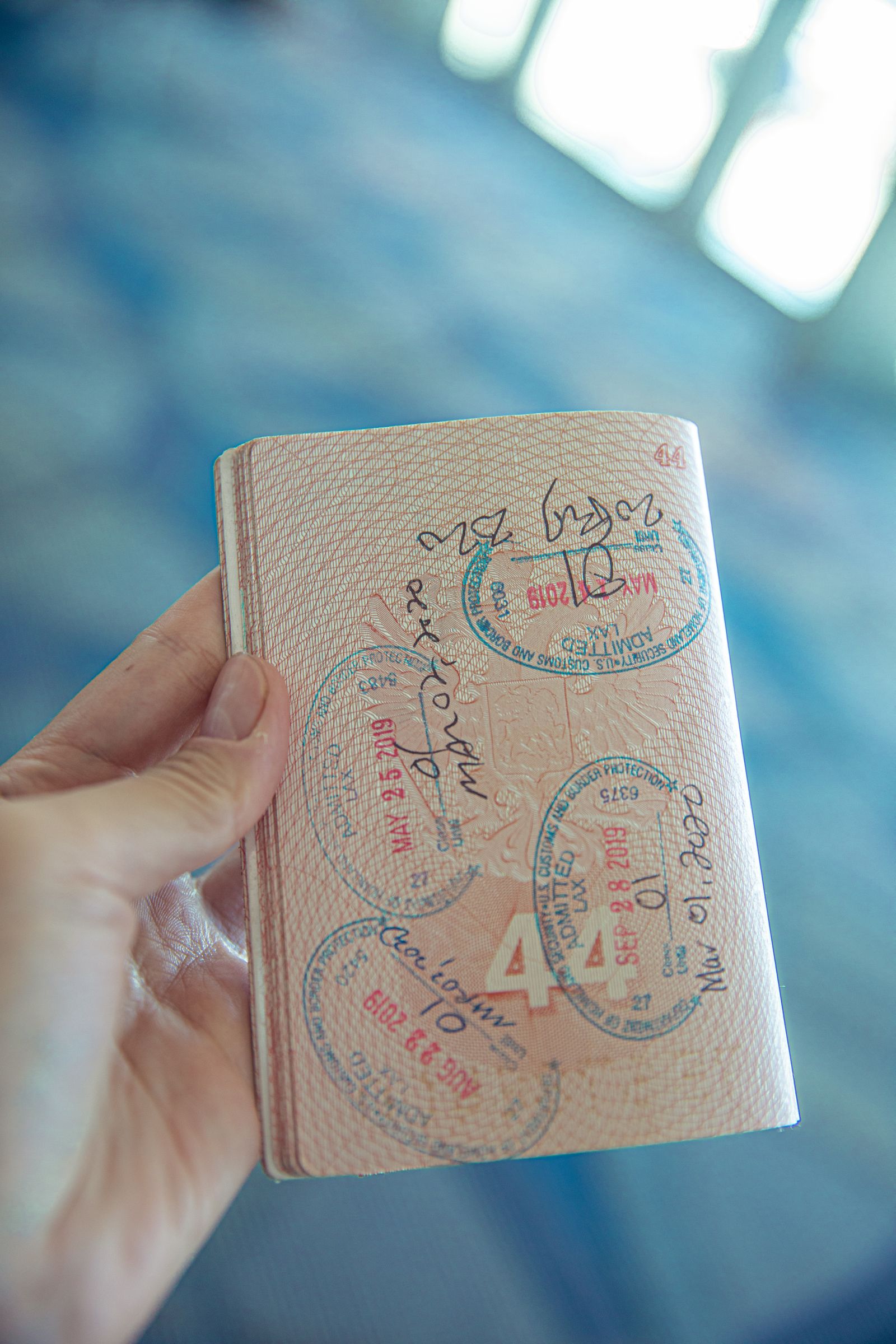
It’s probably the question I get most since I started publishing reader chronicles: “Will they interrogate me?” Fair enough, because the chronicles show every kind of case: a Spanish reader spent three and a half hours in a back room at Ivangorod, while David, a 78-year-old former Royal Marine, crossed at the same checkpoint with smiles and not a single question. For the general picture of each crossing (opening hours, queues, how to get there) see the guide to Russia’s borders; here I focus only on the interview.
What the “interview” is and how it differs from a normal check
The normal check is what happens to most people: you hand your passport in at the booth, they take your photo and fingerprints, maybe ask a question or two (“Tourism?”, “How many days?”), stamp it and you’re in. Three to ten minutes.
The interview (in Russian беседа, “conversation”, though readers call it an interrogation, second-line check or extra screening) is something else. The accounts almost always follow the same script:
- At the booth they keep your passport and send you to wait in a separate area, sometimes with other foreigners.
- After a wait of anything from 20 minutes to several hours, an officer calls you into an office. Russia’s border service is part of the FSB, so whoever interviews you is FSB, even in a green uniform.
- They ask about you and your trip, often in Russian or through a translation app on a phone or tablet.
- In many cases they ask for your phone, unlocked, and take it away for a while or go through it in front of you.
- You get your passport back, it’s stamped and you’re in. In every reader account except three, that’s how it ended.
At the Estonian crossings, and sometimes elsewhere, they hand you a paper questionnaire, in Russian only, before the interview: personal details, address, job, your phone’s IMEI number, whether you’ve done military service, whether you have family in Russia or Ukraine, whether you know anyone fighting on the Ukrainian side and what you think of EU policy. Bring a pen and, if you can’t read Russian, have a camera translation app ready.
What isn’t the interview, though people mix them up: the photo and fingerprints, taken from all foreigners at Moscow’s airports since December 2024 and extended to eleven more checkpoints in June 2026; and long waits in the queue, which at Narva or on the Latvian border are usually down to the EU side or customs, not the FSB. I walk you through it in what happens when you land at a Russian airport.
The data: what you’ve told me, crossing by crossing
This table sums up reader accounts (chronicles, contact forms and emails from 2025 and 2026) and reports from the Telegram groups for each border. Take it for what it is: a sample of experiences, not a study with statistical value. There are a few dozen cases per crossing at most, people write more when something goes wrong, and the Telegram groups are mostly Russians and dual nationals. But the patterns repeat too often to be chance.
| Crossing | Interview for Europeans | Typical length | What comes up most |
|---|---|---|---|
| Pulkovo (St Petersburg) | Very rare | 3–10 min | The smoothest entry in all the accounts |
| Sheremetyevo and Vnukovo (Moscow) | Sometimes (roughly 1 in 3) | 1–4 h if it happens | British, American and Canadian travellers, almost always |
| Regional airports (Kazan, Yekaterinburg, Saratov) on international flights | Frequent | 20 min–2.5 h | Sometimes every foreigner on the flight is called |
| Narva–Ivangorod (Estonia) | Frequent in 2026, but short | 5–20 min interview (occasionally 3 h); the whole crossing, 3 to 24 h | Hours of queueing, mostly on the Estonian side |
| Koidula and Luhamaa (southern Estonia) | Almost certain | Short interview, but 2–12 h of waiting | Paper questionnaire and an interview for every non-Russian |
| Kaliningrad (from Poland or Lithuania) | Variable | 1–4 h if it happens | More likely on a first crossing and for English speakers |
| Latvia (Burachki, Ubylinka) | Frequent | 4–6 h on the Russian side | Phone check, sniffer dog and questionnaire |
| Upper Lars (Georgia) | Frequent if you’re the only foreigner | 15–60 min | Interview via translation tablet and phone taken away |
| Storskog–Borisoglebsk (Norway) | Rare | Minutes | No questions and no phone check in the accounts |
Where you cross
St Petersburg and Moscow airports
Pulkovo is the easiest way in of everything I’ve collected. About ten readers (French, German, Italian, an American on a three-year visa) were through in 3–10 minutes, sometimes with a single question. Arriving in the small hours helps: with the airport empty, the queue is short and the officers are in no hurry to pull anyone aside.
At Sheremetyevo and Vnukovo most people also get through without an interview, but this is where back-room cases start to pile up. An Italian student at Sheremetyevo was asked how long he was staying, why he’d chosen Russia, what he studied and what his parents did for a living, while they scrolled through his WhatsApp, contacts and installed apps: just over an hour. A Frenchman was held for three hours and questioned about the names in his contacts. A Spanish reader arriving at Sheremetyevo on a flight from Minsk was separated from the Russian-speaking passengers and asked a few questions for under a quarter of an hour. And Catherine and her partner got a “little interrogation” with their phones checked.
Don’t confuse being held with being interviewed: a Spanish reader with a private visa was kept for an hour and a half at Kazan in a waiting area with some 60 foreigners while passports were checked, but with no questions. And John, an American, was sent to “extra screening” on both his arrivals at Vnukovo, which turned out to mean waiting an hour and a half in a chair, with no interview and nobody touching his phone.
Regional airports on international flights
This one surprised me: in cities where few Western tourists arrive, an interview is more likely than in Moscow. In Yekaterinburg, the three tourists on a flight from Istanbul were interviewed one by one, 20–30 minutes each. In Saratov, six Italians arriving from Yerevan were called into a small room one at a time for some questions and a look through their photo gallery. In Kazan, Michael, a reader from Sweden, had two phones and his laptop checked and was also asked to lift his shirt and trouser legs so they could look for tattoos; two and a half hours in all. They all got in without further trouble.
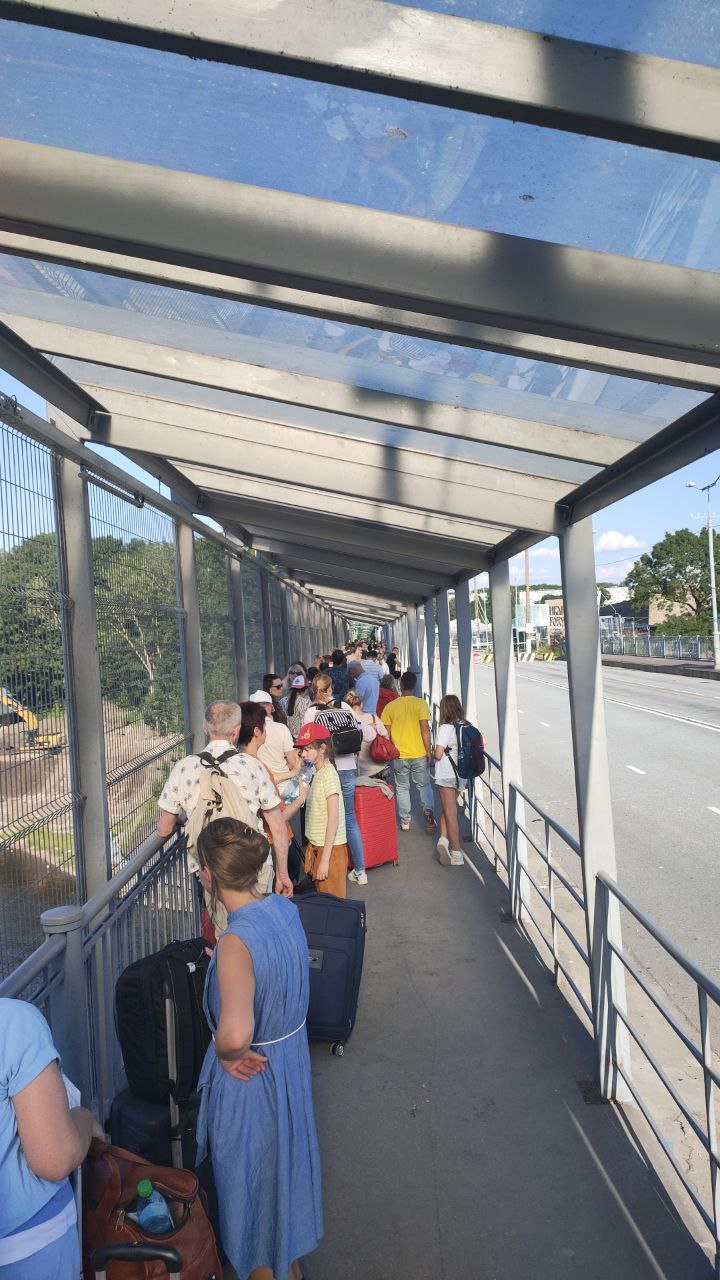
Narva–Ivangorod: hours of queueing, a short interview
Make no mistake: Narva is not a quick crossing. In the accounts, getting all the way through takes three to five hours on a normal day, and in the holidays or when the border is jammed I’ve read of waits of 10, 23 and even 24 hours, split between the queue and the checks. Most of that time is spent on the Estonian side. What’s different from the southern crossings is what happens once you reach the Russian booth.
There, nearly all the readers who describe it had a quick, even friendly check with no interview: Leo, from Lithuania, remembers two bored-looking officers who asked the usual questions and waved him through. On Telegram, though, the interview shows up in most 2026 reports that describe the Russian check, if only briefly: 5 to 20 minutes, sometimes just to note down your phone’s IMEI. A German woman who crosses almost every month says she has never been interviewed at Ivangorod, but has been at the southern crossings.
The exception was Javier, from Alicante, in September 2026: a sniffer dog on his luggage, a separate room, two and a half hours of questions about his money, his girlfriend, his family and whether he had served in Ukraine, a look through the photos on his phone, and then a second officer who asked almost the same questions for another hour. He thinks being Spanish, unusual at that crossing, played a part. He got in and, on the way out, it took five minutes with no questions.
In short: at Narva, expect hours of queueing and the possibility of a short interview; what’s less common than at Koidula or Luhamaa is spending hours waiting for the FSB.
Koidula and Luhamaa: count on it
The two southern Estonian crossings (Koidula–Kunichina Gora, towards Pskov, and Luhamaa–Shumilkino) are where the pattern is clearest. Every Western reader who entered through them was interviewed: a Spaniard, a Swede, two French readers, an Italian. On Telegram, a Baltic Shuttle passenger wrote this October that at Kunichina Gora every foreigner on the bus was called in for an interview, and in August, at Luhamaa, a bus with about twelve EU passports spent twelve hours on the Russian side until all the interviews were done.
The interview itself can be five minutes; it’s waiting your turn that takes forever. A Spanish reader who crossed at Koidula in August 2026 spent eleven hours at the border: the Russian side let Russians through and held everyone else back. He was asked whether he had Ukrainian friends, his WhatsApp, Telegram, calls and photos were gone through thoroughly, and when they found chats with Ukrainian students and a call to the Russian consulate, the interview stretched out with questions about his job and his Russian wife. He got in. Ernst, a 19-year-old Swede, waited ten hours at the same crossing because of the FSB interviews. A Frenchman at Luhamaa had to fill in a sheet about Ukraine and explain why he’d had five tourist visas in a row; they phoned his friend in Moscow at five in the morning to check where he’d be staying.
Interestingly, on Telegram there are Estonian, Lithuanian and Latvian women with e-visas or residence permits who went through Koidula without an interview in under an hour. The filter seems to look harder at people from further afield than at the neighbours.
If you’re on a bus, bear in mind that it won’t always wait for you: there are reports of buses leaving five passengers behind, and of readers who missed theirs and had to catch the next one.
Kaliningrad
At the Kaliningrad crossings from Poland and Lithuania, most readers don’t mention an interview on the Russian side; the hours go on the queue and customs. But there are cases: Joseph, a British reader on the bus from Gdansk, was interviewed at length in Russian about his life, his family, his travels and the history of the conflict in Ukraine, and they looked through his photos. He missed the bus. At Chernyshevskoye, a German was told he was being interviewed “because it’s your first time through this crossing” (an hour in total), and an EU couple spent four hours there with both phones checked. And in July 2025, on a bus from Gdansk, some Americans were held at Mamonovo while the Italians and Spaniards on the same bus went straight through.
Latvia
At the Latvian crossings (Terehova–Burachki and Grebneva–Ubylinka) the wait on the Russian side is long and the checks thorough. A Frenchman who entered twice in a camper van describes a search with a dog, a phone check, a questionnaire, a cash declaration and an X-ray of the vehicle: four to six hours each time. Miki, an Ecuadorian married to a Russian, was asked a lot of questions, had his phone taken away for an hour and then had the interview. In the Telegram group Россия–Эстония Граница a passenger wrote in June 2026 that, on a bus entering at Burachki, eight or nine people went through the interview, some of them three times, and they spent ten hours on the Russian side. If you’re planning to take the Riga–Moscow bus, keep it in mind.
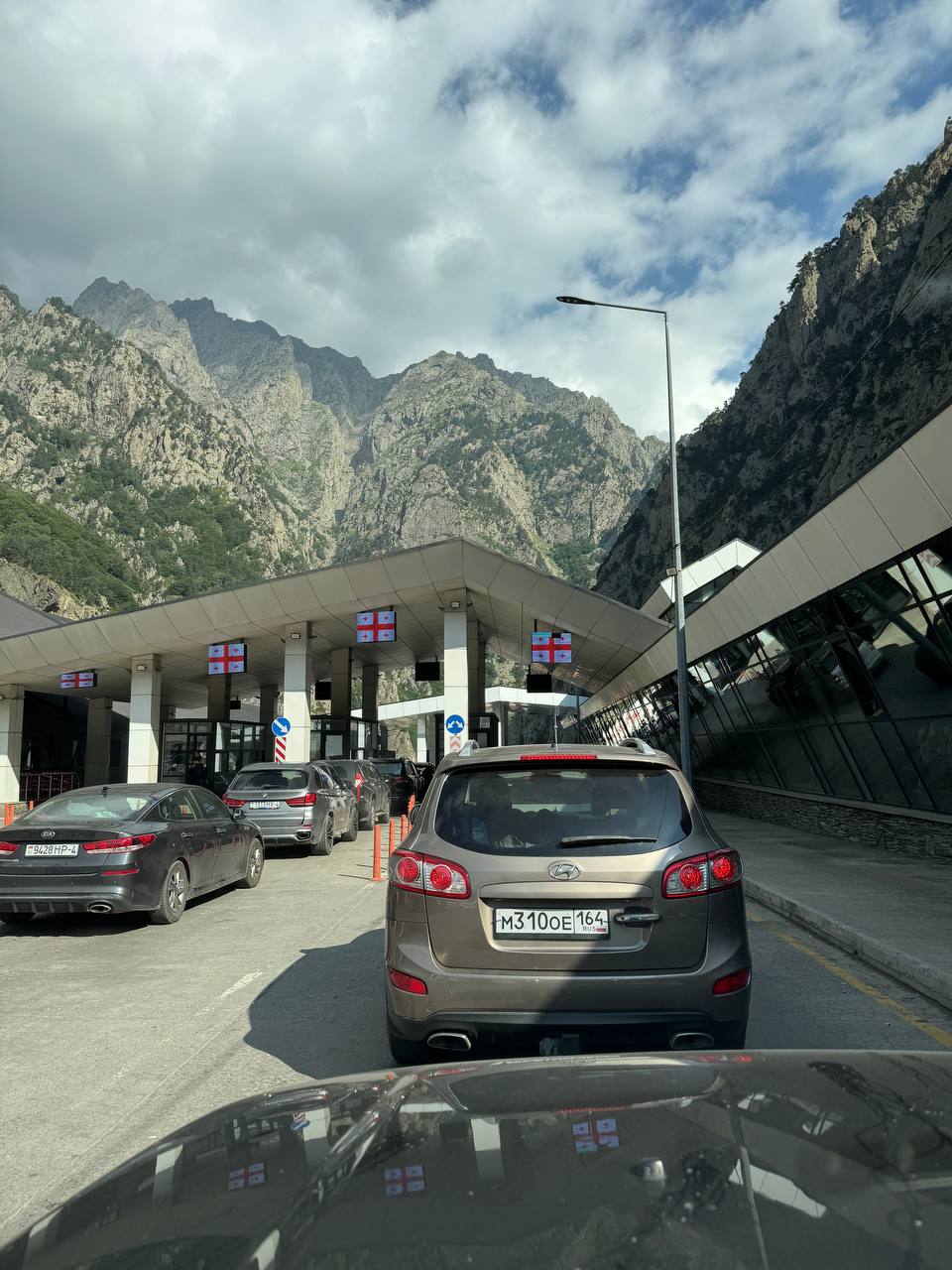
Upper Lars, from Georgia
At Upper Lars the key factor seems to be travelling as the only foreigner in a marshrutka full of Russians. A Spanish reader crossed that way in the early hours in July 2026: he was sent to a room, questioned for about 15 minutes through a translation tablet and had his phone taken for another 20. An hour in total; the rest of the minibus had already left. Some Italians in a van describe a long, meticulous crossing with questions, forms and a vehicle search. On Telegram, the people reporting the most interviews here are Russians born in Crimea or Ukraine, with up to an hour spent going through their Telegram and contacts.
Norway and Belarus
At Storskog–Borisoglebsk, both readers who wrote to me went through without questions: an Italian on the Kirkenes–Murmansk shuttle, “no luggage check, no questions, no phone inspection”, and John, a Norwegian who ended up chatting with the guards about his 1991 Cadillac. On Telegram there is the odd dual national interviewed there in 2025.
Between Belarus and Russia there’s in principle no border control for citizens of the two countries, but a foreigner on an e-visa can’t enter that way: the FSB took Nicolas and his partner, both French, off the Minsk–Moscow train at Smolensk and sent them back to Minsk. They were polite about it, but they didn’t let them continue. It’s one of the three refusals I have, and it had nothing to do with the interview: it was a visa issue.
Your passport and profile: as important as the crossing, or more
Beyond the crossing, some profiles come up again and again among the people interviewed:
- British, American and Canadian travellers. This is the clearest pattern by nationality. Bonnie, a 19-year-old from Britain, spent more than four hours at Vnukovo; another British reader, on his fourth trip, simply expected to be held for three hours; an American wrote on Telegram that he and two friends were pulled aside on three of their four entries, always with a phone check. They put it down to coming from an “unfriendly” country. Even so, there are Americans who got through Pulkovo in ten minutes.
- Any link to Ukraine. Being born there, Ukrainian stamps, contacts with a +380 prefix or chats with Ukrainians. A Spanish reader born in Ukraine had a quick extra check at Vnukovo in January 2026; in June, at the same airport, the room was much fuller and he was refused entry with no reason given. He flew back to Spain on the next flight.
- A Russian partner or family. Paradoxically, people with ties to Russia tend to get interviewed. A Swedish reader married to a Russian says that since mid-2026 he has been interviewed on every entry and exit, for one to three hours, always professionally.
- Lots of trips in a row or a private invitation. An Italian was asked nothing on his first two entries; on the third they asked why he went to St Petersburg so often and what he thought of the conflict. With back-to-back tourist visas or a private invitation, expect them to check up on the Russian who invited you.
- Being the only foreigner on the bus, the marshrutka or the flight. It makes you stand out.
- Speaking Russian. It won’t get you off the hook: when Shea, a Canadian, said he spoke “a little”, the whole interview was conducted in Russian. His advice: if your level is low, say so and ask for English.
What doesn’t seem to matter: the type of visa. There are people interviewed and not interviewed on both e-visas and regular visas. Nor do the accounts suggest they single out foreign men of military age.
What they ask
The questions repeat a lot from one account to the next. Roughly in order of frequency:
- Purpose of the trip, where you’re going, where you’re staying and for how many days.
- Your job, your studies and sometimes what your parents or partner do.
- How much money you’re carrying and where it comes from. Since foreign Visa and Mastercard cards haven’t worked in Russia since March 2022, almost everyone travels with cash, so it’s a normal question.
- Whether you’ve been to Russia before and, if you go often, why.
- Whether you have family or friends in Russia and in Ukraine, or have been to Ukraine.
- Whether you’ve done military service or have any connection with an army.
- What you think of the “special military operation” or the conflict. It comes up in quite a few accounts, though not in most.
None of the readers who wrote to me remember questions about Crimea or sanctions. And the tone, with a few exceptions, is correct: several readers use words like “polite” or “professional”, even if the atmosphere is intimidating.
Do they check your phone during the interview?
If you get an interview, quite likely: among the readers who were interviewed, two out of three had their phone checked. Outside the interview, hardly ever. What they look at, according to the accounts:
- The photo gallery, most often, sometimes with the location data.
- WhatsApp and Telegram: chats and the channels you follow.
- Your contacts, especially Ukrainian numbers or Slavic-sounding names.
- Your call log and installed apps.
- The IMEI and serial number, which they note down even when they look at nothing else.
Sometimes they go through it in front of you in a couple of minutes; other times they take it away for 20 minutes to an hour, and in some cases the laptop too. What the law says, what happens if you refuse to unlock it and how to prepare it before you leave are covered in can Russian border guards search your phone.
How long it takes and what happens next
The conversation itself usually lasts 5 to 30 minutes. What drags everything out is the waiting before and after: at airports, one to four hours in the cases you’ve told me about; at the Estonian and Latvian crossings, two to twelve hours on the Russian side, because there’s one officer for a lot of interviewees. If you have a domestic flight or a train afterwards, leave at least four or five hours’ margin. A French reader nearly missed his flight to Krasnoyarsk after being held two hours in Moscow.
The ending, in the vast majority of cases, is the same: you get your passport back and you’re in. Of the more than 90 readers, three were refused entry: the French couple on the Smolensk train (because of the visa), the Ukrainian-born reader at Vnukovo, and a British reader’s relative who was accused of working for MI5 and sent back on the next flight. Russian law allows entry to be refused on state security grounds without giving a reason, and also if you give false information about yourself or the purpose of your trip.
And it doesn’t always happen on the way in: some readers had their interview on the way out. Nicolas and Lara, a French couple, spent 45 minutes in a room with military officers at Irkutsk airport, with their phones checked and questions about Ukraine, after entering through Pulkovo without any.
How to prepare so it goes quickly
These are the tips that come up most among people who have been through it:
- Don’t lie, not even about details. Questions get repeated, sometimes by a second officer, precisely to look for inconsistencies. Giving false information is a legal ground for refusing you entry.
- Keep your answers short and calm. Tourism, these dates, this hotel. There’s no need to give political opinions; if asked, a brief, neutral answer.
- Leave your phone looking like a normal phone, neither empty nor full of things you’d have to explain. Several readers deleted Ukrainian contacts, photos of weapons or military gear, Twitter or their VPN beforehand and recommend doing so; do it at home, never in the queue.
- Write down your IMEI (dial *#06# on your phone) in case the questionnaire asks for it, and bring a pen.
- Bring water, food, a power bank and a plan B if you’re travelling by bus: it won’t always wait.
- Tell someone where and when you’re crossing, so they don’t worry if you’re out of contact for hours.
To see how each crossing is doing this week, the Telegram groups where people report queues and interviews in real time are in queues and waiting times at Russia’s borders.
Have you entered Russia recently and been interviewed, or got through without a single question? Every new account helps sharpen these patterns: tell me about your experience here.
Frequently asked questions
Does the FSB interview every foreigner entering Russia?
No. Most European tourists flying into St Petersburg are through passport control in minutes. The interview is almost certain at the southern Estonian crossings (Koidula and Luhamaa), frequent on the Latvian border and at regional airports, and more likely if you are British, American or Canadian or have any link to Ukraine.
What do they ask at the Russian border interview?
Mainly the purpose of your trip, where you are staying, your job or studies, how much money you are carrying, whether you have been to Russia before, whether you have family or friends in Russia or Ukraine and whether you have done military service. Sometimes they ask what you think of the conflict in Ukraine.
How long does the Russian border interview take?
The conversation itself usually lasts 5 to 30 minutes, but with the waiting beforehand you can spend one to four hours at an airport and two to twelve hours at the land crossings from Estonia and Latvia.
Will they check my phone if I get interviewed?
Quite likely: two out of three interviewed readers had their phone checked, mainly the photo gallery, WhatsApp, Telegram and contacts. Outside the interview, phone checks are rare.
Does it matter whether I have an e-visa or a regular visa?
The accounts show no difference: there are travellers interviewed and not interviewed on both types of visa. The crossing, your nationality and your profile matter far more.
Can I be refused entry after the interview?
Yes. Russian law allows entry to be refused on security grounds without explanation, and also if you give false information. But it is rare: of more than 90 readers, only three were refused entry, and one of those was for using an e-visa on a route from Belarus where it is not valid.
Is there also an interview when leaving Russia?
Sometimes. Some readers who entered without any trouble were questioned and had their phones checked on the way out, for example at Irkutsk airport or the port of Vladivostok.
In This Article
Was this useful? I'll tell you when something changes in Russia
One short email a month with what has changed for travellers (visas, payments, border crossings, apps), based on what readers report to me from Russia. More than 4,000 of us already. No spam: if you ever lose interest, unsubscribing is one click.
Irena DomingoAbout Me
I was born in Russia. I grew up between two worlds: my father was Russian, my mother Spanish — a descendant of the "Children of Russia", the Basque children evacuated to the USSR during the Spanish Civil War. I've worked as a translator, interpreter and Russian teacher for over 30 years, and since 2013 I've been writing this blog to help travellers discover Russia with practical, always up-to-date information. Author of the Russiable Guide. If this blog has helped you plan your trip, you can buy me a coffee ❤️.
 How to Enter Russia Visa-Free (Visa-Exempt Countries): The ruID App and the Electronic Travel Authorization
 Russia Migration Card in 2026: How It Works and What to Do With It
 Russia Customs in 2026: What You Can Bring (and What You Can’t)