
Gorky Park in Moscow: What to See and Do in the Russian “Central Park”
 By Irena Domingo
Updated on
In This Article
Gorky Park is Moscow’s most loved and most visited urban park, the “Russian Central Park”. It stretches along the bank of the Moskva River, just a short walk from the centre, and brings together in a single visit open-air Soviet art, historic 18th-century gardens, a hill with the best views of the city and a riverside that was completely renovated in 2025. In this article I take you from north to south through its four zones, with a map, practical tips and all its curiosities.

The essentials, in 30 seconds
- Admission: free and open 24 hours. You only pay for specific attractions (the Garage Museum, some exhibitions).
- Where: Krymsky Val 9, about 2 km south of Red Square.
- Metro: Park Kultury or Oktyabrskaya for the main entrance; Vorobyovy Gory for the hill at the far end.
- Time: a half-afternoon for the central part; a whole day if you want to walk all the way to Sparrow Hills (about an 8 km walk).
- Four zones from north to south: Muzeon, Parter, Neskuchny Garden and Sparrow Hills.
- Official website: parkgorkogo.ru (in Russian only).
0. Gorky Park, the favourite of Muscovites
Gorky Park is one of my favourite spots in Moscow and it has changed a lot in recent years.
The truth is that Moscow is a capital with beautiful green parks, such as Zaryadye, VDNKh, Kolomenskoye, Tsaritsyno or Izmailovo.
But if there is one park beloved by Muscovites, it is Gorky Park (or Gorki), which combines nature with a central location and has become the most visited park in the city: more than 40,000 people set foot in it on weekdays and up to 150,000 at weekends and on public holidays.
It is an urban park running along the Moskva River, in a fairly central part of the city, about 2 kilometres south of Red Square.
Its official name is the Gorky Central Park of Culture and Leisure, though everyone knows it simply as Gorky Park.
The park is named after the Soviet writer Maxim Gorky, the founder of socialist realism and a five-time nominee for the Nobel Prize in Literature. He died in 1936 and, if you visit the Lenin Mausoleum, you can see his grave in the necropolis along the Kremlin wall. There is a monument dedicated to him in the park:

The park opened its doors on 12 August 1928 and took the name Gorky in 1932. The layout of its central part, from the entrance to the Neskuchny Garden, was the work of the avant-garde architect Konstantin Melnikov, on the site where a large agricultural and industrial exhibition had been held in 1923. Its 212 hectares hold gardens, ponds, recreation areas, sports facilities, museums, restaurants and much more.
In the late 1980s and the 1990s the park filled up with fairground rides, stalls and food stands, it fell into disrepair and admission became chargeable. Everything changed in the spring of 2011, when a radical overhaul was carried out: around a hundred rides and illegal structures were dismantled, the gardens were restored and entry became free again. Since then it has been a modern, well-kept park full of cultural life.
The 4 parts of Gorky Park
Today Gorky Park is divided into 4 distinct parts from north to south, each with its own personality. Interestingly, their unification is recent: Sparrow Hills was incorporated into the park in 2013 and the Muzeon in 2015.
- Muzeon. In the northern zone, it is Russia’s first open-air sculpture museum, with around a thousand pieces (more than 500 on display), many of them Soviet statues removed from squares all over the country after the collapse of communism.
- Parter. This is the central and liveliest part of the park, the one that was born in 1928 out of that post-revolution exhibition.
- Neskuchny Garden. In the middle section, it is the most historic area, with little palaces, fountains and bridges well worth discovering at a leisurely pace.
- Sparrow Hills (Vorobyovy Gory). A beautiful nature reserve on a hill beside the Moskva, with one of the best views of the city.
Walking the whole park along the river can take you several hours. You can also rent a bike at the stands inside the park or through the city’s public bike-sharing service to get around faster.
On this interactive map I have marked the park’s main points of interest, ordered from north to south and colour-coded by zone. It will help you get your bearings and plan your route:
Map of the main points of interest in Gorky Park. You can zoom in and click on each point.
How to get to Gorky Park
Depending on which area you want to visit, one metro stop or another will suit you better. The two Metro stations closest to the main entrance are Park Kultury and Oktyabrskaya, although the park has several entrances. To go up to Sparrow Hills, the handiest stop is the Vorobyovy Gory metro station.
You can do the visit in the afternoon, after seeing other attractions in the centre such as the nearby Tretyakov Gallery or the Cathedral of Christ the Saviour. In fact, I include this park in my Russia travel itineraries.
Admission to Gorky Park is free and inside you can relax in its green areas or take a boat trip along the Moskva River.
Restaurants and cafés in Gorky Park
Along the park there are a good twenty restaurants and cafés, plus plenty of mobile food stalls. Some of the best known are:
- Vremena Goda (Russian and European cuisine by the water)
- Syrovarnya, from Arkady Novikov’s group
- PRO Harcho (Black Sea cuisine)
- Ostrovok, next to the Golitsynsky pond
- Cochonnet, a café with a pétanque court
- The Garage Café, in the contemporary art museum

On top of all this, there is now the whole new gastronomic promenade along the Pushkin embankment, which I tell you about further down.
A few curiosities about Gorky Park
In the world of cinema, Gorky Park has also made it onto the big screen. Notable examples are the American thriller Gorky Park (1983), based on Martin Cruz Smith’s novel, and the spy film Red Sparrow (2018). It also appears or is mentioned in series such as The Americans (2013-2018) or House of Cards (2013-2018).
In the world of music, the park is mentioned in the famous song Wind of Change by the Scorpions, in the light of the social and political changes that Eastern Europe was going through in the early 1990s. There was even a Russian rock band named after the park.
I’m sure you’re already getting the urge to visit, so below I take you on a north-to-south tour of the highlights of this huge park.
1. Muzeon Art Park
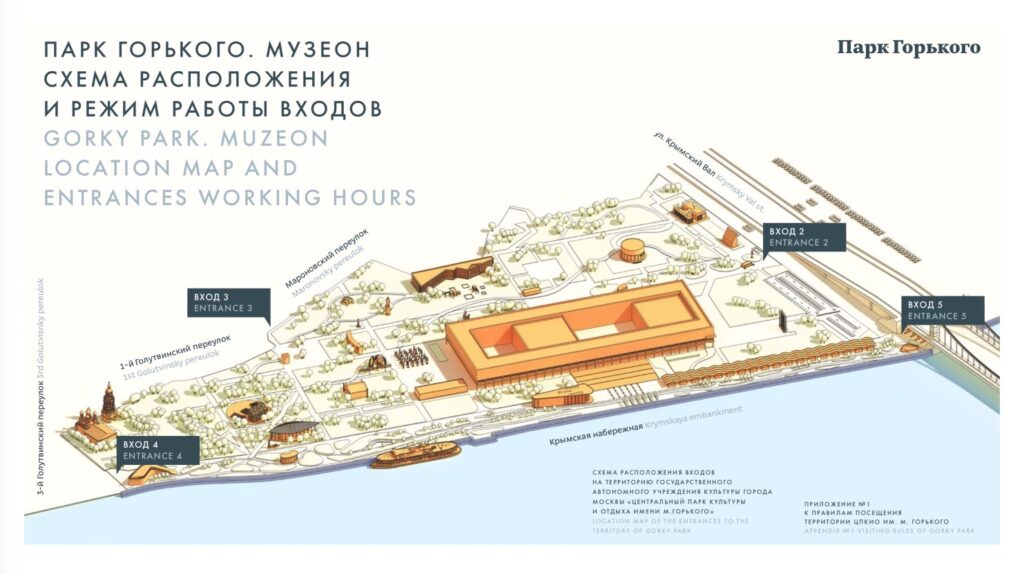
I recommend starting the tour in the northern zone of the park, which runs roughly from the monument to Peter I the Great to the Krymsky Bridge.
The route begins along the pedestrian zone of the Krymskaya embankment, by the monument to Peter I the Great. This 98-metre-high monument, made of bronze, steel and copper, was erected in 1997 to mark the 300th anniversary of the Russian Navy and the 850 years of Moscow.
It is the work of the Georgian sculptor Zurab Tsereteli. Some reports published in the Russian media suggested that it was a recycled statue of Columbus, which Tsereteli had reportedly tried, without success, to sell to the United States, Spain and several Latin American countries in 1991-1992 to celebrate the 500th anniversary of the discovery of America. Tsereteli denied those rumours. In 2017 a sculpture of Christopher Columbus that Tsereteli himself had made in 1991 was unveiled in Puerto Rico.

Once you leave this controversial monument behind, you can head to the Muzeon Art Park, Russia’s first open-air sculpture museum. Here numerous statues from the Soviet era, removed from parks and squares all over the country after the collapse of communism, are “laid to rest”.
The Muzeon has been accumulating monuments since 1992 and its collection brings together close to a thousand pieces, of which more than 500 are displayed outdoors, including notable works by Vera Mukhina, Ivan Shadr, Yevgeny Vuchetich and other sculptors. Today it also hosts a summer cinema, temporary exhibitions and festivals.
Among all the sculptures, standouts include a huge steel figure of the Soviet world, several giant Lenins without their pedestals, a statue of Stalin with no nose and various Red Army monuments.
- Website: parkgorkogo.ru/areas/muzeon
- Open-air space with free access
- The park is open from 8:00 to 22:00, while the Krymskaya embankment is open 24 hours


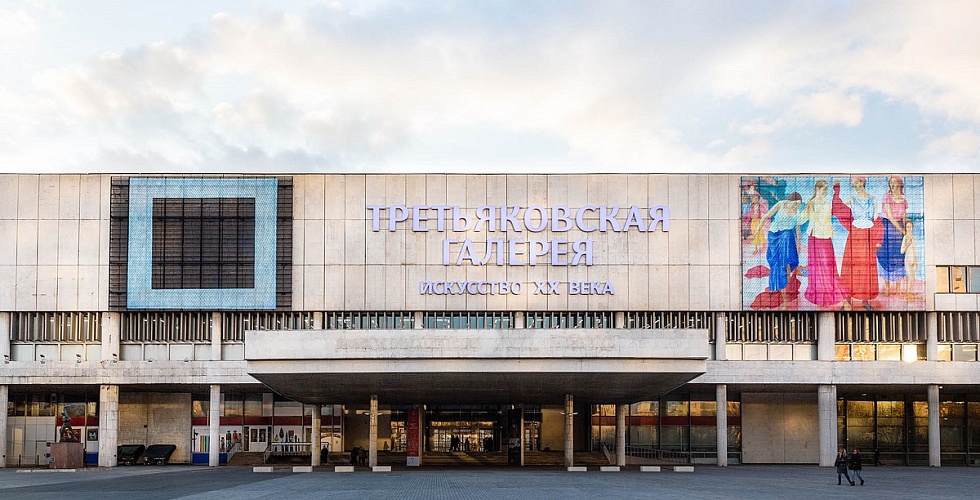
The park sits right next to the New Tretyakov Gallery, administratively merged with the State Tretyakov Gallery in 1985. In this museum you can see 20th- and 21st-century Russian art with pieces by Kandinsky, Chagall or Malevich. You have all the information in this article: The Tretyakov Gallery: Russian art like you’ve never seen before.
This first zone of the park ends at the Krymsky Bridge, or Crimea Bridge, a steel suspension bridge built in 1938 as part of the ambitious reconstruction plan that Stalin launched for the centre of Moscow.

2. Parter
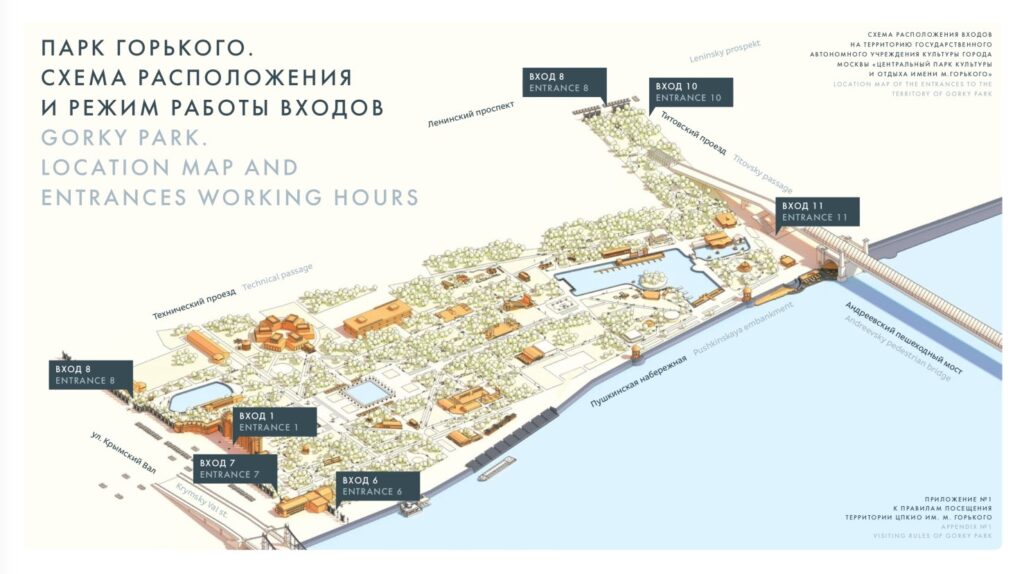
The Parter is the central part of Gorky Park, completely remodelled in 2011. Here you will find wide green spaces, bike and boat rentals on its ponds, picnic areas, open-air cinema and concerts, markets, good restaurants, the Garage contemporary art museum, jetties for taking a cruise along the Moskva and even urban beaches for sunbathing in summer.
The 2011 overhaul did away with the old amusement park, with roller coasters and other rides that were in very poor condition.
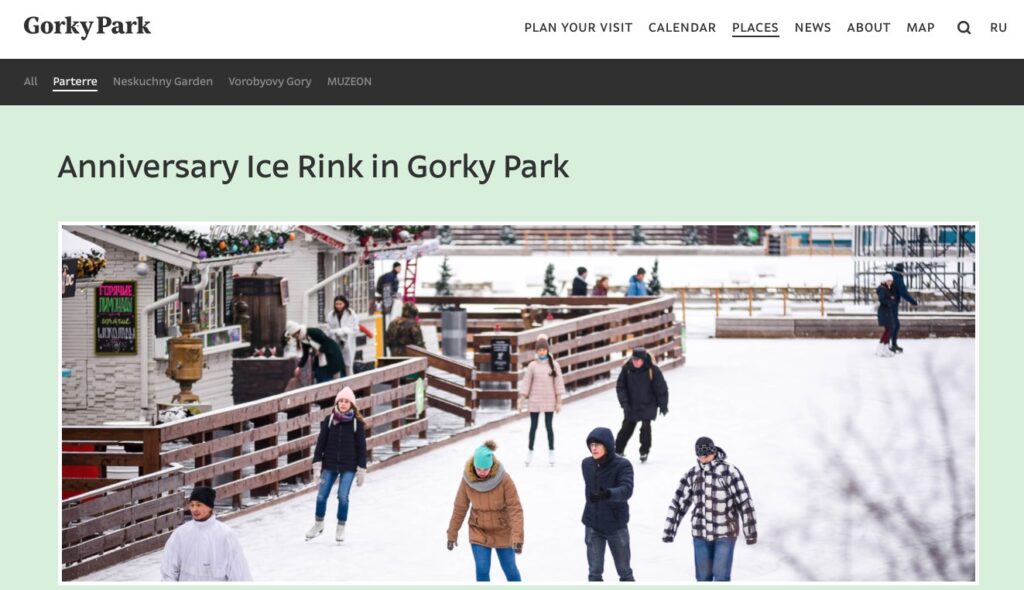
In winter, one of the largest ice-skating rinks in Europe is set up here. It’s not the typical rectangular rink, but a huge circuit with lanes and routes running among the trees, along which you can stop at cafés and rest areas with your skates still on.
Let me tell you about the most important things in this part of the park.
2.1. The main entrance and its viewpoint
The most recognisable monument in Gorky Park is its entrance arch, 24 metres high, built in 1955 to the design of architect Georgy Schuko. In 2015 it reopened after a restoration, with a rooftop viewpoint and the Museum of the History of Gorky Park in its left pylon.
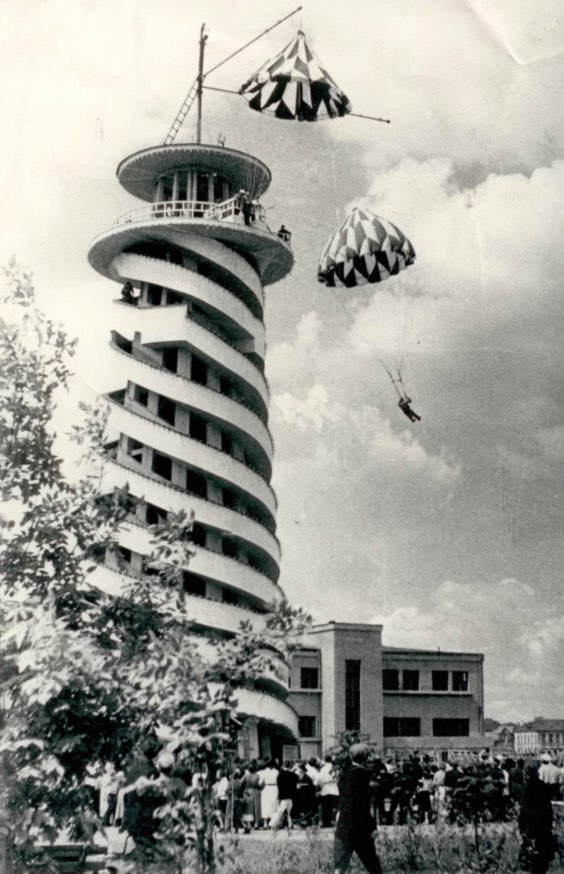
In the small Museum of the History of the Park you can see a replica of Gorky’s main attraction in the 1930s: the Parachute Tower, from which people jumped by parachute.

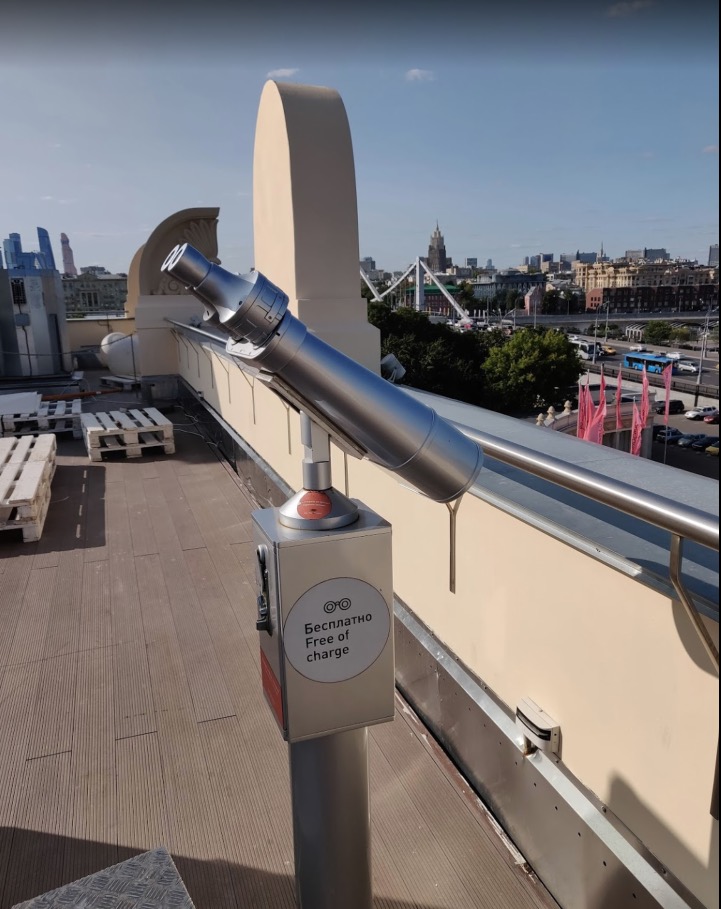
From the museum you can climb to the rooftop of the arch to enjoy great views of the park.
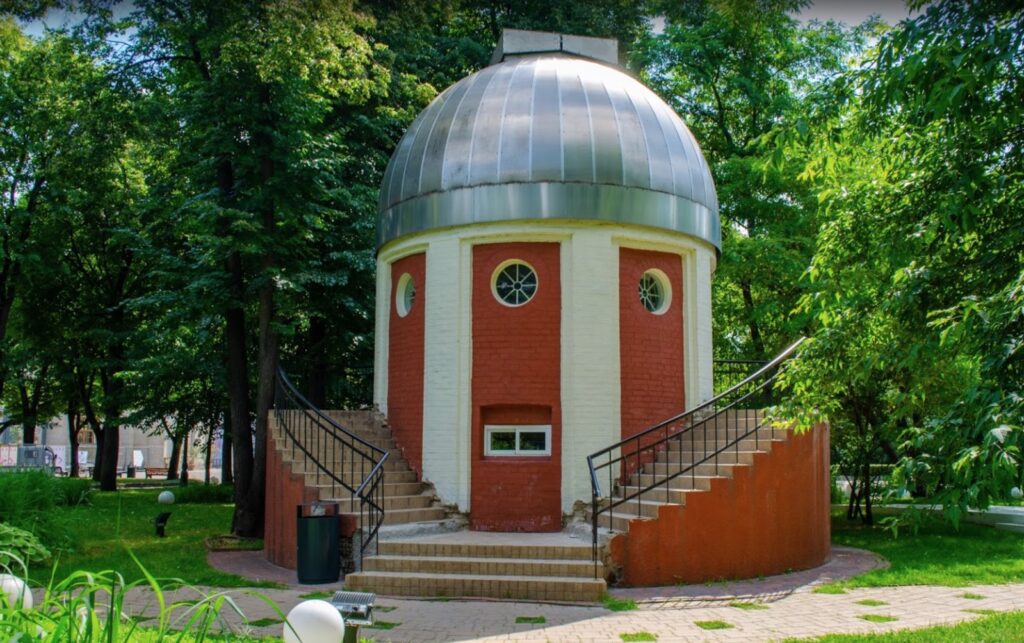
For astronomy lovers, just past the main gate and turning right you will find a small observatory. In Moscow it’s hard to see the stars because of the lighting and the grey days, so you have to pick a clear night.

Near the entrance is the sculpture of the ballerina, the work of the Soviet sculptor Elena Yanson-Manizer. The model was the legendary Bolshoi Theatre ballerina Galina Ulanova. The Parachute Tower used to stand on that very spot.


2.2. The Pushkin embankment, now an 8 km promenade
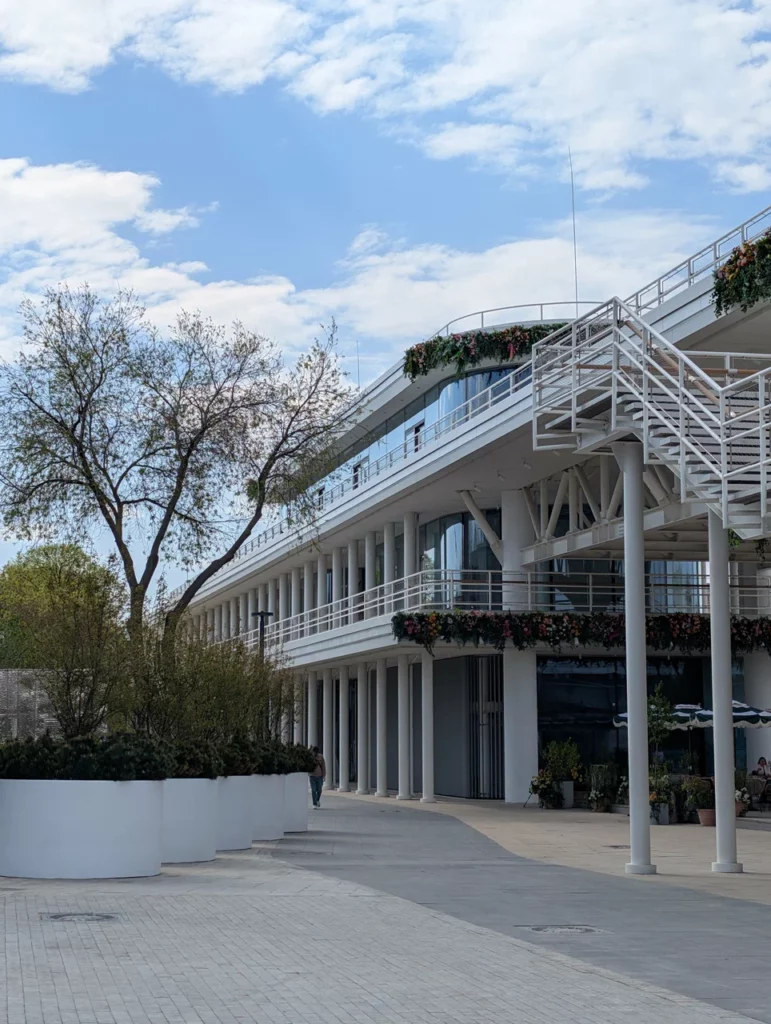
If there is one new feature that justifies going back to Gorky Park, it’s the Pushkin embankment (Pushkinskaya naberezhnaya). It was closed for works throughout 2024 and reopened at the end of December 2025 completely transformed: today it is a continuous 8-kilometre promenade beside the Moskva River, from the Muzeon to Sparrow Hills, paved in granite and with benches, lampposts and new pavilions.
The new pavilions, shaped like a moored ocean liner, are the work of the Wowhaus architecture studio, the same one that designed the neighbouring Krymskaya embankment. The decoration draws on sketches by the monumental painter Alexander Deineka, whose images fit the spirit of the Gorky Park of the 1930s.
The embankment has filled up with cafés and restaurants. The most talked-about opening was, in March 2026, the flagship restaurant of “Vkusno — i tochka” (the chain that replaced McDonald’s in Russia), with waiter-robots, alongside a two-storey Rostic’s, a Teremok, a billiards hall and several cafés. It’s fair to say that turning the historic embankment into a big food court has sparked debate among Muscovites: some love being able to eat cheaply by the water, while others feel it clashes with the character of the place. Judge for yourself when you go.
Gorky Park also has its own jetty on the Moskva (renovated as the “Gorky Park-1” mooring), from which you can take a boat to cruise along the river, both the classic Radisson flotilla cruises and the new electric river trams. There are departures from morning until night, and some boats offer dinner on board.

2.3. Garage Museum of Contemporary Art
In the central part of the park is the Garage Museum, the contemporary art museum founded in 2008 by Dasha Zhukova and Roman Abramovich (former owner of Chelsea). Since 2015 it has occupied its current building, the work of architect Rem Koolhaas (OMA studio), who rebuilt the old 1960s Soviet restaurant Vremena Goda.
The museum had a spell with its exhibition programme on hold, but the building, its excellent bookshop and its café are still running. Before going, I recommend checking its website to see what exhibition is on at any given time.
- Website: garagemca.org
- Check current prices and opening hours on its website


2.4. Golitsynsky garden and pond, public baths and beach
Past the Garage Museum you will find the Golitsynsky garden, with its pretty pond, where you can rent a little rowing boat in summer.

In summer, the park sets up urban beach areas where you can lie out in the sun by the water. Besides the classic sun-lounger area, a new beach opened in 2025 at the Pionersky pond.

This is also where the rose-garden fountain stands, the work of architect A. V. Vlasov.
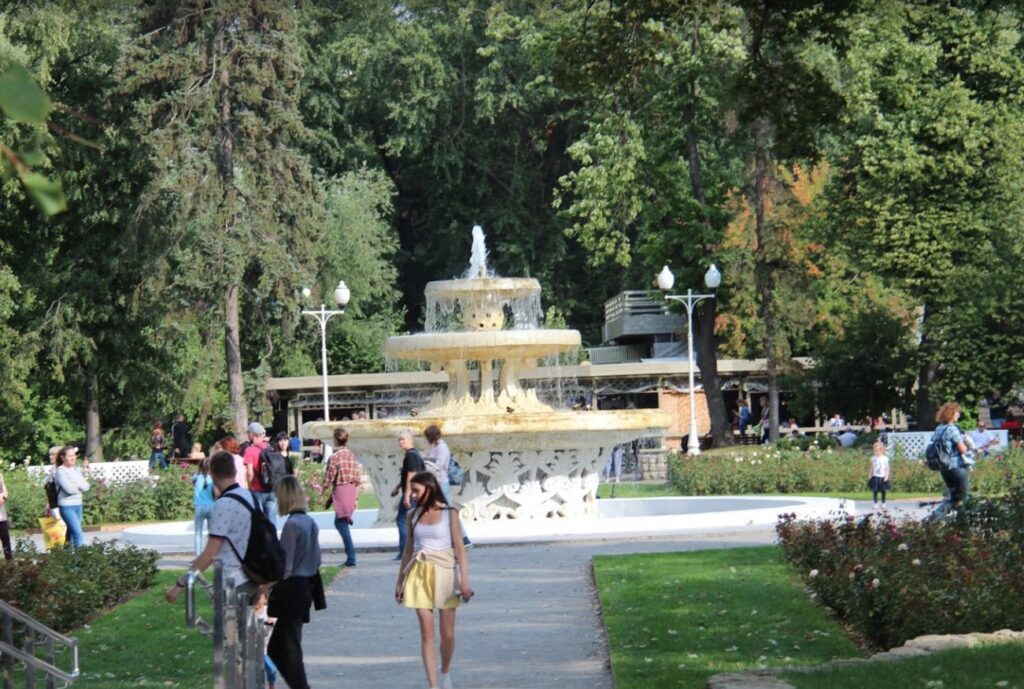
Near the pond you will see the public baths building, erected in 1933 by the same architect, A. V. Vlasov: a singular architectural monument from the era of socialist realism.

2.5. Pushkinsky Bridge, the park’s footbridge
The Parter ends at the Pushkinsky Bridge, a beautiful footbridge over the Moskva completed in the year 2000, which reused part of the old Andreevsky railway bridge from 1905-1907.
It’s worth going up to enjoy the views of Moscow. Right below there are restaurants and terraces for sunbathing in summer.


3. Neskuchny Garden
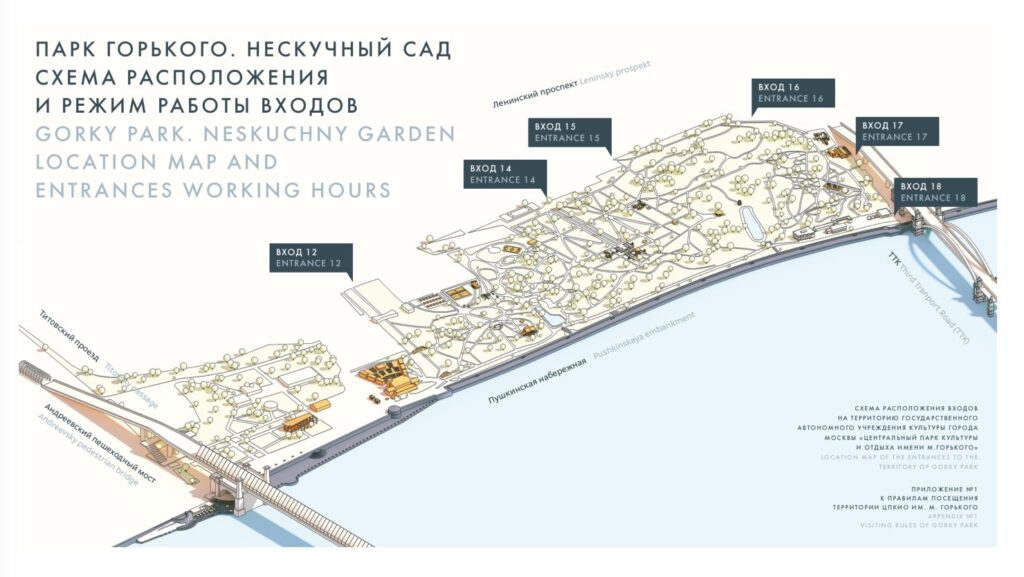
The Neskuchny Garden runs from the Pushkinsky Bridge to the Novoandreyevsky Bridge.
The Neskuchny (the “not boring” or “cheerful” garden) is the most historic part of Gorky Park.
It is a landscaped garden of about 59 hectares whose origins go back to 1728. It grew out of the merger of several estates that belonged to noble families —the Demidovs, Trubetskoys, Orlovs, Golitsyns and Romanovs—; the garden as it is today took shape in the first third of the 19th century, after Nicholas I bought up those properties.
This is where the prettiest and most peaceful landscaped areas are, far less crowded than the rest of the park. There is also a jetty here.
One of the things I like most about this garden is that you can feed the squirrels and the birds right from your hand. There are also several playgrounds and adventure areas, so it’s an ideal place to go with children.


The garden has both historic and modern structures: the hunting lodge, Count Orlov’s summer house with its grotto, the Bather fountain, the stone bridges and the Stas Namin Music and Drama Theatre (the Green Theatre), where open-air concerts are programmed in summer. Below, I go through the most interesting sights from north to south.
3.1. The Diver monument
At the start of this zone, beside the river and very close to the Pushkinsky Bridge, you will come across the Diver monument, a three-metre bronze sculpture by the artist Leonid Tishkov, unveiled in 2016. Its helmet lights up at night and turns into a lighthouse.
The idea is based on a project that the sculptor Vera Mukhina wanted to build in 1937 and which was never carried out.

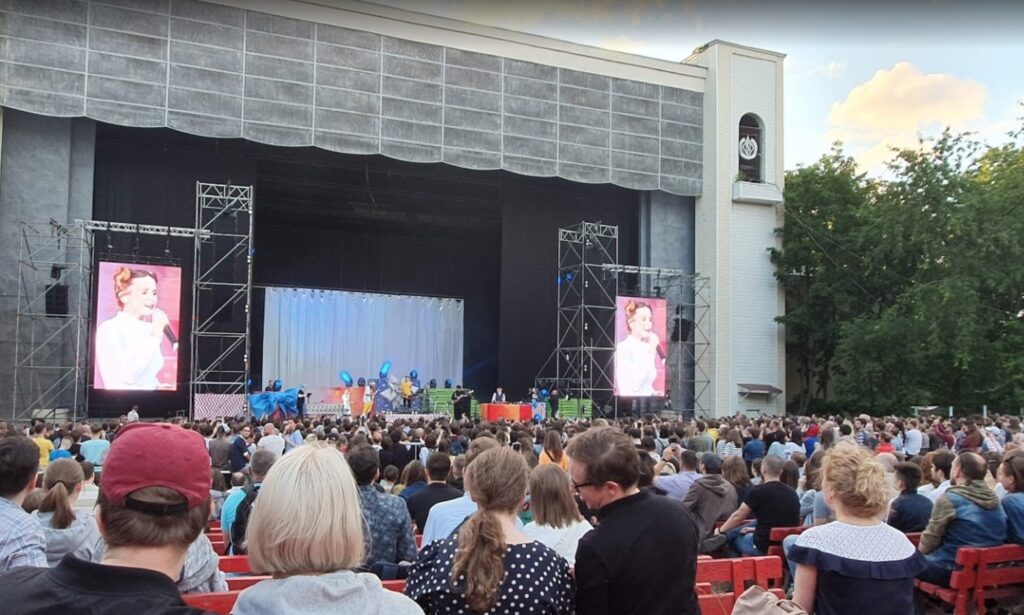
3.2. Stas Namin Music and Drama Theatre (Green Theatre)
Near the Diver monument is the Stas Namin Music and Drama Theatre, or Green Theatre, an open-air theatre that today programmes all kinds of musical performances in summer.
It opened in the mid-1930s, with a capacity for 20,000 people, for political rallies by the Soviet leaders and as an open-air cinema.
It was here, in 1936, that the Soviet film Circus, starring Lyubov Orlova, premiered.
- Website: stasnamintheatre.ru
3.3. Count Orlov’s summer house and its gardens
Between 1804 and 1806 a two-storey summer house, with four Corinthian columns, was built on the estate of Count Fyodor Alexeyevich Orlov.
Some say it was a place for secret meetings between Empress Catherine II and Grigory Orlov; others, that it served as a games venue for Anna Alexeyevna Orlova-Chesmenskaya. The house offers a very picturesque view of the Moskva, surrounded by beautiful gardens.

3.4. The Bather fountain and Yekaterininsky pond
Near Count Orlov’s summer house is the Bather fountain: a sculpture under which the water flows down a series of steps towards the Moskva, coming from the Yekaterininsky pond. The sculpture is the work of Romuald Iodko.


3.5. The stone bridges
This part of the park is known for its stone bridges, built at the end of the 18th century to make it easier to reach the estate on horseback. The grotesque stone bridge stands out.


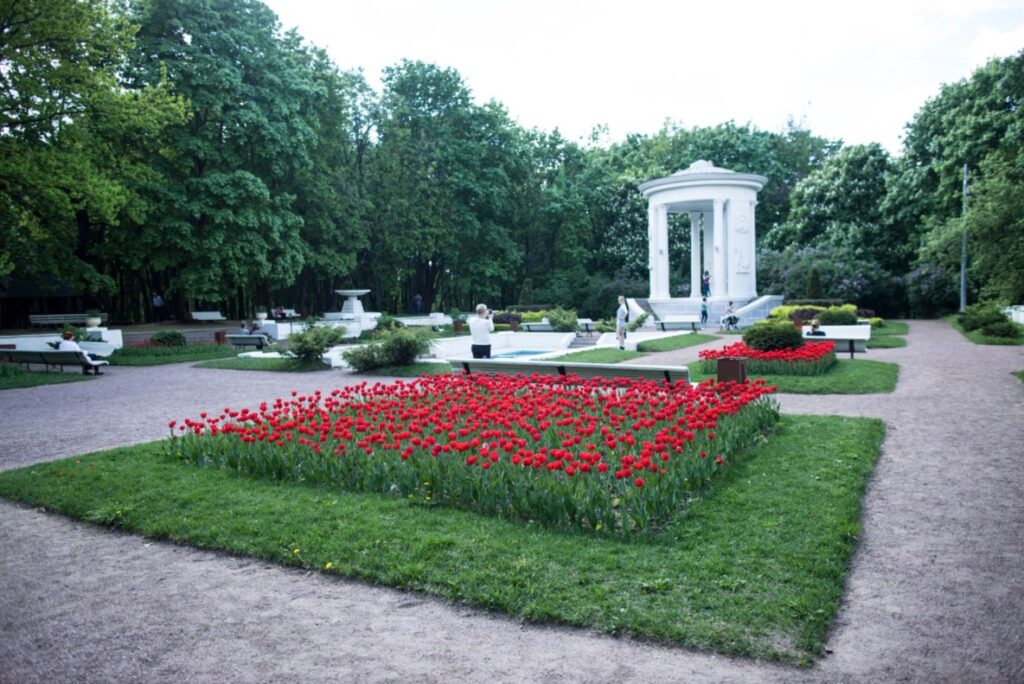
3.6. Moscow 800th anniversary rotunda
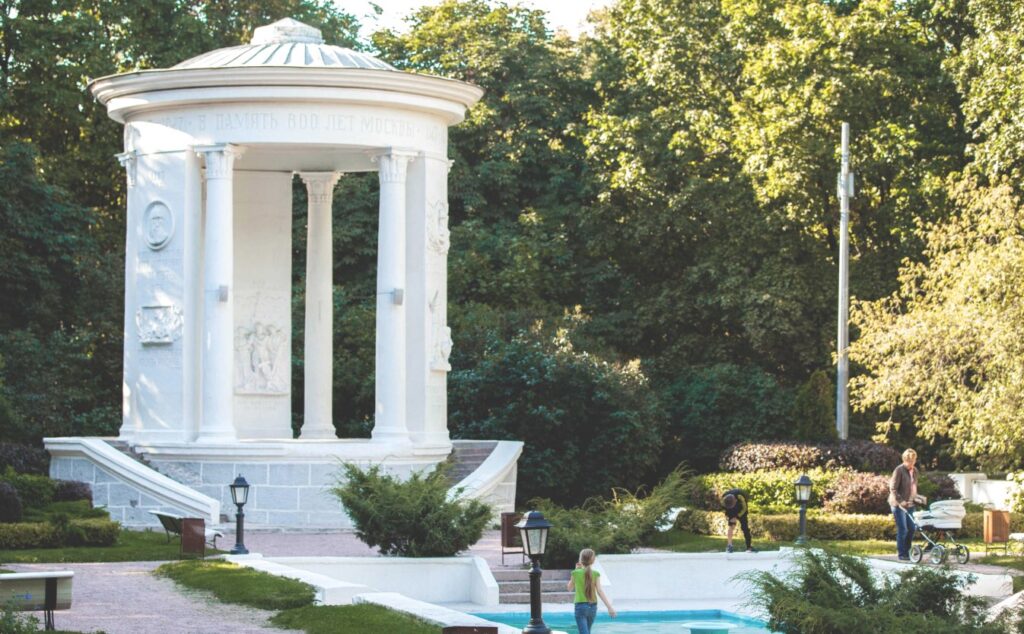
In the central part of the Neskuchny is the rotunda dedicated to the city’s 800th anniversary, built in 1951 (the decree was signed by Stalin himself in 1947).
In summer it’s a place where poems are recited and music groups perform.
3.7. Prince Trubetskoy’s hunting lodge
The hunting lodge of Prince Nikita Yuryevich Trubetskoy is the oldest building in the Neskuchny Garden and the only building preserved from the former Trubetskoy estate.
The little stone house originally stored hunting rifles and gunpowder. The servants lived there, and kennels were built nearby.
The lodge is famous for being the setting of a legendary television programme that began airing in the Soviet Union in the mid-1970s: “What? Where? When?”. It’s a quiz show in which a team of six experts tries to answer questions sent in by viewers: whoever sends a question wins a prize if the experts get it wrong, and the team scores points if they come up with the right answer.

4. Sparrow Hills (Vorobyovy Gory)
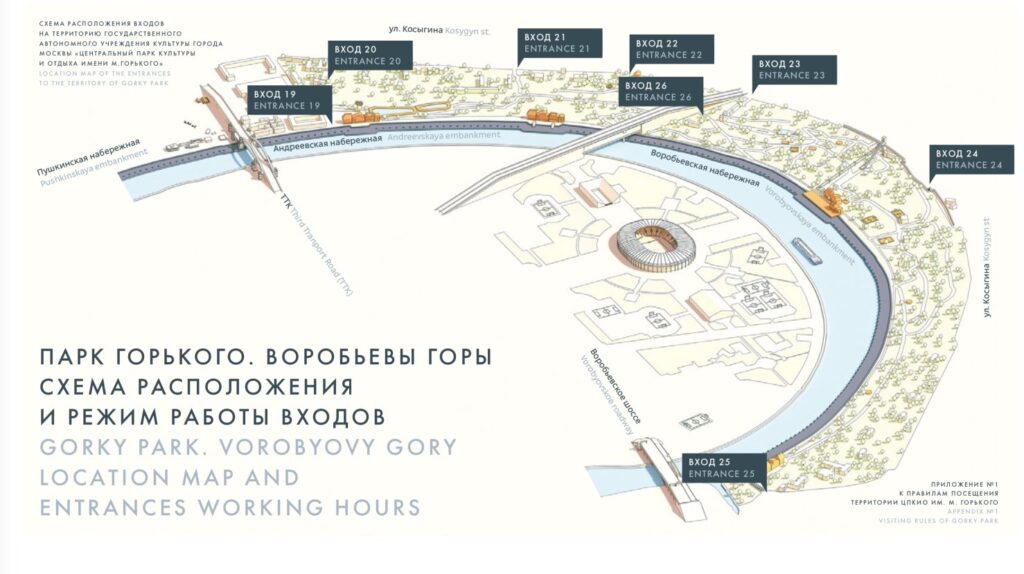
The last part of Gorky Park is Sparrow Hills (Vorobyovy Gory), a beautiful elevated hill on the bank of the Moskva that rises some 80 metres above the river.
To get to the top you have to cross a protected nature reserve, with more than 400 plant species and more than 150 species of animals and birds —in fact, 67 bird species have been counted in its woods—, with ecological trails and natural springs.
At the foot of the hill, beside the river, stands St Andrew’s Monastery (Andreevsky), founded in 1648, one of the oldest active monasteries in Moscow and a lovely stop if you stroll along the bank.

At the top of Sparrow Hills you get a spectacular panorama of the city (as long as you get a clear day). It’s a place much loved by Muscovites, where you’ll see lots of tourists and couples of newlyweds taking photos.

From here you can also admire some of Stalin’s Skyscrapers, known as the Seven Sisters —the Moscow State University (MSU) building, very close by, is especially striking—, or the skyscrapers of the Moscow City financial district.

Right below the hill, on the other side of the river, is the Luzhniki Olympic Stadium, where the 1980 Summer Olympic Games were opened and closed and where the 2018 Football World Cup final was played.

Since 2018 you can cross to the other bank of the Moskva on the Sparrow Hills cable car, although you can also go over the Luzhnetsky Bridge, a two-tier arch bridge: cars run on the upper level and the metro trains and pedestrians on the lower one.
- Cable car website: srkvg.ru
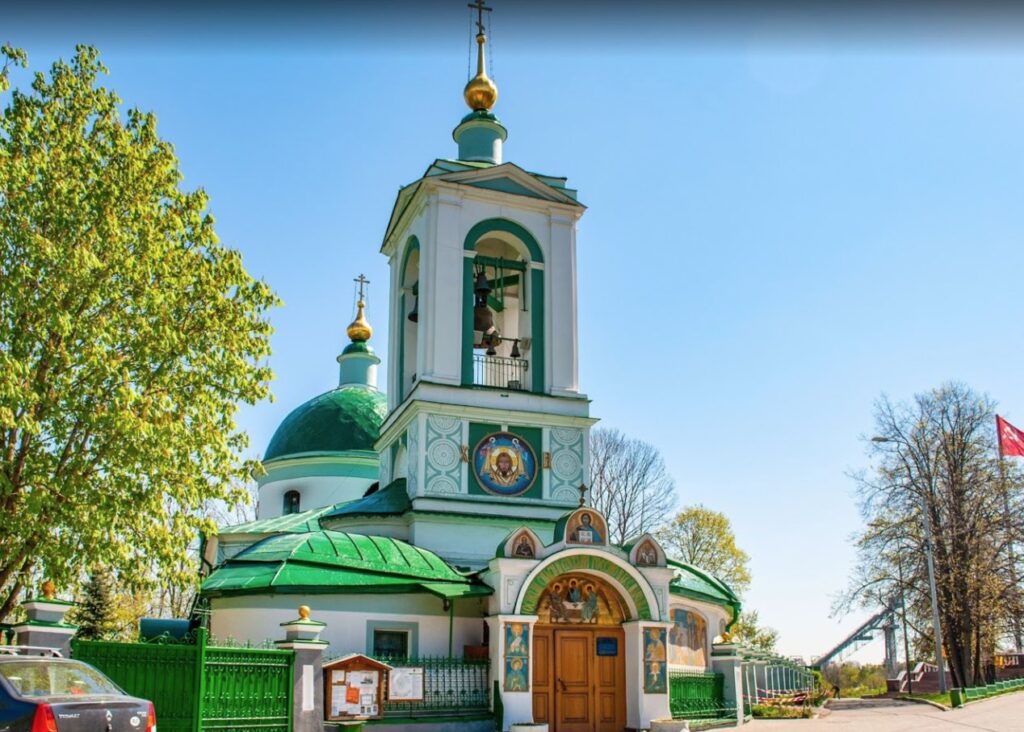
On Sparrow Hills stands the Church of the Trinity, a monument well worth visiting that is protected as Russian cultural heritage: the perfect place to end this tour.
And that’s it for this north-to-south tour to enjoy Gorky Park, which I hope has been useful. It’s a park I love and, while updating this article, I’ve rediscovered just how much it has changed and all the new things it has to see.

Frequently asked questions about Gorky Park
How much does it cost to enter Gorky Park?
Admission to the park is free and it is open 24 hours. You only pay for specific attractions, such as the Garage Museum or some exhibitions. The Muzeon, the gardens and the Pushkin embankment are also free to access.
How much time do I need to visit Gorky Park?
To see the central part (Parter and Muzeon) a half-afternoon is enough. Walking the whole thing from north to south, all the way to Sparrow Hills, is about 8 kilometres and can take you a full day. A good option is to combine it with a boat trip along the Moskva River.
How do you get to Gorky Park?
The main entrance is next to the Park Kultury and Oktyabrskaya metro stations, about 2 kilometres south of Red Square. To go up to the Sparrow Hills, the handiest stop is the Vorobyovy Gory metro station.
What is the new Pushkin embankment?
It is the riverside promenade that reopened at the end of 2025 after a major overhaul: 8 kilometres from the Muzeon to Sparrow Hills, with granite paving, new pavilions shaped like an ocean liner and lots of cafés and restaurants.
What can you do in Gorky Park in winter?
In winter one of the largest ice-skating rinks in Europe is set up, with routes running among the trees. There are also events, festivals, cafés and a beautiful atmosphere when it snows.
What are the must-sees in Gorky Park?
The entrance arch, the Muzeon with its Soviet sculptures, the Golitsynsky pond, the Neskuchny Garden with its squirrels and little palaces and, above all, the views of Moscow from Sparrow Hills.
In This Article
Was this useful? I'll tell you when something changes in Russia
One short email a month with what has changed for travellers (visas, payments, border crossings, apps), based on what readers report to me from Russia. More than 4,000 of us already. No spam: if you ever lose interest, unsubscribing is one click.
Irena DomingoAbout Me
I was born in Russia. I grew up between two worlds: my father was Russian, my mother Spanish — a descendant of the "Children of Russia", the Basque children evacuated to the USSR during the Spanish Civil War. I've worked as a translator, interpreter and Russian teacher for over 30 years, and since 2013 I've been writing this blog to help travellers discover Russia with practical, always up-to-date information. Author of the Russiable Guide. If this blog has helped you plan your trip, you can buy me a coffee ❤️.
 Russian Banya: What It Is and the Best in Moscow and St. Petersburg
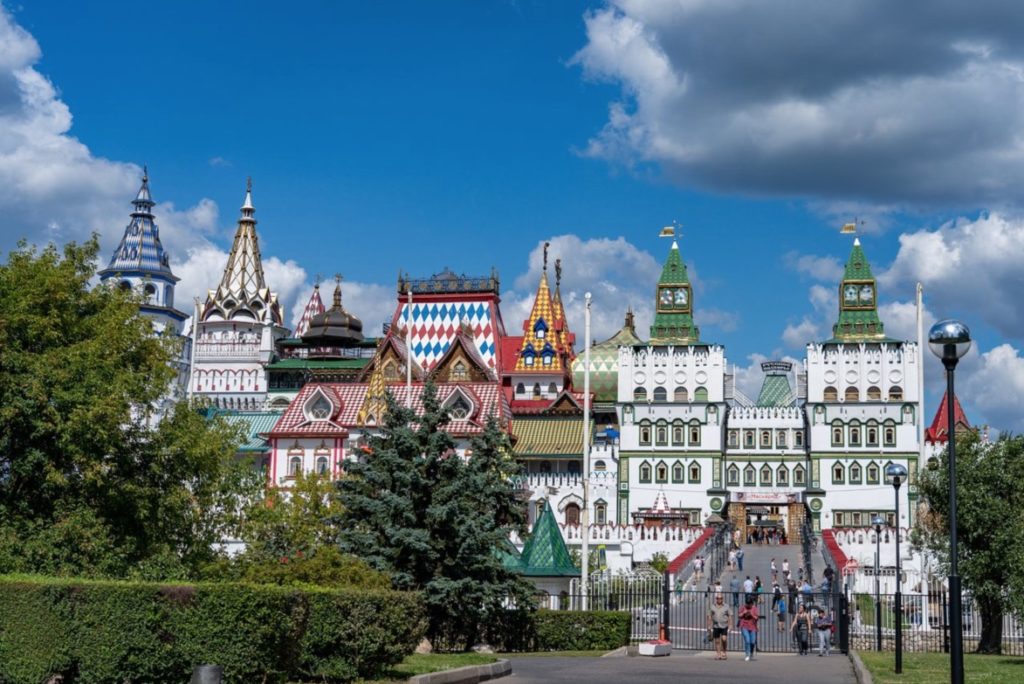 Izmaylovo Kremlin, Souvenir Market and Stalin’s Bunker in Moscow
 Moscow Public Transport: Troika Card, Tickets and How to Get Around