
Lenin Mausoleum in Moscow: How to See the Embalmed Leader on Red Square (for Free)
 By Irena Domingo
Updated on
In This Article
Lenin’s Mausoleum is one of the most singular things you can visit in Moscow: seeing the embalmed body of the Bolshevik leader right in the heart of Red Square, for free and without any ticket. It’s open Tuesday, Wednesday, Thursday, Saturday and Sunday, from 10:00 to 13:00. The queue forms next to Nikolskaya Tower, by GUM, and the visit inside lasts barely two or three minutes. But there are strict rules and, since 2025, the building has been undergoing restoration, so it’s worth reading this guide before you show up.

I’ve been inside several times and I always leave with the same feeling: you step into a time capsule. You go through an airport-style security check, walk down a flight of black marble stairs, do a short loop around an illuminated sarcophagus where Lenin lies in a dark suit, and you’re back outside. Cold, silent, strange and absolutely unforgettable. As a bonus, you walk past the Necropolis of the Kremlin Wall, where Stalin, Brezhnev, Gagarin and other big names of the USSR are buried.
What exactly is Lenin’s Mausoleum?
Lenin’s Mausoleum is the tomb where, since 1924, the embalmed body of Vladimir Ilyich Ulyanov, alias Lenin, leader of the October Revolution and the first head of the Soviet government, has been preserved. The current building, a stepped pyramid of red marble, black granite and labradorite, was designed by architect Aleksei Shchusev and inaugurated in autumn 1930. It stands about 12 metres tall and 24 metres wide, right opposite GUM and pressed against the Kremlin wall.
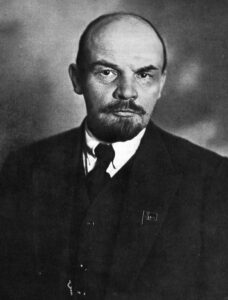
There have actually been three mausoleums on this same spot. The first one, made of wood, was built by Shchusev in just three days for the funeral of January 1924. The second one, also wooden but bigger and with a tribune, opened a few months later. The third — the current stone one — arrived in 1930, when it was decided this was going to last.
Lenin died on 21 January 1924, aged 53. His wish was to be buried in St. Petersburg next to his mother, but Stalin pushed for him to be embalmed and put on display. A “Commission for Immortalisation” of scientists worked on the chemical formula and, except for the Second World War (when the body was secretly evacuated to the Siberian region of Tyumen between 1941 and 1945), Lenin has been here ever since.
In the basement of the mausoleum itself there’s a laboratory where a team of biologists and biochemists treat the body with a special solution every year and a half, change his suit and repair any damage. The sarcophagus has had bulletproof glass since the 1970s, after several vandalism attempts (including an explosion in 1973 that killed several visitors). Honestly, after a century of chemical treatments, Lenin’s body looks more and more like a wax mannequin. Experts at the Centre for Biotechnologies claim they can preserve it “for a practically indefinite period”. You’ll be the judge.
Why is Lenin still there today?
Since the fall of the USSR in 1991, part of Russian society has been calling for Lenin to finally be buried. A Lenta.ru poll from January 2026 showed that 59% of Russians want him removed from the mausoleum and given a proper burial, while 41% prefer to keep things as they are. Earlier polls had given similar numbers (56-63% in favour of burial).
Even so, the Kremlin won’t move. Putin has said on several occasions that Lenin will stay there “until a clear majority of Russians publicly says otherwise”, to avoid further dividing society. Kremlin spokesman Dmitry Peskov has said the topic “is not on the agenda”. Meanwhile, the Ministry of Culture keeps funding the preservation of the body (around 13 million rubles a year, roughly 150,000 dollars).
The Communist Party is also against any move, as are the families of the figures buried in the Necropolis: a Communist leader recently said he had collected signatures from descendants of the 400 Soviet heroes laid to rest there (Gagarin, Korolev, Keldysh) and that all of them oppose any relocation. So unless there’s a major political shift, Lenin stays put.
Opening hours, price and how to get there
Opening hours
The Mausoleum is open:
- Tuesday, Wednesday, Thursday, Saturday and Sunday, from 10:00 to 13:00.
- Closed Monday and Friday.
Heads up: even on opening days, the Mausoleum can shut without notice if there’s an official event on Red Square (rehearsals for the Victory Day parade on 9 May, concerts, major holidays), if it coincides with the body’s maintenance period, or if specific restoration work is being carried out. I’ll explain what’s going on with the ongoing restoration further down.
Price: always free
Entrance is free and there are no official tickets: if any website is selling them, it’s a scam. The Mausoleum is run by the Federal Protective Service / Kremlin Commandant’s Office (FSO), not by the Kremlin Museum, which is a different institution and does charge for entry. The only thing you can pay for is a combined guided tour that includes the Mausoleum within a wider visit to Red Square or the Kremlin Necropolis, but it’s not mandatory.
Getting there
The Mausoleum sits on Red Square, against the Kremlin wall and opposite GUM. The closest metro stations (6-7 minutes on foot) are:
- Okhotny Ryad (line 1, red)
- Teatralnaya (line 2, green)
- Ploshchad Revolyutsii (line 3, dark blue) — the best for getting next to Lenin, you come out almost at the foot of the State Historical Museum
The three stations are connected to each other underground, so however you arrive you’ll come out close by.
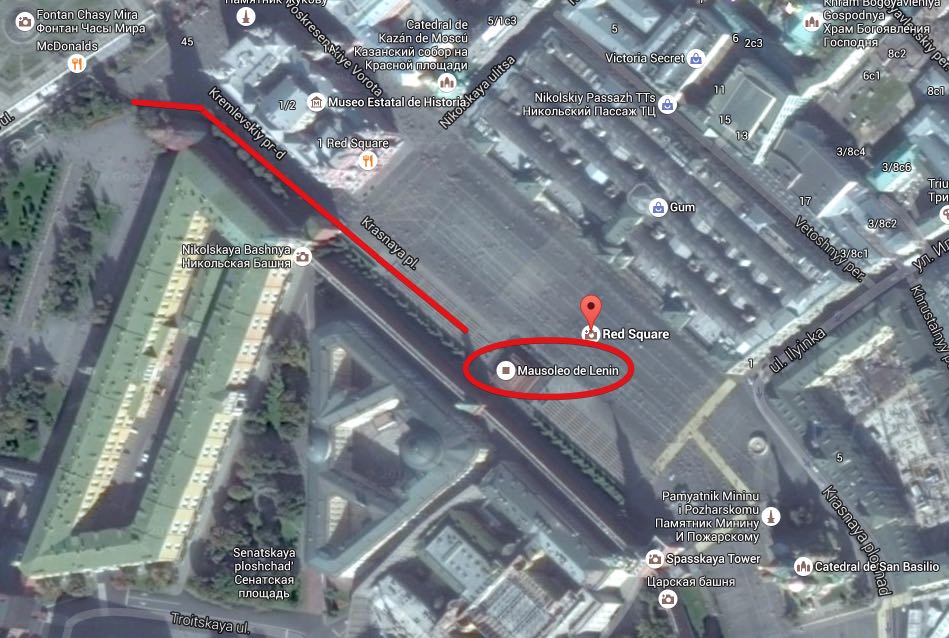
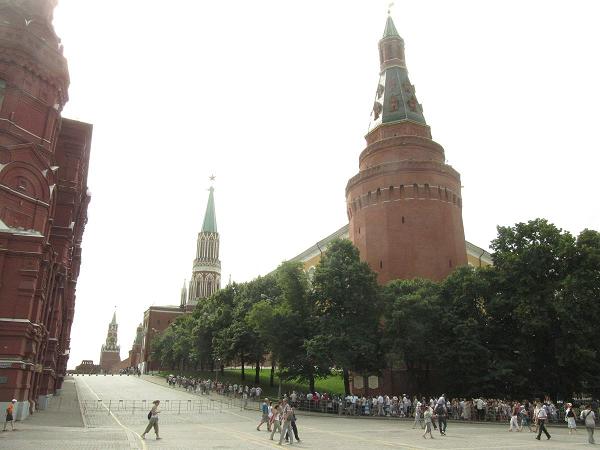
One important thing: the queue to enter the Mausoleum doesn’t form at the building’s entrance. Years ago you used to line up almost at the foot of the “Ленин” inscription, but today, because Red Square is constantly used for concerts, parades and events, access is usually channelled through Nikolskaya Tower (the corner between Red Square and Manezh Square, next to the State Historical Museum). That’s where the metal-detector checkpoint is, and from there you walk along the Kremlin wall to reach the Mausoleum.
The restoration works: what changes for your visit
In May 2025 the Russian Ministry of Culture signed a contract worth around 19.6 million rubles with the EKS company for the restoration of the Mausoleum. The main works were due to be completed by 27 August 2026 and the contract runs until 19 June 2027. In 2026 the Mausoleum has stayed open apart from short closures (23 April to 17 May, 18 July and 4 November), and in November 2026 the Ministry of Culture put out to tender the design of a new restoration of the sarcophagus. No closure has been announced for it yet.
Here’s what matters to you:
- Lenin’s body has not been moved: the works affect technical and administrative areas (waterproofing, reinforcement of staircases, utilities), not the funeral hall where the sarcophagus is.
- The visit still works for most of the period, but there may be occasional closures of several weeks, generally around national holidays (1-9 May, 7 November) or specific phases of the construction work.
- Before you go, check whether Red Square is open at all (sometimes the whole square is closed for parade preparations) and whether the Mausoleum is operating that day. The most reliable thing is to ask at your hotel reception the night before.
The rules: what you can NOT bring or do
The Mausoleum is run by the FSO, the federal service in charge of Kremlin and Presidential security. That means airport-level checks and inflexible rules. Before you go in they’ll send you through a metal-detector arch, search your clothes and bag, and look at you sideways if you’ve got anything in your pockets.
You cannot enter with:
- Backpacks or large bags (anything from a regular shoulder bag size and up starts being a problem). A small bum bag or a women’s handbag usually pass.
- Sharp or pointed objects: knives, manicure scissors, nail files, Swiss army knives… careful if you’ve come straight off a train trip with that kind of thing in your bag.
- Bottles of liquid, cans, food.
- Bulky metal objects.
- Flammable liquids, animals, scooters, skateboards, bicycles.
The big issue is that the cloakroom in Alexander Garden, which in theory could keep your stuff, in practice only accepts visitors with a Kremlin ticket or a museum entry. Since the Mausoleum is free and has no ticket, you can’t use it to leave your backpack. In 2025 visitors found this out the hard way: police turn away anyone with a backpack and there’s no easy alternative. My advice: come light, leave your stuff at the hotel, or travel with a companion and take turns getting in while the other watches the bags. Another option is to leave luggage at the locker room of the Leningradsky / Kazansky / Yaroslavsky stations (the three are clustered together at Komsomolskaya Square) if you’re passing through.
Inside the Mausoleum, on top of that:
- Photos and videos are forbidden. The guards are paying attention and will call you out immediately. Curiously, they do let professional cameras hang from your neck (as long as you don’t use them); the problem is the backpack, not the camera.
- You have to take off your hat: no caps, hats, hoods or sunglasses. Looking at Lenin with a cap on is considered disrespectful.
- No talking, no noise. If you open your mouth you get shushed. You can’t keep your hands in your pockets either.
- You can’t stop to look at the body: the line moves slowly but never stalls, and the guards will gesture for you to keep going if you linger.
What you’ll find inside
Once you’ve cleared the security check and walked a stretch along the Kremlin wall (with the Necropolis funeral plaques on your right, set into the wall itself), you reach the building’s entrance. They let you in in groups of about ten people. You cross the threshold and you notice the change: the air is cool, almost cold, thanks to the climate control that keeps the body in optimal condition.
The route is always the same: you walk down a black marble staircase on your left until you reach the Funeral Hall, a room with a stepped ceiling, granite panels and vertical red strips that look like flags rippling in the wind. The sarcophagus sits right in the centre, on a pedestal, shaped like an inverted trapezoid. It was designed by Shchusev and Yakovlev after the Second World War, replacing Konstantin Melnikov’s original; the side glass has been bulletproof since the 1970s.
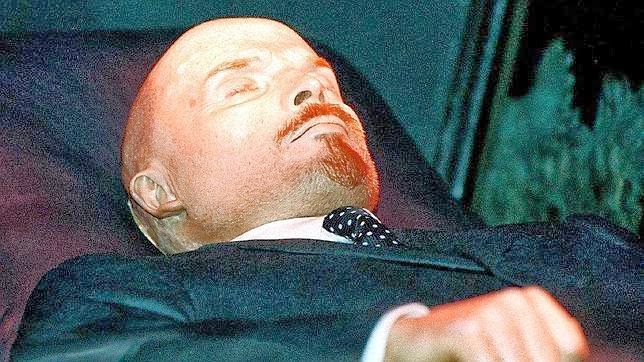
Inside the sarcophagus, on a red cushion, lies Lenin in a dark three-piece suit. Lamps built into the structure light him from the inside, creating that theatrical, almost mystical effect that sticks with you. There are bronze wreaths on either side and two flags: one for labour and one for combat. You take a short loop around the sarcophagus (left side, front, right side) and walk up the right-hand staircase to the exit. You’re inside for two or three minutes at most. The whole visit, including the security check and the queue, usually takes between 30 and 60 minutes.
If you’re expecting a museum experience with panels, audio guides, archive photos and so on, forget it. This isn’t a museum, it’s a tomb with two specific features: the body is on display and the silent script of the route is imposed on you. That austerity is precisely what makes it interesting. The impression you take with you lasts longer in your head than the three minutes you spend inside.
The Necropolis of the Kremlin Wall
On the way to the Mausoleum, before you enter, you pass in front of the Necropolis of the Kremlin Wall. It’s an open-air cemetery with around 400 graves in total, and here you can take photos. It’s worth spending 10-15 minutes on it.
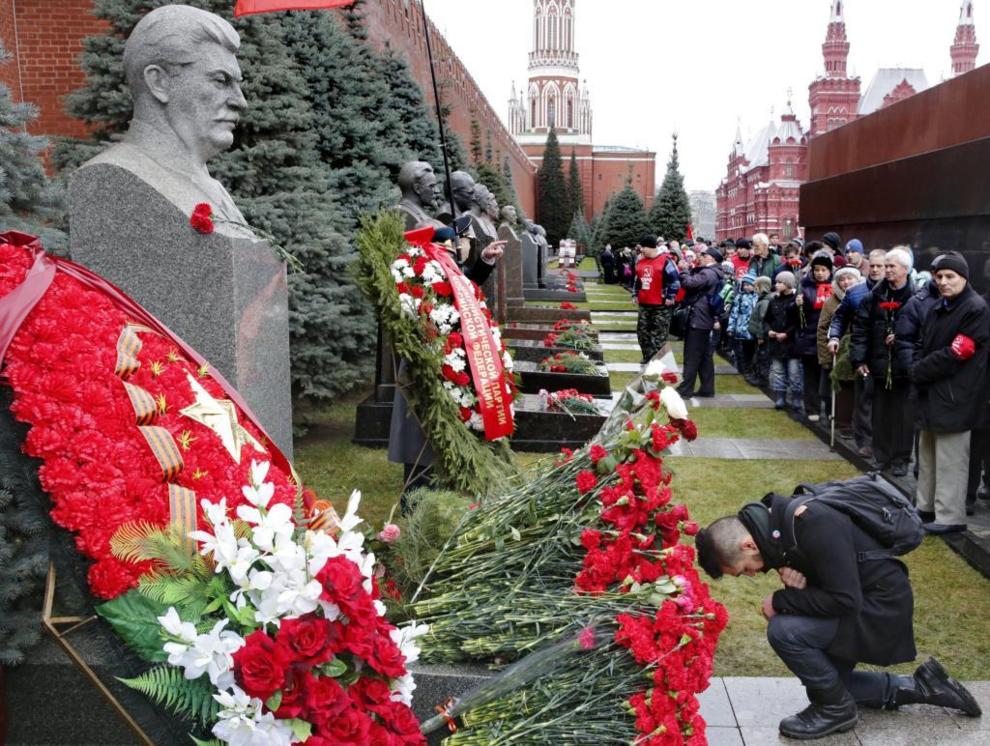
Right next to the Mausoleum stand the busts of the main Soviet leaders:
- Joseph Stalin, whose embalmed body shared the Mausoleum with Lenin between 1953 and 1961, before Khrushchev, in the middle of de-Stalinisation, ordered him out and had him buried here.
- Leonid Brezhnev, Yuri Andropov, Konstantin Chernenko, the last three General Secretaries of the CPSU before Gorbachev.
- Mikhail Suslov, Mikhail Kalinin and other historical leaders.
Inside the Kremlin wall (in funerary urns) lie figures like Yuri Gagarin, the first man in space; Sergei Korolev, the father of the Soviet space programme; the writer Maxim Gorky; the aviator Valery Chkalov; and revolutionaries such as Felix Dzerzhinsky and Yakov Sverdlov. Curiously, neither Khrushchev nor Gorbachev is here: the first fell out of favour, the second chose not to be.
Tricks to avoid queues and make the most of your visit
The good thing about the Mausoleum is that the queue tends to move fast (groups go in every few minutes). The bad thing is that, especially in summer and ever since the restoration was announced, attendance has gone up. My tricks after several visits:
- Show up before 10:00. If you’re at Nikolskaya Tower by 9:30 you’ll be among the first and the whole visit (queue + interior) will take you 30-40 minutes. If you arrive at 11:30, expect at least an hour and a half.
- Avoid weekends in high season and the days around the big holidays (1 May, 9 May, 7 November). A Tuesday or Thursday morning is the best day.
- Watch the weather: with rain or extreme cold there are fewer people, and the queue is in the open.
- Don’t go in a rush: if Red Square is closed for an event that day, you’ll lose the whole morning. Plan three or four hours for the full experience (Mausoleum + Necropolis + walk around the square).
- Combine it with the Kremlin: the Kremlin opens every day except Thursday (10:00 to 17:00 from October to mid-May, 9:30 to 18:00 from 15 May to 30 September), so a good day to plan it is Tuesday, Wednesday or Saturday: Mausoleum in the morning (10:00-11:30) and Kremlin afterwards.
- If you’d rather understand what you’re seeing in depth and skip dealing with logistics or queues, consider booking a private guided walk of Red Square that includes Mausoleum access: many local guides know the rhythm of the queue and tend to bring their group at quieter times.
There are also unofficial “guides” who offer to skip the queue for a fee. I don’t recommend them: the line moves quickly if you arrive early, and I’d rather not get into trouble with the FSO right in the middle of Red Square.
What visitors say (Yandex Maps)
The Mausoleum has a high rating on Russian maps: 4.9/5 on Yandex Maps with close to 8,000 reviews. The most common takeaways from real visitor feedback:
- “It’s free and the queue moves fast”
- “The guards are very strict: no talking, no caps, no hands in your pockets”
- “It’s striking to see the body up close, it looks like wax”
- “An unavoidable part of Russian history that you have to see once in your lifetime”
- “You have to arrive early, around 9:30, and forget about the backpack”
Click on the map to see more reviews and photos directly from visitors on Yandex Maps.
Where to eat near the Mausoleum
The visit ends around 11:30-12:00 and, if you’ve started early, chances are you’ll be hungry. Luckily you’re in one of the spots in Moscow with the most food choices. Three options I’ve personally tested, in order of budget:
- Stolovaya 57 (inside GUM, second floor): a Soviet-style canteen inside the shopping arcade. You order at the counter by pointing at dishes, and you eat pelmeni, shchi soup, Russian olivier salad or solyanka for around 400-700 rubles per person. Views over GUM’s atrium. It’s my favourite for value for money and atmosphere.
- Bosco Caffè (also in GUM, ground floor): terrace with direct views over Red Square and St. Basil’s. Italian-international menu, high prices, but the spot is worth it for the views. Great coffee and breakfast.
- Café Pushkin (Tverskoy Boulevard 26A, 10 minutes on foot): the classic for elegant Russian cuisine, in a 19th-century-styled building. Book ahead at peak hours. Top-end restaurant prices.
If you’d rather go for Russian fast food, the Tverskaya area (10 min walking north) has several Teremok outlets, the blini and pelmeni chain that’s everywhere and very budget-friendly. I have a more detailed guide on the best restaurants in Moscow if you want to go deeper.
What to see around: the full half-day plan
The Mausoleum isn’t really visited in isolation. If you’re going to Red Square, the natural thing is to chain it with several stops nearby. My suggestion for a well-rounded morning:
- 9:30: Mausoleum queue at Nikolskaya Tower.
- 10:00-11:00: Visit to the Mausoleum and the Necropolis.
- 11:00-11:45: Walk around Red Square, photos in front of St. Basil’s Cathedral and the monument to Minin and Pozharsky.
- 11:45-13:00: Entry to St. Basil’s Cathedral or to GUM (the central aisle with the glass roof and the plombir ice cream at 100 rubles are essentials).
- 13:00: Lunch at Stolovaya 57 (inside GUM itself).
- 14:30 onwards: If it’s Tuesday, Wednesday or Saturday, head into the Kremlin and the Armoury. If it’s Thursday, switch the plan to Gorky Park or a museum of your choice.
If you’re putting together your whole trip to the Russian capital, I have a complete guide with itineraries for 1, 2, 3, 4 or 5 days in Moscow where the Mausoleum shows up on the morning of day one or two.
So, is it worth it?
My honest take: yes, especially if it’s your first time in Moscow and you’re interested in 20th-century history. It’s not “beautiful” in the touristy sense (there’s nothing Instagram-friendly to see inside), but few places condense the strangeness of the Soviet experiment quite like this: an embalmed body kept on display for a century, in the political heart of Russia, with armed guards and almost religious rules. It’s an experience that sticks with you.
If, on the other hand, dead bodies or enclosed spaces unsettle you, or if you’re tight on time and would rather invest the morning in the Kremlin or the Tretyakov Gallery, it’s perfectly fine to skip it. The outdoor Necropolis looks the same whether you go inside the Mausoleum or not.
2024 marked the centenary of Lenin’s death and of the Mausoleum on Red Square. Now, in 2026 and with a fresh round of restoration underway, the same question keeps coming back: will this be the moment when Lenin is finally buried next to his mother in St. Petersburg, as he supposedly wished? For now, every sign says no.
Frequently Asked Questions
How much does it cost to enter Lenin’s Mausoleum?
Entry is free. There are no tickets to buy and no online reservations. If a website tries to sell you tickets for the Mausoleum it’s a scam: the only way in is by queuing and going through the security check.
What are Lenin’s Mausoleum opening hours in 2026?
It’s open Tuesday, Wednesday, Thursday, Saturday and Sunday, from 10:00 to 13:00. Closed Monday and Friday. There may be occasional closures because of official events on Red Square, national holidays or specific phases of the ongoing restoration, so it’s worth checking the day before.
Can you take photos inside the Mausoleum?
No. Photos and videos are forbidden inside the building, and the guards watch closely. You can photograph the exterior and the Necropolis of the Kremlin Wall, where the graves of Stalin, Brezhnev, Gagarin and other Soviet leaders are located.
Can I bring a backpack into the Mausoleum?
No. Backpacks, large bags and sharp objects are not allowed. The cloakroom in Alexander Garden in practice only accepts visitors with a Kremlin or museum ticket, so it’s better to come without luggage, leave your stuff at the hotel, or take turns with a travel companion.
How long does the visit to the Mausoleum take?
You’re inside the building for barely two or three minutes: you walk down the stairs, do a short loop around the sarcophagus and walk up on the other side. Adding the queue and the security check, the whole thing usually takes 30 to 60 minutes.
Is the Mausoleum closed because of the restoration works?
Not as a rule. The main restoration works were due to finish by 27 August 2026 (the contract runs until June 2027), they don’t affect the funeral hall and Lenin’s body has not been moved. But it does close from time to time: in 2026 it was shut from 23 April to 17 May, on 18 July and on 4 November, so check before you go.
Is there a dress code?
You have to take off any headwear: caps, hats, hoods and sunglasses are forbidden inside the Mausoleum because they’re considered disrespectful. You also can’t keep your hands in your pockets, talk or make noise. There’s no specific dress code beyond that.
Which metro station should I take to reach Lenin’s Mausoleum?
The closest stations are Okhotny Ryad (line 1, red), Teatralnaya (line 2, green) and Ploshchad Revolyutsii (line 3, dark blue). The three are connected and 6-7 minutes on foot from the access point at Nikolskaya Tower, next to the State Historical Museum.
In This Article
Was this useful? I'll tell you when something changes in Russia
One short email a month with what has changed for travellers (visas, payments, border crossings, apps), based on what readers report to me from Russia. More than 4,000 of us already. No spam: if you ever lose interest, unsubscribing is one click.
Irena DomingoAbout Me
I was born in Russia. I grew up between two worlds: my father was Russian, my mother Spanish — a descendant of the "Children of Russia", the Basque children evacuated to the USSR during the Spanish Civil War. I've worked as a translator, interpreter and Russian teacher for over 30 years, and since 2013 I've been writing this blog to help travellers discover Russia with practical, always up-to-date information. Author of the Russiable Guide. If this blog has helped you plan your trip, you can buy me a coffee ❤️.
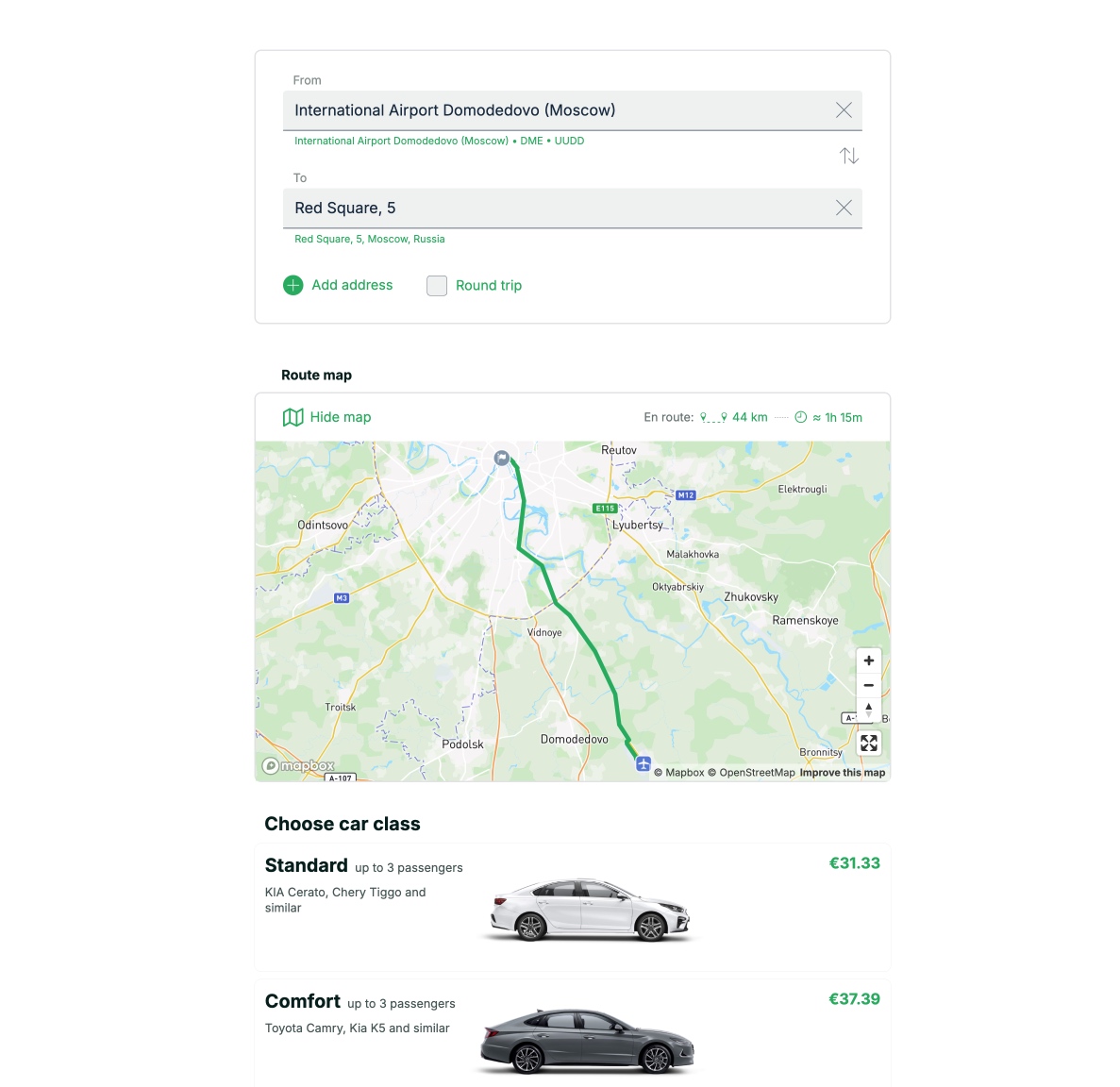 How to book a taxi in Moscow, Saint Petersburg, or in other Russian cities
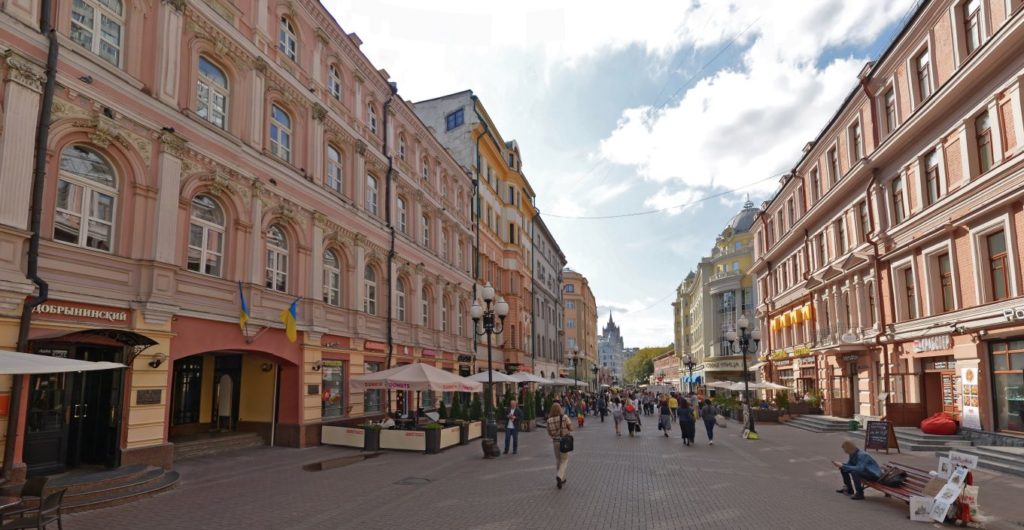 A tour along Arbat Street, the most famous street in Moscow
 Kvas: The Russian Fermented Drink You Didn’t Know You Needed to Try