Moscow is a city you can enjoy enormously with kids, and I say it from my own experience. The list of things to do as a family is endless: the largest indoor amusement park in Europe, a zoo, giant aquariums, space museums, interactive science museums, circuses, theaters, Ferris wheels, observation decks with a free ice-cream factory, river cruises… In this article I’ll walk you through the best things to do in Moscow with your children, organized by theme, with prices and details updated for 2026.

1. Moscow, a capital with a thousand things to do with kids
You’ve probably wondered at some point: is it worth traveling to Moscow with children? For me the answer is a resounding yes.
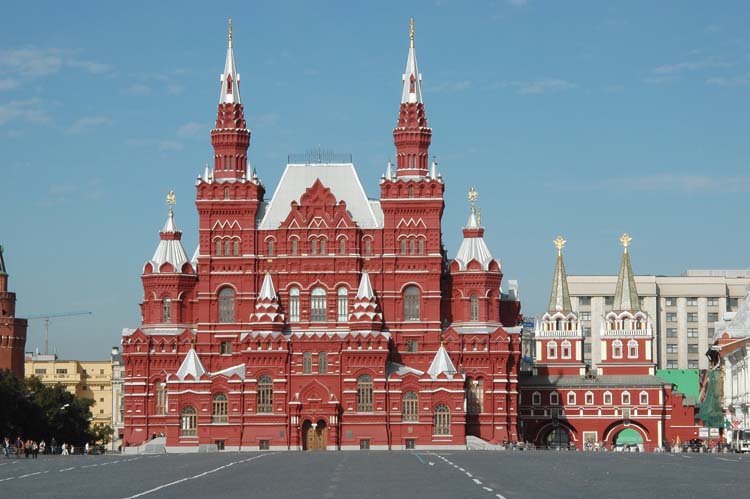
Before getting into the specifically kid-focused plans, keep in mind that many of the city’s “classic” sights also work wonderfully with children. Strolling through Red Square, gazing up at St. Basil’s Cathedral (which looks like something straight out of a fairy tale), visiting the Kremlin or even going down into Lenin’s Mausoleum can be fascinating for them. If you’d like a general overview of the city before you start planning your trip, I recommend my complete Moscow guide.
But in this article I focus on the places designed for little ones and for the older kids (the teenagers) too, all of them fun, varied and, in most cases, with a strong cultural and educational slant. Russians place huge importance on educating their children from a very early age, and you can feel it in the quality of the museums and children’s spaces.
Let’s start with a few practical tips born of common sense and of my own stays in Moscow with my kids.
2. Tips to know before traveling to Moscow with children
Documents
Always carry your children’s passport and visa with you to avoid trouble when entering and leaving Russia and during your stay. If you’re not sure which visa you need, I explain it all in my guide to the visa for traveling to Russia.
If your kids are little and tend to wander off, a good idea is to put a bracelet on them with their basic details and your mobile number, in case you get separated in a crowd.
Getting around
Around the city, the most convenient way to move is by metro or taxi, and each option has its advantages.
When you travel as a family, it’s often worth booking a taxi or transfer, especially from the airport or when you’re loaded down with luggage. You can request it with a child seat. Bear in mind that Western apps like Uber or Gett don’t work in Russia, so it’s best to have this sorted out in advance.
The other option is the metro, which is far cheaper and, on top of that, an attraction in itself: kids love riding up and down its incredibly long escalators and seeing the palace-like stations. Children under 7 travel free. That said, be careful during rush hour, hold the little ones’ hands, and remember that many stations have no elevator for a stroller (you’ll have to go down the escalators carefully).
If you’re going to travel between cities, for example from Moscow to St. Petersburg, children aged 5 to 10 get a discount of around 30% on the train, and those under 5 travel free if they don’t take up a seat. I explain how to buy tickets from abroad in my guide on how to buy train tickets in Russia.
Kid-friendly restaurants in Moscow
In Moscow you’ll find fast-food chains everywhere. Watch out for one big change compared to years ago: McDonald’s left Russia in 2022 and its restaurants reopened under the Russian brand Vkusno i tochka (“Tasty, and that’s it”), with a virtually identical menu. KFC became Rostic’s, while Burger King and Subway carry on as normal.
For a traveler, though, it’s far more interesting to try the Russian fast-food chains, with typical local dishes (blini, grechka, pelmeni, borsch, sirniki…). They’re a cheap, quick option that kids tend to love, and they usually have areas for them to play. The two best known are Teremok, built around the world of blini (crêpes), and Kroshka Kartoshka, focused on the potato. You’ll find them in central areas and in shopping malls, sometimes as a restaurant and sometimes as a street kiosk.

Russian gifts and toys for children
There are two gifts that little ones tend to love: matryoshkas and Cheburashka.
Matryoshkas are one of the great icons of Russian culture. They’re traditional hand-painted wooden dolls that, in their classic version, depict Russian women decorated with flowers. The fun part is that they’re hollow and, inside each one, there’s a smaller doll, and inside that another, and so on (anywhere from 5 up to several dozen). Kids are fascinated by taking them all out and putting them back one by one. They’re toy and decoration at once, and a much-loved souvenir. You’ll also find ones that break with the traditional style: politicians, footballers or movie characters.

The second is Cheburashka, a classic character from Russian children’s literature and cartoons, with a body a bit like a little bear with enormous ears, hugely popular across the country (and which in recent years has enjoyed a new boom thanks to a hit film in Russia).

3. The best things to do with kids in Moscow
Below I’ll show you the places your children will love, sorted by theme: amusement parks, zoos, museums, circuses, theaters, observation decks… It’ll be impossible to visit them all, so pick the ones that best match your kids’ tastes and ages.
3.1. The amusement park: Dream Island (Остров мечты)
If you can only pick one big amusement-park outing, this is the king. Dream Island (“Island of Dreams,” or Ostrov Mechty in Russian) is the largest indoor theme park in Europe and the first of its kind in Russia. It opened in 2020 and has become one of the city’s star attractions for families. Since it’s completely covered, it’s the perfect plan for a rainy, cold or generally bad-weather day, something you’ll be grateful for more than once in Moscow.
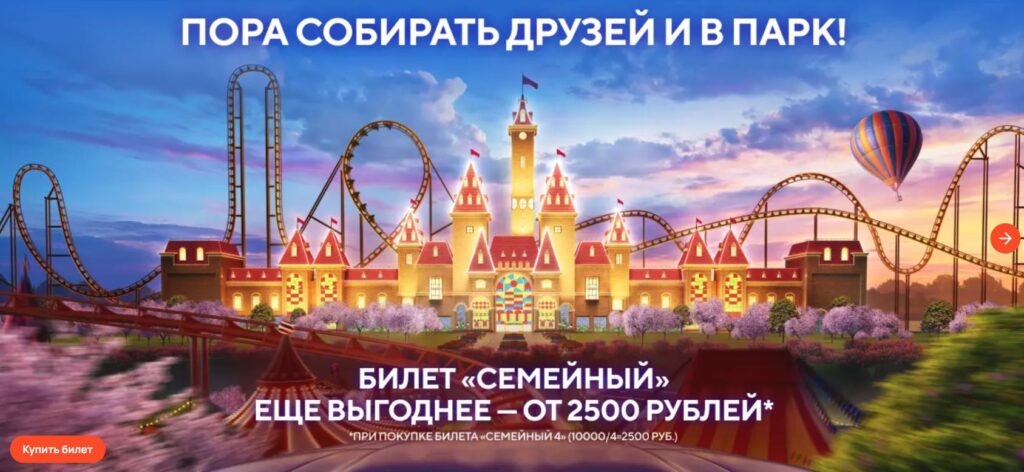
The park is organized into nine themed worlds built with enormous attention to detail (the Smurfs’ village, the Teenage Mutant Ninja Turtles, Hello Kitty, Hotel Transylvania, the Snow Queen’s castle, a fairy-tale village…), with more than 40 rides for all ages, from gentle carousels for the youngest to roller coasters for teenagers. Beyond the rides, there’s a covered shopping promenade (with streets that imitate Rome, Barcelona or London), restaurants, a cinema and a landscaped outdoor park.
Practical details: it’s south of the center, next to Технопарк (Tekhnopark) metro station. The amusement park is open from 12:00 to 22:00 and the covered promenade from 10:00. The “Standard” ticket (access only, no rides) is around 3,100 rubles, while the “All inclusive” ticket (unlimited access to almost all rides) ranges from about 2,800 rubles on weekdays to 3,500 rubles or more on weekends and holidays. There are family rates.
An important warning if you’re going with very young children: many rides require a minimum height (often 104, 120 or 140 cm). Children under 90 cm get in free, but they’ll only be able to go on very few rides. If your little ones are quite short, measure them before buying the “All inclusive,” because it may not be worth it. Always check the height restrictions on the official website before you go.
3.2. Outdoor parks: Gorky Park and Kolomenskoye
It’s not all about paying for admission. Moscow has magnificent free parks where kids can run around to their heart’s content.
Gorky Park is the quintessential urban park, right in the heart of the city and on the banks of the Moskva River. It has fountains, very original playgrounds, boat rental in summer, a giant ice rink in winter, cafés and plenty of green space. It’s a perfect spot for the kids to burn off energy between sights, and admission is free.

A bit farther from the center but just as worthwhile is Kolomenskoye, the former summer residence of the tsars, now turned into a huge open-air museum-reserve (255 hectares) with palaces, churches, vegetable gardens and apple orchards. Kids can see how the tsars lived and, in summer, watch knights’ tournaments and historical reenactments. There’s a free shuttle to move between the main points, and entry to the grounds is free (some indoor museums are paid separately).
3.3. Zoo and aquariums
Moscow Zoo
The Moscow Zoo is one of the oldest in the world: it dates back to 1864, when it opened with little more than a hundred animals. Today it’s home to thousands of animals from hundreds of species and, after a thorough renovation, the enclosures are spacious and well kept.
Among its stars are the giant pandas, which arrived in 2019 and became crowd favorites. In 2023 Katyusha was born there, the first panda born in Russia, quite an event. Another symbol of the zoo is the Pallas’s cat (manul), a grumpy-looking feline that lives in the steppes of Mongolia and Siberia. There are also penguins, giraffes, elephants, flamingos and a children’s petting zoo. A tip: on the zoo’s website you can check the animals’ feeding times; watching them feed the polar bear or the belugas is quite a spectacle.

Practical details: long opening hours that vary by season (longer in summer; it’s worth checking the website). Adult admission is around 1,500 rubles and the children’s rate (ages 4–17) about 750–1,000 rubles. Note: children and students registered as Moscow residents get in free, and many foreigners qualify for reduced rates. Allow at least 4–5 hours to see it at a relaxed pace.

Moskvarium (the giant aquarium at VDNKh)
The Center for Oceanography and Marine Biology “Moskvarium” is the largest aquarium in Europe located away from the coast. It sits inside VDNKh (the big exhibition and leisure complex in the northeast of the city), and it’s one of the great must-dos with kids.
Its tanks are home to more than 12,000 marine and freshwater creatures: sharks, rays, octopuses, an electric eel, jellyfish, Baikal seals, giant Kamchatka crabs… Beyond the aquarium, Moskvarium puts on spectacular aquatic shows with dolphins, whales, sea lions and walruses (from May 2026 with a new musical, “The Little Mermaid”).
Practical details: open from 10:00 to 22:00. Aquarium admission is around 850 rubles for adults and 650 for children (ages 3 to 12), while the aquatic shows are paid separately (between 1,750 and 6,500 rubles depending on the seat). Children under 2–3 get in free. Tickets are sold online on its website.

Oceanarium “Rio”
The Oceanarium “Rio” (officially “Oceanarium No. 1”) was Moscow’s first big aquarium and is still a good option, especially if you’re staying in the northern part of the city. It’s in the RIO shopping mall, on Dmitrovskoye Avenue. It houses more than 10,000 specimens of marine life spread across themed zones (the lagoon with rays and sharks, the polar zone with penguins, the tropical forest, the coral reef…), and it also has an exotarium with reptiles, birds and mammals.
Practical details: open every day from 10:00 to 22:00 (ticket office until 21:00). Adult admission is around 1,200 rubles on weekdays and 1,400–1,500 on weekends; the children’s rate (ages 5–13) about 800–1,000 rubles. Children under 5 get in free. There are free shuttle buses from several metro stations to the shopping mall.

3.4. A full day at VDNKh: Ferris wheel and cartoons
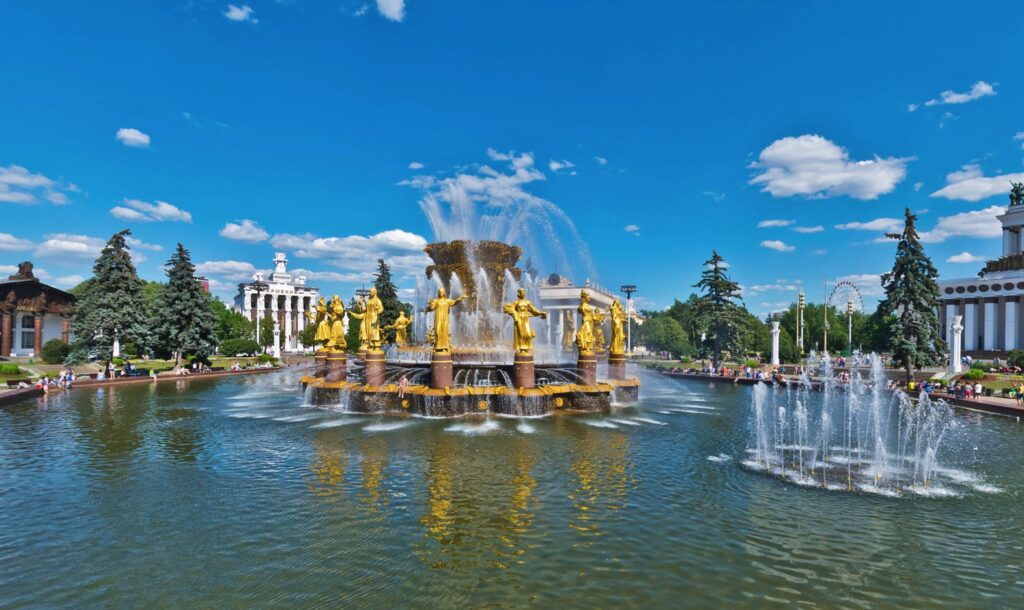
Since Moskvarium is at VDNKh, take the chance to dedicate the whole day to this complex, because it packs in several great family outings.
A few minutes’ walk from the aquarium is “Solntse Moskvy” (“Sun of Moscow”), the largest Ferris wheel in Europe, at 140 meters tall (like a 45-storey building). It opened in 2022 and has enclosed, climate-controlled cabins, some of them with glass floors. On a clear day you can see up to 50 km around. Children under 3 ride free and there are children’s rates.
Right next door is SoyuzMultPark, an interactive park dedicated to the characters of the legendary Soviet cartoons (Cheburashka, the Bremen Town Musicians, the residents of Prostokvashino, Mowgli…), with nearly twenty interactive attractions designed for children. And, if you’ve still got time and energy, VDNKh itself has pavilions, museums (such as the Museum of Cosmonautics, which I cover below), green spaces and cafés to spend the whole day.
3.5. Space and astronomy museums
Moscow Planetarium
The Moscow Planetarium, the oldest in Russia, is ideal for discovering the world of the stars, the history of astronomy and the conquest of space. Besides observing the sky, you can run experiments in the interactive Lunarium museum, see antique astronomical instruments in the Urania Museum, and touch real meteorites.
They also screen films about the universe, the Moon or space. There’s a highly recommended one called “Flight over Moscow,” 20 minutes long, where you soar over the capital from a bird’s-eye view. Some screenings are available in English and prices vary.
Practical details: open from 10:00 to 21:00; closed on Tuesdays. Prices vary depending on the area you access (usually around 100 to 650 rubles per area). There are discounts for buying a ticket to several areas, and children under 6 get into the Lunarium free. Buy online on the website.

Museum of Cosmonautics
Dedicated to Soviet space exploration, the Museum of Cosmonautics sits at the base of the Monument to the Conquerors of Space, an impressive 107-meter obelisk depicting the trail of a rocket taking off, unveiled in 1964. The museum displays spacesuits and space capsules, models, space-age posters and even animals that traveled to space. It’s a great outing if your kids are into all things space, and it’s at VDNKh, so it combines very well with the Ferris wheel and Moskvarium. I tell you more in this article: Moscow in space: from the Museum of Cosmonautics to the Planetarium.
Practical details: open from 10:00 to 19:00 (Thursdays and Saturdays until 21:00). Admission is around 250–450 rubles, with family discounts.

3.6. Science and nature museums
Experimentanium
A museum dedicated to science through hands-on practice: here everything is touched, tried and experimented with. The Experimentanium has more than 300 interactive exhibits on mechanics, optics, acoustics, electricity, magnetism, hydrodynamics and puzzles. Your kids will learn how musical instruments work, and play with optical illusions, magnets and electrical phenomena… A full sensory experience for curious minds of any age.
Practical details: open from 9:30 to 19:00 on weekdays and from 10:00 to 20:00 on weekends and holidays. Adult admission is around 850–950 rubles and the children’s rate about 850 rubles; children under 3 get in free. There are guided tours in English with prior booking.
Orlov Museum of Paleontology
The Moscow Museum of Paleontology, part of the Russian Academy of Sciences, is one of the largest of its kind in the world and a sure hit if your kids love dinosaurs. It holds thousands of fossils tracing the evolution of life on Earth: dinosaurs from Mongolia, Permian therapsids and Precambrian fossils from Siberia, among many others, spread across six halls. It has a strong educational side, with workshops for school groups.
Practical details: open Wednesday to Sunday, from 10:00 to 18:00. Admission is around 300–600 rubles (schoolchildren and students pay less) and children under 6 get in free.

Darwin State Museum
The Darwin Museum, founded in 1907, is the largest natural-history museum in Europe devoted to evolution. It’s big, varied and very educational: it explains the theory of evolution and natural diversity with thousands of animals, film screenings, an interactive center, an ecological trail and a “preschool academy.” It constantly runs quests, workshops and activities for children, so it’s a great plan for a bad-weather day.
Practical details: open from 10:00 to 18:00 (closed Mondays; on Thursdays it opens from 13:00 to 21:00). Main admission is around 400–550 rubles for adults, with discounts for schoolchildren and students; children under 7 get in free.

Zoological Museum of Moscow University
If you want to complement the zoo and the Museum of Paleontology, the Zoological Museum of Lomonosov Moscow State University lets you see wildlife from all over the world preserved and mounted with great quality. Founded in 1791, its collections range from insects to mammals, taking in amphibians, reptiles and birds. It also has a science terrarium open to the public on weekends.
Practical details: open from 10:00 to 17:00 (closed Mondays and the last Tuesday of each month; Thursdays from 13:00 to 21:00). Adult admission is around 200–400 rubles, and schoolchildren and students pay much less.
3.7. Circuses
Great Moscow State Circus
The circus in Russia is a major art form and a world reference. The Great Moscow State Circus, on the Sparrow Hills, is an experience that thrills the whole family: acrobats, balancing acts, illusionists, trained animals, dazzling sets and a lot of technique. Founded in 1971, it seats 3,400 people. As a guide, tickets run from 1,000 to 5,000 rubles.

Nikulin Circus
The Nikulin Circus, on Tsvetnoy Boulevard, is one of the oldest and most emblematic in the country, with the classic clowns, acrobats, tightrope walkers and top-level animal trainers. It seats more than 2,000 people, and as a guide, tickets run from 1,000 to 3,500 rubles.

3.8. Theaters for children
S. Obraztsov State Puppet Theater
In the world of puppets, the Moscow State Puppet Theater is the oldest (1931) and most famous in the city, founded by the celebrated Sergey Obraztsov. It’s a one-of-a-kind place, with its own museum, and its shows are for all audiences. Tickets run, depending on the show and seat, from 400 to 1,500 rubles. Sold online.

Yuri Kuklachev Cat Theater
A wonderfully original idea where the stars are… cats. At the Kuklachev Cat Theater, the most well-trained felines amaze audiences with incredible acts and antics. A plan kids adore. Tickets run from 500 to 2,500 rubles. Sold online.

“Natalia Sats” Musical Theater for Children
The Natalia Sats Musical Theater has a very full program, with operas, ballet and dramatic productions designed for the youngest audiences. It’s a wonderful way to introduce your kids to the performing arts. Tickets generally run from 200 to 2,000 rubles, with many productions around 500 rubles.
3.9. Shopping and record-breakers with kids
Central Kids Store (CDM, on Lubyanka)
The Central Kids Store on Lubyanka (CDM) is a seven-storey children’s shopping and entertainment center, in a magnificent 1953 building very close to Red Square. Entry is free. It houses dozens of shops, entertainment areas and restaurants, but its appeal goes far beyond shopping.

Inside you’ll find one of the largest mechanical clocks in the world (it weighs five tons), a spectacular atrium with stained-glass windows inspired by fairy tales and, in the Hamleys store on the ground floor, an 18.5-meter Lego rocket made of almost 2 million pieces. There’s a three-dimensional light show at 6, 7, 8 and 9 pm.

Don’t miss the observation deck on the sixth floor, with good views of the capital and an entrance from the Childhood Museum (with antique toys). Access to the deck costs around 50 rubles. Center opening hours: 10:00 to 22:00.
Izmailovo Kremlin
The Izmailovo Kremlin is a colorful cultural center of wooden architecture, with plenty to do as a family: buy souvenirs and typical products at its famous market (at better prices than in the center), visit small, quirky museums (the Bread Museum, the Doll Museum…) and stroll around the lake and the green area beside it. Entry to the grounds is free; you only pay for the museums, which are small and inexpensive.

3.10. Other plans kids love
Panorama360 and the Moscow City skyscrapers
In the area of the Moscow City skyscrapers you’ll find Panorama360, the highest observation deck in Europe, on the 89th floor of the Federation Tower. Beyond the 360º views over the whole capital, it has an irresistible hook for kids: an ice-cream factory that gives away free ice cream to visitors, plus a chocolate factory. It’s a great outing, especially at sunset. There are children’s rates and the youngest pay very little.
Cities of professions (KidZania and Kidburg)
Kids love “cities of trades,” mini-cities where they step into the shoes of firefighters, doctors, cooks or pilots, earn a symbolic salary and spend it inside. The best known is KidZania, in the Aviapark shopping mall, a miniature city with dozens of professions for children roughly aged 4 to 14. Another option is Kidburg, based in the Central Kids Store (CDM) itself and in other centers. (If you see the old “Masterslavl” recommended in other guides, note that its Moscow location is no longer operating.)
Cruise on the Moskva River
One of the loveliest and most relaxing things to do as a family is a boat ride on the Moskva River. The modern boats (Radisson-type) sail all year round, even in winter, and let you see the Kremlin, the Cathedral of Christ the Saviour, the Moscow City skyscrapers and other illuminated landmarks from the water. It’s ideal at sunset, when the city lights up. They usually accept children from age 3 and it’s a calm plan, perfect for ending the day.
Frequently asked questions about traveling to Moscow with kids
Is it worth traveling to Moscow with kids?
Yes. Moscow has a huge range of things to do with children: the largest indoor amusement park in Europe (Dream Island), a zoo, giant aquariums, science and space museums, circuses, theaters, a 140-meter Ferris wheel and river cruises. On top of that, many museums and attractions are free or very cheap for children and students.
What is the best thing to do with kids in Moscow if it rains?
Dream Island (Остров мечты), the largest indoor theme park in Europe, is perfect for rainy or cold days because it is completely covered. Other good indoor options are the Moskvarium, the Darwin Museum, the Experimentanium and the Planetarium.
Do children pay admission at Moscow’s museums and attractions?
In many cases they don’t, or they pay very little. It also depends on age. Numerous museums and the zoo offer free admission for children and students, especially those registered as Moscow residents, and discounts for foreigners. It is always best to check each place’s official website before buying.
Are there height restrictions at the Dream Island amusement park?
Yes. Many rides at Dream Island require a minimum height (often 104, 120 or 140 cm). Children under 90 cm get in free but can only go on a few rides. If you are traveling with very young children, it is worth checking the height restrictions before buying the All Inclusive ticket.