

St. Basil’s Cathedral is the most photographed building in Moscow and probably the structure most identified with Russia worldwide. If you’re a foreign visitor, the entrance ticket costs 2,000 rubles (about $25), the cathedral opens every day except the first Wednesday of each month and, since May 10, closing time has been extended until 9:00 PM on weekends. In this article I’ll walk you through how to plan your visit, what to see inside, how to skip the queues, and every practical detail based on my own experience and information cross-checked with the official website.
This is step 5 of my guide to planning a trip to Russia in 10 steps, where you’ll find everything else in order.

St. Basil’s Cathedral or Cathedral of the Intercession? The naming confusion
First, a clarification that saves a lot of confusion: the cathedral’s official name is the Cathedral of the Intercession of the Most Holy Theotokos by the Moat (Покровский собор, Pokrovsky sobor in Russian). The “by the moat” part refers to the old Alevizov moat, which used to run along the Kremlin wall and was filled in during the 19th century.
The popular name, St. Basil’s, comes from the holy man Vasily Blazhenny (“Basil the Blessed”), a yurodivy (holy fool) who used to beg in Red Square and to whom prophecies and miracles were attributed. He was buried right next to the church, and in 1588 a tenth chapel was built over his tomb in his honor. Since this chapel was the only one heated in winter and remained open year-round, people gradually started referring to the entire complex as “St. Basil’s Cathedral”. The name stuck and it’s still in use today.
One more thing worth clarifying: this is not Moscow’s main cathedral, nor the seat of the Patriarch. That role belongs to the Cathedral of Christ the Saviour. And it’s not part of the Kremlin either: the two stand right next to each other but are completely separate sites with separate entrances.
Why it’s worth going inside (not just snapping photos from outside)
Most foreign tourists I see in Red Square take a few photos from outside and walk away. That’s a mistake. Inside, the cathedral is nothing like what you’d expect: there’s no large central nave like in a Catholic church, but instead a labyrinth of eleven small chapels connected by narrow corridors and galleries covered in frescoes. Each chapel has its own iconostasis, its own vault, and its own atmosphere.
On Yandex Maps it has a 5.0 out of 5 rating with more than 8,000 ratings, and most reviews agree on the same thing: the surprise of discovering that the interior is far more interesting than it appears from the outside. I can confirm it. If you’re going to pay 2,000 rubles and you’ve travelled thousands of miles to reach Moscow, give it the time it deserves.
The cathedral has been on the UNESCO World Heritage list since 1990, together with the Kremlin complex and Red Square.
A very short history (just the essentials)
Construction was ordered by Ivan the Terrible between 1555 and 1561, to celebrate the conquest of the Kazan Khanate. Each of the nine original churches was dedicated to a saint whose feast day coincided with a decisive battle of the campaign. The central church, the tallest one, is consecrated to the Intercession of the Theotokos, the feast day on which the final assault on Kazan began.
For a long time it was assumed that the architects were Italian. Today we know they were Russian masters: Postnik and Barma (some historians even believe they were one and the same person). The famous legend that Ivan the Terrible had them blinded so they couldn’t build anything similar elsewhere is false: later archives show Postnik working on other major projects, including the Kazan Kremlin.
What is true is that the cathedral has been on the verge of demolition more than once:
- Napoleon tried to blow it up in 1812. According to tradition, a sudden downpour put out the burning fuses.
- In the 1930s, the Stalinist regime considered tearing it down to expand Red Square and make military parades easier. Lazar Kaganovich even presented Stalin with a model of the square without the cathedral, but Stalin ordered him to put it back. And there it still stands.
- During World War II it was camouflaged with fake façades and grey roofing so that German bombers couldn’t identify it from the air.
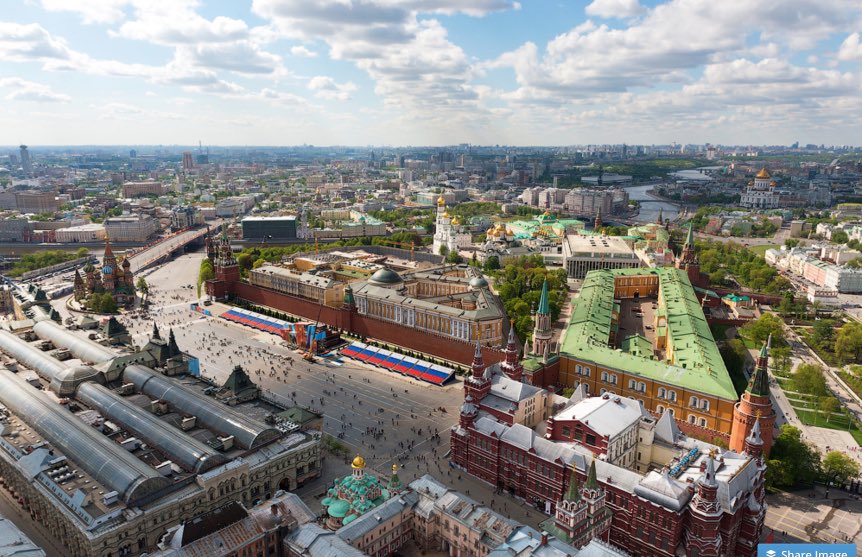
What to see outside: the domes and the details you shouldn’t miss
Before going inside, walk all the way around the building. Most people only look at it from Red Square, but every side has its own charm and the exterior details are some of the most interesting features of the whole complex.
The nine domes (and why no two are alike)
The cathedral’s iconic image is its multicolored domes, all different from each other: with scales, with diamond shapes, with golden spirals, with spikes. Curiously, when they were finished in the 16th century they were smooth and gilded. Their current shapes and colors came later, the result of restorations during the 17th and 18th centuries. The last major intervention, in the 1960s, replaced the metal cladding with copper, which is much more rust-resistant.
There are several theories about why the domes are so different: from a symbolism linked to the planets of the solar system (each dome representing one planet) to a representation of the Heavenly Jerusalem. The truth is that no historian has fully settled the question. The most widely accepted hypothesis today is that they reflect the idea of paradise as a lush and varied garden.
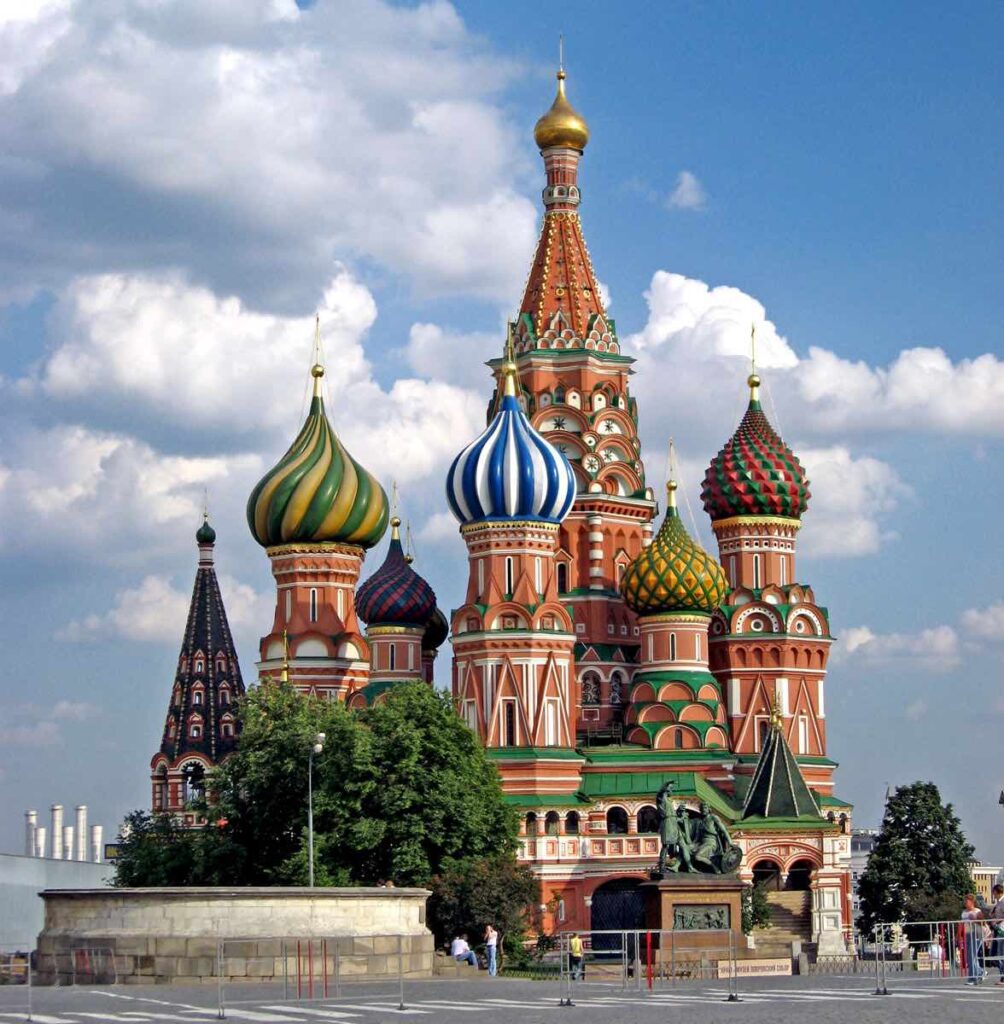
The monument to Minin and Pozharsky
Right in front of the cathedral, on the side facing Red Square, stands the first monumental sculpture Moscow ever had: a bronze statue of Kuzma Minin and Dmitry Pozharsky, the two leaders who rallied the people to drive out the Polish invaders during the Time of Troubles (early 17th century). Originally placed in the center of the square, it was moved to its current spot in 1931 to clear the way for Soviet parades.
The Place of Skulls (Lobnoye Mesto)
A few meters away you’ll see a circular white-stone platform: the famous Lobnoye Mesto. Despite what many guides will tell you, this wasn’t where executions took place (those were carried out at Bolotnaya Square). It was a tribune from which the Tsar’s decrees were read out and where the Patriarch blessed the faithful on Palm Sunday.
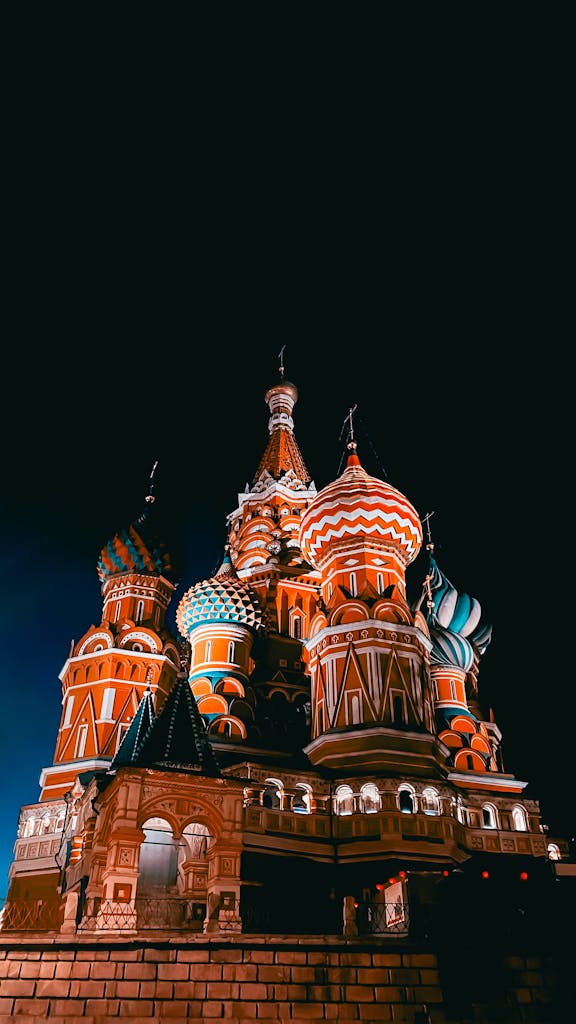
The cathedral at night
My tip: come back at night. The night-time lighting brings out the colors and there are far fewer people around for photos. If you visit in winter, with snow on the ground and sub-zero temperatures, the scene is straight out of a fairy tale.
What to see inside: the eleven chapels of the labyrinth
Here’s where the surprise lies. From outside the cathedral looks like one massive structure, but inside it’s a series of small spaces connected by narrow corridors, white stone staircases, and galleries covered in floral frescoes. My recommendation is to take it slow, no rush, and let the corridors guide you.

The central church: the Intercession of the Theotokos
It’s the tallest one (the central tower with its tent-shaped dome stands about 47 meters from the floor). It contains the largest and most ornate iconostasis of the complex: carved wood in baroque style with gilding, columns and figures, transferred from the old St. Alexander Nevsky Cathedral of the Kremlin in the 18th century. The walls are white, which emphasizes the verticality of the space.
The Church of St. Basil (the only heated one)
This is the small chapel that holds the relics of Vasily Blazhenny. The tomb is marked by a sarcophagus decorated with scenes of the saint’s miracles. On the wall hangs an original embroidered cloth from 1589 with his image: gold and silver threads on green satin, a unique piece of textile artwork.
If you visit on a Sunday morning around 10:00 AM, you can witness the Orthodox liturgy in this chapel. It’s the only church in the complex where weekly services are held, and entry during the service is free (although you’ll only see this chapel; you won’t be able to walk around the rest of the museum).
The Chapel of St. John the Blessed
Right next to St. Basil’s chapel, this one houses the relics of another, lesser-known yurodivy: Ivan “Big Cap” (Bolshoy Kolpak), nicknamed for the huge cloth hood he wore to hide the iron chains weighing more than 30 kg with which he mortified his body. The original 17th-century chains are on display here.
The galleries and floral frescoes
What impresses me most every time I come back are the interior galleries, completely covered with floral frescoes: tulips, vines, imaginary flowers, all in an explosion of colors representing the Garden of Eden. No motif is repeated. If you look closely, you’ll see that the walls even feature an illusion of “painted bricks” — a 16th-century decorative trick.

The acoustics and the a cappella choirs
Embedded in the walls there are more than 80 clay vessels that work as natural sound amplifiers. That’s why the choirs singing a cappella in some of the chapels sound as if you were inside a music box. If you’re lucky, you’ll come across a male quartet performing: it’s one of the most moving moments of the whole visit. My advice: stop, listen, don’t just walk past. They usually have a hat or a tip box; if you enjoyed it, leave a few rubles.

The podklet (basement) and the exhibition
The whole cathedral rests on a stone basement (the podklet) with walls up to three meters thick. Inside it there are vaulted niches that once served as a strongroom: this is where the Tsar’s treasury, books (including, according to legend, Ivan the Terrible’s mythical lost library) and even the belongings of wealthy merchants who didn’t trust their own homes were kept. Today it houses the museum’s permanent exhibition: ancient icons, ceremonial banners, architectural fragments, and archaeological pieces found in the building itself.

Tickets and prices: what you’ll pay as a foreigner
Here’s the most important piece of information: in Russia, foreign visitors pay more than Russians. It’s not a surprise, it’s the standard in most major museums and has been for years. Here are the official up-to-date prices according to the State Historical Museum’s website:
- Adult foreigner: 2,000 ₽ (about $22).
- Foreign children and teenagers (7-17 years old): 1,000 ₽.
- Children under 7: free (any nationality).
- Audio guide in a foreign language: 600 ₽ extra.
- App with interactive audio guide: download to your phone, also from 600 ₽.
On the last Sunday of every month, under-18s of any nationality enter for free. If you’re traveling with kids and you can fit it into your schedule, you’ll save 1,000 ₽ per child.
Buy online or at the box office?
Tickets are sold on the official site: tickets.shm.ru. The catch, as you probably know if you’re planning a trip to Russia, is that Western Visa and Mastercard cards haven’t worked in Russia since 2022. The official site only accepts Russian (MIR) cards, which leaves you with two options:
- Pay at the box office in cash (rubles). The ticket office is at the main entrance, next to the bell tower. Bring your cash already exchanged: here’s where you can exchange rubles.
- Book a guided tour through international platforms that do accept your card. This includes the entrance ticket (the agency pays it in rubles for you) and, on top of that, you get a guide who explains everything. In the guide on Moscow guided tours I tell you which platforms work right now.
If you’re going on your own, I’d recommend getting to the box office first thing in the morning (around 10:00 AM on weekdays). In high season there can be significant queues at midday and in the afternoon.
Updated opening hours (mind the changes)
The museum extended its hours on May 10. Here’s the current schedule:
- Monday, Tuesday, Wednesday and Sunday: 10:00 AM – 7:00 PM.
- Thursday, Friday and Saturday: 10:00 AM – 9:00 PM.
- Weekly closure: the first Wednesday of every month (technical cleaning).
Important: the box office and the museum entrance close 45 minutes before the official closing time. If you want to enter on the last available day Thursday, Friday, or Saturday, don’t show up later than 8:15 PM.
In winter, when temperatures drop below -15 °C (5 °F), the museum may shorten its hours since most of the chapels aren’t heated. The same goes for days with parades, concerts, or festivals on Red Square: access to the area is restricted on those days, and it’s worth checking the museum’s official Telegram channel, which posts daily updates.
How to get there: the three useful metro stations
The cathedral is right in the middle of Red Square, so getting there is easy with the Moscow Metro. Three stations leave you within a ten-minute walk:
- Площадь Революции (Ploshchad Revolyutsii): the closest one. Take exit 11, head toward Gostiny Dvor, turn right onto Ilyinka Street, and you’ll reach Red Square in 5 minutes.
- Охотный Ряд (Okhotny Ryad): take the exit toward Manezhnaya Square, walk past the State Historical Museum (with the equestrian statue of Marshal Zhukov), go through the Resurrection Gate (Voskresensky), and enter Red Square from the north. About 7 minutes on foot.
- Китай-город (Kitay-gorod): take exit 14, walk along Varvarka Street past Zaryadye Park. About a 10-minute walk, but you’ll arrive from the south, right where the bell tower and the museum entrance are.
If you arrive when Red Square is closed for an event, an alternative entrance is usually opened from Vasilevsky Spusk (the slope going down toward the Moskva River, right behind the cathedral). The museum posts videos of the alternative route on its Telegram channel whenever this happens.
Interactive map and reviews
Here’s the exact location on Yandex Maps. Click on the marker to see photos, reviews, and the traveler rating (5.0 out of 5 with more than 8,000 ratings):
Official address: Red Square, 7. Moscow, 109012. Coordinates: 55.7525° N, 37.6231° E.
Practical tips to skip the queues and make the most of your visit
After several visits, these are the tips that actually work:
- Get there early. At 10:00 AM, when it opens, there are no queues. From around noon it starts to fill up, and by 2:00 PM you can expect a 20-30 minute wait to get in.
- Avoid weekends in high season (May to September). If Saturday is your only option, go first thing in the morning or after 7:00 PM (remember, on Thursday, Friday, and Saturday it stays open until 9:00 PM).
- Set aside at least an hour and a half for the full visit if you want to walk through the eleven chapels and the basement exhibition. Only the quick route can be done in 45 to 60 minutes.
- Travel light with bags. There’s a free cloakroom, but if your backpack is bigger than 30×40 cm you’ll have to leave it. Same with umbrellas, so if rain is in the forecast, a packable raincoat is a better choice.
- Watch the stairs: access to the second floor (where the nine main chapels are) is by narrow, steep white stone staircases. It’s not accessible for wheelchairs or strollers.
- Photos without flash and without a tripod are allowed, but not in temporary exhibitions. Professional cameras with long lenses may be questioned.
- Dress respectfully. It’s a museum and an active church at the same time: women don’t need to cover their heads, but avoid shorts and tank tops.
And one personal tip that few guides mention: look for the southeast angle, from around the Bolshoy Moskvoretsky Bridge. That’s where you get the classic photo with all the domes lined up and the river in the background. Much better first thing in the morning, with soft light, or at sunset.
Where to eat nearby (without falling into tourist traps)
The Red Square area is full of tourist restaurants with inflated prices. These are my honest recommendations:
- Stolovaya 57 (3rd floor of GUM): a retro Soviet-style canteen inside the GUM department store, just across from the cathedral. Traditional Russian food (borscht, pelmeni, beef stroganoff) at surprisingly reasonable prices. Great if you’re traveling with kids.
- Bosco Café (ground floor of GUM): a terrace with a direct view of the cathedral. More expensive, but the location is unbeatable. Book ahead if you want a window table.
- Café Pushkin: a 10-minute walk away, on Tverskoy Boulevard. High-end Russian cuisine in a beautiful 19th-century setting. Pricey, but worth it for a special dinner.
- Zaryadye Park: right next door, with several casual options including a food court. A good plan if you want to grab a quick bite and get back to sightseeing.
You’ll find more options in the guide on where to eat in Moscow.
What to combine the visit with (in the same day)
The cathedral sits at the heart of Red Square, so with a well-organized day you can cover the most important sights of Moscow. Here’s my suggestion:
- Morning: Kremlin (10:00 AM, first entry) → Lenin’s Mausoleum (if open) → St. Basil’s Cathedral (around 1:00 PM).
- Lunch: at GUM or in Zaryadye.
- Afternoon: a stroll across Red Square, a visit to GUM, and Zaryadye Park with its “floating bridge” lookout over the river.
If you only have three days in Moscow, you’ll want to read the guide with itineraries from 1 to 5 days.
Myths and curiosities
To finish, a few things I learned on my last visit that completely change the way you’ll look at the cathedral:
- It’s a building on sand. The whole structure stands thanks to a foundation of absorbent limestone and walls up to three meters thick. Without that 16th-century engineering, it would have shifted toward the river long ago.
- There’s a secret staircase inside the walls that connects the podklet to the central church. It has uneven steps, deliberately irregular, designed to throw off anyone not in on the trick. The Tsar used it to access the treasure chamber unseen.
- The Kazan mosque theory claims the design was inspired by the Kul-Sharif mosque that Ivan the Terrible destroyed when he conquered the city. Russian historians dismiss this, but the structural similarity (a central core surrounded by four large and four small chapels) keeps the debate going.
- The underground passages to the Kremlin are popular legend, but there’s an amusing clue: during some restoration work, a hole was found in the foundations from which a badger jumped out. Where there’s a burrow, there could be a passage. They’re still searching.
Frequently asked questions
How much does it cost to enter St. Basil’s Cathedral as a foreigner?
The ticket for adult foreigners costs 2,000 rubles (about $22). Foreign children and teenagers between 7 and 17 pay 1,000 rubles, and those under 7 enter for free. The audio guide in a foreign language costs an extra 600 rubles.
Can tickets be bought online with a foreign card?
No. The official site tickets.shm.ru only accepts Russian (MIR) cards since 2022. If you’re going on your own, you’ll have to pay at the box office in cash rubles. The alternative is to book a guided tour through platforms that do accept Western cards: the agency itself buys the ticket for you.
What are the cathedral’s opening hours?
From May 10, it opens Monday, Tuesday, Wednesday and Sunday from 10:00 AM to 7:00 PM, and Thursday, Friday and Saturday from 10:00 AM to 9:00 PM. The box office closes 45 minutes before. The first Wednesday of every month it is closed for technical cleaning.
How long do I need to visit it?
Plan between 60 and 90 minutes for a complete visit including the eleven chapels and the basement exhibition. If you’re in a hurry, you can see the essentials in 45 minutes.
Is St. Basil’s Cathedral the same as the Kremlin?
No. They are different and separate monuments, even though they stand right next to each other on Red Square. The cathedral is an Orthodox church turned museum, while the Kremlin is the former fortress and residence of the Tsars (today the seat of the Russian government). Each has its own entrance and ticket price.
Are services held inside?
Yes, but only in the Chapel of St. Basil, on Sundays starting at 10:00 AM and on some Orthodox feast days. Entry during the service is free, although you’ll only see that specific chapel.
Is it accessible for people with reduced mobility?
Only partially. There are accessible areas (some rooms in the podklet), but access to the second floor, where the nine main chapels are, is by narrow and steep stairs without an elevator. For wheelchairs and strollers, the full route is not feasible.
Can photos be taken inside?
Yes, free of charge and without special permission, always without flash and without a tripod. Photography is usually banned in temporary exhibitions. Professional cameras with large lenses may require additional authorization.


