Last Updated on January 5, 2024 by Irena Domingo
In this article I will you explain how you can obtain the tourist visa to China in Canada, in an easy and economical way, collecting all the documents electronically from your computer. The Chinese visa proceedings can be done in two ways: using the online visa service offered by Here Shanghai or through the Chinese Visa Application Service Center (CVASC).

Important Notes:
- I will try to keep this article updated, but keep in mind that the proceedings in the consulates sometimes change from one day to the next, so I recommend that you compare the information in this article with the official information provided by the Chinese consulates in Canada.
- This article focuses on obtaining the Chinese visa in Canada, though the process is the same in the USA, UK, Australia or in EU countries. However, the proceeding may differ slightly in each country, so it is best to consult the Chinese consulate websites in each country.
I'm going to talk about ...
- INTRODUCTION
- 1. GETTING YOUR CHINESE VISA ONLINE: Here Shanghai
- 2. THE CHINESE VISA PROCEEDING IN THE CHINESE VISA APPLICATION SERVICE CENTER (CVASC)
- Prior considerations in order to understand the Chinese visa process
- Step 1. Have a passport
- Step 2. Buy tickets for plane, train or other means of transport
- Step 3. Make hotel reservations
- Step 4. Fill out the application form
- Step 5. Submit the documentation (and make the payment)
- Step 6. Check the passport with the visa
- 3. POST-VISA PROCEEDINGS: immigration card and registration
INTRODUCTION
Until recently, the Chinese visa proceeding in Canada was carried out at the consulates of the Chinese Embassy in Canada; however, due to the increase in the demand for visas, the Chinese Consulate delegated these functions to a private agency, the Chinese Visa Application Service Center (CVASC).
If you had to pay only the consular fees, now you have to add the service fees charged by this private agency, so that the total cost of the one-entry visa is 162.15, as long as you do the proceeding personally at one of their offices in Vancouver, Toronto, Calgary, Montreal or Ottawa.
In addition, since 2016 it is also possible to carry out the Chinese visa proceeding online and without moving from home, through the renowned collective or group visa. This proceeding is carried out by a private agency in Shanghai, called Here Shanghai, and the visa is issued to groups of 2 or more people traveling together and with the same itinerary in China.
If in the visa process in the Chinese Visa Application Service Center (CVASC) you have to physically submit a series of documents and you get the visa physically stuck in your passport at the end of the process, in the case of the group online visa you have to send the scanned documents through an online form and what you get at the end is a sheet with the stamped visa, containing a list of the names of the group traveling to China; this sheet is not attached to the passport and is sent to you from Shanghai to your home in Canada via international courier service, such as FEDEX, UPS or DHL.
In this article, I will you explain step by step how to apply for the tourist visa to China in two ways: online through Here Shanghai (section 1) or through the Chinese Visa Application Service Center (section 2).
1. GETTING YOUR CHINESE VISA ONLINE: Here Shanghai
The fastest and easiest way to get a visa to China is through Here Shanghai (formerly China Visa Direct) a travel agency located in Shanghai, specifically, in the renowned “Shanghai Free Trade Zone”, an area created by the Chinese government to promote innovation, development and business growth. The name of the agency behind Here Shanghai is Shanghai Chende Talent Consulting Service Co., LTD.
During 2016, it launched the first online platform specializing in the application for collective visas to China, through which it is possible to apply for the Chinese collective visa for groups of 2 to 10 people, without leaving home. You won’t have to go to any consulate.
The visa is issued by the Immigration Office of the Ministry of Public Security in Shanghai and to obtain it some requirements must be fulfilled.
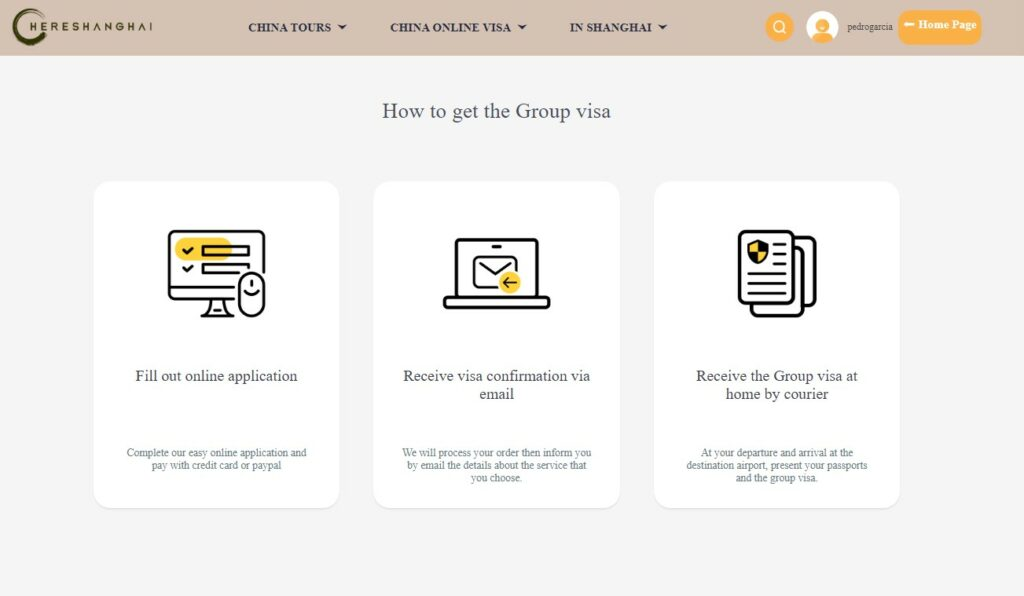
Previous questions about online visa
What requirements must be met?
- The online collective tourism visa is a visa that is issued for groups of at least 2 people and a maximum of 10. All the members of the group have to carry out the same itinerary in China, by entering and leaving the country at the same time. It is an ideal visa if you travel with family or friends and everyone will do the same itinerary.
- Entry into China must necessarily be through Shanghai, but you can travel throughout the country and exit from any other city (it is not mandatory to leave through Shanghai).
- To obtain this visa you must scan your documents and send them electronically: a copy of the passport page with your personal information, a copy of the round trip ticket (either by air or train) and a copy of the hotel reservations.
- After sending the documents online and making the payment, they will send the visa to your home address, via international courier service.
- The visa is a sheet of A4 size, which details the information of the authorized group.
- The price of the visa for Canadians is 165 euros, although it remains at 157 euros with the 5% discount if you use this link: https://www.hereshanghai.com/?inv=tNWivv
- Fingerprinting is not necessary for this type of visa.
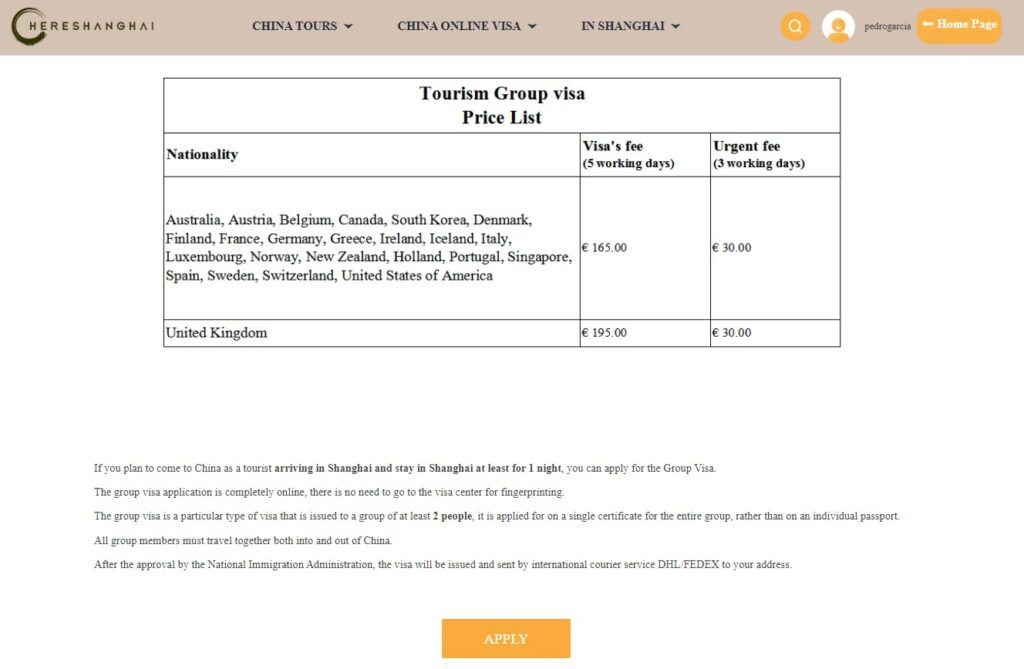
When can I begin the proceeding?
You can start requesting the visa online in around 20 days in advance. It doesn’t matter if you start applying with more days in advance, as this agency will initiate the proceeding anyway 15 days before your arrival in China.
Why do they do so? Because it is a valid visa for 30 days from the date of entry into China, which must be used within 15 days from its date of issue. The visa is valid for a single entry, so if you plan to leave China to re-enter (two entries), this visa won’t work for you.
Since you are sending the documentation, the visa takes around 3 business days, to which you have to add another 3 working days that it will take the visa to arrive to your home, through FEDEX, UPS or DHL international courier service.
- Example: if you apply for the visa on July 16th, 2024, since the expected date of entry into China is August 1st, 2024, you will receive the visa at your home around July 24th, 2024 (Wednesday). If the date of issuance of the visa is July 20th, 2024 (approximately), this would mean that you must enter China before August 3, 2024 (within 15 days of the date of issuance of the visa). If you enter China on August 1, then the validity of the visa will be until August 30 (30 days from the date of entry into China).
Here you can see a real example of group visa:

- It is a visa issued on June 4 and that must be used to enter China no later than June 18 (no problem if you enter on June 18 or before June 18, but not you can enter from June 19).
- If you enter China, for example, on June 15, then you can stay in China until July 14, since the visa has a maximum validity of 30 days. If you enter on June 18, then you can stay until July 17.
- The visa is valid for a single entry.
Next, I will explain the steps to apply and process the collective online visa:
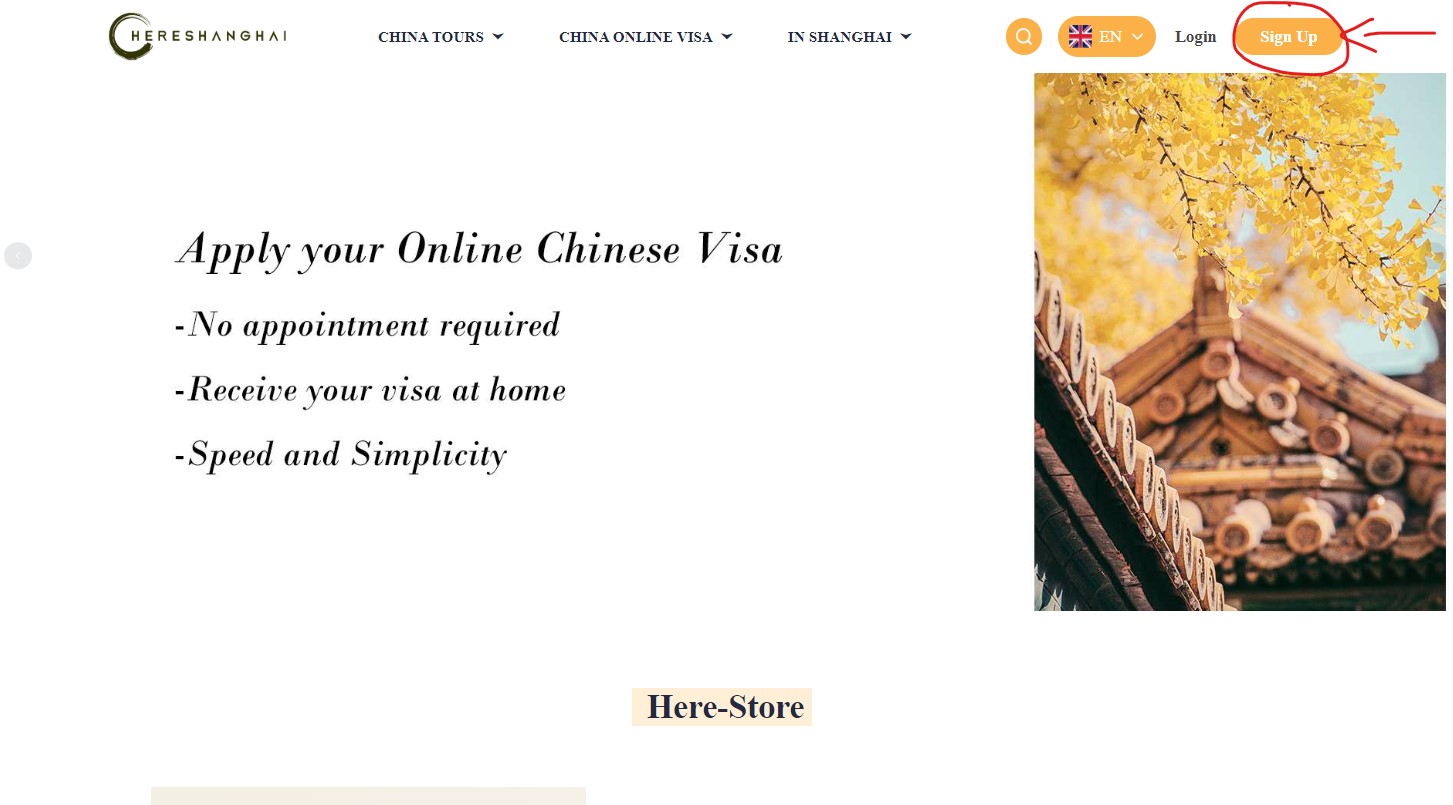
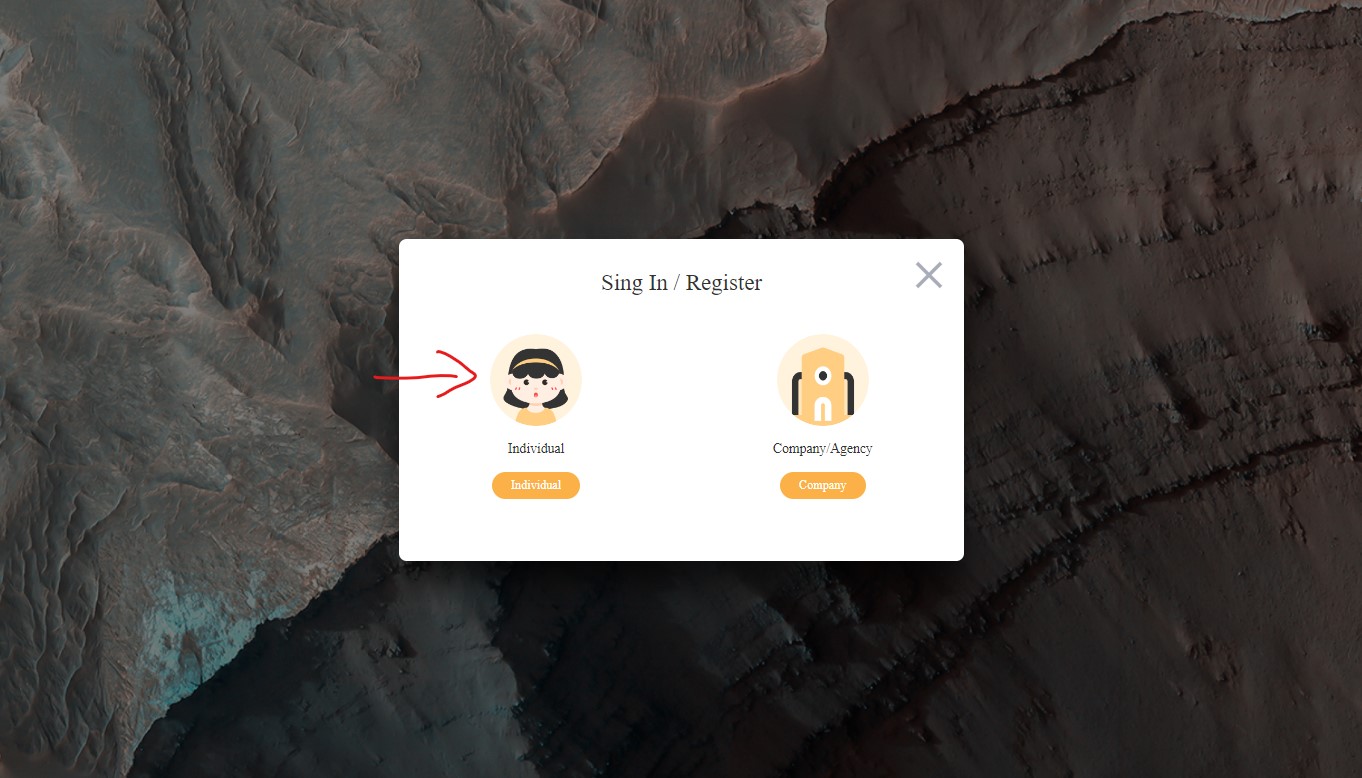
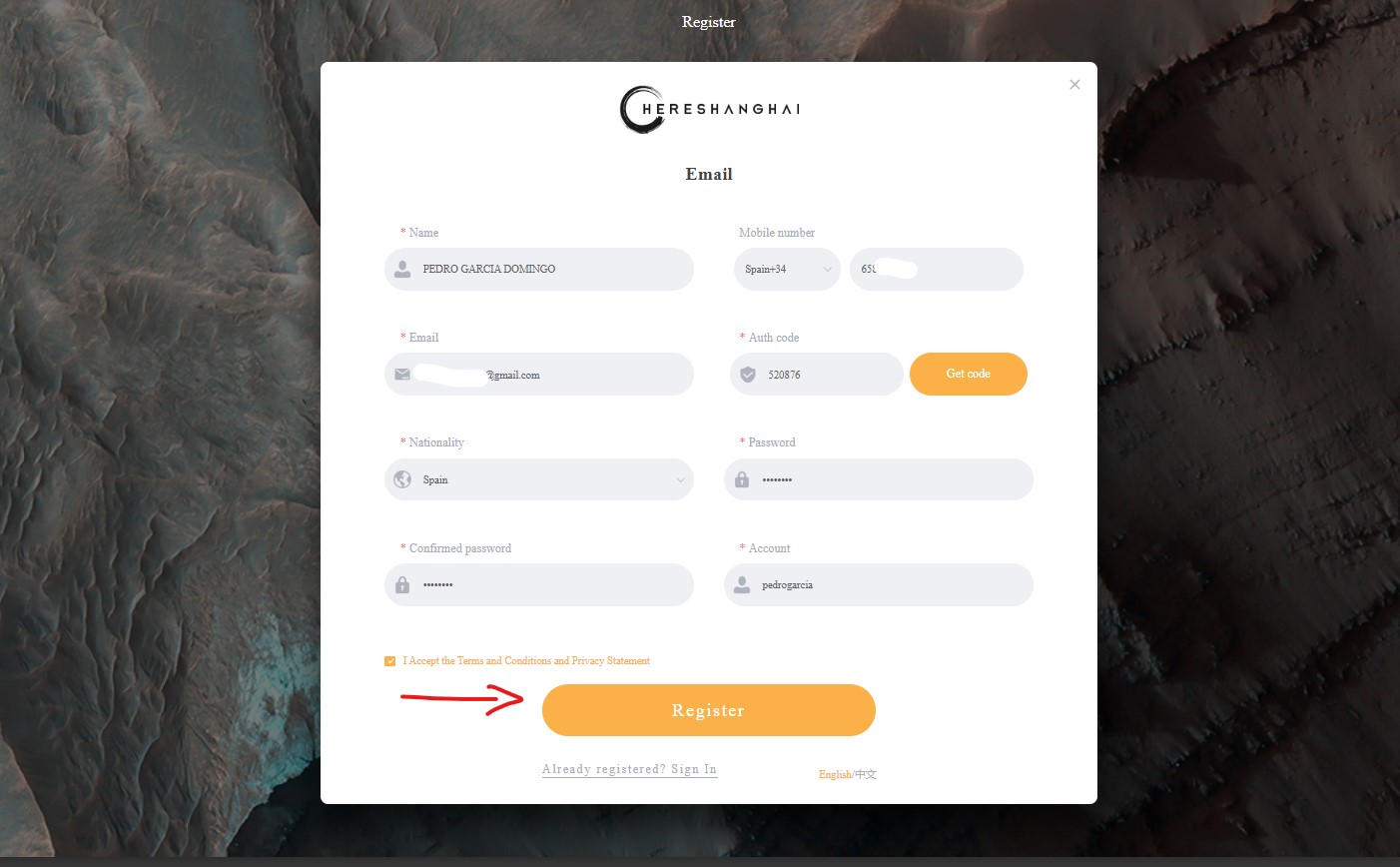
Step 1. Sign up on the platform
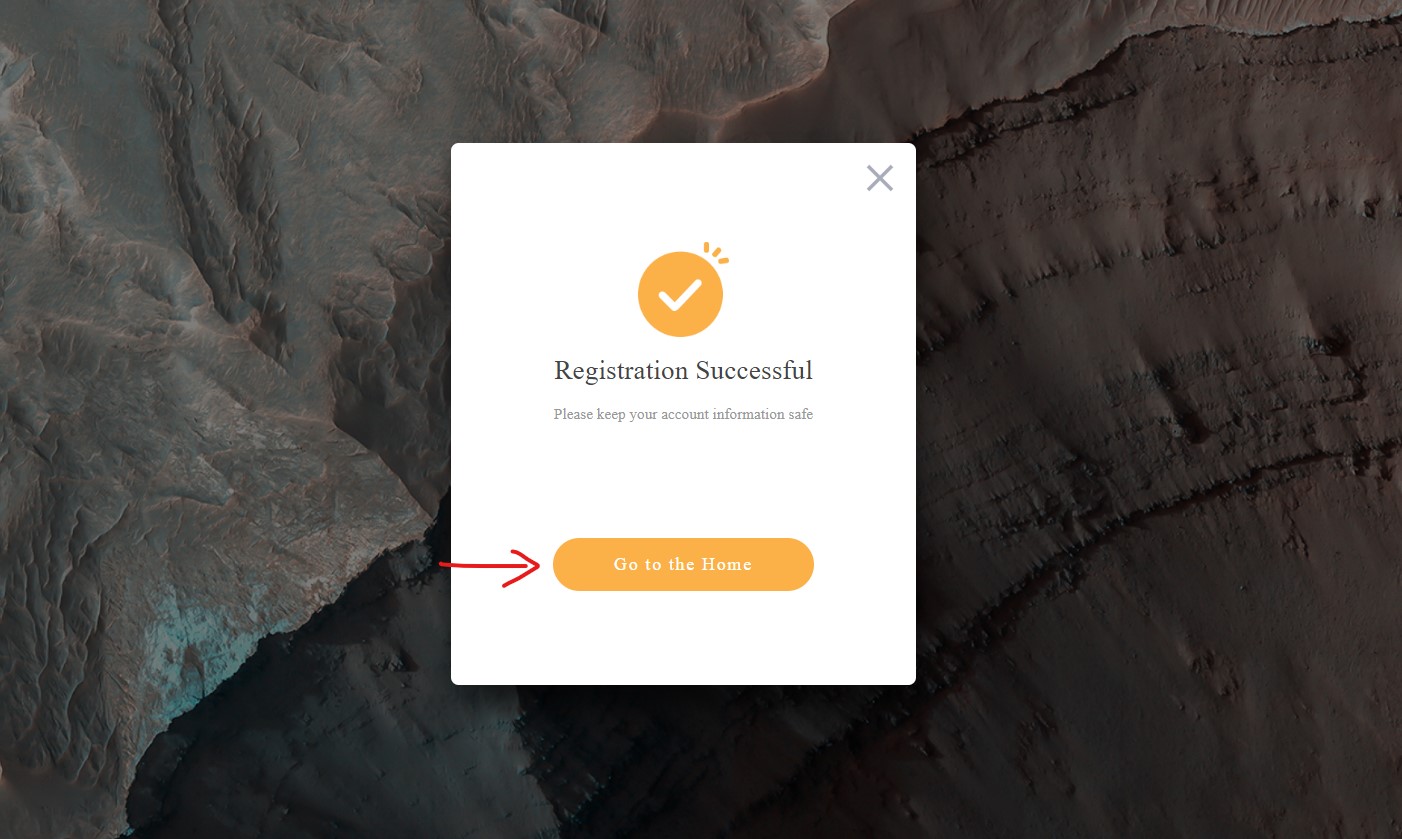
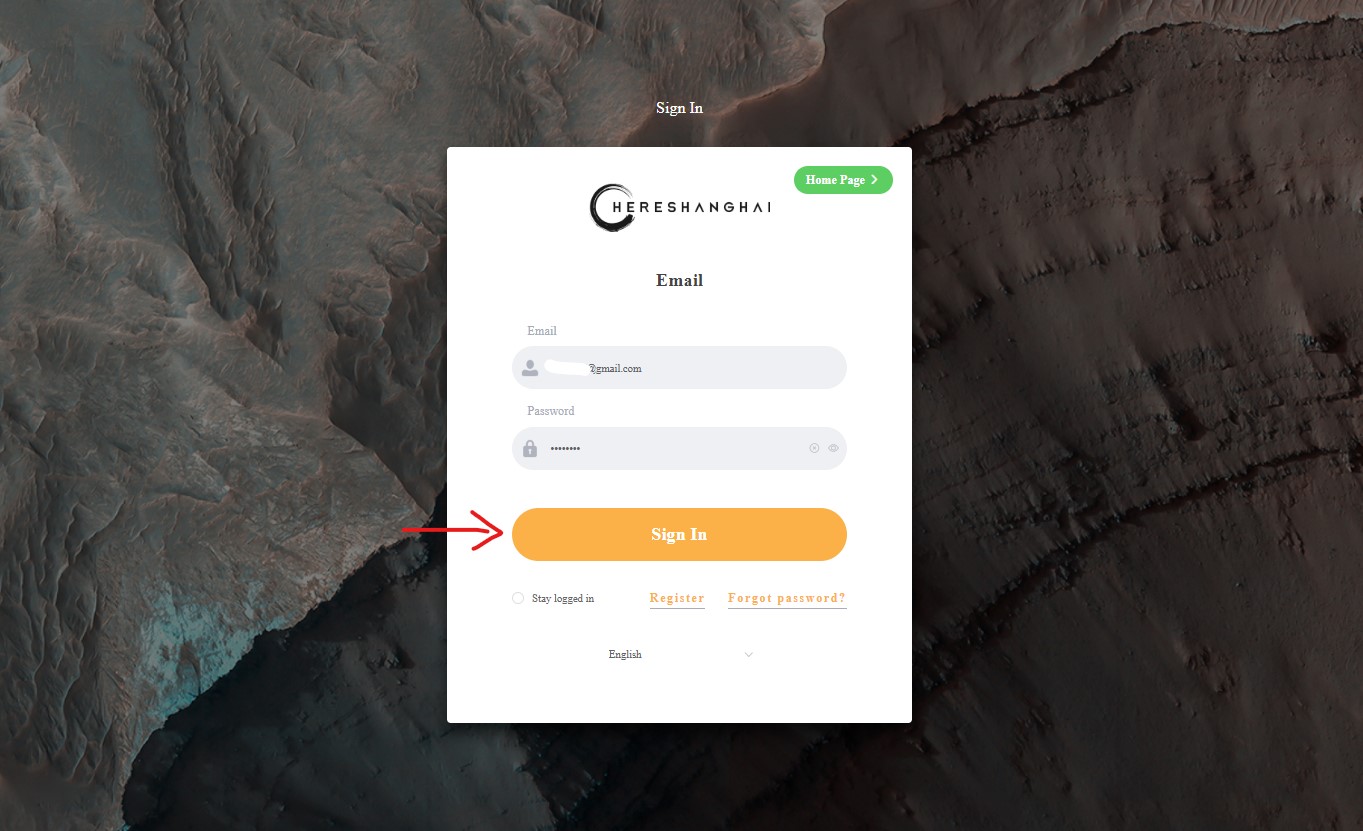
Before beginning the process of applying for a collective visa, you must register on the platform. After completing the registration form, you will be sent an email with the access data to the platform (if it does not arrive, check your email’s spam folder).
If the group leader or family head signs up, it’s enough, and he/she can be responsible for applying for all the group members, as well handling the total payment.
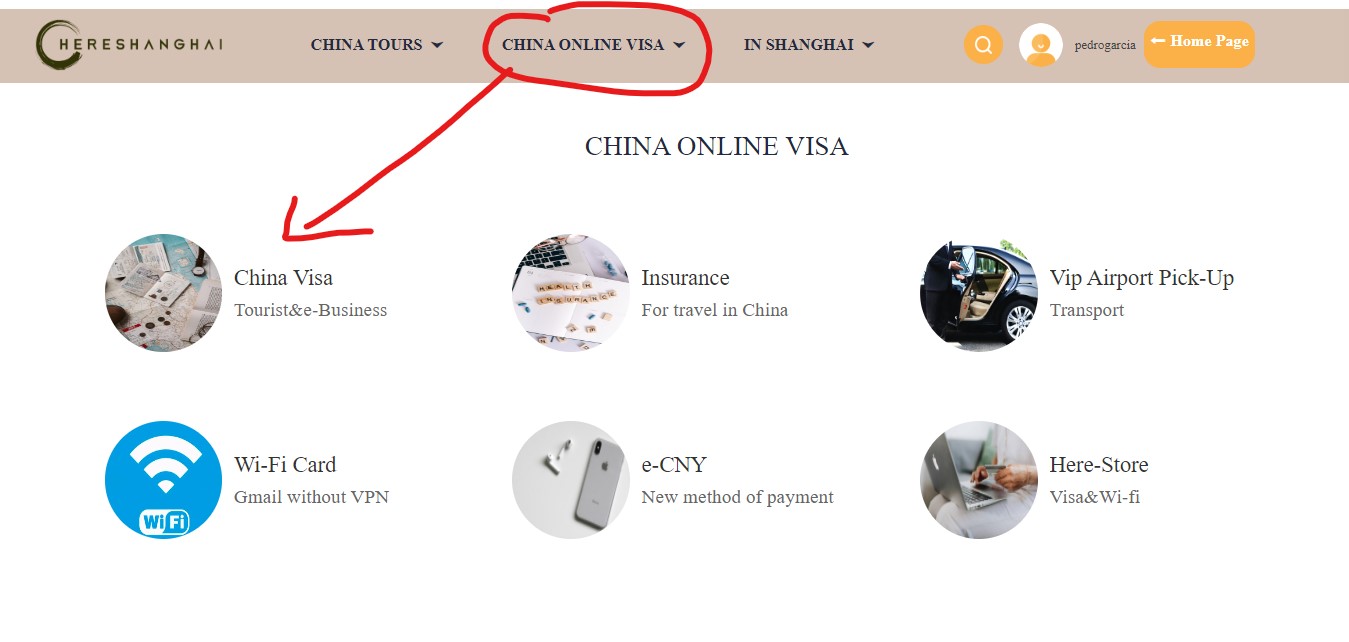
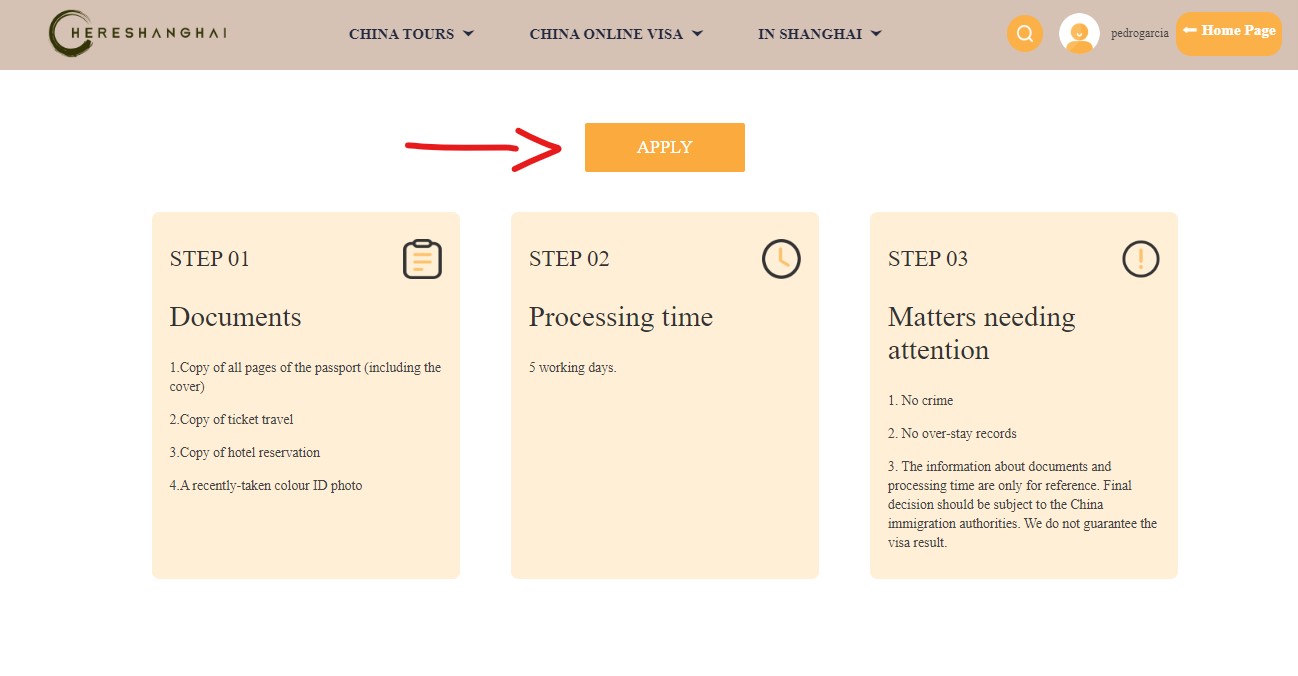
Step 2: Select the type of visa
You select the type of visa, in this case, group visa:

Step 3. Enter personal information and send the online documentation
In this step you will have to enter the personal information and attach the travel documentation of each member of the group. It is very important that you review and check the personal information carefully, as the issued visa will be based on this data. There is a field in which you can specify a different shipping address, if different to home address.
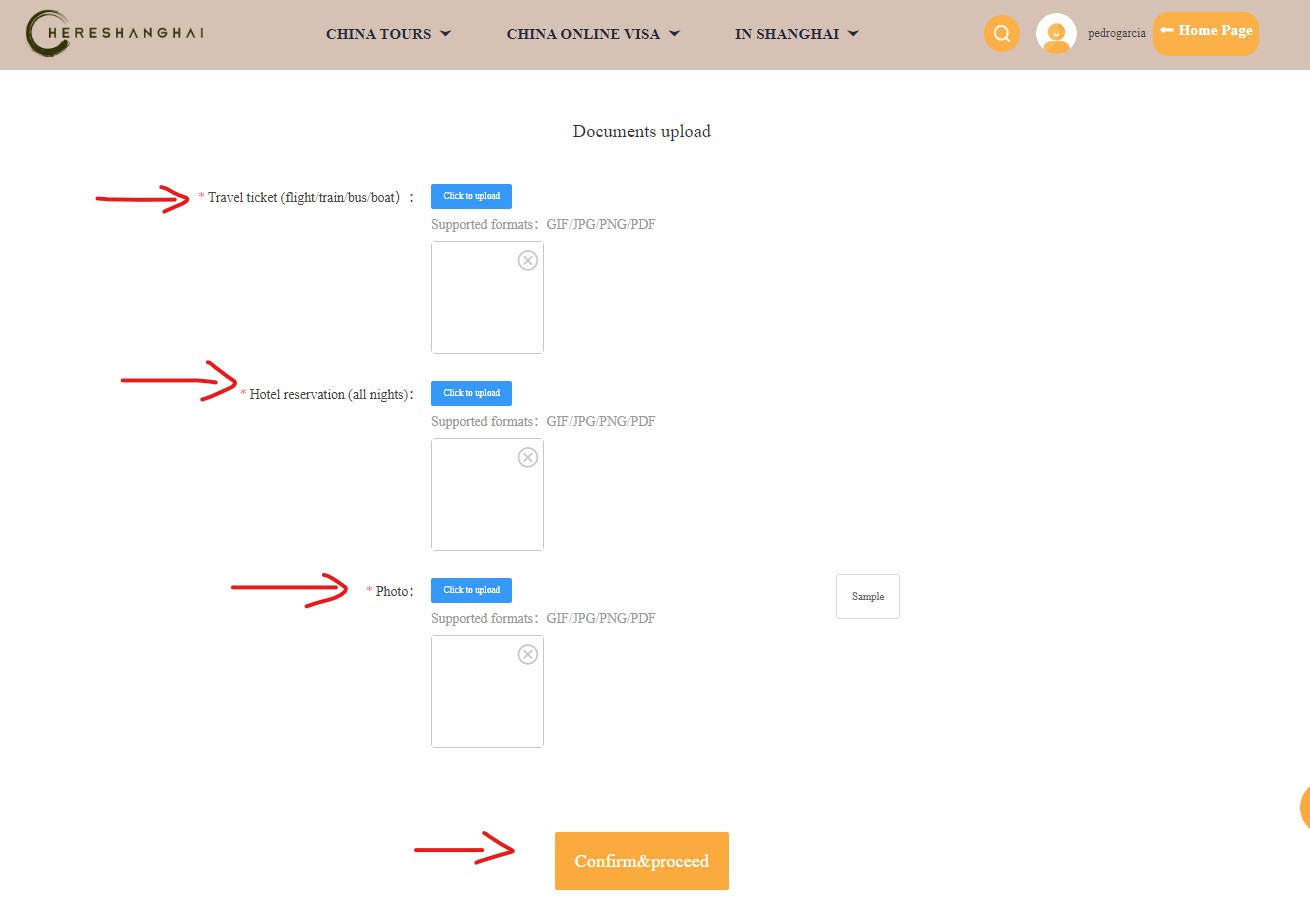
As for the documents, it is the same that you request at the consulate, just that in this case you have to send electronically (PDF, JPG, PNG or GIF):
- A recent color photo
- Passport page containing your personal information
- Airline (or train) tickets
- Hotel reservations for the duration of the trip.
Note that:
- You can only send one file for each document, so if, for example, you have several hotel reservations in separate files, put them together in a single file.
- Once you fill in the details of the first traveler, you can add the details of the rest of the travelers using the “Add another passenger” button.
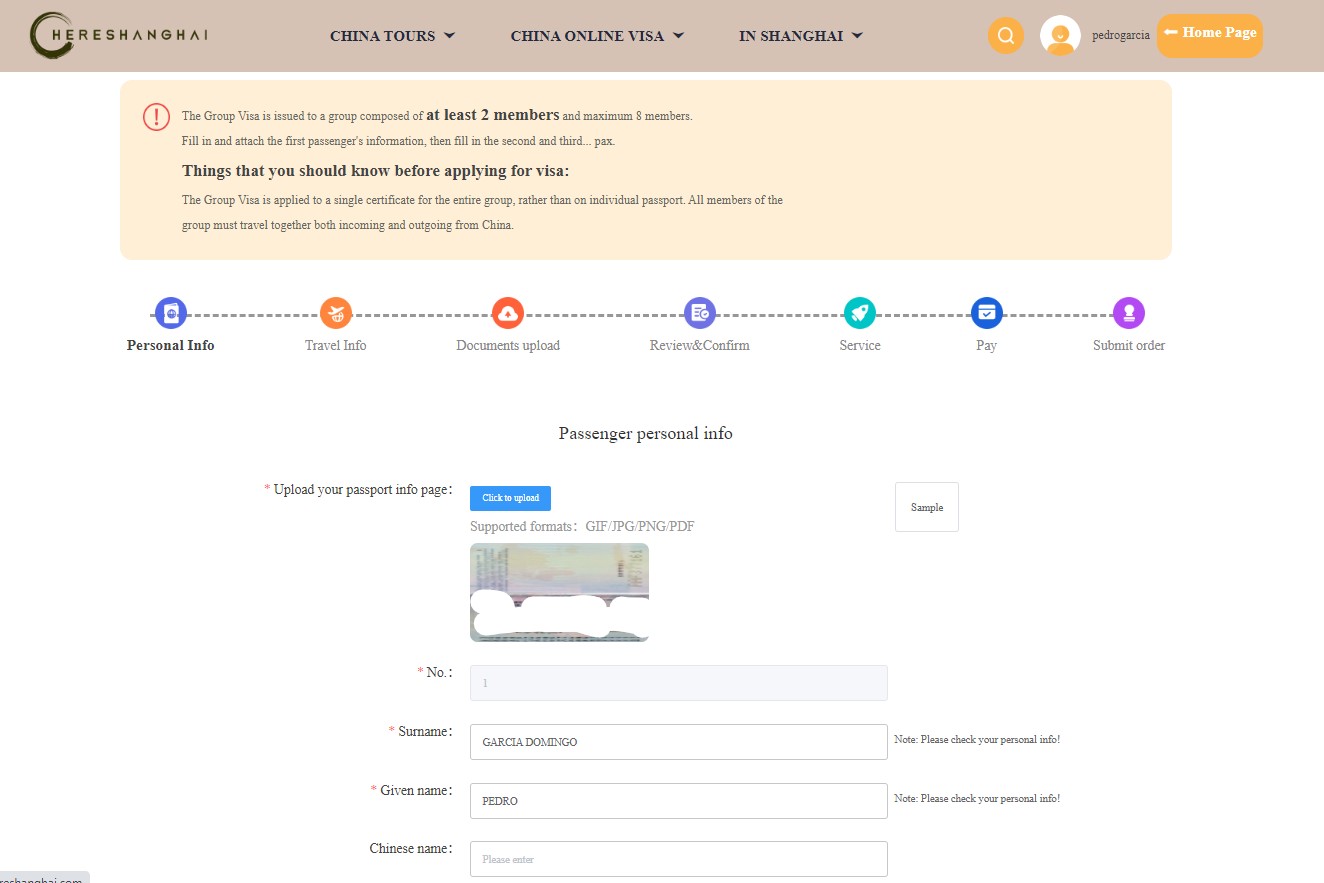
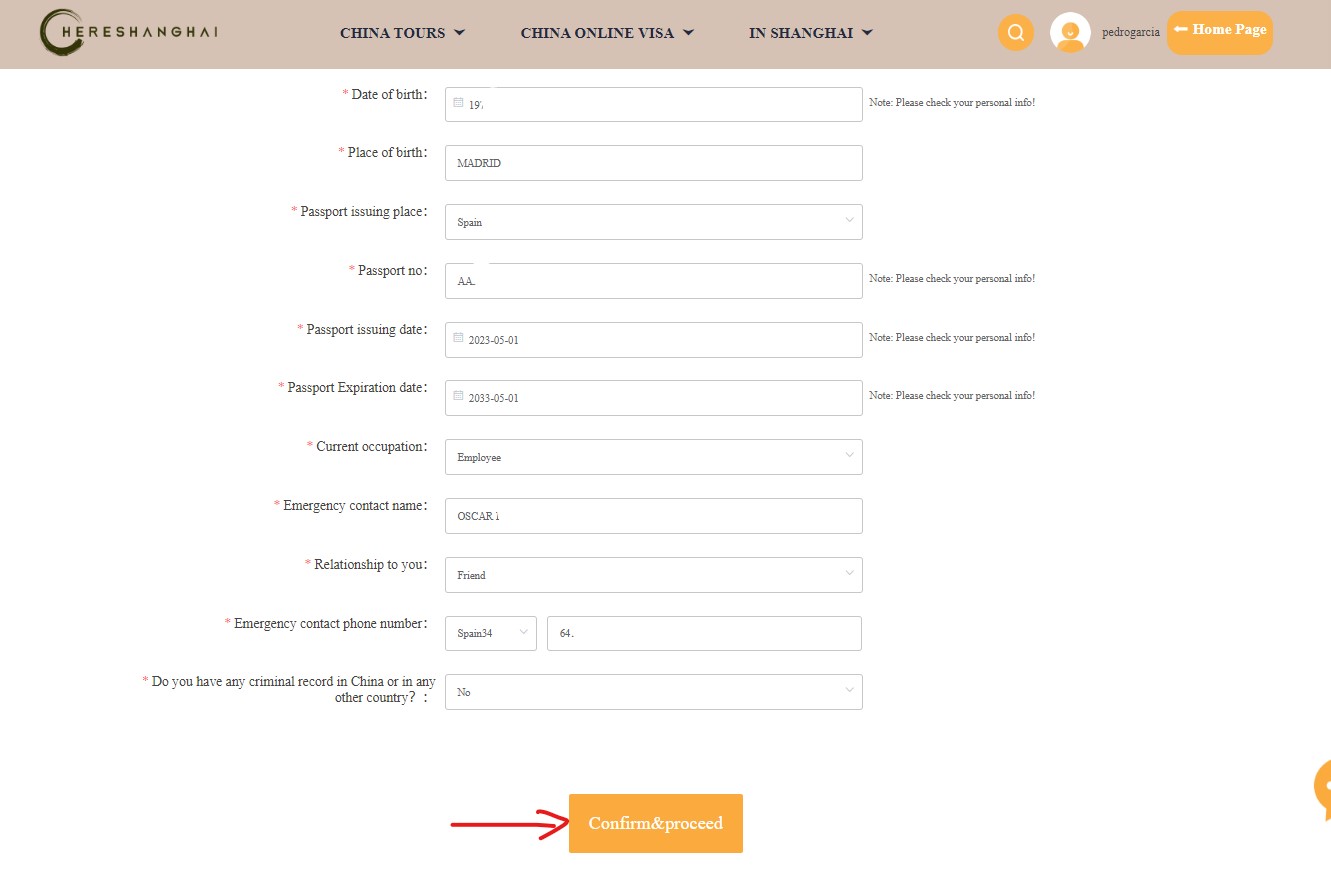
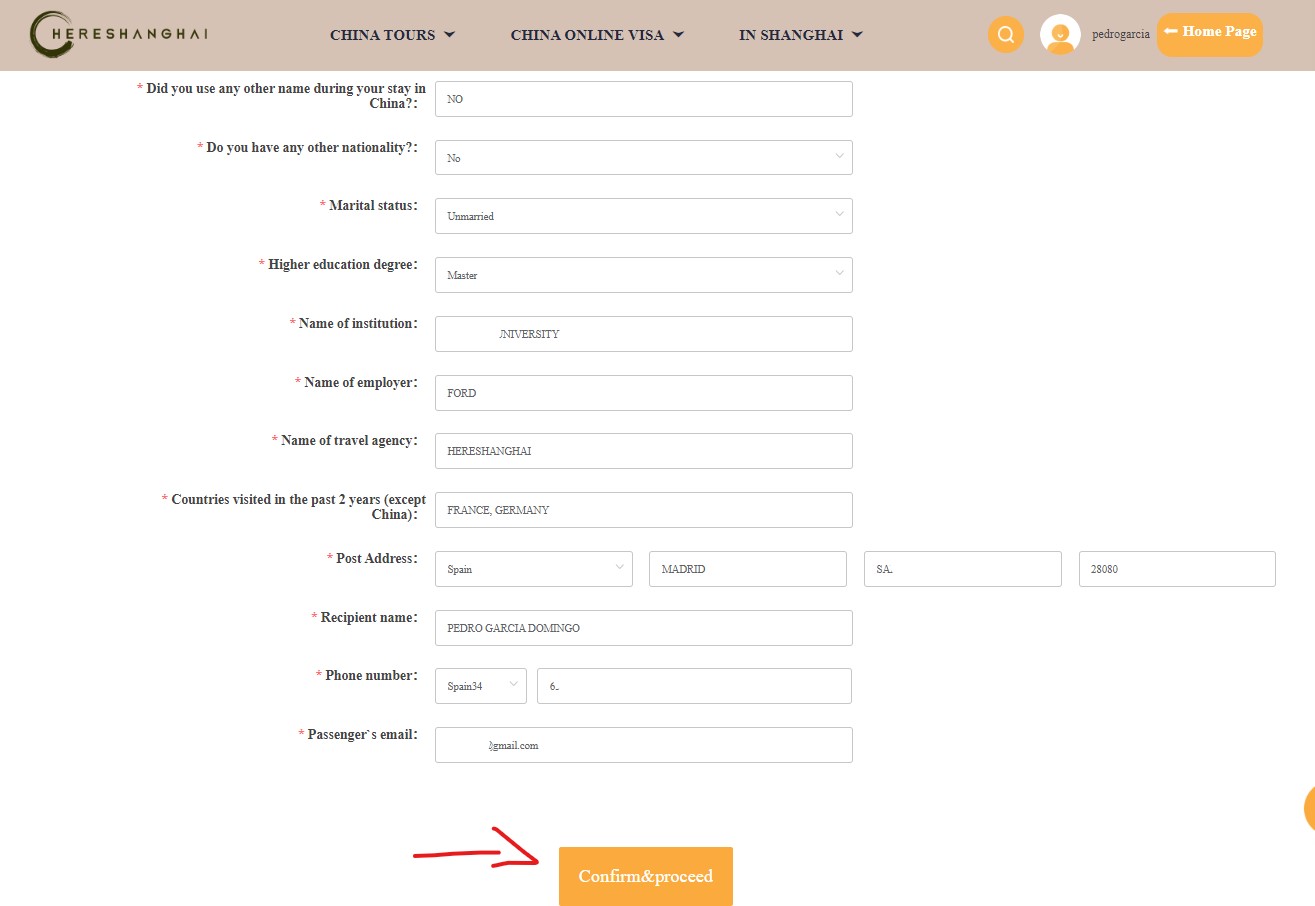
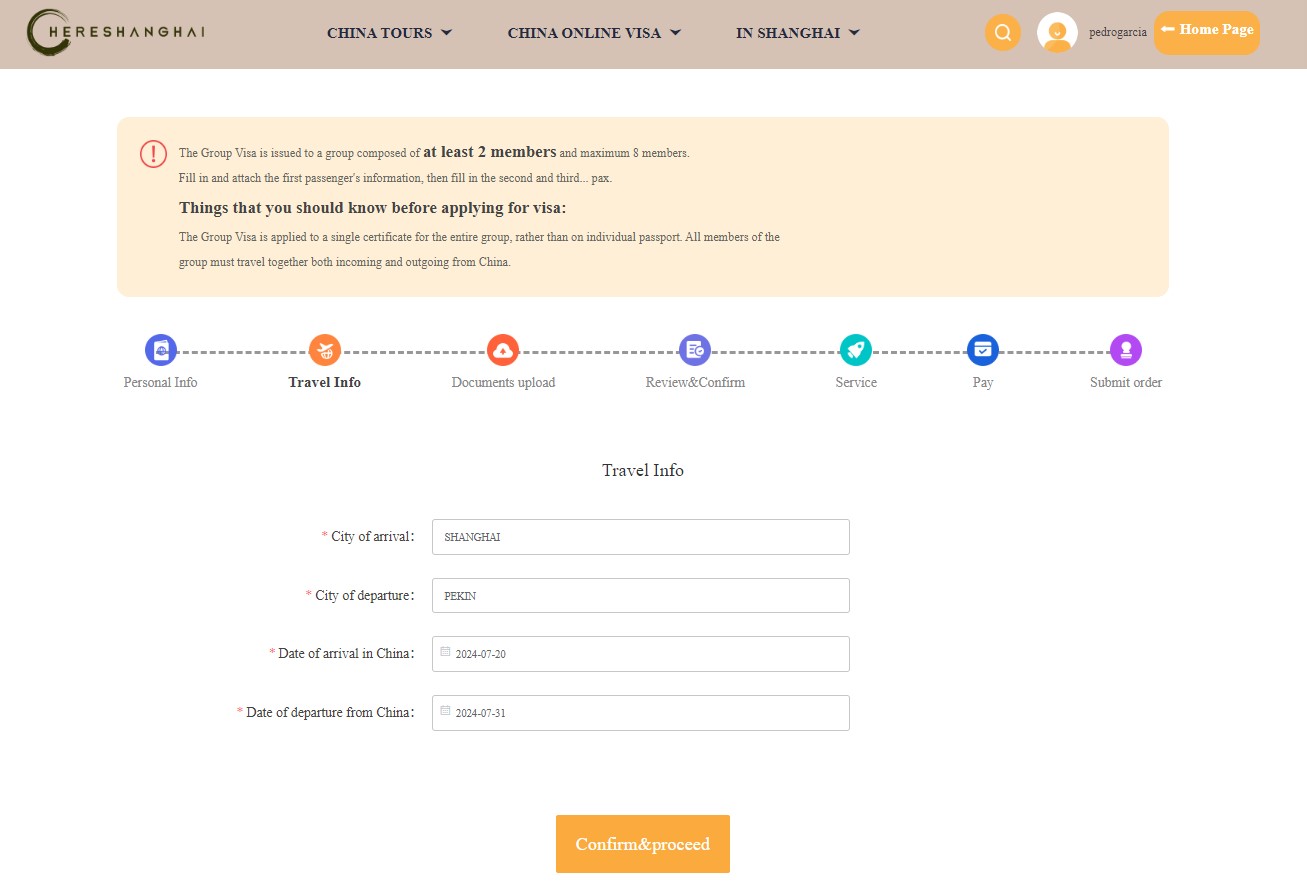
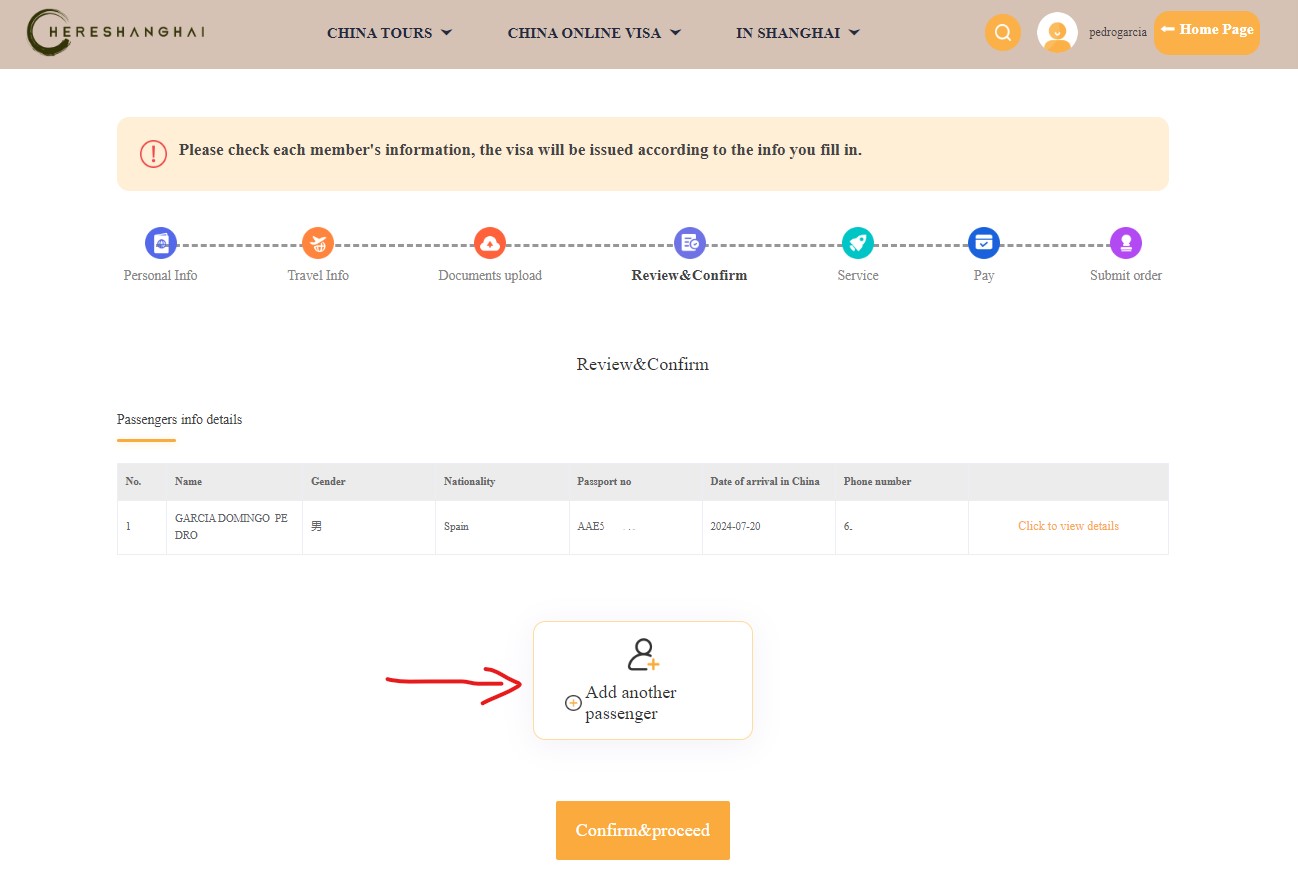
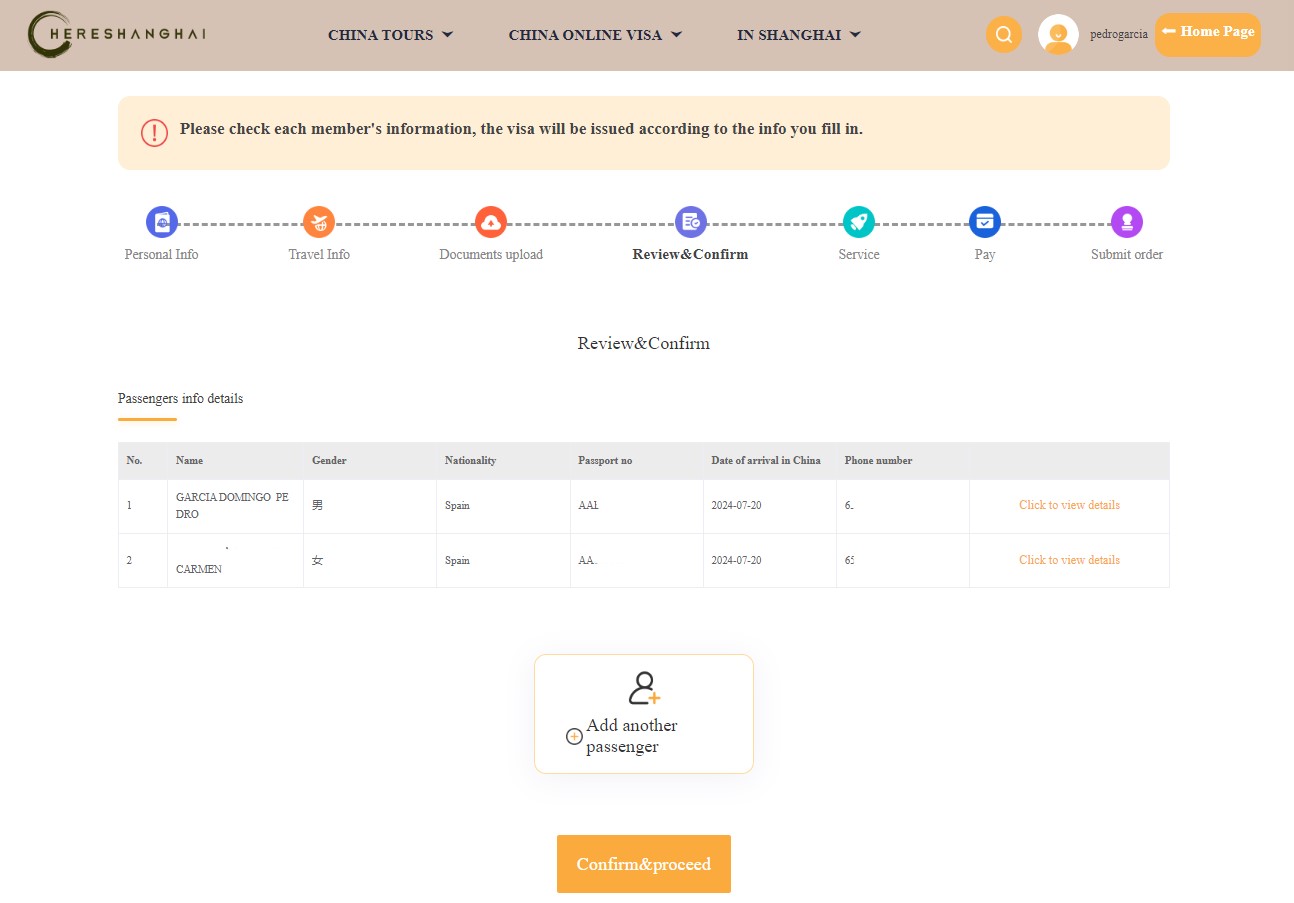
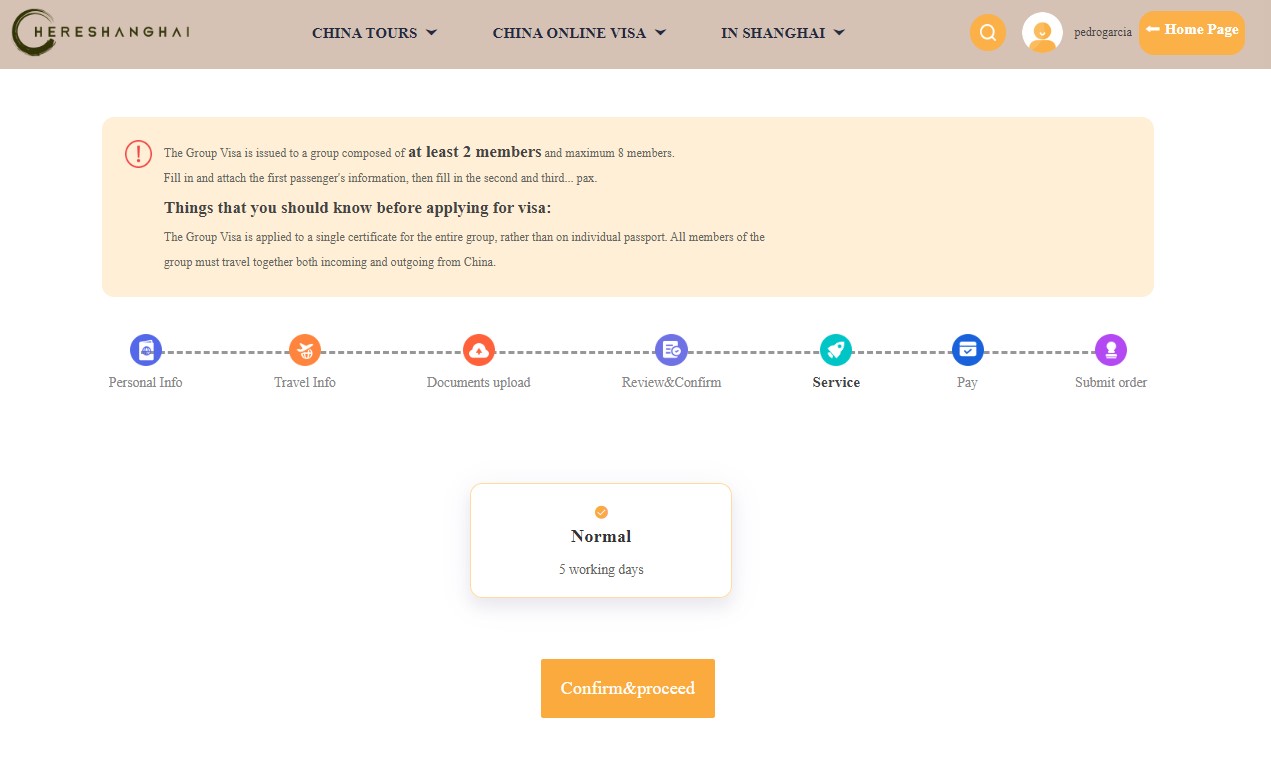
Next, you should check thoroughly that all the information is correct and, if so, click on the “Confirm” button. It is very important to review and verify the information thoroughly before clicking on the “Confirm” button, since once confirmed, you will not be able to change it. If you need to make a change, you have to press the “Modify” button.
Step 4. Visa confirmation by email and payment
Once they review your request, they will send you an email to make the payment, which you can make by card or PayPal.
The payment includes visa fees, agency management fees and shipping costs of sending the visa by international courier, either by FEDEX, UPS or DHL.
After the completion of the payment you will receive an email confirmation and you can track your visa on your website.
Step 5. Receiving the visa
The collective visa will arrive at the home address of the group leader, meaning the person who has been responsible for all the proceeding management (unless during the application process you have indicated another different address in which it is more convenient to receive the visa). This is an example of how the visa looks:

The visa will be requested upon your entry to China. If you see that the customs officer goes to look for the visa in your passport, you can tell him/her that this is a group visa and that it comes on a separate sheet. Upon leaving the country, customs will keep the visa. Therefore, in your passport there will be no trace of your passage through China.
2. THE CHINESE VISA PROCEEDING IN THE CHINESE VISA APPLICATION SERVICE CENTER (CVASC)
With a few exceptions, which you can check on the website of the Government of Canada, Canadians must apply for a visa to travel to China. There are many types of visa, depending on the purpose of the trip: tourism visa, business visa, transit visa, study visa, work visa, etc. Next, I will explain step by step how to process the tourist visa to China in Canada.
Prior considerations in order to understand the Chinese visa process
Before beginning in explain in detail each of the steps to follow to apply for the tourist visa to China in Canada, it is convenient to answer some basic questions to better understand the application process.
When is the right moment to begin the procedure?
It is advisable to begin the visa application process between 30 and 45 days before your date of entry into China. You can apply for your visa up to 3 months in advance, but it is not advisable to do it in a rush, as I will explain later, the validity of the visa begins to count from when the consulate issues the visa.
When will I receive my visa?
If you complete the proceeding in person and submit all the required documentation correctly, you will have the visa in around 4 working days. However, keep in mind that the number of processing days may vary, depending on the time of year and the existing demand, but on average it’s around 4 working days. This period can be shortened if you use the Express (3 working days) or Rush procedure (2 working days), paying more.
- Example: if you submit the documents on a Wednesday, your visa will probably be ready on Tuesday of the following week.
If you carry out the remote proceeding through the courier service of the CVASC, the processing time is 10 business days.
- Example: If you send the documents via courier on a Wednesday, you will receive the passport with the visa back at your home in about two calendar weeks (maybe less, depending on your place of residence).
What is the period of validity of the visa?
The period of validity of the visa refers to the period that elapses between the date of issuance of the visa (when you submit your application) and the expiration date of the visa. It is the period during which you can enter China. It can be 3 months, 6 months or 1 year. As I explain later, this does not mean you can stay 3, 6 or 12 months in China.
- Example: if you plan to enter China on August 1st, 2024 and you submit the correct documentation in person at the CVASC on July 1st, 2024, your visa should be issued and ready by July 7th, 2024 (add 7 more days if you are doing the proceeding by courier). Your visa would be valid for 3 months from the date of issue, approximately, from July 1st, 2024 to October 1st, 2024 (3 months).
What is the maximum duration of the stay?
The duration of the stay refers to the period that you can stay in China since you entered the country. On a tourist visa (one entry visa) with a validity period of 3 months, the maximum period of stay is 30 days.
- Example: if your visa is valid from July 1st, 2024 to October 1st, 2024, and you enter China on August 1, 2024, you can stay in China for a maximum of 30 days, meaning till August 30th. If you enter China on September 11th and the period of validity ends on October 1st, then you can only stay in China for 20 days.
Both the period of validity of the visa and the duration of the stay are indicated in the visa. Below is an example of how a 3-month tourist visa (one entry visa) and a 30-day stay duration look:
The information that is indicated in the visa is the following:
- Visa category: L (tourism)
- Validity: 3 months, from October 6th, 2015 to January 6th, 2016.
- Issuance date: October 6th, 2015
- Name of visa holder
- Birthdate
- Number of allowed entries: 01 (in the next section, I explain what this means)
- Duration of stay: 30 days after entering
- Place of issue
- Passport number
What does the number of entries refer to?
One important concept is the number of entries, which refers to the times you can enter China during the validity period of the visa. Thus, the visa can be of:
- Single entry. The most common type is the single entry visa, through which you can only enter China once. It does not matter if you enter China through Beijing and you leave through another city like Shanghai, since in this case you would only enter China once. The single entry tourist visa is valid for 3 months (just like the previous image).
- Double entry. It means that you can enter China twice. For example, if you enter China and stay in the country for a few days and then want to visit another country (for example, Laos, Vietnam, Mongolia, Nepal, India, or Japan), the double entry visa will allow you to re-enter China during the validity period of your visa. The double entry visa is valid for 3 to 6 months from the date of issue. Below is an example of a double-entry business visa (the tourism one-entry visa would be the same, but it would indicate L instead of M). Note that the stay period is 6 months (from October 6th, 2015 to April 6th, 2016) and that the duration of each stay (every time you enter China) is 30 days, meaning that you can stay for 30 days every time you enter China (in total, you can stay a maximum of 60 days in China, 30 days for each time you enter).
IMPORTANT: the visa entitles you to enter Mainland China, which refers to the area of China under the effective sovereignty of the People’s Republic of China, but doesn’t include the special administrative regions of Hong Kong and Macao (former European colonies). This means that if during your trip in China you want to visit Hong Kong (or Macao), and re-enter China, you will need a two-entry visa.
- Multiple entries. The multiple entry visa is the one that allows you to enter China as many times as you want during the validity period of the visa. It is valid for 6 months to 1 year (or even longer, up to 10 years). As you can see in the screenshot below, in the “Entries” section, M is indicated (which means multiple entries). For every time you enter China during the validity period of the visa, you can be there for 30 days.
China’s 10-Year Visas
Starting from March 2015, China announced that multiple-entry L (tourist visa), M (business visa), Q2 (family visit visa), and S2 (short-term Private Visit Visa) with the validity for up to 10 years (not exceeding the life of the passport) would be issued to citizens of Canada. The duration of stay is 60 days per entry for tourist and business visas.
Note that the validity of visa depends on the validity of the applicant’s passport.
If you’ll be traveling to China frequently for tourism or business, this 10-year travel visa will keep you from having to apply for a new visa every single time you make a trip. Note that the fee for a 10-year visa is exactly the same than for other types of visas for shorter stays
The application requirements are the same. The only time you need to provide travel documents (proof of round trip tickets, hotel reservations, etc.) is when you’re first applying for the visa. Once you actually get the visa, you have the right to enter China at any time for the duration of the visa.
Example:

Now that all these concepts have been clarified, I will explain you step by step how to process the tourist visa to China in Canada.
Step 1. Have a passport

In order to obtain the Chinese visa, the first thing you will need is a passport that meets the following conditions:
- Must have a minimum validity of 6 months from the day you submit the visa application. For example, if you apply for a visa on July 1st, 2024, your passport must have a validity date beyond January 1st, 2025.
- Your passport must have at least two blank pages, in order to place the visa there.
- Your passport must not present any type of deterioration such as being torn on the cover, be stained or having broken pages. In these cases it is better to renew the passport before applying for the visa, since in the consulate they are usually very strict and they won’t approve the visa if the passport is damaged.
Other things to keep in mind about the passport are:
- To apply for the visa you must submit (or send by courier) your original passport, which will remain in the hands of the Consulate for a few days. This is because the visa will be attached to one of the pages of your passport.
- In addition to the original passport, you must also send a photocopy of the passport page indicating your personal information and photo.
Step 2. Buy tickets for plane, train or other means of transport
Secondly, to process the visa it is mandatory to present a copy of the round trip tickets of the means of transport that you will use to enter and leave China, whether it is by plane, train or bus.
- If you travel to China by plane, the best prices are usually found around three months before reserving your trip. Some companies, such as Air Canada, Air China or Hainan Airlines, offer non-stop direct flights from Canada to China, but there are many other companies with which you can fly on stopovers. Once you have purchased the ticket, you must print it:
- If you enter or depart by train from China, you must also submit a copy of the train tickets.
- However, it is not necessary to present the tickets of the trips that you are going to make in the countryside (for example, if you plan to travel by train from Beijing to Shanghai, it is not necessary to present the train ticket).
Some advices:
- Check your airline’s refund policy- if you’re not confident about your visa application it may be wise to pay a little extra for a refundable ticket.
- Additionally, some insurers might offer a ‘cancel for visa denied’ benefit but you’ll have to pay more for this type of cover.
Step 3. Make hotel reservations
The Chinese authorities want to know where you will be at each moment and what will be your itinerary. For this reason, in addition to airline or train tickets, they will also request documentation that justifies the itinerary you are going to make (and that, as I show you later, you must indicate in the application form).
If you are travelling on your own and you will stay in hotels…
The most common case is when you are travelling independently and you will stay in hotels. In this case, all hotel reservations must be presented and must cover the entire duration of the trip.
The most practical thing is to make all hotel reservations through Booking platform, in those accommodations that allow free cancellation. This way, once you have obtained the visa, you can change your hotel reservations for others; in the event that your travel plans change or you find another hotel that best suits your needs.
In the following screenshot you can see an example of a confirmed Booking reservation with free cancellation. It is enough that the name of the person making the reservation appears (this name, if necessary, can also be modified from Booking’s personal area):

If you are travelling with an agency…
If you are going to China with a travel agency with an organized tour, they can issue an invitation letter that should contain your information, the itinerary you will have, hotels you will stay in and the information of the agency that is inviting you.
If you are visiting Chinese friends or resident foreigners in China …
In this case, you must ask your friend to write you an invitation letter with your information, information about the visit (arrival and departure days, places to visit, relationship between the applicant and the person who invites), as well as their personal information (name, phone, address in China and signature).
Step 4. Fill out the application form
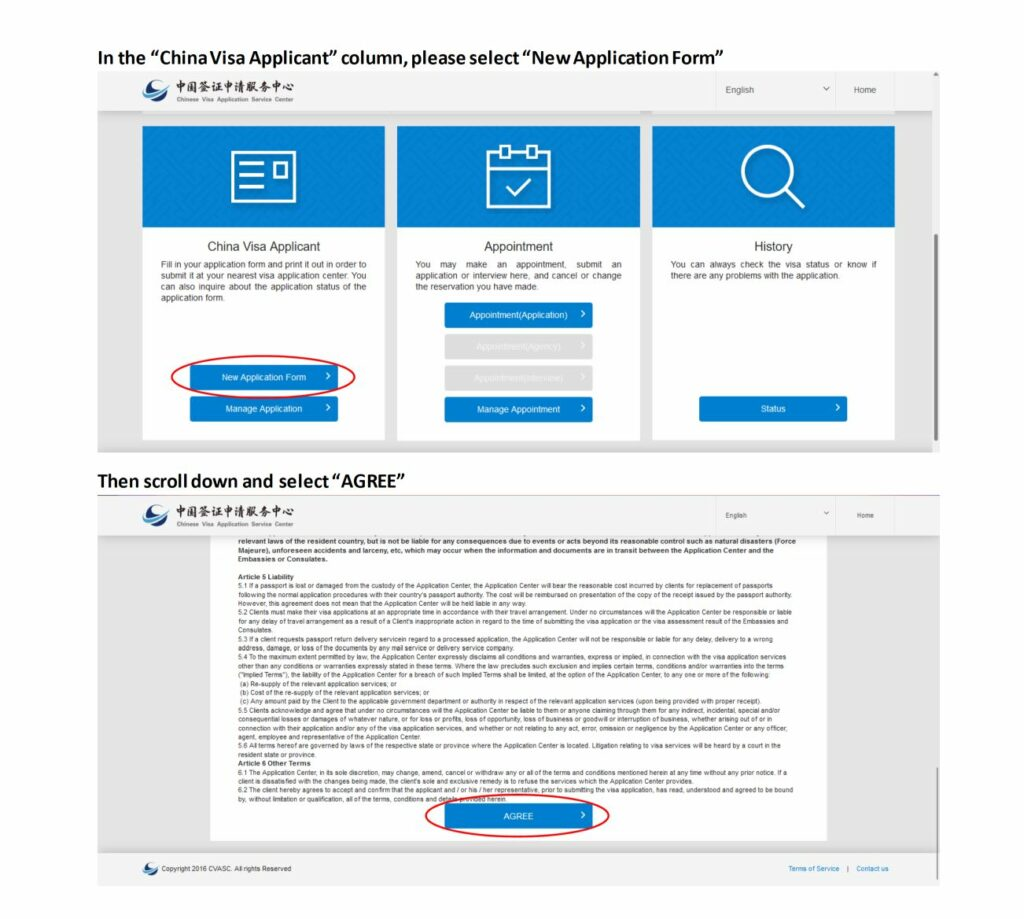
Once you have the previous documentation (passport, tickets and hotel reservations), you can fill out the application form. You must do it electronically by using computer. In regards to the electronic form you should consider that:
- After completing it electronically, you must print it.
- Each person with a passport must fill out a different form. If you have minor children, you must fill out the form and sign it for them (both the father and the mother).
- During the completion it is important to write down your application number, in order to recover the form, in case you have not completed it at all or in the case that you have made a mistake in some section and have to correct it.
- The form is saved electronically for 30 days.
- If after printing it, you have to correct a section, and you can’t recover the previous form, you will have to fill in a new form and reprint it (there is no problem in filling out a new form, even if you had filled another one before).
Let’s see how to fill out the form:
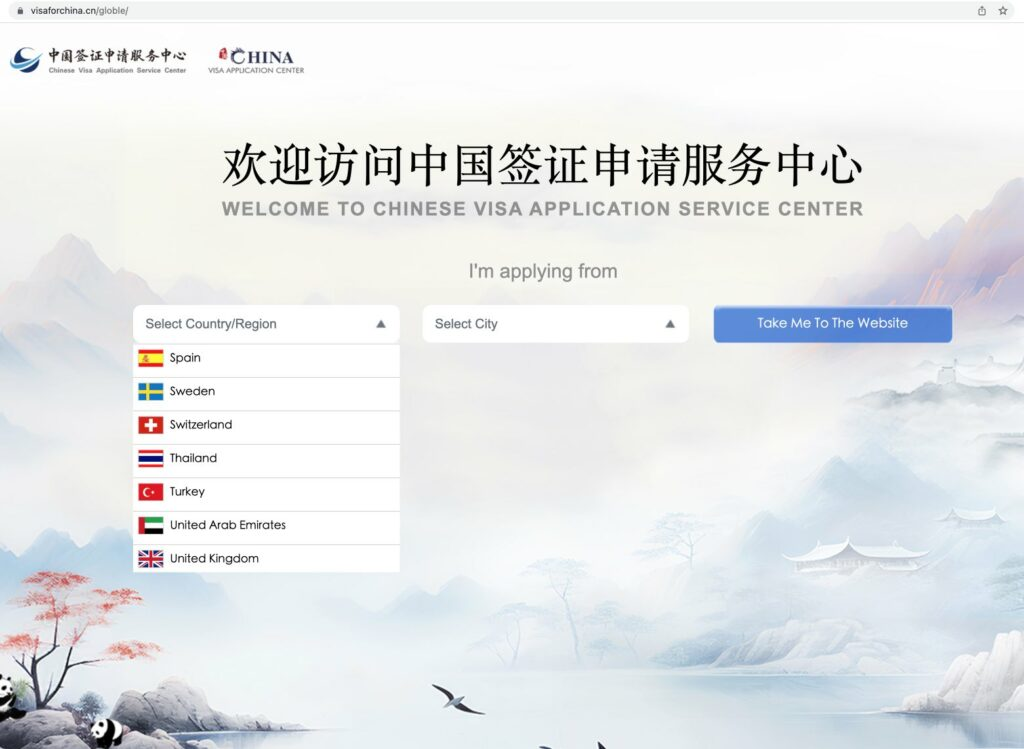
Access the CVASC website. You will see that you can choose between the centers of Canberra, Sydney, Melbourne, Perth or Brisbane. You must choose the center that is in your consular district. Service areas of the Visa Centres:
- CVASC Vancouver: the province of British Columbia and the Yukon Territory of Canada
- CVASC Toronto: provinces of Ontario and Manitoba
- CVASC Calgary: Alberta, Saskatchewan, and Northwest Territories
- CVASC Montreal: Quebec and New Brunswick
- CVASC Ottawa: Ottawa Region (613 or 343 area code), Gatineau (QC), Prince Edward Island, Nova Scotia, Newfoundland and Labrador, Nunavut.
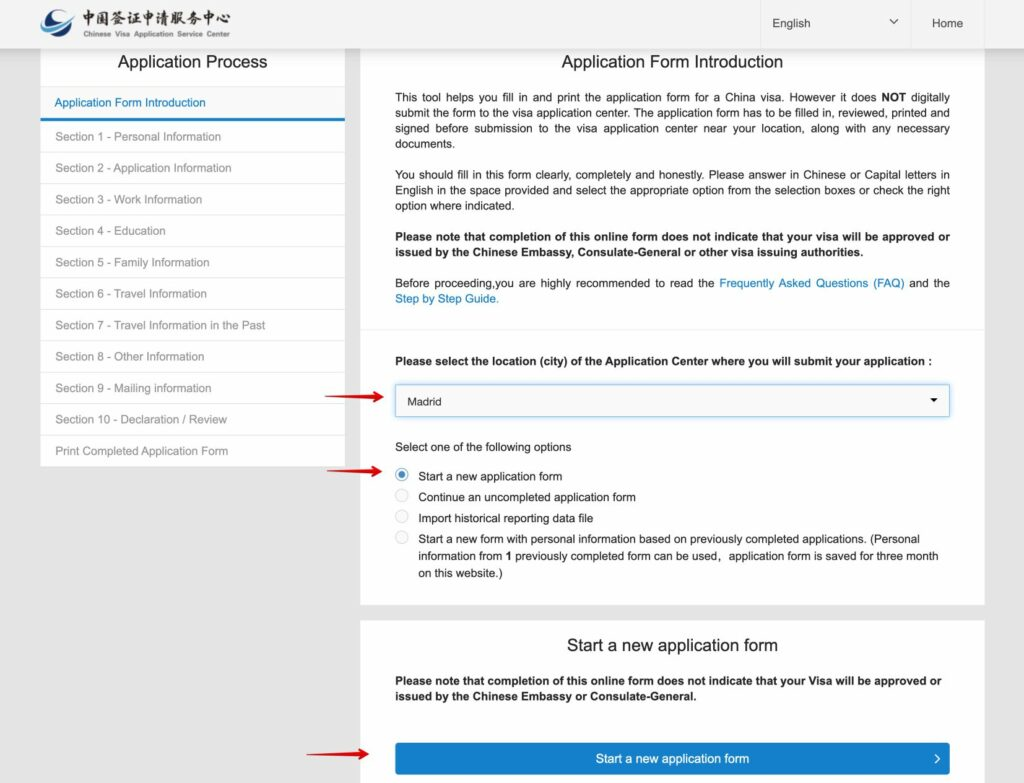
Section 1. Personal information
- The form number will appear first: write it down in case you want to recover it later.
- Depending on each person’s circumstances, the answers to some of the questions will have to be marked as “Not applicable” (for example, if you have not had a previous nationality).
- Fill in your personal details exactly as they appear in your passport.
- Upload a recent photo.
- Fill in your personal information: date of birth, gender, place of birth, marital status, etc.
- If you were born in China or have had Chinese nationality, you must also indicate it on the form.
- You must also fill out your passport details: type of passport (usually ordinary), number, place of issue, authority that issues it (Passport Program of Immigration, Refugees and Citizenship Canada), date of issue and expiration date.
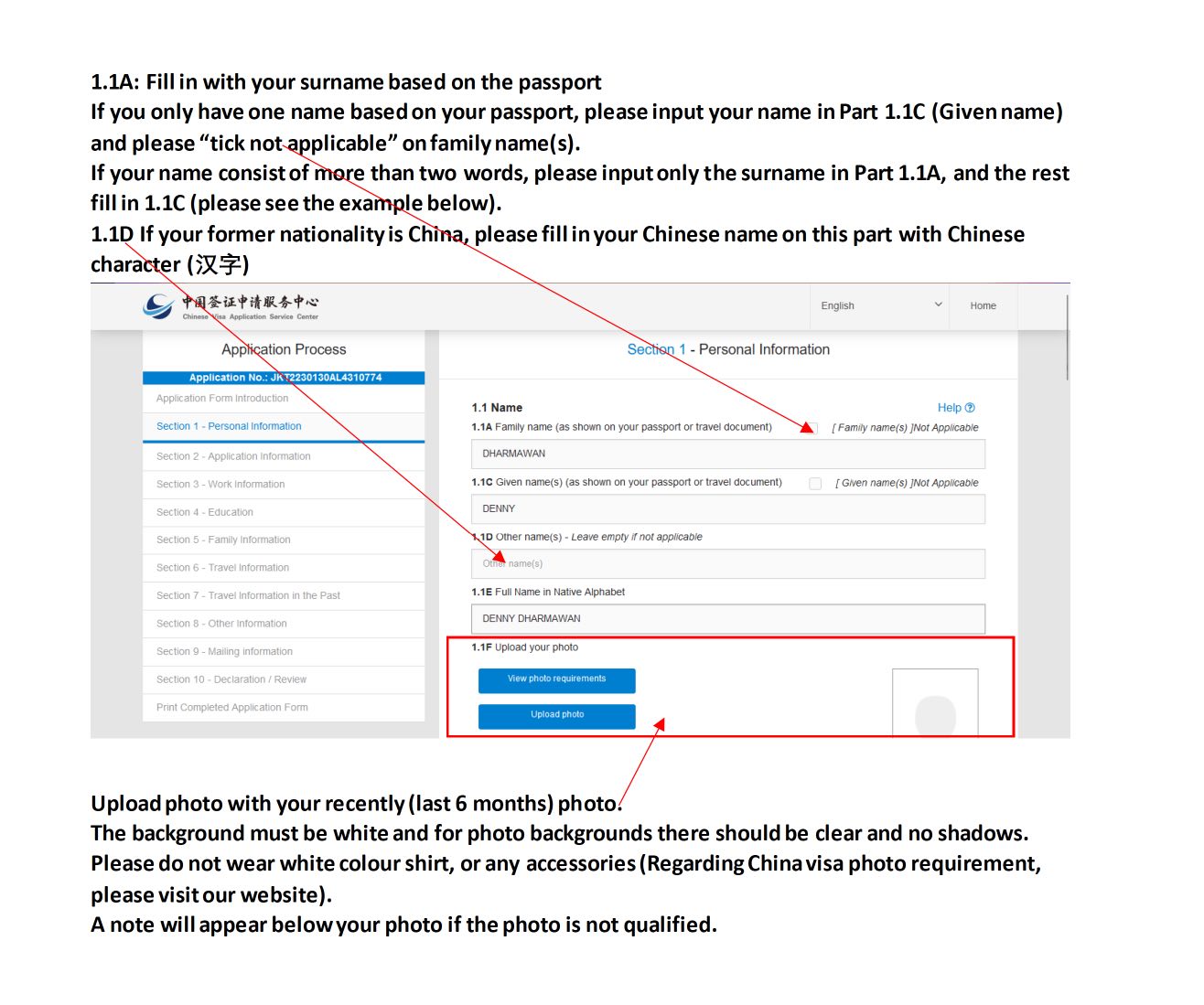
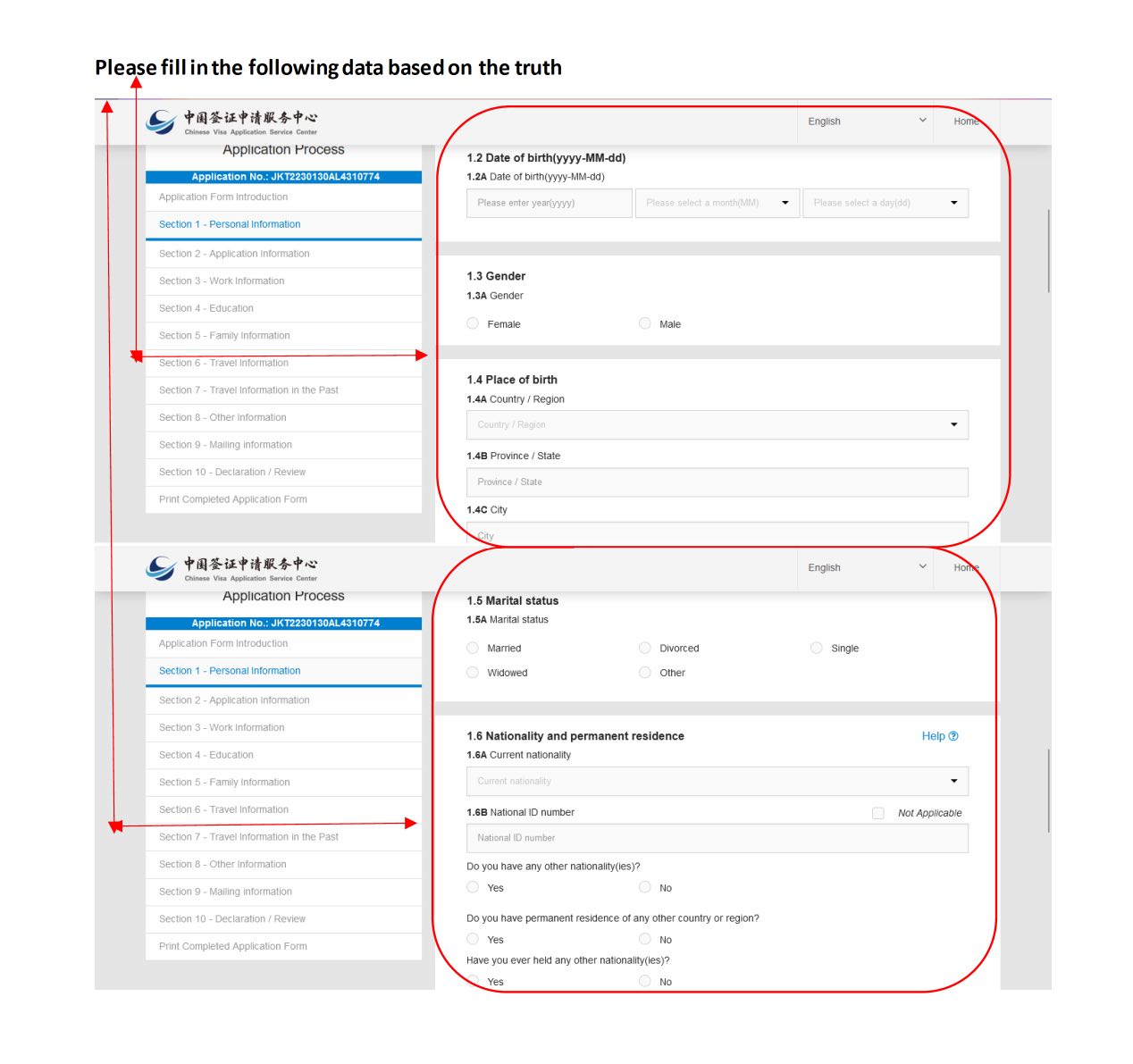
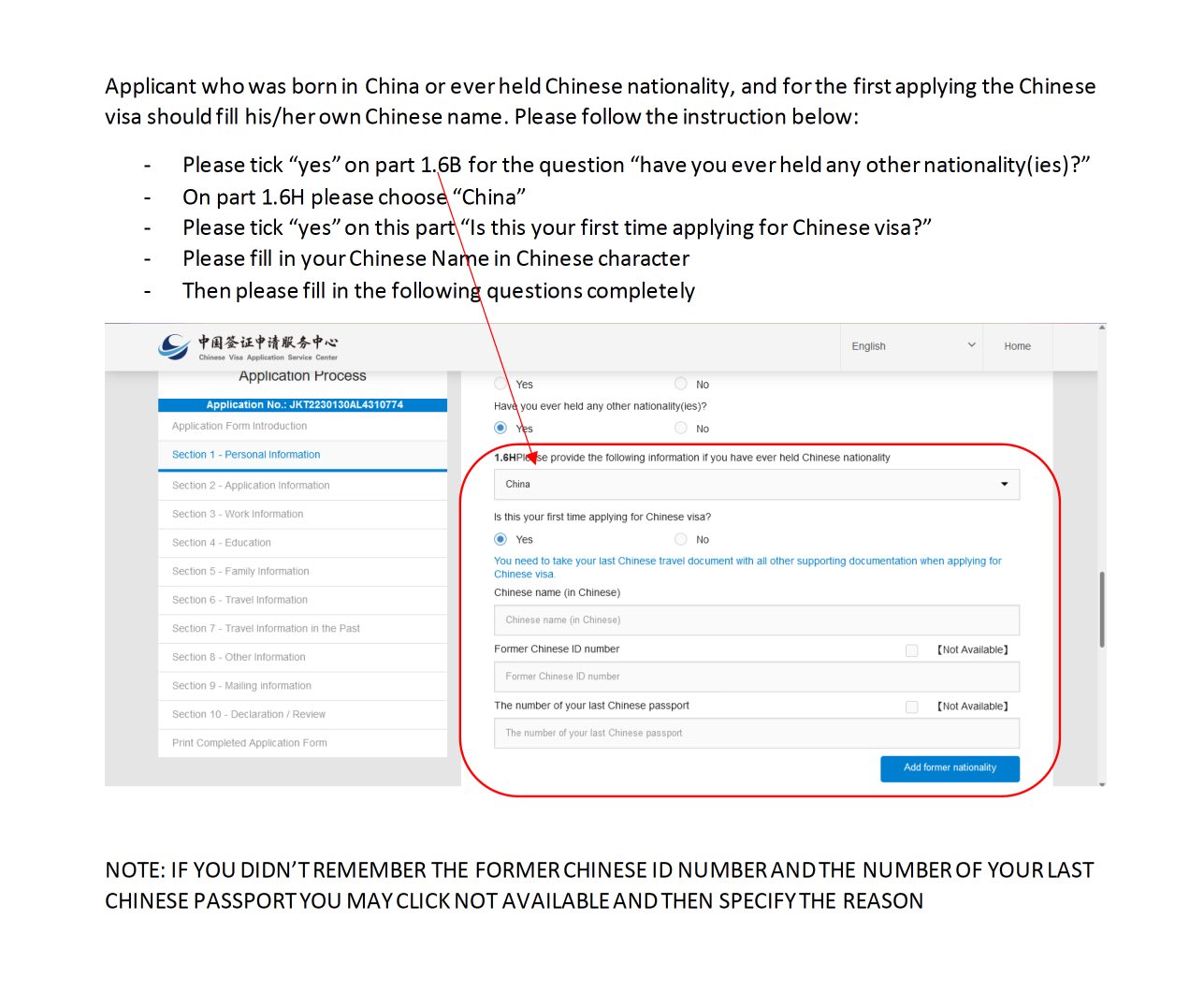
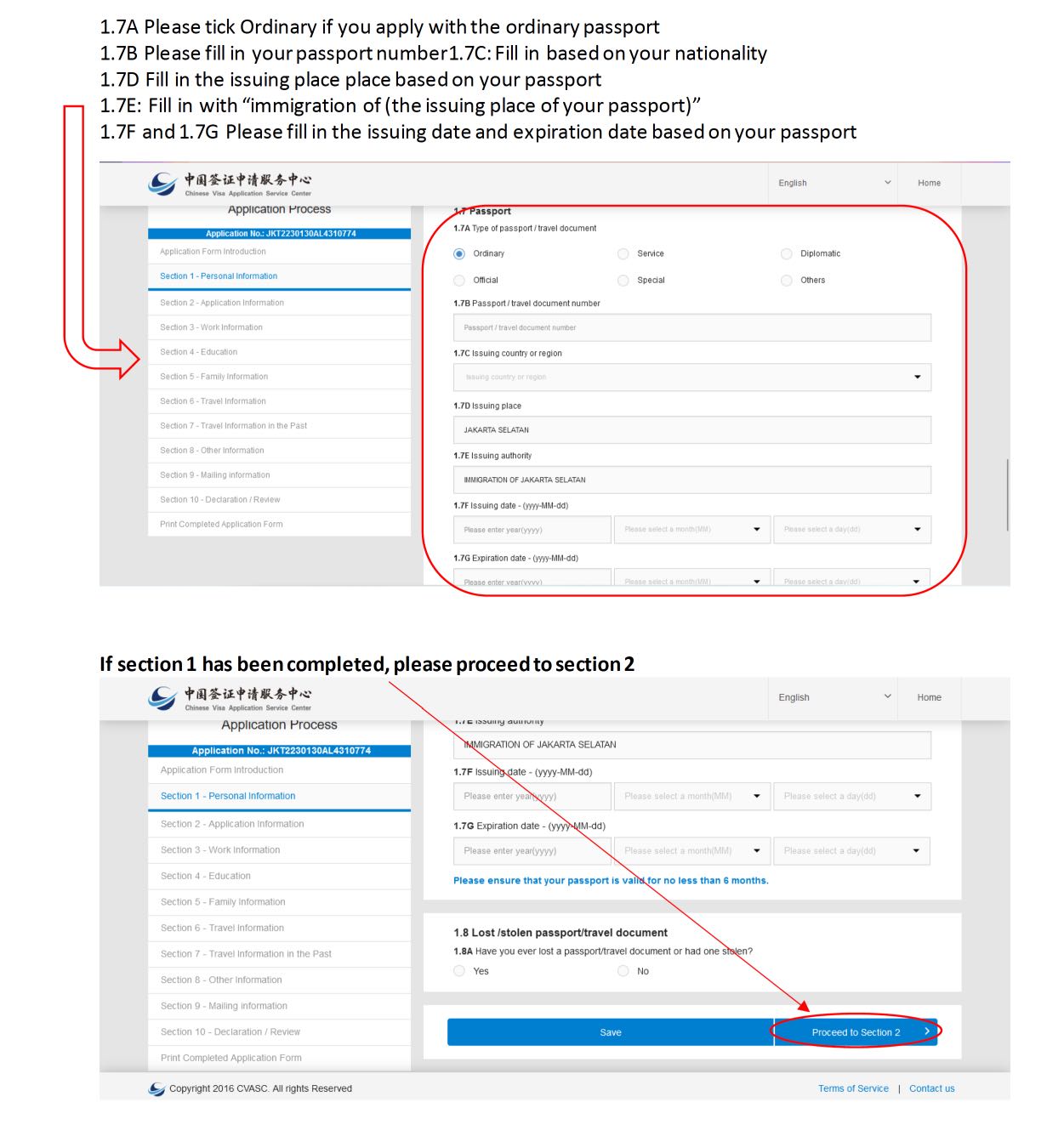
Section 2. Application information
- Choose the type of visa. If it is for tourism, choose “(L) Tourism”.
- Number of entries: if you do not plan to leave the country and then re-enter, indicate “Single”. Otherwise “Double” or “Multiple”.
- Specify whether you request Normal or Express service.
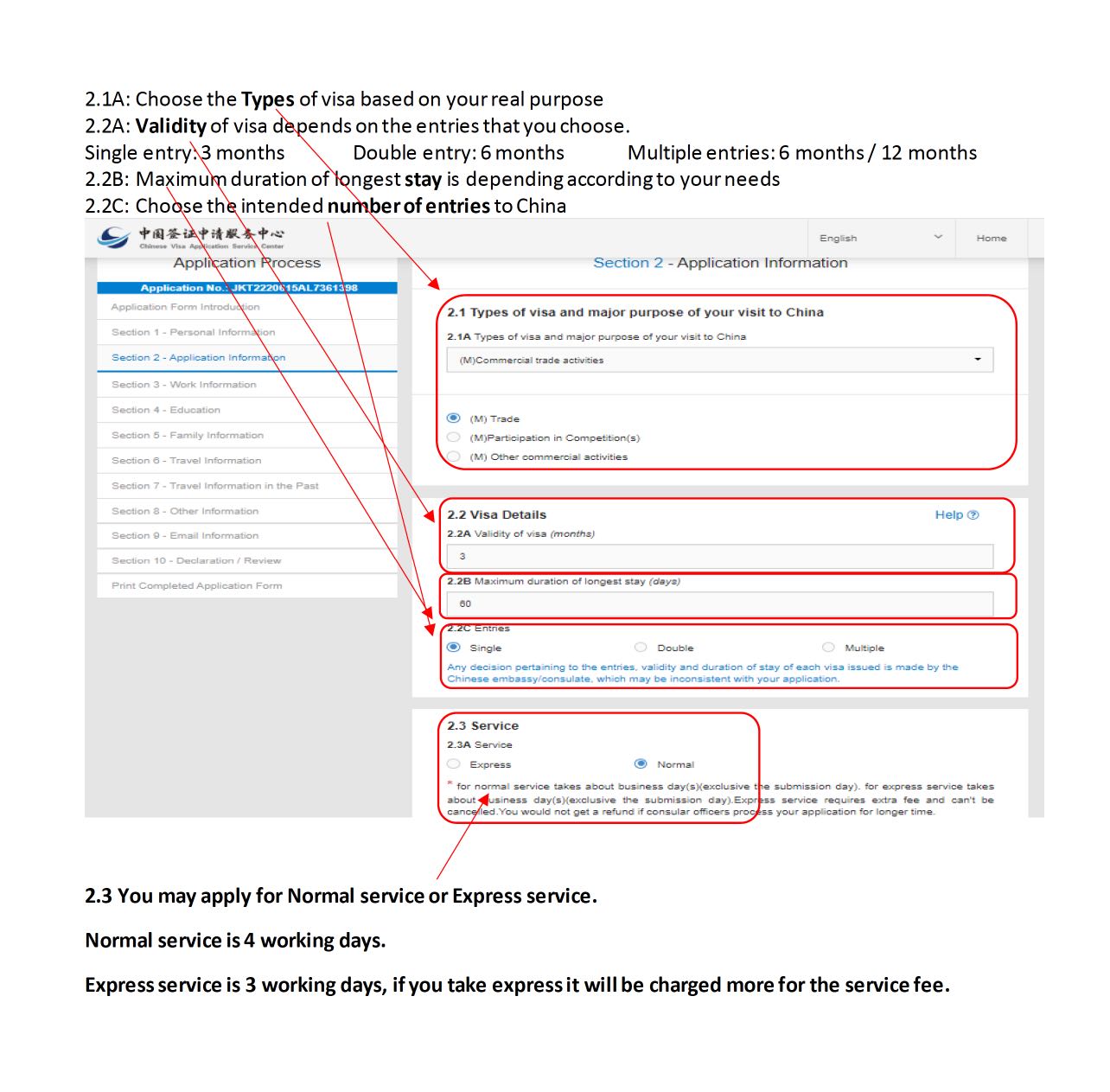
Section 3. Work information
- Fill in the information about your job, annual income and experience.
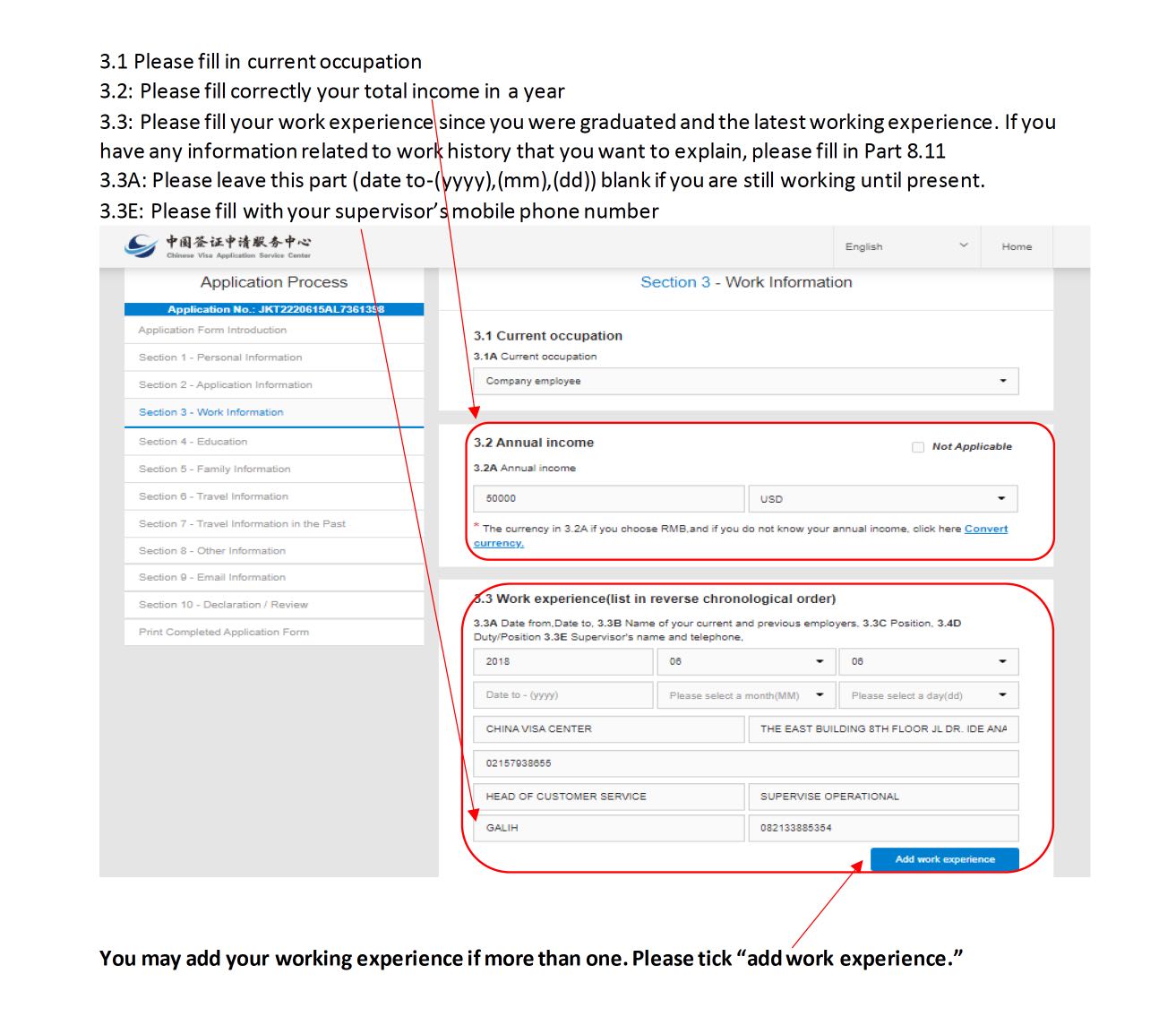
Section 4. Education
- Fill in your information about the languages you speak and your studies.
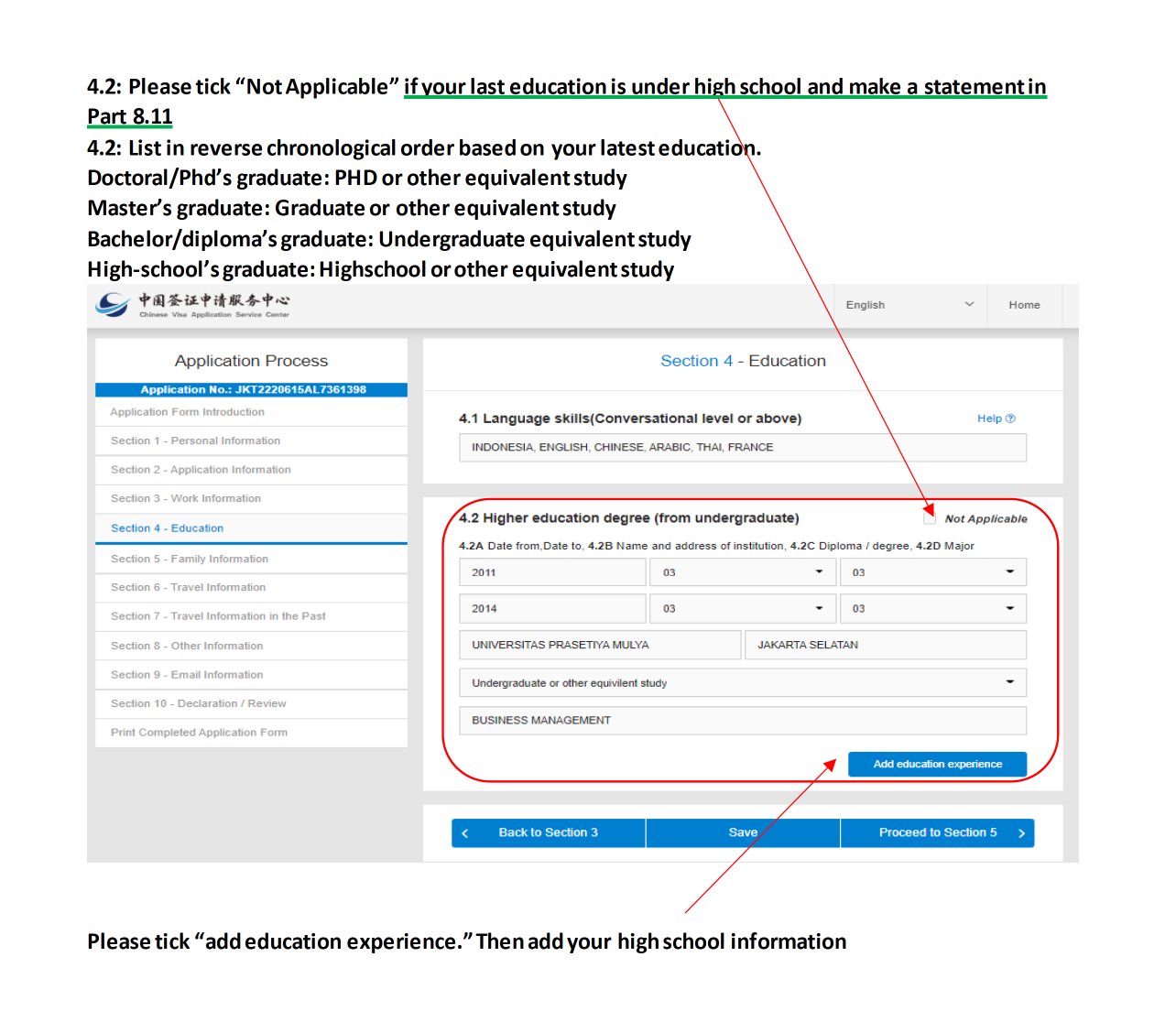
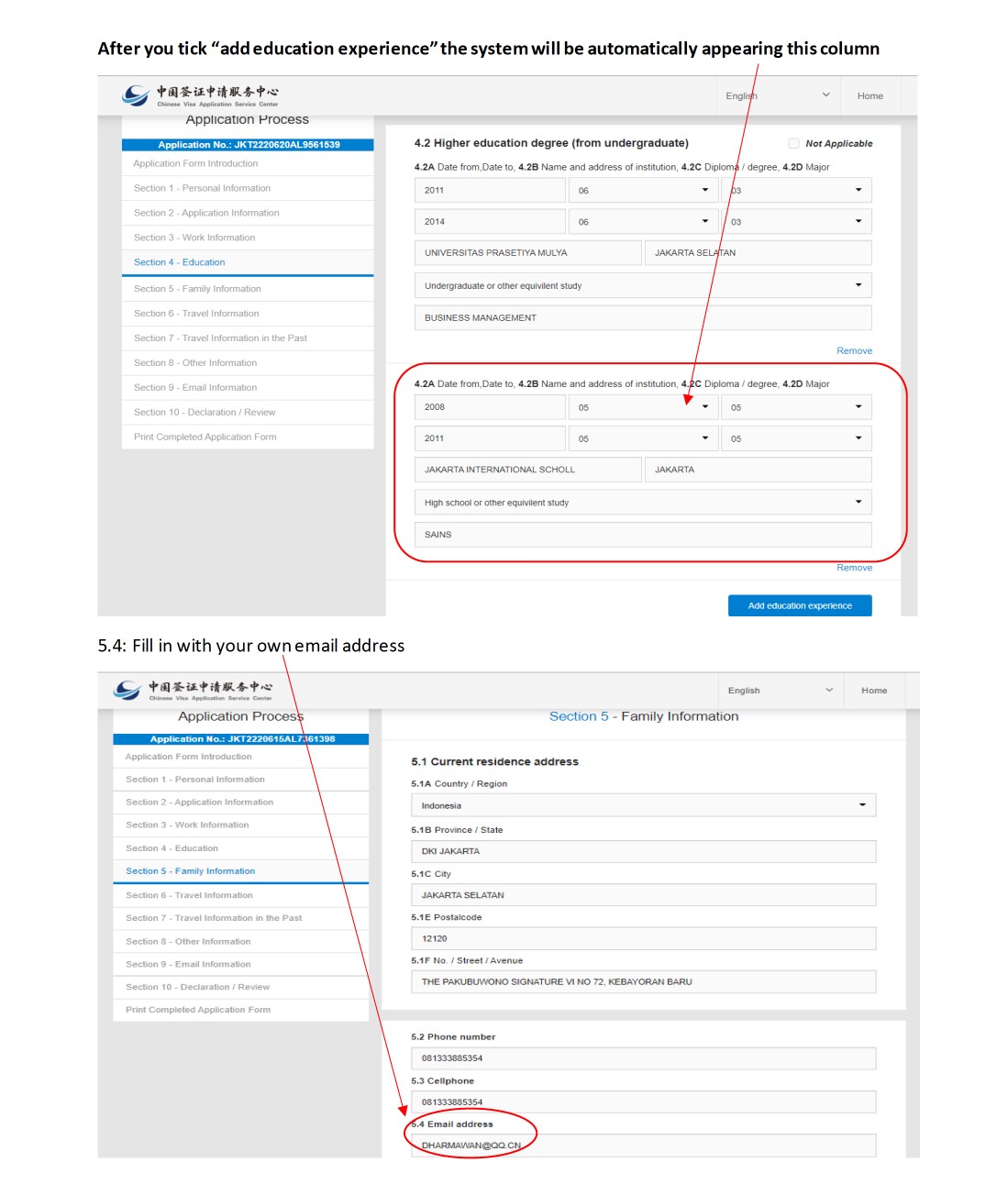
Section 5. Family information
- Fill in your information about address, mobile number and email.
- Fill in the details of your parents (if they are not living you must indicate “Deceased”).
- Fill in the details of your children (if you have), as well as the details of relatives in China (if you have).
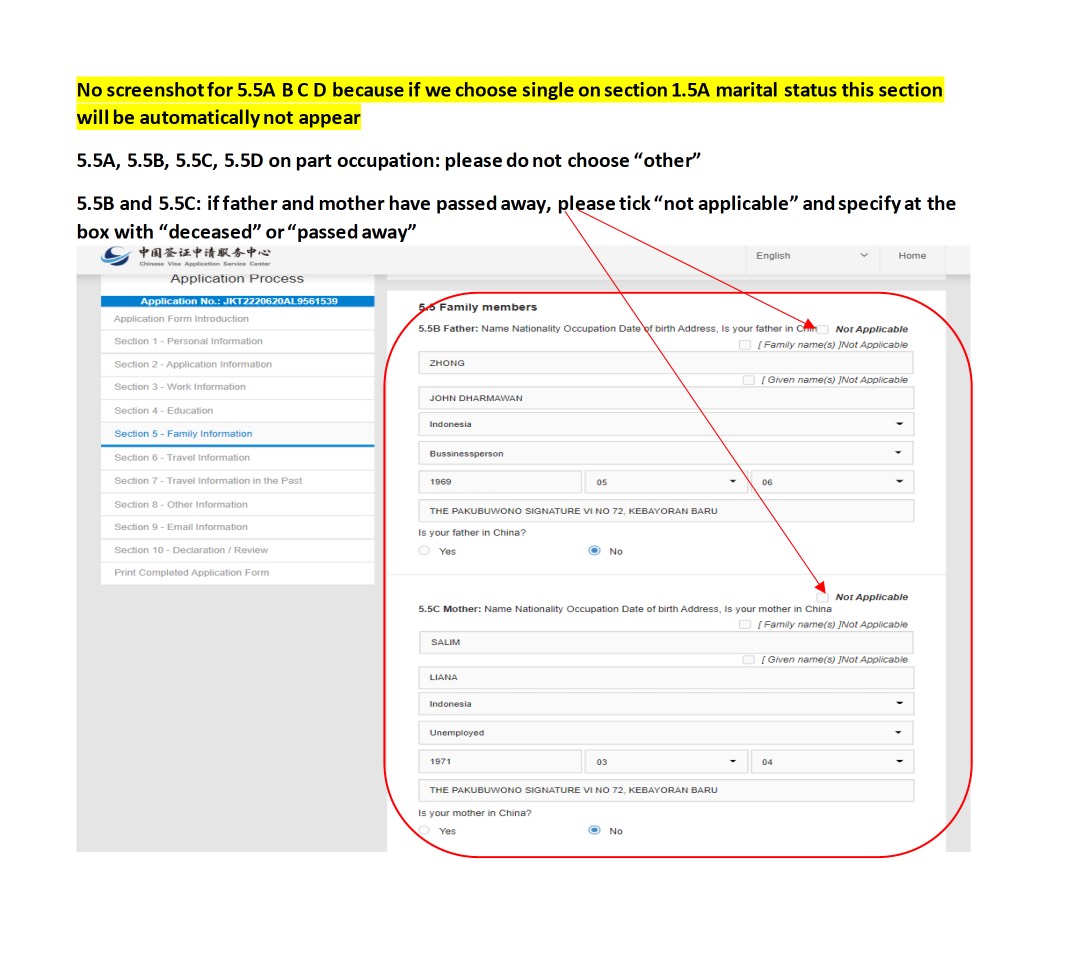
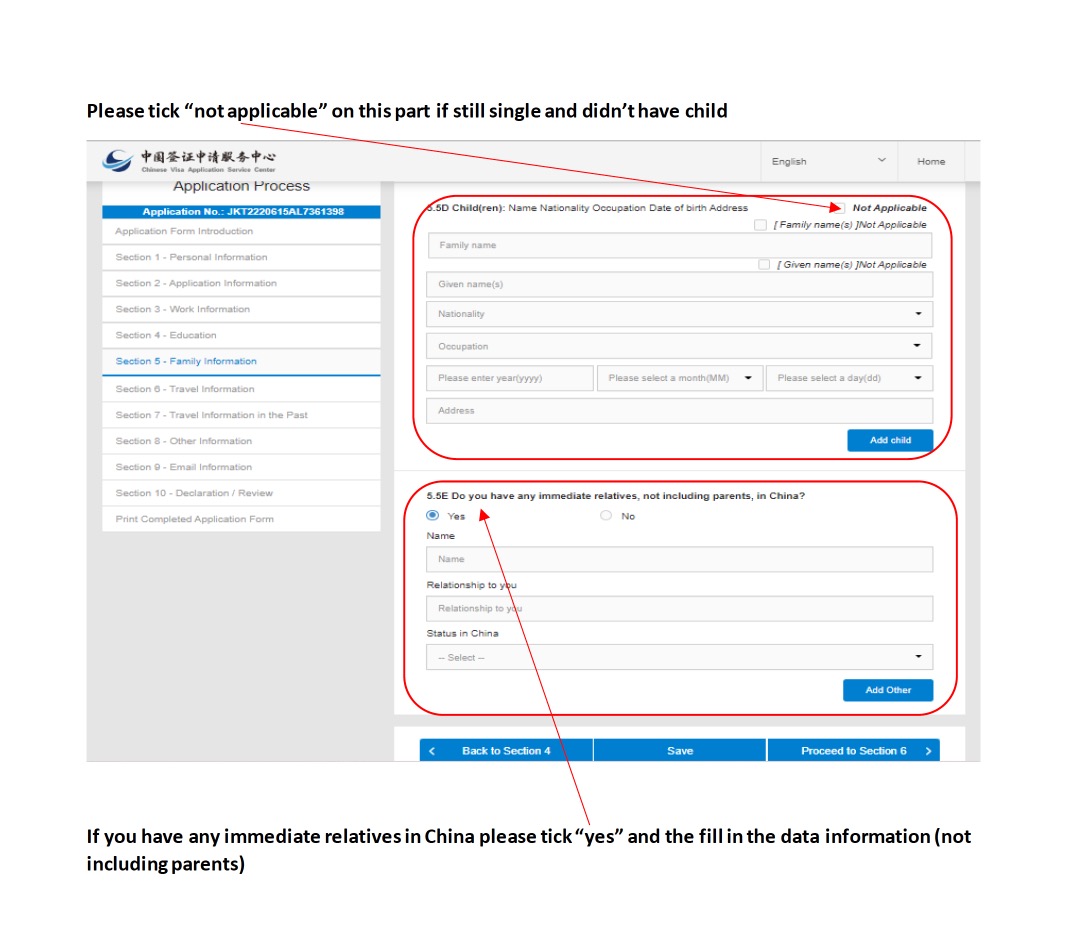
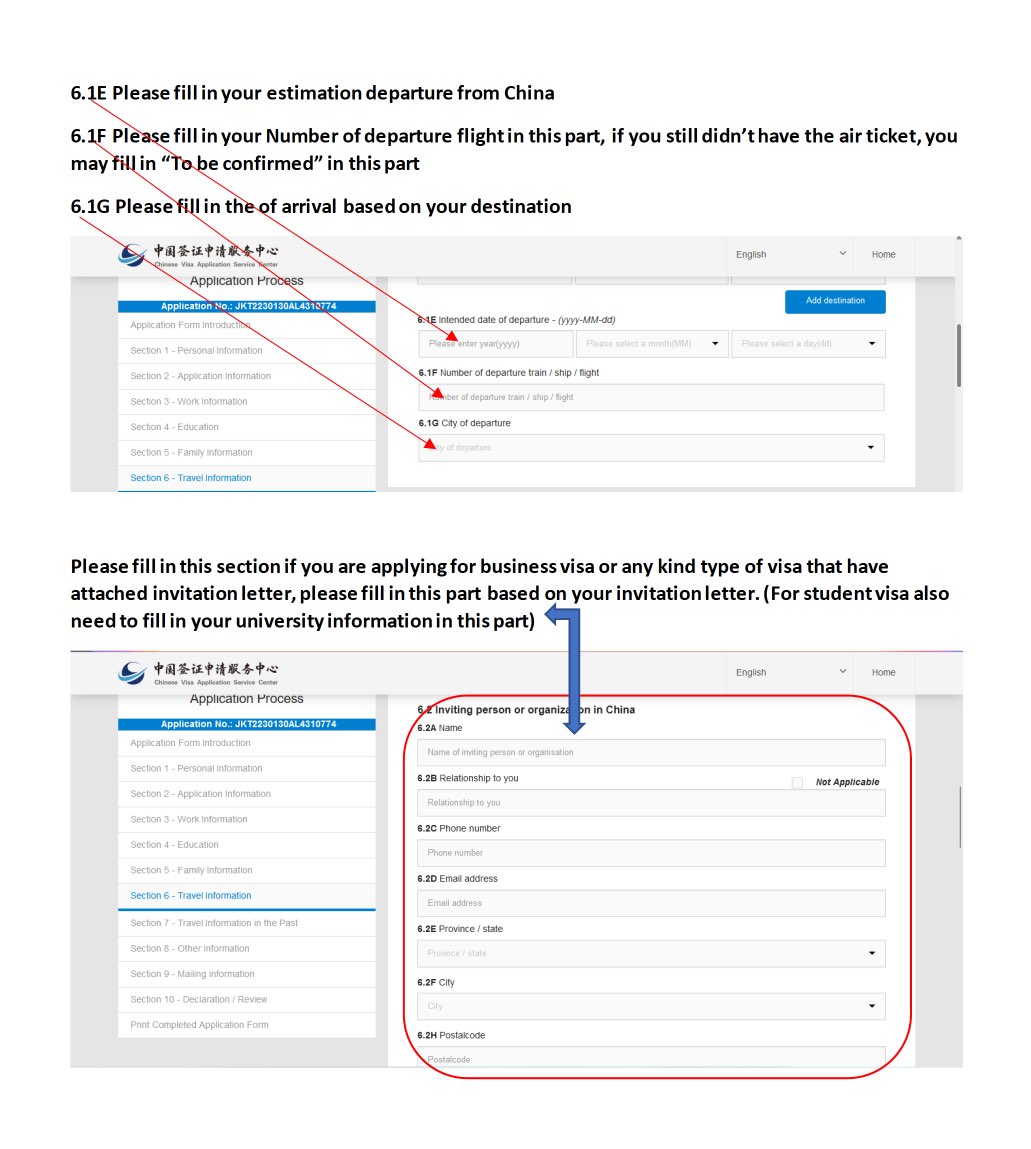
Section 6. Travel information
- In this section they want to know everything about your trip to China: estimated arrival date, destinations you will visit, estimated departure date, flight number, etc.
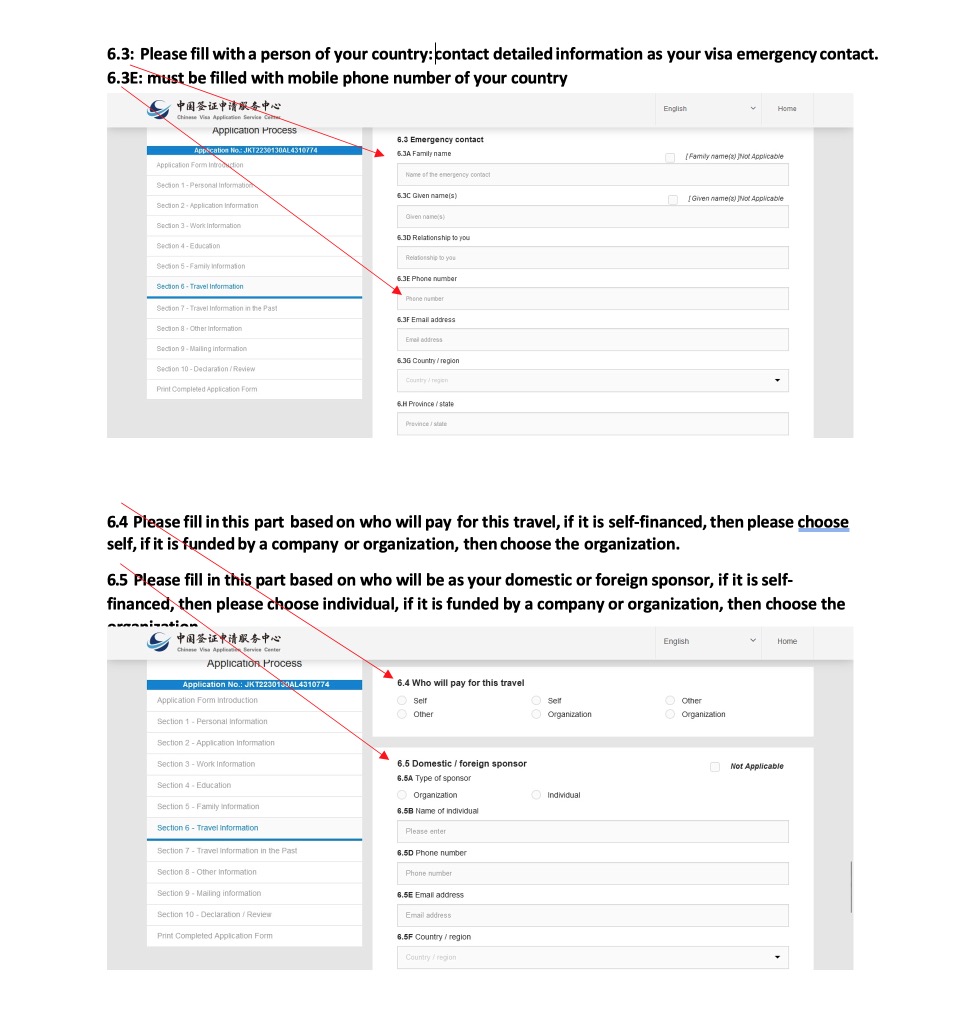
- For visas that require an invitation letter, you must complete the details of your invitation letter.
- You must also provide the details of a contact person in case something happens to you during your trip.
- You must specify who pays for the trip or if you have a sponsor (otherwise indicate “Not applicable”)
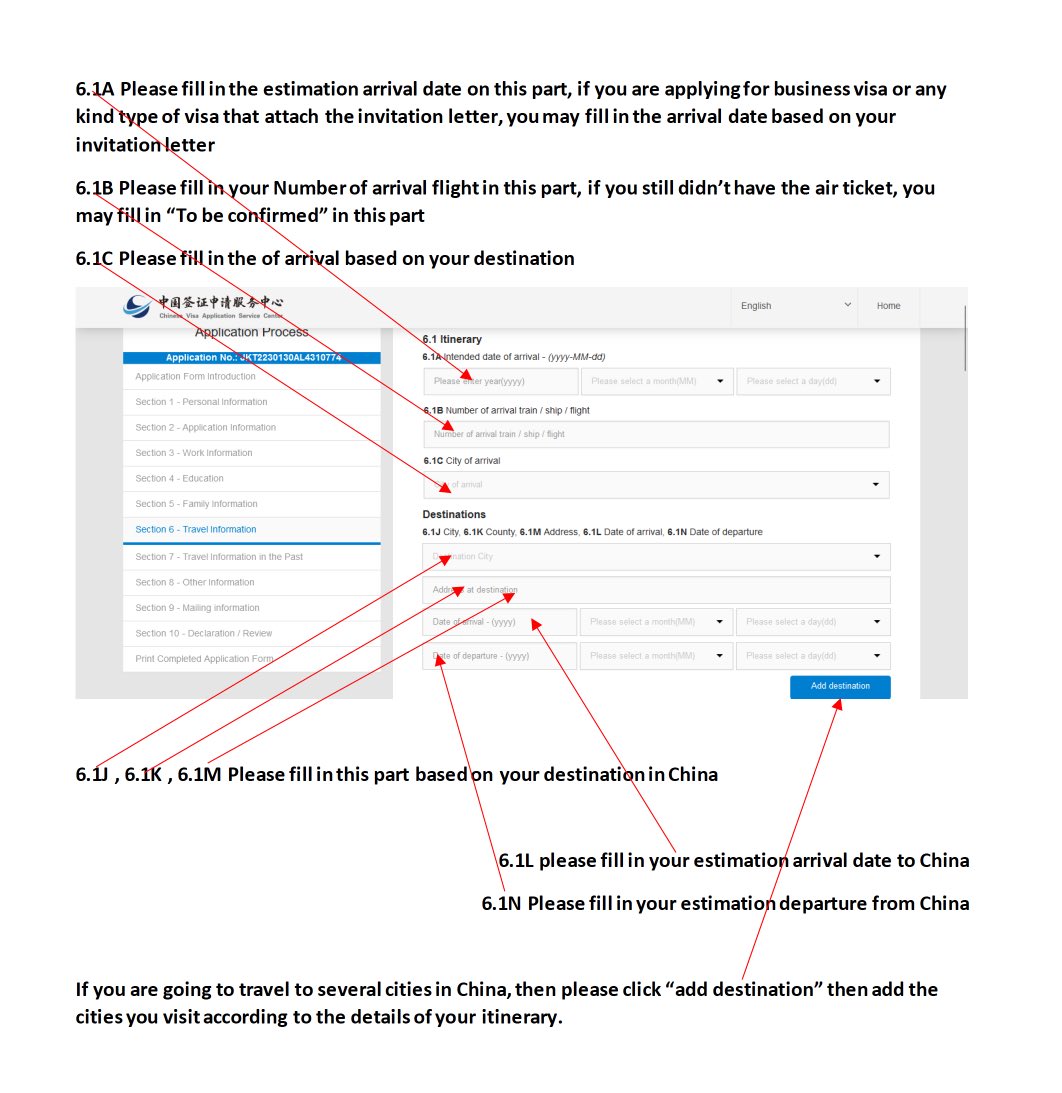

Section 7. Travel information in the past
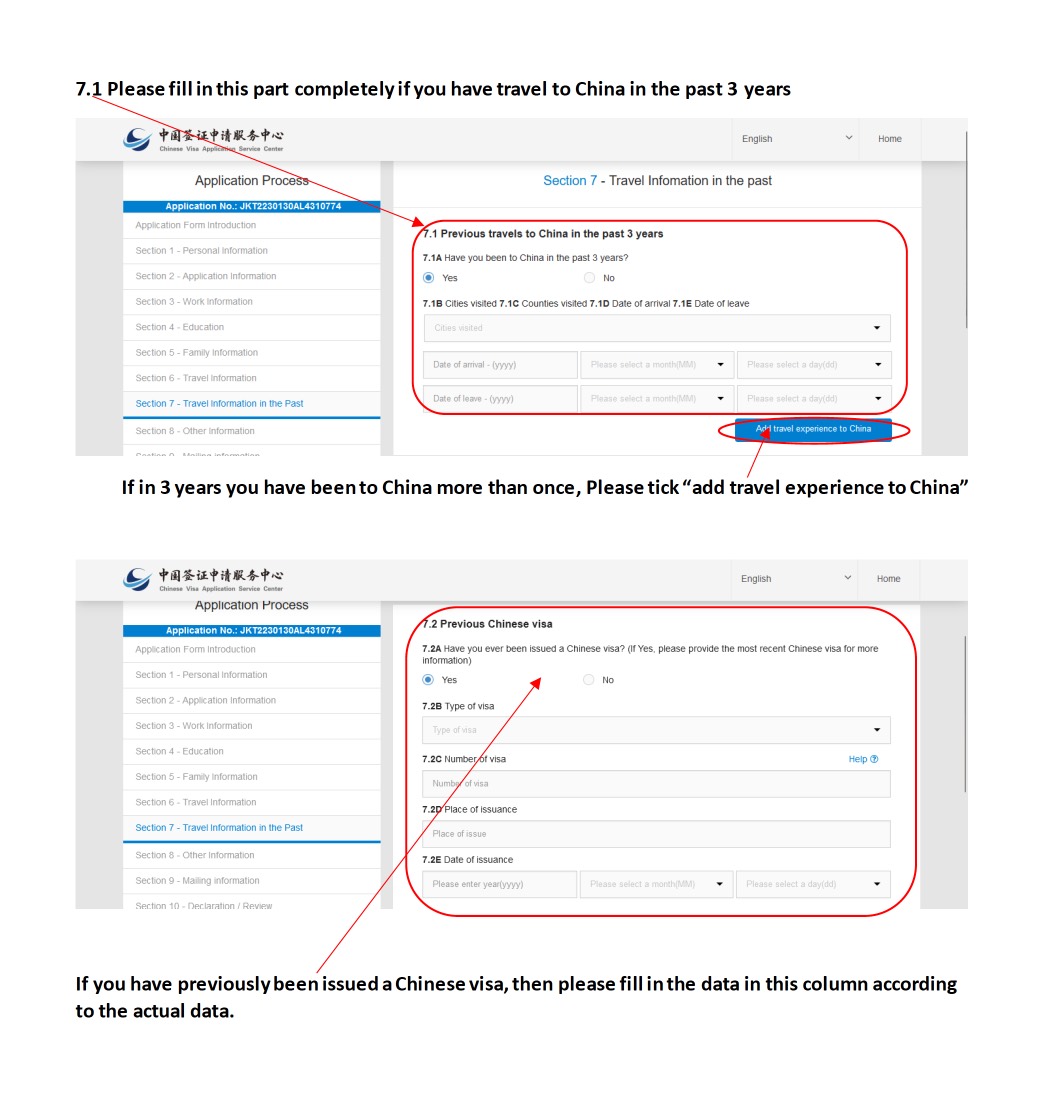
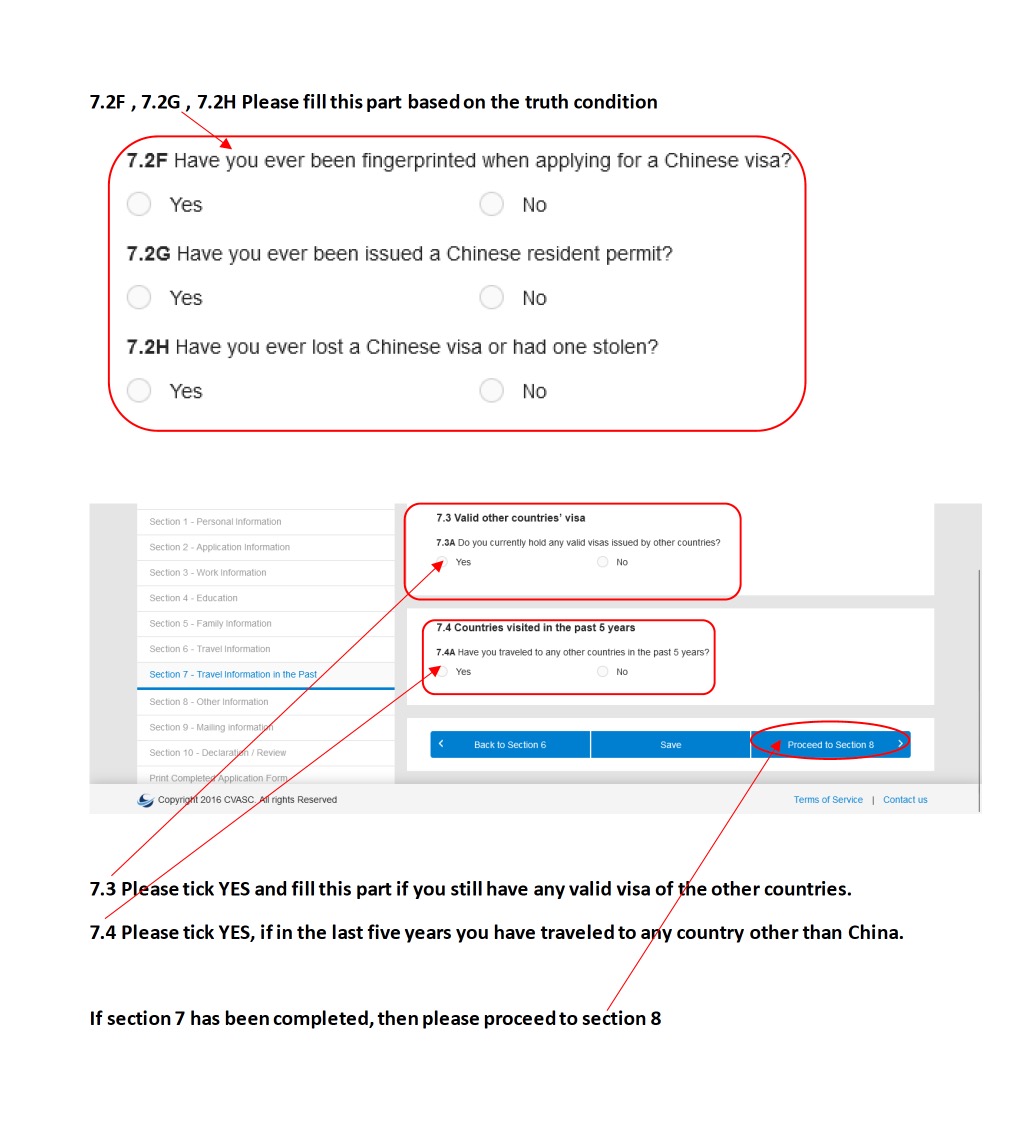
- You must indicate if you have traveled to China during the last 3 years and if you have previously obtained a Chinese visa or the countries you have visited during the last 5 years.
- Since 2019, fingerprinting of all 10 fingers is mandatory, so it is necessary to go to the visa center, unless you are in one of the exceptions (if you have already had your fingerprints taken previously for another visa, if you are over 70 years old or under 14, etc.). UPDATE: “Effective from August 9, 2023 until December 31, 2023, qualified applications for single or double entries Chinese visa in M, L, Q2, G, C categories will be exempted from fingerprints collection.“
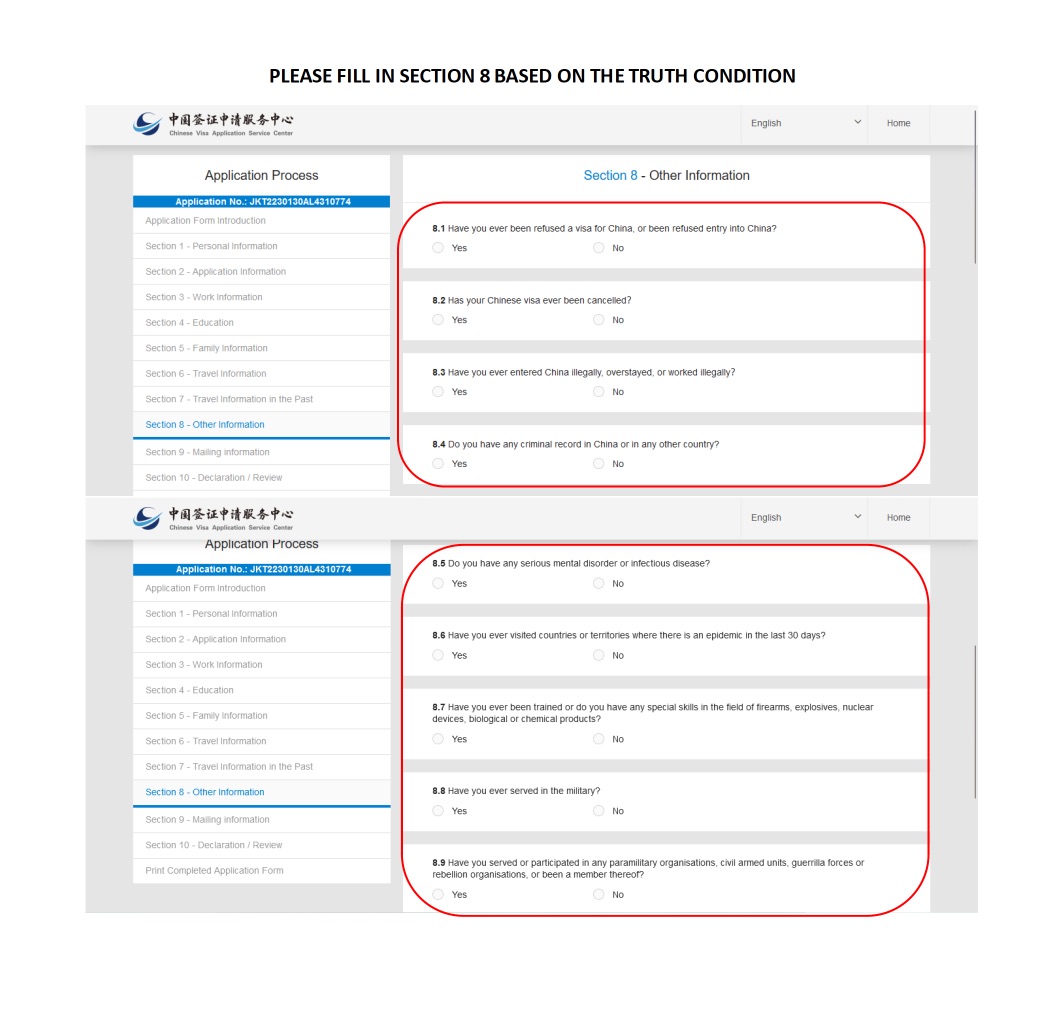
Section 8. Other information
- You will have to answer Yes/No to some questions: if you have entered China illegally, if you have a criminal records, etc.
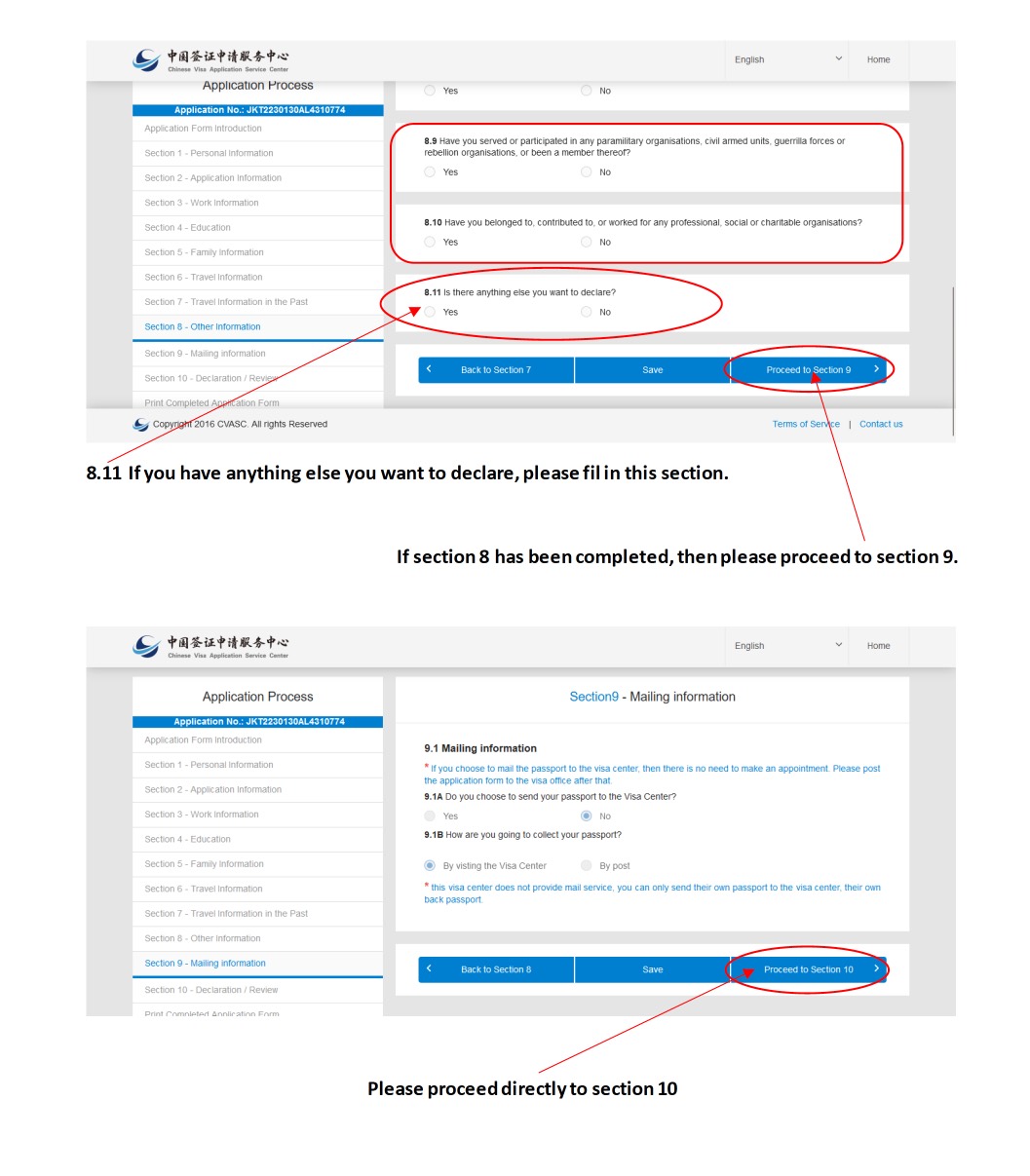
Section 9. Mailing information
- You must indicate if you are going to carry out the procedure by mail and how you are going to collect your passport (at the visa center or by mail).
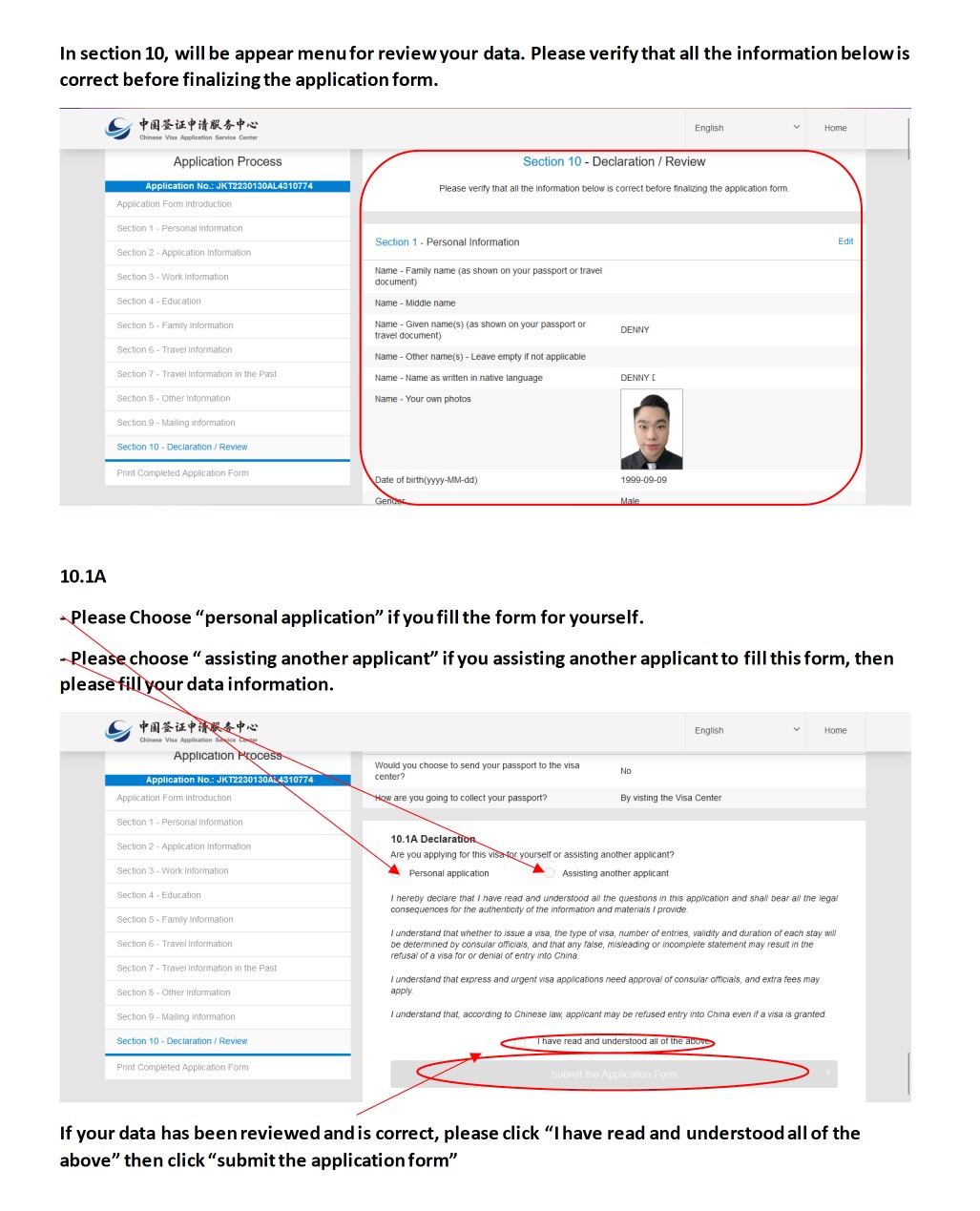
Section 10. Declaration/Review
- Here you can review all the data you have provided and edit it if any data is incorrect.
- You must also indicate if you have filled out the form yourself or if someone else has done it for you.
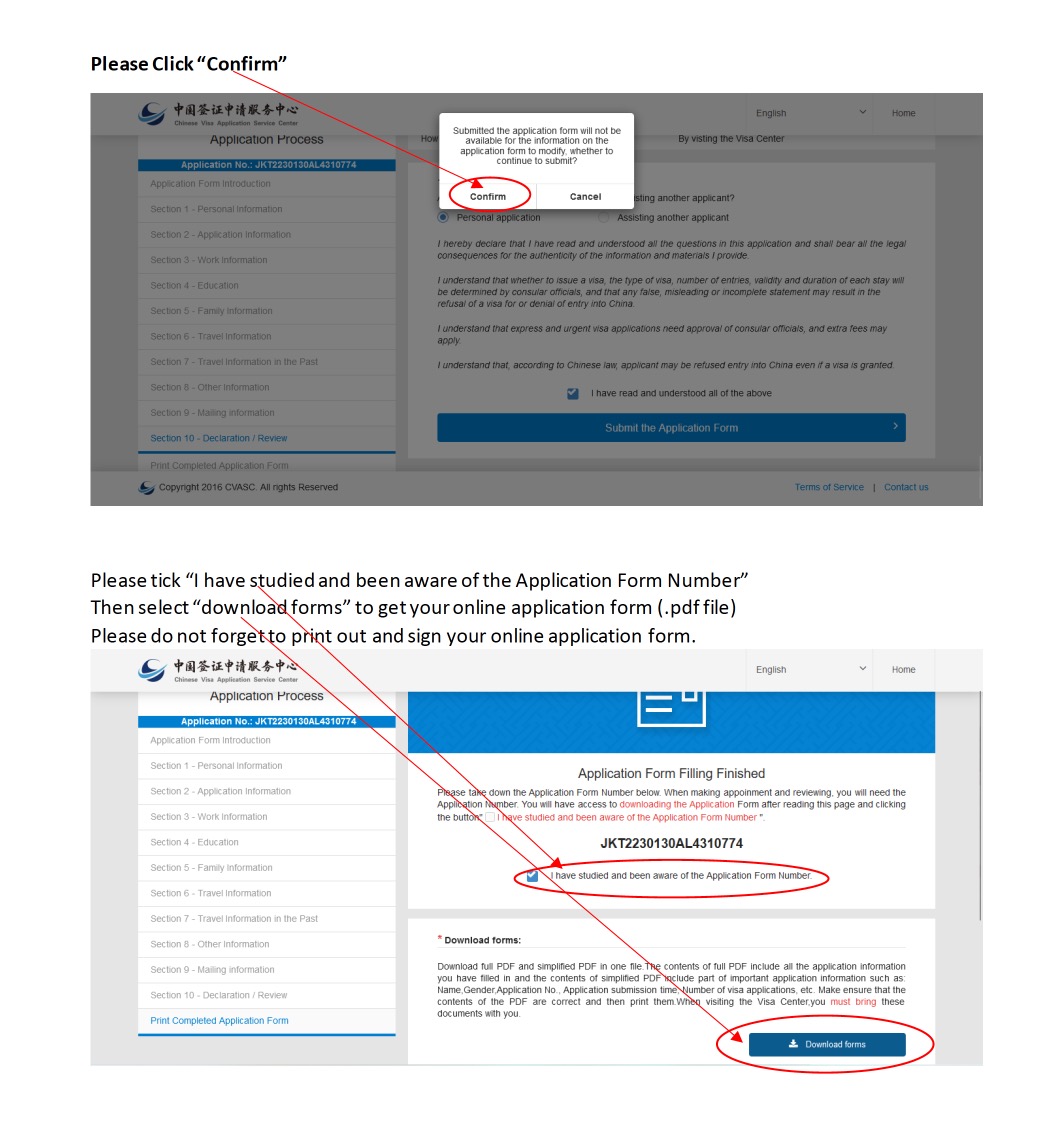
- Finally you must send the form, download the form in PDF, print it and sign it. DON’T FORGET TO SIGN THE FORM.
Step 5. Submit the documentation (and make the payment)
Now that you have all the documentation ready (form completed with photo and signature, round-trip tickets, hotel reservations, original passport and a photocopy of the passport page indicating your personal information and photo), it is time to submit all the documents at the window. The document submission process can be done in person or by courier.
Step 5.1. Face-to-face proceeding
Since 2019, fingerprinting of all ten fingers has been mandatory, except in the following cases:
- People under 14 years of age or over 70 years of age,
- Holders of diplomatic passports or those who meet the conditions for the issuance of diplomatic, service or courtesy visas.
- Persons who have been issued a visa in the same passport at the same embassy or consulate within a period of five years and whose fingerprints have been preserved.
- Persons whose fingerprints are missing on all ten fingers or whose fingerprints cannot be preserved on all ten fingers.
This means that you will most likely have to complete the process in person. UPDATE: Effective from August 9, 2023 until December 31, 2023, qualified applications for single or double entries Chinese visa in M, L, Q2, G, C categories will be exempted from fingerprints collection.
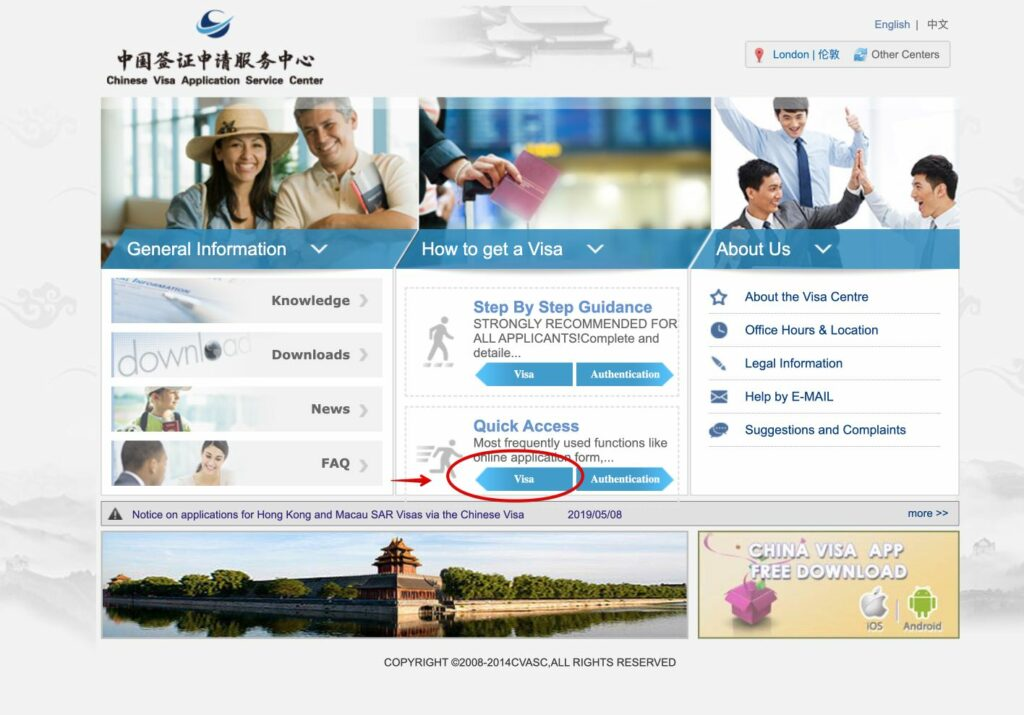
If you are going to complete the proceeding in person, the first thing you should do is to make an appointment, by going to the CVASC main page, clicking on “Quick Access” and then clicking on “Appointment”. You must indicate your personal information and the number of requests that you will submit. Application by appointment is compulsory as from 15 October, 2015. You are suggested to arrive at the center 20 minutes earlier than your booked time slot with all documents required.

On the day of your appointment, you can go with all the documents to the CVASC center of your consular district. The schedule is Monday through Friday from 9:00 AM to 3:00 PM.
If you can’t go personally, another person (family, friend or travel agent) may go for you to submit the application with all the documents and also to collect the passport with the visa (an authorization is not necessary). IMPORTANT: the application form must be previously signed by the interested party (be careful to not forget this).
You will submit the documentation at the window, where they will review it and give you a receipt with the date in which you will have to go to collect the passport with the visa. Another person can go in your place with this receipt.
The Chinese Visa Center accepts cash and debit card. The standard procedure costs 162.15 CAD (if you use the express or rush proceeding, it is more expensive).
Step 5.2. Proceeding by courier
In the CVASC website you have a check list if you are going to make the document submission by courier, that you must fill out and sign.

As you can see in this check list (red arrows), when the shipment is made by courier you have to provide new documentation:
- Firstly, you must fill out the payment authorization form, with the details of your card, in which you will be charged the total cost. Personally I think it is a very unsafe system, given that if this letter gets lost, other people could know your personal information and make fraudulent purchases.

- Second, you must attach an envelope already paid for the return of the passports with the visa to your address (Canada Post Xpresspost)
Once you have all the documentation indicated in the check list, you enter it in an envelope and send it. In the same checklist of each CVASC center you will have the shipping address. You can apply for several visas in a single shipment. It is suggested that you use Canada Post Xpresspost to deliver your application.
IMPORTANT. In some centers (for example, in Vancouver), the Visa Centre staff will inform you of the amount of payment when your passport is ready. You can remit the payment to the Visa Centre by Bank transfer. The Visa Centre will post your passport back as soon as it receives your payment.
Step 6. Check the passport with the visa
Once you receive the passport with the visa, you must check that all the information is correct: period of validity, number of entries, length of stay and personal information.
If you find an error or omission, let CVASC know so that they will correct it. If the error is attributable to you, additional fees will apply, otherwise they will correct it immediately without additional cost.
3. POST-VISA PROCEEDINGS: immigration card and registration
When you arrive in China, you still have to do a couple of proceedings: the immigration card of arrival in China and the registration. When exiting the country, you must deliver the departure card.
3.1. The immigration card of arrival in China (and departure from China)
Upon arrival in China you must complete the ‘Arrival Card’, which will be kept by the immigration officer. You will keep the ‘Departure Card’, which you will have to deliver when you leave the country. Here is an example of this immigration card (front and back):
It is very simple to fill. On the arrival card you should indicate:
- Family name
- Given names
- Nationality
- Passport No
- Intended Address in China
- Male / Female
- Date of birth
- Visa No
- Place of Visa Issuance
- Flight No/Ship’s name/Train No
- Purpose of visit (only one): for tourism “Sightseeing / in leisure”
- Signature
The departure card is equally simple to fill:
- Family name
- Given names
- Passport No
- Date of birth
- Male / Female
- Flight No/Ship’s name/Train No
- Signature
If you lose this card, never mind, as you can get a new card at the airport to fill out, since it doesn’t come with any special stamps or numbers.
3.2. Foreigner Registration in China
On the back of the immigration card, you will see an important announcement; in section 1 it warns that foreigners who won’t stay in hotels, hostels or pensions, must register their arrival (by themselves or the host of the house) within 24 hours (72 hours in rural areas) at the nearest Police Station, where they will give you a form that you must fill out and they will ask for your passport and copies of the page where your personal information comes, as well as from the visa and the entry stamp.
If you stay in hotels there is no problem, since when you check in, the hotel will take care of the registration.
If this article has been useful, the best way to help me is to share it on your social networks: Twitter, Facebook, Linkedin…
Thank you very much!
PS: If you have found any inaccuracy, error or omission in this article, please, tell me and I will correct it to keep it as complete and updated as possible, so it can be useful to other travelers.
