Novodevichy Convent is one of the most beautiful corners of Moscow and, for me, the place where Russian history breathes deepest outside the Kremlin. A 16th-century walled complex, declared a UNESCO World Heritage Site and fully restored in 2024 for its 500th anniversary. Right next to its walls lies the Novodevichy Cemetery, where Chekhov, Gogol, Bulgakov, Eisenstein, Shostakovich, Khrushchev, Yeltsin, and Gorbachev are buried: the most famous civic pantheon in Russia and, I’ll just say it now, my favorite part of the visit.
In this guide I explain how to plan the visit in 2026: what’s free and what you have to pay for, the updated prices for foreign visitors, how to get there, which parts are most worth your time, where to eat nearby, and how to avoid typical mistakes like showing up on a day the museum is closed or trying to enter the cemetery through the convent’s gate.
1. What is Novodevichy and why visit it
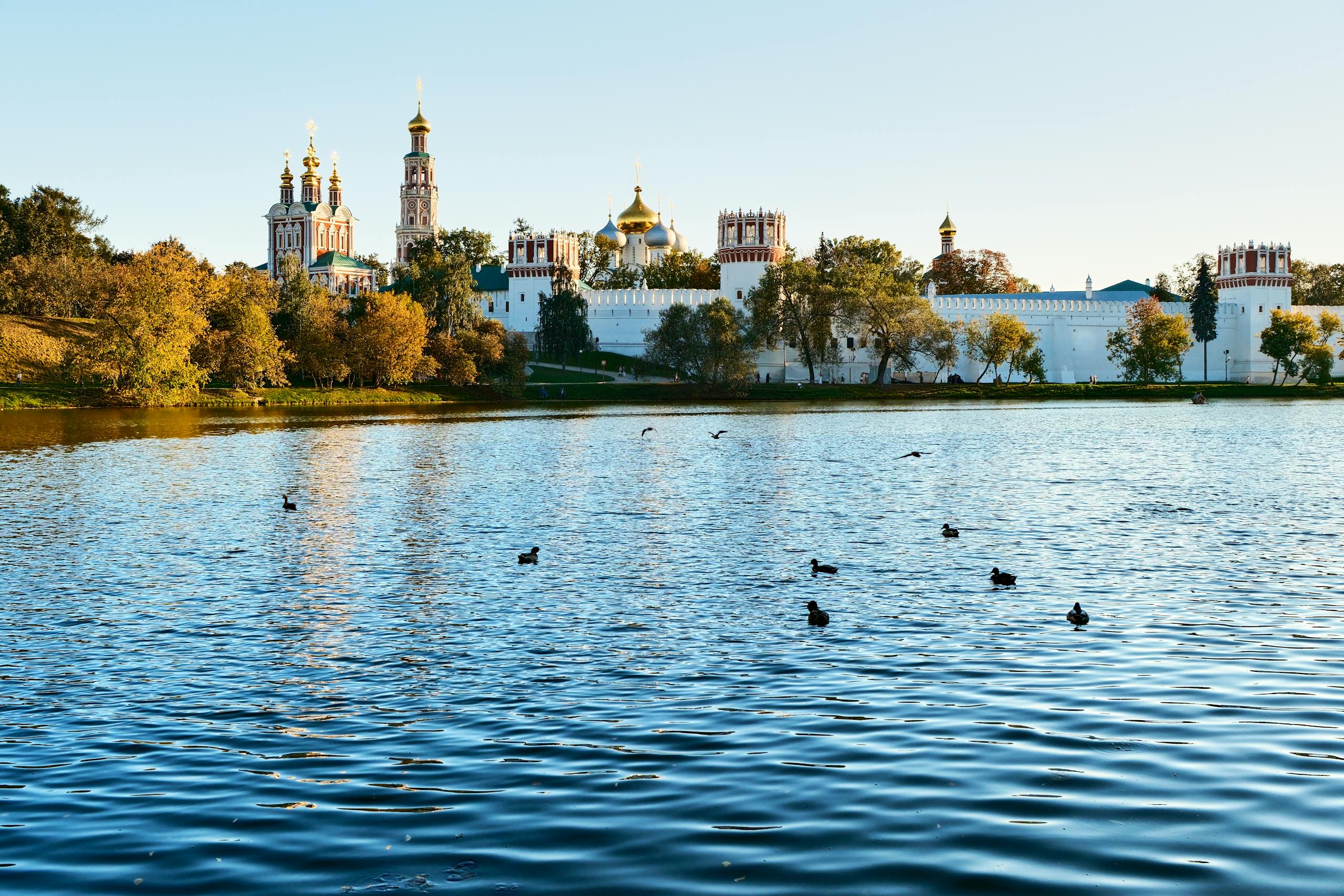
The Novodevichy Convent (in Russian, Новодевичий монастырь, “Convent of the New Maidens”) is an Orthodox women’s monastery founded in 1524 by Grand Prince Vasili III to commemorate the return of Smolensk to the Russian state. It stands in the southwest of Moscow, in a bend of the Moskva River, just over four kilometers from the Kremlin.
What you’ll find is a walled compound with twelve towers, a 72-meter bell tower (the second tallest in Moscow after Ivan the Great’s at the Kremlin), and eight churches from the 16th and 17th centuries in remarkable condition. The whole complex has been a UNESCO World Heritage Site since 2004 and, after a decade of restoration work, the comprehensive renovation was essentially completed in autumn 2024 to coincide with the 500th anniversary.
A few meters from the walls lies the Novodevichy Cemetery, an independent burial ground (with its own entrance) where some 26,000 figures from Russian culture, science, and politics rest. It’s the part of the visit that’s most worthwhile and, on top of that, it’s completely free.
If you have time in Moscow, plan a full morning here. If you’d rather see the city’s must-sees first, take a look at my guide on what to see in Moscow in 1, 2, 3, 4, or 5 days: it explains how to slot Novodevichy into your itinerary depending on how long you’ll be in town.

2. Practical information for visiting Novodevichy
Here’s the basic info you need to plan the visit. The first thing to understand is that at Novodevichy there are three different things, paid for (or not) separately:
- Entering the monastery grounds and walking around inside: free. The monastery is still active (there are nuns and services are held) and the courtyard is open to anyone.
- Visiting the church museum (exhibitions and museumized churches): paid. This is what gives you access to the museum halls, the icons, Tsarevna Sofia’s chambers, and, in summer, the interior of the Smolensk Cathedral.
- Visiting the Novodevichy Cemetery: free. It’s a separate site with its own entrance, on the far side of the southern wall.
2.1. Opening hours
- Monastery grounds (free access): every day from 7:00 a.m. to 7:00 p.m. Useful to know if you’re staying nearby and want to drop in early or at sunset, when there are fewer visitors.
- Monastery museum (paid): every day from 9:30 a.m. to 5:30 p.m. The official museum website publishes any changes and closure days.
- Smolensk Cathedral (interior): the oldest and most spectacular building in the complex only opens in summer. If you go in winter or in the off-season, you won’t get to see it from inside, which is a good reason to plan your trip between May and September if you can.
- Novodevichy Cemetery: from May 1 to September 30, 9:00 a.m. to 7:00 p.m. From October 1 to April 30, 9:00 a.m. to 5:00 p.m. Open every day.
2.2. Updated prices (2026)
Since 2022 the museum has applied a specific price for foreign visitors, separate from the rate for Russian citizens. These are the official museum prices:
- Foreign adult (access to the monastery territory + exhibition): 1,000 ₽ (about $11–12 / €10–11 at current exchange rates).
- Foreign children and students: 500 ₽.
- Guided tour with a certified guide in a group (minimum 5 people): 1,500 ₽ per foreign visitor.
- Cemetery entry: free.
- Walking around the monastery courtyard without entering the museum: free.
You can buy tickets at the monastery’s ticket office or on the official website (which accepts Russian cards and shows a QR code). If you don’t have a Russian MIR card, the easiest option is to pay at the ticket office in cash or with a MIR card if you already have one.
2.3. How to get there
- Address: Novodevichy proyezd, 1 (Новодевичий пр., 1), 119435 Moscow.
- Metro: Sportivnaya station (red line, line 1 / Sokolnicheskaya). From the exit toward Ulitsa 10-letiya Oktyabrya, it’s a 5–7 minute walk to the convent’s main gate.
- Bus / trolleybus from Sportivnaya metro: bus 64 and 132, trolleybus 5 and 15. Not really necessary unless you have mobility issues; it’s an easy walk.
- By taxi: always book through the Yandex Go app (Western apps like Uber or Bolt don’t work in Russia).
Important: the cemetery entrance is not in the same place as the convent entrance. This is a very common mistake. To go to the cemetery, walk out of the monastery, turn left, and follow the wall along Luzhnetsky proyezd. The cemetery gate is at Luzhnetsky proyezd, 2, about a 5-minute walk away.
2.4. Rules of behavior
- This is an active convent: women must cover their heads and shoulders before entering the churches (scarves are available at the entrance); men should wear long pants and remove their hats.
- Inside the churches, photography is forbidden without permission, especially during services.
- Silence is expected in the cemetery. It’s a place where many Muscovites visit family graves; it’s not just a tourist attraction.
3. What to see inside Novodevichy Convent
Inside the walls of Novodevichy there are fourteen main buildings, eight of them churches. Here’s a summary of the must-sees, in the order you’ll come across them if you enter through the main (north) gate.

3.1. Church of the Transfiguration (main entrance)
Built between 1687 and 1688 above the main gate of the compound. It’s the first thing you see when you cross the wall and a fine example of Moscow Baroque: five green domes, a white facade with carved details, and the immediate sense of “I’m walking into another century.”
3.2. Smolensk Cathedral (16th century)
The oldest building and the jewel of the complex. It was built between 1524 and 1525, modeled on the Cathedral of the Assumption in the Kremlin. Inside: 16th-century frescoes recently restored (during the works, paintings hidden for decades were uncovered) and a five-tier carved-wood, gilded iconostasis commissioned by Tsarevna Sofia from the masters of the Kremlin Armory. Inside there are royal tombs, including those of Sofia Alekseyevna herself and Eudoxia Lopukhina, Peter the Great’s first wife.
Remember: it only opens in summer. If your trip falls between May and September, don’t miss it. In winter, you’ll have to settle for seeing it from outside.


3.3. The bell tower (1689–1690)
Seventy-two meters tall, six octagonal tiers, and red brick combined with carved white stone. It’s the most visible building in the complex and the second-tallest bell tower in Moscow, behind only Ivan the Great’s at the Kremlin. The architect Vasili Bazhenov wrote that Ivan the Great’s bell tower is worth seeing, but Novodevichy’s is the one that truly captivates the eye of anyone with good taste. Hard to argue with him once you stand in front of it.

3.4. Church of the Assumption and refectory
Built between 1685 and 1687. Its quirkiest feature is structural: the adjoining refectory has a 393-square-meter vaulted ceiling without a single column to support it, an impressive technical feat for the late 17th century. A copy of the Iveron icon of the Mother of God is kept here, brought from Mount Athos in 1648 and transferred to the monastery in 2009 from the State Historical Museum.

3.5. Church of the Intercession and adjoining palaces
A deep-red church (1685–1687) above the old southern gate, with the so-called Maria Chambers attached. Right opposite, the Lopukhin Chambers, where Eudoxia Lopukhina, Peter the Great’s first wife, was confined. Look closely at the facade: it still has a 17th-century sundial that keeps telling the time.

3.6. Tsarevna Sofia’s chambers and Naprudnaya Tower
In Naprudnaya Tower, in the old streltsy guardhouse, there’s a permanent exhibition on the life of Tsarevna Sofia Alekseyevna. Sofia served as regent of Russia between 1682 and 1689, while her half-brothers Ivan V and Peter I (the future Peter the Great) were too young to rule. When Peter took power, he locked her up here. She died at the monastery in 1704 and is buried in Smolensk Cathedral. It’s a story straight out of a novel, and understanding what happened here changes how you see the rest of the convent.
3.7. Church of St. Ambrose of Milan
A smaller church and, for me, one of the prettiest in the complex. Built in the 16th and 17th centuries and rebuilt after a fire in 1796. It hosts liturgical services and, outside service hours, you can visit it.

3.8. The museum exhibitions
Since 2010 the complex has been managed by the Russian Orthodox Church through the Church Museum of Novodevichy Monastery. The permanent exhibitions most worth seeing are the one inside Smolensk Cathedral (with restored frescoes and the iconostasis), “Painting with a Needle” (the workshop of gold and icon embroidery), and the one dedicated to Abbess Serafima (1914–1999), the first abbess after the monastery’s reopening in 1994. Exhibitions rotate, so it’s worth checking the official page before going.
4. Novodevichy Cemetery: Russia’s civic pantheon
If you only had time for one of the two, I’d send you straight to the cemetery without hesitation. The Novodevichy Cemetery is, alongside the Kremlin Wall, the most important civic burial ground in Russia. Some 26,000 figures rest here across 7.5 hectares of garden-park, divided into three historical sections (the “old,” the “new,” and the “newest”), added as the cemetery filled up.
The cemetery as such was officially opened in 1904 (although there had been burials at least since the 16th century within the convent walls themselves). In the 1930s, when the Soviet regime razed many Moscow cemeteries, the remains of illustrious figures like Gogol, Aksakov, and the painter Levitan were moved here. UNESCO has it on its list of the 100 most important cemeteries in the world and, in practical terms: entry is free.

4.1. Who’s buried here (the names you shouldn’t miss)
It’s hard to keep the list short. Here are the figures that practically every visitor (Russian or foreign) comes looking for:
- Anton Chekhov (1860–1904); his burial here in 1904 was one of the first high-profile funerals.
- Nikolai Gogol (1809–1852) and Mikhail Bulgakov (1891–1940), the latter buried near Gogol.
- Vladimir Mayakovsky, Bella Akhmadulina, Vasily Shukshin, Andrei Voznesensky.
- Konstantin Stanislavski (1863–1938), father of the acting method.
- Sergei Eisenstein (1898–1948), director of Battleship Potemkin.
- Eldar Ryazanov (1927–2015), one of the great Soviet comedy directors.
- Sergei Prokofiev, Dmitri Shostakovich, and Alfred Schnittke: three of the most important Russian composers of the 20th century.
- Mstislav Rostropovich (1927–2007), considered the greatest cellist of the 20th century, and his wife, the soprano Galina Vishnevskaya.
- Yuri Nikulin (1921–1997), Russia’s most beloved clown, sculpted sitting on the curb with his dog Fyodor at his feet.
- Lyudmila Gurchenko, Lyubov Orlova, Innokenty Smoktunovsky, Oleg Tabakov, Vasily Lanovoy: actors and actresses spanning several generations.
- Nikita Khrushchev (1894–1971), Soviet leader from 1958 to 1964. His black-and-white tomb is one of the most photographed.
- Boris Yeltsin (1931–2007), the first president of the Russian Federation, with a Russian tricolor flag in marble as a tombstone.
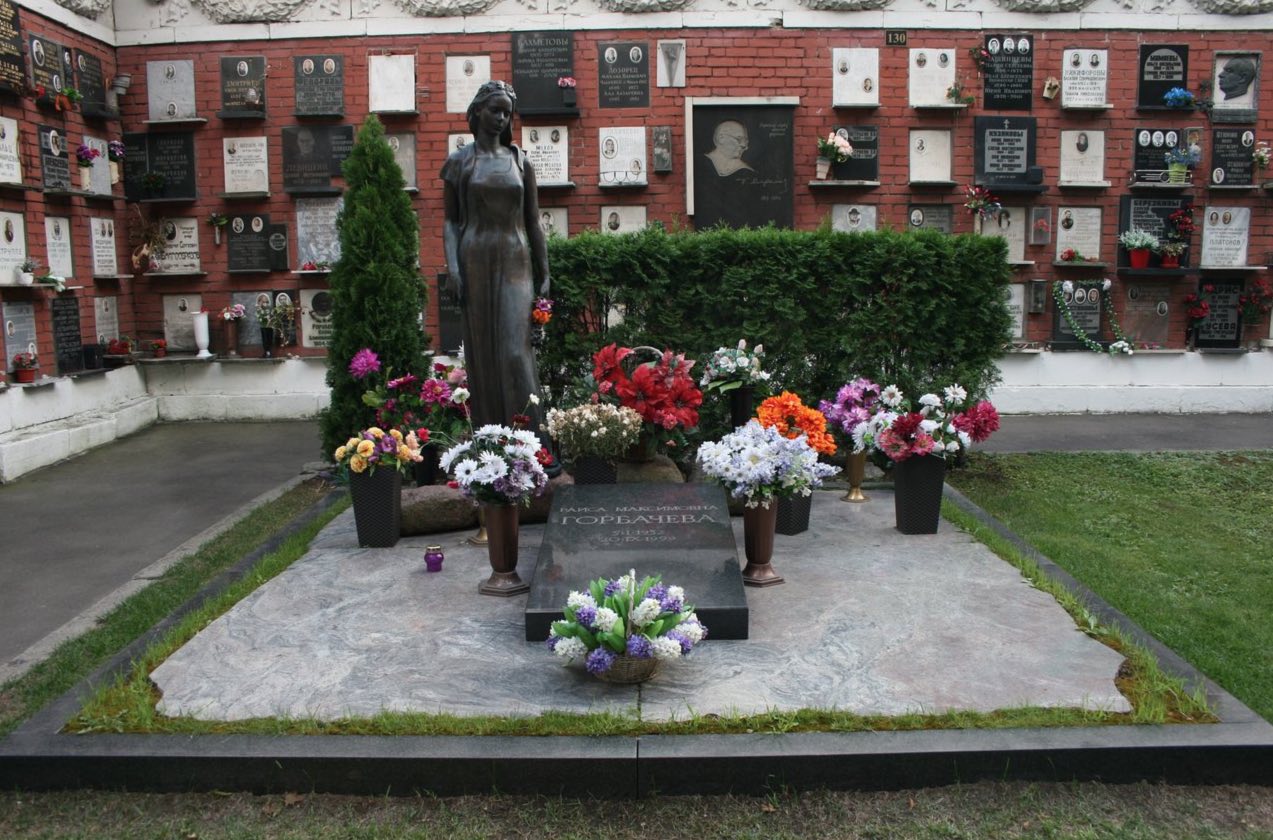
- Mikhail Gorbachev (1931–2022), buried here in September 2022 next to his wife Raisa.
- Vladimir Zhirinovsky (1946–2022), the long-time leader of the Liberal Democratic Party.


4.2. More than tombs, sculptures
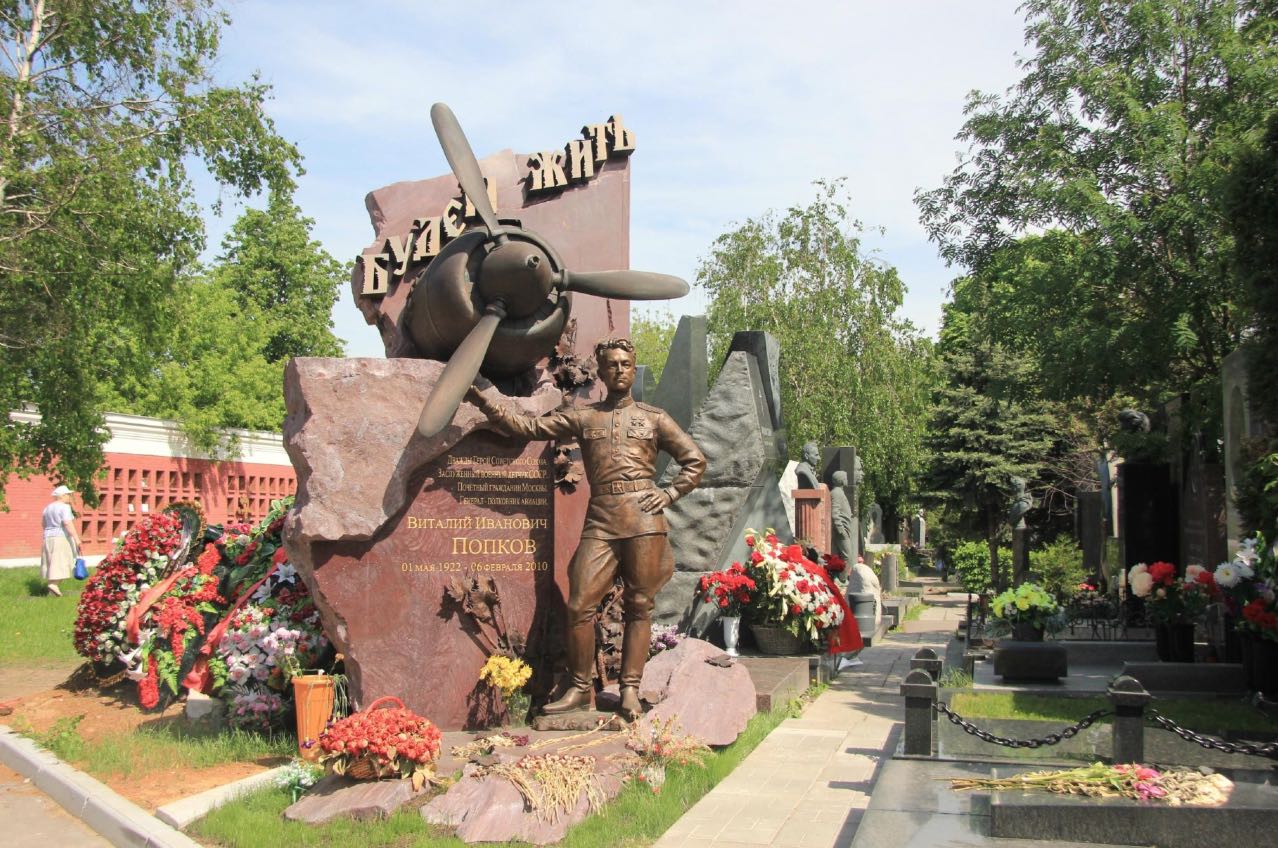
What makes the cemetery special isn’t just the names but the sculptures. Almost every headstone is a personalized work of art that portrays the deceased at their craft: pilots with a plane mounted above the mausoleum, Nikulin in his clown costume, military officers with their bronze medals. If you enjoy European funerary art (Père-Lachaise, Staglieno, Recoleta), you’ll like Novodevichy.



4.3. How to find your way around
At the cemetery entrance there’s a map (in Russian) with the most-visited tombs numbered. If you don’t read Cyrillic, two suggestions. First, snap a photo of the map before you go in so you can check it on your phone. Second, pull up novodevichye.com on your phone before going: it’s an unofficial but very thorough database with an alphabetical and professional index plus an interactive map. It’s in Russian, but with your browser’s translator it’s perfectly usable.
5. Practical tips to plan the visit and skip the lines
- How much time to set aside: a full morning (3–4 hours) for convent + cemetery without rushing. If you only do the cemetery, count on 1.5–2 hours.
- Best time of day: weekdays, first thing in the morning (monastery grounds open at 7:00 a.m., museum at 9:30 a.m.). Sunday gets busier after services.
- Best time of year: late May or the first weeks of June, to see the complex with the lilacs in bloom (Novodevichy is famous for them) and the Smolensk Cathedral open. Autumn with the yellow leaves is also lovely.
- Skipping lines: except on Sundays and religious holidays, there usually aren’t lines.
- Guided tour? The museum’s own tours are in Russian. For tours in English, check my list of guided tours in Moscow: some agencies offer it as a half-day tour with the cemetery included.
- Free audio guide: the monastery’s website has a virtual tour with audio guide. It’s in Russian, but with your browser’s translator it works fine.
- Combine it with nearby spots: a 10-minute walk away is Luzhniki Stadium, the venue of the 2018 World Cup. And from the pier on the lake there are boat tours along the Moskva River to Gorky Park or Zaryadye, a really pleasant way of returning to the center.
6. Where to eat near Novodevichy
The Khamovniki neighborhood is residential and quiet, with several options five to ten minutes’ walk away. Because Moscow restaurants come and go, it’s worth checking on Yandex Maps that they’re still open: Givi i Tsatsivi (Georgian cuisine, good value), Golubka (Russian and Italian cuisine next to the convent’s pond), and the Russian chain Kroshka Kartoshka (filled baked potatoes, cheap fast food) are three very different alternatives. And if you combine your visit with a walk around Luzhniki Stadium, you’ll find more cafés and restaurants there.
Frequently asked questions
How much does it cost for a foreign visitor to enter Novodevichy Convent?
Entry to the monastery grounds is free: you can walk around the courtyard freely. Entry to the church museum (which gives you access to the exhibitions and, in summer, to the interior of Smolensk Cathedral) costs 1,000 ₽ for foreign adults and 500 ₽ for foreign children and students. Entry to Novodevichy Cemetery is free.
Are the convent and the cemetery the same thing?
No. They’re two separate sites with separate entrances. The convent (Новодевичий пр., 1) is the walled monastery. The cemetery (Лужнецкий пр., 2) sits against the southern wall of the convent, but it has its own outer gate. To go from one to the other you walk out, follow the wall around, and enter through the other gate (5 minutes’ walk).
What’s the best time to visit Novodevichy?
Weekdays, first thing in the morning (from 9:30 a.m. when the museum opens). Weekends are busier with local visitors, especially Sunday after services. If you enjoy photography, sunset is also a good time because the complex is almost empty when the museum closes at 5:30 p.m., but the courtyard stays open until 7:00 p.m.
Is Smolensk Cathedral open year-round?
No. The interior of Smolensk Cathedral can only be visited in summer (roughly May to September). You can see it from outside any time of year. It’s important to know this if you’re going in winter: even though the museum is open, you won’t be able to enter the oldest and most spectacular building of the complex.
Are there guided tours in English?
The museum’s own guided tours are in Russian. For tours in English, you’ll need to use private agencies.
Can you take photos inside?
In the monastery courtyard and the cemetery, yes, with reasonable limits. Inside active churches you have to ask for permission or pay a photography supplement, and you can never photograph during liturgical services. Professional photo and video shoots require prior authorization from the museum.
Is the restoration finished?
The complete restoration of the complex, started in 2014, was essentially finished in autumn 2024 to coincide with the monastery’s 500th anniversary. All 36 buildings of the complex have been restored. You may still see scaffolding in some specific areas, but the visit experience is now complete.
How do I pay if I don’t have a Russian MIR card?
The museum ticket office accepts cash in rubles. Visa and Mastercard cards issued outside Russia have not worked since 2022.