
Understanding Russia Through Film: Essential Movies to Watch Before You Travel
 By Irena Domingo
Updated on
In This Article
Admit it: almost everything you think you know about Russia, a film told you. And if that film came out of Hollywood, chances are the Russian was the villain: the boxer who feels nothing, the spy with the metallic accent, the gangster with the gold chain. Before you’ve even set foot in the country, you’re already carrying a caricature around in your head.
In this article I want to do the opposite: eight films to understand the real Russia —the one of ordinary people, small kitchens and long winters— and I’ll tell you where to watch them for free and with subtitles. And since this is a travel blog, I’ll also tell you where each one was shot, in case you fancy walking through those settings when you go.
Why Russians are almost always the bad guys for Hollywood
The stereotype wasn’t born by accident. During the Cold War, the Soviet Union was the perfect ideological enemy, and Hollywood turned it into a stock villain: someone the American hero would always end up beating. Ivan Drago, the Soviet boxer in Rocky IV (1985), is the textbook example: a soulless, doped-up, silent machine, pitted against the warm-blooded good guy of the film.
The funny thing is that the Berlin Wall fell in 1989, the USSR vanished in 1991… and the cliché didn’t go with it. Russians stayed on duty as the bad guys: the mafia in John Wick (2014), the villains in half the James Bond films, the Soviet invasion in Red Dawn, the Russian storyline in Stranger Things. Why did it survive? Mostly commercial convenience: casting Russians as the bad guys drew far fewer complaints than doing the same with other groups, and it let films reach almost any audience without upsetting anyone who mattered.
There’s even a visual grammar of the “evil Russian”: the blue-grey filter, the feeling that it’s always winter, the interchangeable names (Ivan, Boris, Dimitri), the cold, hulking man or the tall, dangerous spy. In English-language cinema the Russian is almost never an ordinary person: he’s a spy, a gangster, a soldier, a threat. The exact opposite of what you’ll see in the films below, where the normal people the caricature erases finally show up.
Everyday Russia, the Russia of the soul
I’ll start with the easiest ones to fall for. These are comedies and dramas that half the country once watched and that today, on top of that, you can watch for free: Mosfilm, the great Soviet studio, has legally uploaded hundreds of its classics to YouTube. I’ve left the player for each one below. A trick for the language barrier: many already come with English subtitles; if you want them in another language, hit the CC icon, then the gear, and choose “Auto-translate.” And a note on the ratings: I use the IMDb score, but bear in mind that on Kinopoisk —the “Russian IMDb,” where the voters are mostly Russian— almost all of these classics rate even higher, nearly always above 8.
Moscow Does Not Believe in Tears (1980)
If you only watch one, make it this one. It follows the lives of three friends who arrive in Moscow at twenty with a head full of dreams, and tracks them over two decades: love, children, disappointments, the climb up the social ladder. It won the Oscar for Best Foreign Language Film in 1981 and has a reputation for capturing “the Russian soul” better than any other; the story goes that President Reagan watched it several times before meeting Gorbachev.
Directed by Vladimir Menshov · 8.0 on IMDb · shot in Moscow. IMDb page
The Irony of Fate (1976)
This is THE New Year’s Eve film in Russia: millions of people watch it every 31 December, the way other countries watch the midnight countdown. The premise is a brilliant joke about Soviet urban planning: a man gets drunk in Moscow, ends up by mistake on a plane to Leningrad and, because every apartment block was identical, his key opens a flat that’s a carbon copy of his own… where someone else lives. A romantic comedy, melancholic and deeply Soviet.
Directed by Eldar Ryazanov · 8.0 on IMDb · set between Moscow and Leningrad (today’s St. Petersburg). IMDb page
The Diamond Arm (1969)
One of the best-loved comedies in Russian history: an utterly ordinary family man goes on a cruise, breaks his arm at a foreign port and, without realising it, becomes the “courier” for a gang of smugglers who hide diamonds in his plaster cast. Slapstick, songs every Russian knows by heart, and humour that holds up over time. The best part for you as a traveller: a good chunk was shot on the Black Sea coast, around Sochi, where there’s even a monument to its characters today.
Directed by Leonid Gaidai · 8.2 on IMDb · shot in and around Sochi. IMDb page
The great arthouse cinema
If you want to go deeper, here’s the Russia that aims to be a work of art. These films are long, slow and demanding, but the kind that stay with you. Both are by Andrei Tarkovsky, probably the most admired Russian filmmaker outside Russia, and Mosfilm has them on YouTube with English subtitles!
Andrei Rublev (1966)
The portrait of a 15th-century icon painter that ends up telling the story of all of medieval Russia: princes at war, the Tatar invasions, the weight of the Church, hunger and faith. Tarkovsky shot it in real locations you can visit today: Vladimir, Suzdal, the Church of the Intercession on the Nerl, Pskov… almost the entire Golden Ring. In Suzdal there’s even a monument to the director, facing the very landscape he filmed.
Directed by Andrei Tarkovsky · 8.0 on IMDb · shot around the Golden Ring. I explain how to travel through those cities in the guide to the Golden Ring of Russia. IMDb page
Stalker (1979)
Philosophical science fiction —no spaceships or lasers. A guide, the “stalker,” leads two men —a writer and a scientist— through “the Zone,” a forbidden, dangerous territory where, they say, there’s a room that grants your deepest wishes. It’s hypnotic, unsettling and one of the most influential films ever made. A traveller’s curiosity: the “Zone” isn’t Russia at all, but some industrial ruins by the Jägala river, near Tallinn, in Estonia.
Directed by Andrei Tarkovsky · 8.1 on IMDb · shot in Estonia. IMDb page
The Russia you can actually walk through
These three aren’t on Mosfilm (for free), but I’m including them because their settings are among the most recognisable in the country: if you go to St. Petersburg or the Russian Arctic, you’ll look at them with new eyes.
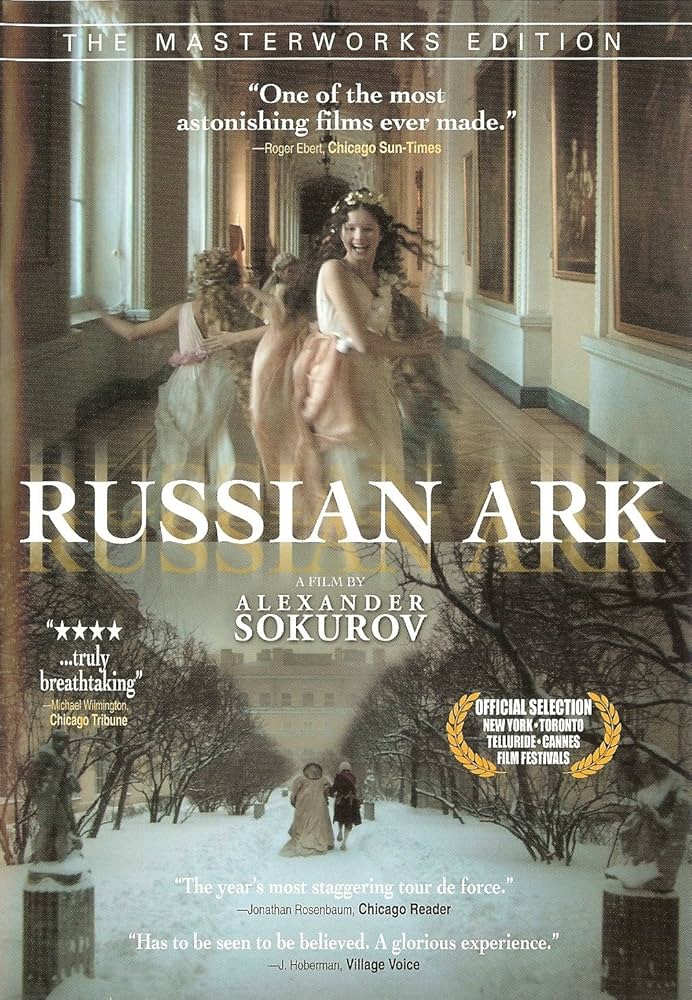
Russian Ark (2002)
The most insane technical feat in cinema: an hour and a half shot in one go, in a single unbroken take, inside the Hermitage Museum. The camera travels through 33 rooms of the former Winter Palace while three centuries of Russian history parade past, with more than 2,000 extras and a final ball that gives you goosebumps. If you’re going to visit the Hermitage, watching it beforehand is the best possible preparation.
Directed by Aleksandr Sokurov · 7.3 on IMDb · shot entirely inside the Hermitage. The guide to visiting it: the Hermitage in St. Petersburg. IMDb page
Brother / Brat (1997)
The rawest, most honest portrait of 1990s Russia. Danila, a young man just back from the army, arrives in St. Petersburg and ends up dragged into the criminal underworld by his brother. It was shot on a shoestring (literally, $10,000) in the city’s real flats and streets —including the Smolensk Lutheran cemetery on Vasilyevsky Island— and that’s exactly why it reeks of truth. An absolute cult film in Russia.
Directed by Aleksei Balabanov · 7.8 on IMDb · shot in St. Petersburg. To get your bearings around the city, my guide to St. Petersburg. IMDb page
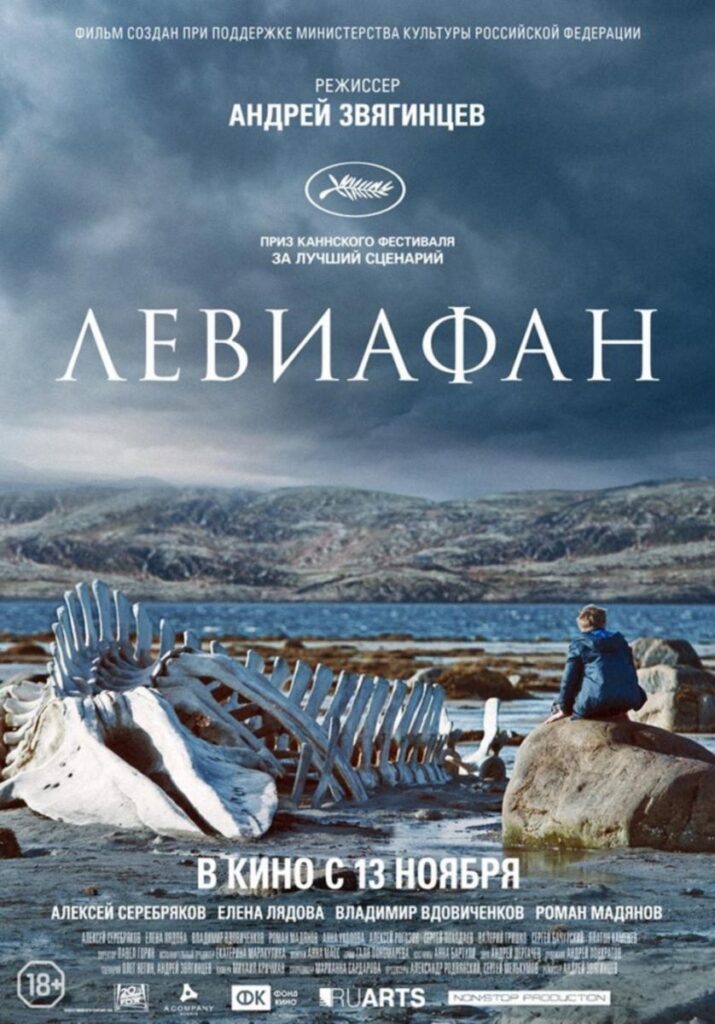
Leviathan (2014)
A mechanic takes on a corrupt mayor who wants to seize his house, and the story gradually turns into a tragedy of biblical proportions. Oscar-nominated and a winner at Cannes and the Golden Globes, it’s a hard watch, but its real star is the landscape: it was shot in Teriberka, an Arctic fishing village on the Kola Peninsula, about 120 km from Murmansk. After the film, Teriberka became a destination for travellers who go to see its beaches, its beached boats and the famous whale skeleton.
Directed by Andrey Zvyagintsev · 7.6 on IMDb · shot in Teriberka (Murmansk). IMDb page
Mosfilm: Russia’s biggest studio (and its free YouTube channel)
Almost all the classics on this list came out of Mosfilm, the studio founded in the 1920s that is to Russia what the big Hollywood studios are to the United States. The good news for you: its official YouTube channel has more than a thousand Soviet and Russian films, restored and free, many with subtitles (English on almost all of them, and some in other languages too). It’s possibly the best legal way to binge on Russian cinema without leaving your sofa.
There’s far more there than fits on this list: War and Peace, Sergei Bondarchuk’s Tolstoy adaptation that won the Oscar and was the most expensive film in Soviet cinema; Solaris, Tarkovsky’s other science-fiction masterpiece; or Battleship Potemkin by Eisenstein, with the staircase scene that’s been copied a thousand times. The English-language channel is @Mosfilm_eng. And if the studio itself piques your curiosity —you can visit it in Moscow— I tell you all about it in the article on visiting Mosfilm.
Kinopoisk: the “Russian IMDb” (and why it matters to you)
If you ever talk films with a Russian, sooner or later you’ll hear something like “it’s got an 8.5 on Kinopoisk.” Kinopoisk (Кинопоиск) is the most popular film website in Russia: it started in 2003 as an IMDb-style database —listings, trailers, reviews, user ratings— and today, in the hands of Yandex (the “Russian Google”), it’s also a streaming platform, a cross between IMDb and Netflix.
Why am I telling you this? Because its ratings better reflect Russian audiences’ taste, especially with Soviet cinema and local productions: a comedy that sits at an 8 on IMDb can push 8.5 on Kinopoisk. To discover which films Russians truly adore, it’s the best compass. That said, its streaming side only works inside Russia: from abroad you’d need a VPN to access it. The database, on the other hand, you can browse from anywhere.
For travellers: where to breathe cinema in Moscow
If you’re the kind of traveller who also loves film, Moscow has two stops that probably won’t be in your guidebook and that, on top of that, sit in the very same place: the grounds of VDNKh, that enormous Soviet-era exhibition park that’s a visit in its own right.
The Cinema Museum (Muzei Kino)
Reopened in 2017 in Pavilion No. 36 at VDNKh, it’s a cinephile’s paradise: original posters, antique cameras, costumes, directors’ personal belongings and a collection of some 169,000 items covering the history of Russian cinema since the 19th century. It has three screening rooms showing Soviet classics every week and an area designed for children. Closed on Mondays.
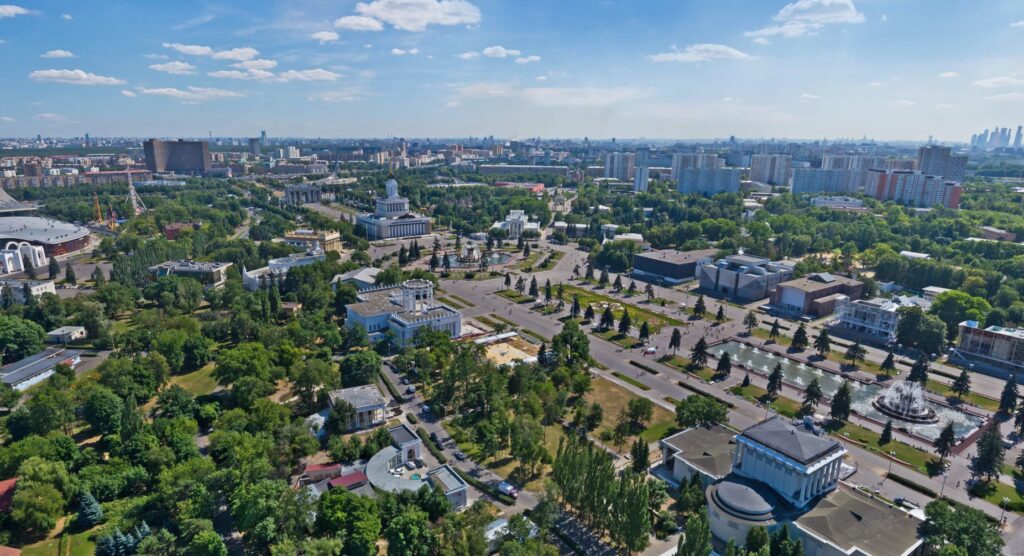
Soyuzmultpark and Cheburashka
A few metres away, in Pavilion No. 7, is Soyuzmultpark, the multimedia park of Soyuzmultfilm, the legendary Soviet animation studio. It’s the kingdom of mythical characters like Cheburashka or the wolf from “Nu, Pogodi!” (the Russian “Tom and Jerry”): 18 interactive attractions, 3D zones and workshops where you can make your own cartoon. A great plan if you’re travelling with kids. I tell you everything the grounds have to offer in the guide to VDNKh.

Which film should I watch before travelling to Russia?
If you can only watch one, Moscow Does Not Believe in Tears (1980) is the best gateway to the Russian character. If you’re heading to St. Petersburg, Russian Ark shows you the inside of the Hermitage; if you’re going to Moscow at New Year, The Irony of Fate is the perfect pick.
Why are Russians always the bad guys in Hollywood films?
The stereotype was born in the Cold War, when the USSR was the ideal enemy, and it stuck around afterwards out of commercial convenience: turning Russians into villains caused little controversy and let films reach almost any audience. That’s why the cliche survived even after the fall of the Soviet Union.
Where can I watch Russian cinema for free and with subtitles?
On Mosfilm’s official YouTube channel, which has more than a thousand restored, free Soviet and Russian films. Almost all carry English subtitles and some come in other languages too; for the rest you can turn on YouTube’s automatic subtitle translation into your own language.
What is Kinopoisk?
It’s the most popular film website in Russia, a kind of local IMDb that also works as a streaming platform, owned by Yandex. Its ratings reflect Russian audiences’ taste very well. The streaming side only works inside Russia, but the database can be browsed from any country.
In This Article
Was this useful? I'll tell you when something changes in Russia
One short email a month with what has changed for travellers (visas, payments, border crossings, apps), based on what readers report to me from Russia. More than 4,000 of us already. No spam: if you ever lose interest, unsubscribing is one click.
Irena DomingoAbout Me
I was born in Russia. I grew up between two worlds: my father was Russian, my mother Spanish — a descendant of the "Children of Russia", the Basque children evacuated to the USSR during the Spanish Civil War. I've worked as a translator, interpreter and Russian teacher for over 30 years, and since 2013 I've been writing this blog to help travelers discover Russia with practical, always up-to-date information. Author of the Russiable Guide. If this blog has helped you plan your trip, you can buy me a coffee ❤️.
 Which Brands Left Russia (and What They’re Called Now)