
Bolshoi Theatre Moscow: How to Buy Tickets as a Foreigner
 By Irena Domingo
Updated on
In This Article
If you’ve been dreaming of watching a ballet or an opera at the Bolshoi Theatre during your trip to Moscow, the first thing you need to know is that buying tickets from abroad has become a lot harder since 2022. The official website is difficult to access outside Russia (you’ll need a VPN), and even if you manage to get in, the payment system won’t accept Visa or Mastercard cards issued outside Russia. To make things worse, the resellers that show up when you search “Bolshoi tickets” on Google are charging 3x, 4x or even 5x the official price.
The good news is that you can still get tickets at the real price. The simplest way is to buy them at the theatre’s own box offices as soon as you arrive in Moscow, paying in rubles in cash. If you have a Russian MIR card, you can also buy online at bolshoi.ru. In this article I’ll walk you through all the options step by step, the real prices in 2026, when tickets go on sale, and what to do if you’re visiting in August and there’s no season running.
This is step 6 of my guide to planning a trip to Russia in 10 steps, where you’ll find everything else in order.
The problems with buying tickets as a foreigner
The Bolshoi’s official website (bolshoi.ru) has an English version and works reasonably well… if you’re in Russia. From outside the country you’ll run into three obstacles stacked one on top of the other:
- Blocked or intermittent access. The site loads very slowly or not at all from foreign IP addresses. The fix is to connect with a VPN to a server that isn’t blocked in Russia (for example Proton VPN).
- Foreign cards aren’t accepted. Even if you manage to get in and register, the payment system only accepts Russian cards (MIR mainly, and some Visa/Mastercard issued by Russian banks). Foreign cards have been rejected automatically since March 2022.
- Even with a MIR card, depending on the bank linked to it, the system may ask for SMS confirmation to complete the online purchase — which requires a Russian phone number.
The easiest ways to get tickets without overpaying
Option 1. Buy at the box office
The simplest option is to buy tickets at the theatre’s box offices once you arrive in Moscow. This is what I recommend to most travellers. As soon as you get there, head to the Bolshoi’s ticket windows and pay in rubles — cash or any Russian card. Official channel, official price, no middleman commission.
The Bolshoi has four official physical box offices, all within walking distance of each other, open every day without exception. Opening hours vary slightly depending on the building:
- Administrative Building box office (Teatralnaya Square, 2 — right at the exit of Okhotny Ryad / Teatralnaya metro). Hours: 11:00–20:00, no break.
- Historic Stage box office (Teatralnaya Square, 1 — the main theatre building). Hours: 11:00–20:00 with a break 16:00–18:00.
- New Stage box office (Bolshaya Dmitrovka, 4/2 — 2 minutes’ walk from the historic building). Hours: 11:00–20:00 with a break 14:00–15:00.
- Chamber Stage box office (Nikolskaya, 17/1 — 5 minutes’ walk, near Red Square). Hours: 11:00–20:00 with a break 14:00–15:00.
All four box offices sell tickets for any performance on any stage, not just their own. In summer (when the theatre closes for vacation, usually 1–28 August), only the Administrative Building box office stays open, with reduced hours 11:00–19:00. For phone enquiries: +7 495 455-55-55.
At the box offices you pay with cash in rubles or a Russian card (including MIR). Foreign cards are not accepted, so bring rubles with you. It’s worth changing money at a bank or exchange office beforehand — check the article on bringing euros in cash to Russia so you don’t lose money on the conversion. For cheap tickets (side boxes, upper galleries) a few thousand rubles will do; for stalls seats at the Historic Stage you’ll want to carry more.
Option 2. Buy online at bolshoi.ru with a MIR card
If you’re already in Russia (or have been before) and you have a MIR card from T-Bank or another Russian bank, you can buy online at bolshoi.ru. Register, pick your performance and seat, pay with MIR and print your e-ticket. Pretty straightforward — similar to any online purchase.
The key detail is that with some cards the payment goes through 3D Secure authentication, and the confirmation code arrives by SMS to the phone number you linked to the card when you opened the account. It’s worth trying.
Option 3. Ask a friend or family member in Russia to buy them
If you know someone who lives in Russia — a friend, partner, family member, former classmate — they can buy the tickets in your name at bolshoi.ru or at the box office. They’ll need to provide your full name and passport number, exactly as they appear on your visa or entry document. They then send you the e-ticket PDF by email.
If you need to send them money from abroad, there are several methods that still work in 2026 (SendNOW, SwapCoin and other P2P platforms).
When do tickets go on sale?
The Bolshoi releases tickets 3 months before each performance, on a specific date that the theatre announces in advance.
The most in-demand performances — The Nutcracker at Christmas, Swan Lake, Giselle, Don Quixote, premieres featuring star dancers — can sell out fast. For the rest of the repertoire there’s usually availability until a few days before the show, or even on the day itself.
To find out the exact on-sale dates, check the website or subscribe to the theatre’s official Telegram channel: @bolshoi_theatre. They also post announcements on their official VK page (the Russian social network equivalent of Facebook).
Real prices in 2026
Official Bolshoi prices have risen a lot in recent seasons. To give you a rough idea, at the Historic Stage for a high-demand ballet the current ranges are approximately:
- Stalls (Parterre): 15,000–50,000 rubles (≈ €145–485).
- First balcony (Bel-étage): 8,000–25,000 rubles (≈ €78–243). The front row of the Bel-étage is considered the best value seat in the whole theatre.
- Second and third tiers: 3,000–12,000 rubles (≈ €29–116).
- Fourth tier and upper galleries: from around 500 rubles (≈ €5) for restricted view up to 6,000 rubles for a full view.
- Subsidised social tickets: 100 rubles (≈ €1), reserved for specific categories of Russian citizens with social discounts.
At the New Stage prices are roughly half for equivalent seating, with the added bonus that the hall is smaller and sightlines are good from almost every seat. The artistic quality of the performances is identical.
If you see tickets advertised on English-language websites for €300, €500 or €1,000, or “VIP Packages” with a guide and dinner for €2,000, those are resellers applying a 200–500% markup on the official price.
The Bolshoi’s stages
Something important to check before you buy: the Bolshoi isn’t a single building but a complex with four performance spaces, and not every show takes place in the famous historic building. When you pick a performance, pay close attention to which stage it’s on.
Historic Stage
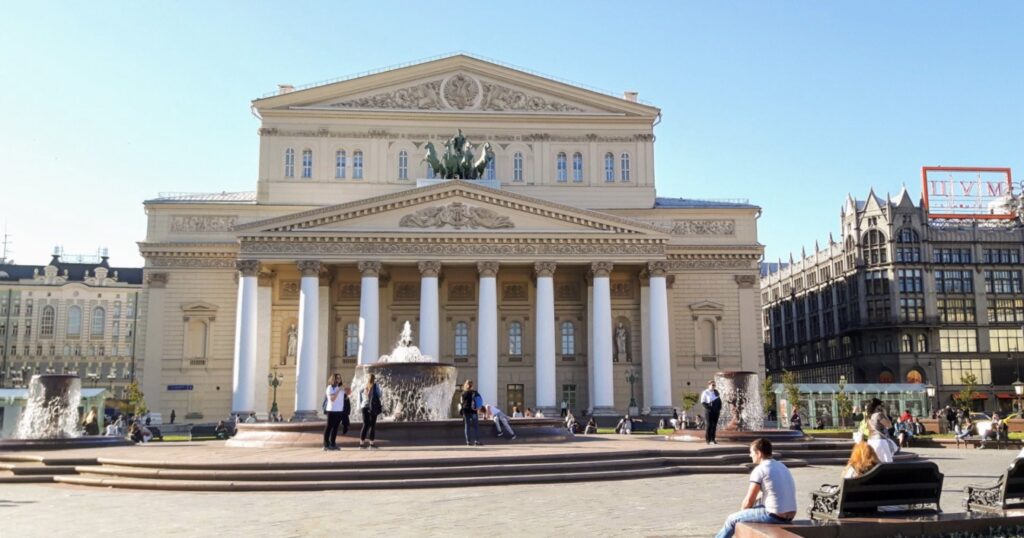
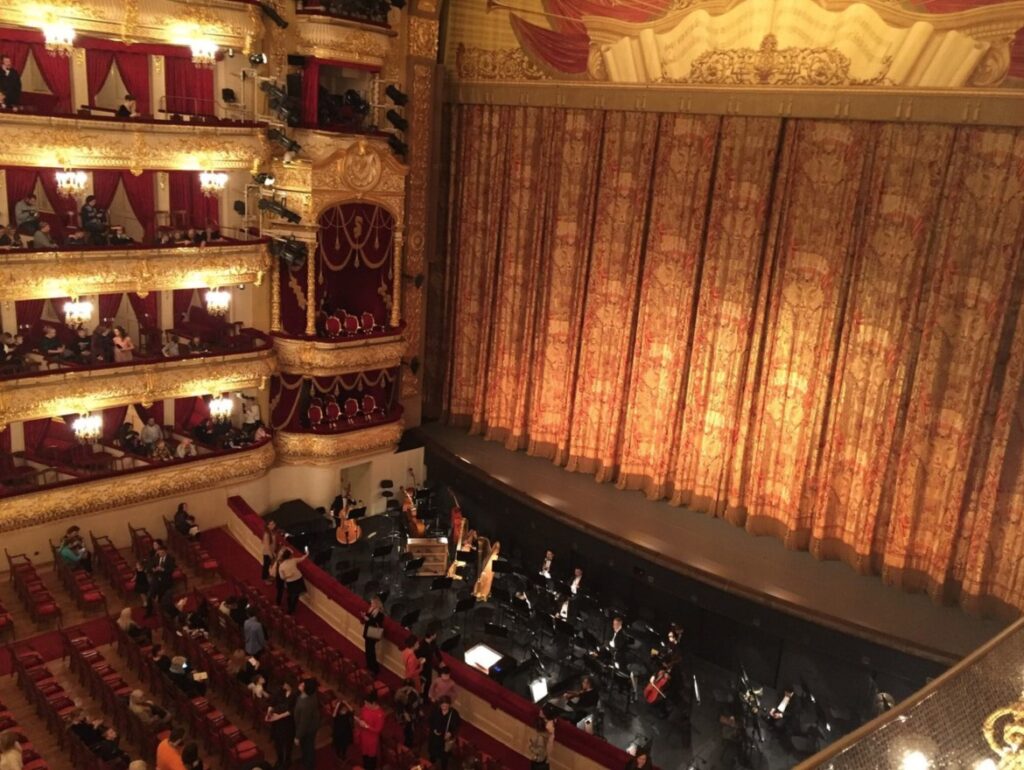
This is the building everyone associates with the Bolshoi: the neoclassical facade with eight columns and the Apollo quadriga on the pediment (the same one depicted on the old 100-ruble note). It reopened in 2011 after six years of restoration, recovering its original imperial appearance. The main auditorium has 1,740 seats arranged across the stalls and six tiers, with boxes lined in gold leaf and upholstered in red velvet. This is where the bulk of the classic ballet and opera repertoire is staged, and where most travellers want to be.
New Stage
An annex to the historic building, originally built to host performances while the main theatre was being restored. It’s more modern and less architecturally impressive, but it features exactly the same company, the same corps de ballet and the same orchestra. Tickets are cheaper, availability is better, and the more intimate hall actually makes the performance easier to enjoy.

Beethoven Hall and Chamber Stage
Inside the historic building’s entrance is Beethoven Hall, a smaller space dedicated to chamber concerts, recitals and educational programmes. The Chamber Stage, located elsewhere, hosts smaller-scale operas.

Guided tours of the historic building (without a performance)
If you can’t get tickets for a show, or if you simply want to see the inside of the Historic Stage during the day with a full explanation, the theatre itself organises guided tours several days a week. They take you through the foyer, the salons, the boxes (including the Royal Box) and the ante-rooms, telling you the history of the building and the company. The tour lasts just over an hour, and if you’re lucky you might catch a live rehearsal in progress (these aren’t announced in advance).
Tours in English and Russian
- Languages: Russian and English.
- Days: usually Tuesday, Wednesday and Friday, though days vary by season. Check the updated calendar in the Excursions section: https://bolshoi.ru/visit/excursion
- Times: around 11:00 (Russian) and 11:15 (English).
- Price: approximately 2,500–3,500 rubles per person (≈ €25–35).
- Booking: tickets are not sold online. You need to go on the day of the tour to the box office at Gate 12 of the Historic Stage. Groups are limited to 20 people, so it’s worth arriving early in the morning (ideally when the box offices open at 11:00).
- There are no guided tours during the theatre’s vacation period (August).

Watch out for resellers: they can charge you 5x the price
If you search “Bolshoi tickets” on Google, half a dozen websites will come up that look official — some are even translated into multiple languages and accept foreign cards. None of them are official. The Bolshoi doesn’t partner with any distributors or resellers: the official website is bolshoi.ru, and only bolshoi.ru.
What these third-party platforms do is buy tickets at the official price the day presale opens — sometimes using paid people to queue at the box offices — and then resell them to foreign tourists with a 200–500% markup. A stalls ticket that costs 25,000 rubles (≈ €240) at the box office ends up being sold on these sites for €800–1,500.
Beyond the inflated price, there are two extra risks:
- The ticket may not be in your name. If the reseller bought it in their own name, at the entrance check they can deny you entry when they see your passport doesn’t match. The Bolshoi is explicit about this: “If the information on the ticket does not match the identity document presented, the theatre administration will not permit the ticket holder to enter.”
- Outright scams. Since 2025 there has been a surge of fake Telegram channels impersonating the Bolshoi (or posing as “locals who can’t make it and are selling their ticket”). They take your money, send a forged PDF, and by the time you realise, they’ve blocked you.
Outside the official Bolshoi website and its box offices, any other channel you see advertised — with names like “bolshoirussia.com”, “boxoffice.bolshoi.org”, “operaandballet.com” or similar — is not the Bolshoi’s official website, no matter how convincing the design looks.
What to do in August, when the Bolshoi is closed
The Bolshoi season typically starts in early September and ends in late July. That means that in August — precisely the month when most travellers visit Moscow — there are no performances on any of the stages. The company is on tour or on holiday, and the building is closed to the public (including guided tours).
If your trip falls during those weeks, here are some excellent alternatives in Moscow:
- Kremlin State Palace (kremlinpalace.org). Inside the Kremlin grounds there’s a theatre with a capacity of 6,000 that programmes classic ballets (Swan Lake, Sleeping Beauty, Esmeralda, Don Quixote) performed by its own company since 1990. The quality is high, prices are roughly half what you’d pay at the Bolshoi, and watching a ballet inside the Kremlin is a fairly unique experience.
- Stanislavsky and Nemirovich-Danchenko Theatre. The great alternative to the Bolshoi for anyone looking for top-tier Russian ballet without Bolshoi-level prices. Good-visibility stalls for around €40 and dancers trained at the same schools as those at the Bolshoi.
- Novaya Opera (novayaopera.ru). A prestigious opera company that programmes in summer when other theatres are dark.
- Kostroma Russian Folklore Show (August–September). A Russian folk dance show by the Russian National Ballet at the folklore theatre (Olimpiyskiy prospect 14). It’s touristy, yes — but a solid plan if you’re visiting in the height of summer and want a Russian cultural evening. More details in the article on Russian folklore shows.

And if your trip includes St. Petersburg, you’ll find the Mariinsky and the Mikhailovsky there — two theatres on a par with the Bolshoi, with their own seasons that only partially overlap with Moscow’s: in some summer weeks there are performances in St. Petersburg even when the Bolshoi is dark.
Visiting rules (important things to know in advance)
- Passport required. Tickets are issued in your name. At the entrance they may check that the name matches your document.
- Minimum age: 6 years for daytime performances and 10 years for evening ones. Children also need to show their document (passport or translated birth certificate).
- Punctuality. The auditorium doors close after the third bell. Arriving late means waiting until the first interval to enter. Get there at least 30 minutes early to clear security and leave coats at the cloakroom.
- Cloakroom is mandatory. Bulky coats, backpacks and large bags cannot be taken into the auditorium. It’s free and very well organised. At the Historic Stage there are five cloakrooms distributed by seating zone.
- Phones on silent — no video recording or photography during the performance (you can take photos in the foyer and salons during the intervals).
- No food or drinks in the auditorium. That’s what the interval buffets are for.
Dress code
There’s no strict code. The Bolshoi’s own website makes it clear: in a city like Moscow, most people go to the theatre straight after work, so a relatively informal style is accepted. That said, two rules are taken fairly seriously:
- No shorts, vest tops or flip-flops. If you show up like that, they won’t let you into the auditorium.
- Ripped jeans and sportswear are discouraged. Dark jeans with a shirt or blouse are fine.
If you want to dress up without overdoing it, the typical choice is a suit without a tie for men or a cocktail dress / skirt with a blouse for women. But a pair of smart trousers and a shirt work perfectly well too.

How to get to the Bolshoi
The Bolshoi is at Teatralnaya Square, 1, right in the centre of Moscow, a 5-minute walk from Red Square and the Kremlin. The nearest metro stations are:
- Teatralnaya (Line 2, green): direct exit to the square, right next to the theatre.
- Okhotny Ryad (Line 1, red): 2 minutes’ walk.
- Ploshchad Revolyutsii (Line 3, blue): 5 minutes’ walk, connected by an underground passage to the two above.
If you’re staying in the historic centre (any hotel within a 1.5 km radius of Red Square), you can easily walk.
Food and drinks at the theatre (bring cash)
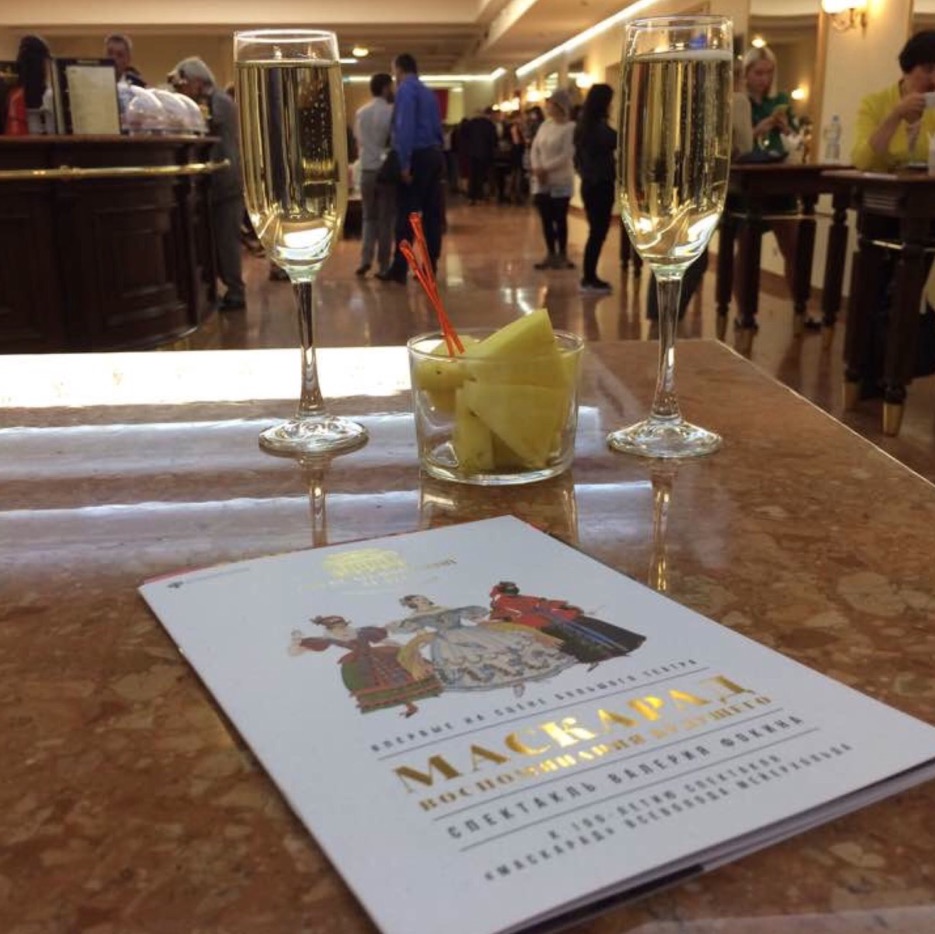
Each stage has two buffets that open during the intervals. They serve champagne, wine, coffee, water, sandwiches, small cakes, blini with caviar and various canapés. Prices are high (a sandwich with red caviar runs about 1,500–2,500 rubles), but it’s part of the experience.

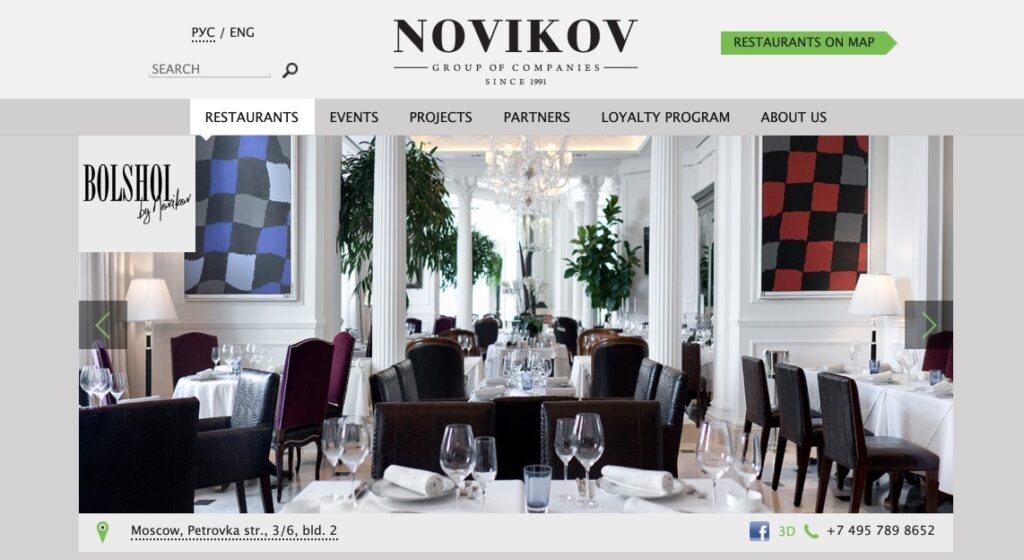
If you’d rather have a proper dinner before or after the performance, a good option is the Bolshoi restaurant by Novikov Group (from 3,500 rubles per person), on Petrovka street, a 3-minute walk from the theatre. Modern Russian cuisine in an elegant setting — worth booking ahead. For more options, see the guide to where to eat in Moscow.
Frequently asked questions
When do Bolshoi tickets go on sale?
Three months before each performance. The exact calendar is published in advance on bolshoi.ru and announced on the theatre’s official Telegram channel.
How much do Bolshoi Theatre tickets cost in 2026?
At the Historic Stage, tickets range from around 500 rubles in the upper galleries to 50,000 rubles in the stalls for high-demand performances. At the New Stage prices are roughly half. Subsidised social tickets cost 100 rubles but are reserved for specific categories of Russian citizens.
What can I do in August when the Bolshoi is closed?
In August there are no performances on any Bolshoi stage because the company is on tour or on holiday. Alternatives in Moscow include the Kremlin State Palace (with classic ballets at half the price), the Stanislavsky Theatre, the Novaya Opera, or the Kostroma folklore show which runs in August and September.
Is there a dress code for the Bolshoi Theatre?
There is no strict code. Shorts, vest tops and flip-flops are banned, and sportswear and ripped jeans are discouraged. The most common choice is smart casual: dark jeans with a shirt or a simple dress are perfectly fine. Bulky coats and large bags must be left in the theatre’s free cloakroom.
Why are tickets on sites like Bolshoirussia.com so expensive?
Those sites are not official, even if they look it. They are resellers who buy tickets at the official price and sell them on to foreign tourists with a 200–500% markup. The Bolshoi does not work with any distributors: the only official channels are bolshoi.ru and the theatre’s own box offices.
In This Article
Was this useful? I'll tell you when something changes in Russia
One short email a month with what has changed for travellers (visas, payments, border crossings, apps), based on what readers report to me from Russia. More than 4,000 of us already. No spam: if you ever lose interest, unsubscribing is one click.
Irena DomingoAbout Me
I was born in Russia. I grew up between two worlds: my father was Russian, my mother Spanish — a descendant of the "Children of Russia", the Basque children evacuated to the USSR during the Spanish Civil War. I've worked as a translator, interpreter and Russian teacher for over 30 years, and since 2013 I've been writing this blog to help travellers discover Russia with practical, always up-to-date information. Author of the Russiable Guide. If this blog has helped you plan your trip, you can buy me a coffee ❤️.
 Cathedral of Christ the Saviour Moscow: How to Visit, Hours and Masses
 Best Places to Enjoy Panoramic Views of Moscow: Where to Go Up
 The Seven Sisters of Moscow: a 2026 Guide to Stalin’s Skyscrapers