
Russian eVisa Duration: 30 Days Today and the Reform That Would Make It 45
 By Irena Domingo
Updated on
In This Article
With the Russian eVisa you can stay in Russia for up to 30 days from the day you enter, and you have 120 days from the day it is issued to make the trip. These are the rules in force since 23 August 2025.
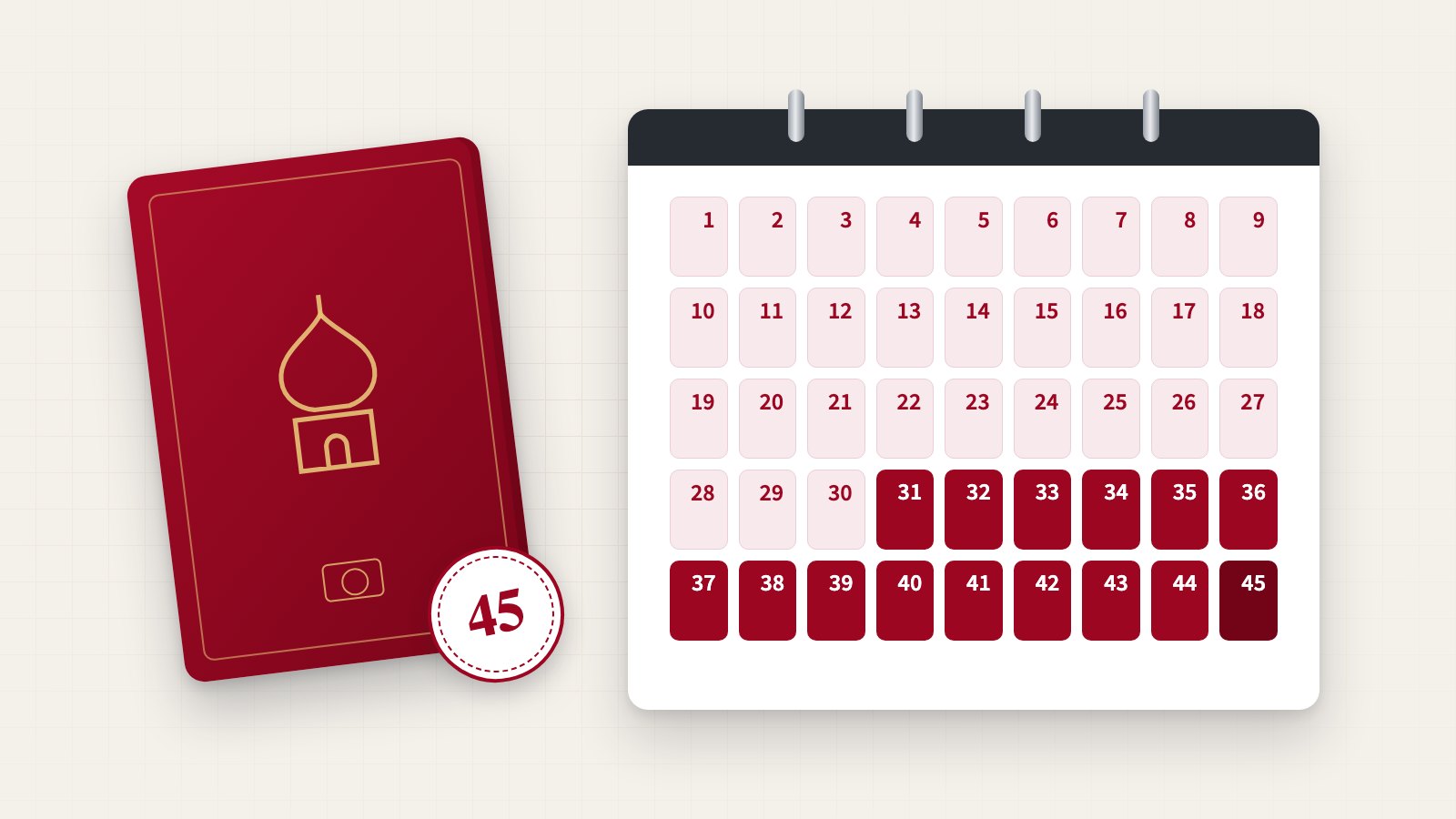
In November 2026, Russia started work on a reform that would change those numbers: the eVisa would last 45 days from the day it is issued, and you could stay in the country for that whole time. It isn’t law yet. Here I explain what applies today, what the reform would change and how it affects you if you’re planning your trip.
How long the eVisa lasts today
Since 23 August 2025, the law that extended the eVisa stay from 16 to 30 days has been in force. The eVisa has two different time limits that are easy to mix up:
| Time limit | Length | How it’s counted |
|---|---|---|
| Validity | 120 days | From the day your eVisa is issued. You have to enter and leave Russia within this period. |
| Stay | 30 days maximum | From the day you enter. The day you arrive and the day you leave count as full days, so it isn’t 30 nights. |
| Entries | One | If you leave Russia, you need another eVisa to come back. |
An example: if your eVisa is issued on 1 March, you can enter Russia whenever you like until the end of June. If you enter on 10 April, you have to leave by 9 May at the latest.
The eVisa can’t be extended, unless it’s impossible to leave Russia because of urgent medical treatment or force majeure. If you need more than 30 days or several entries, you need a regular visa: the options are compared in the Russian visa guide. And to apply for the eVisa step by step, there’s the Russian eVisa guide.
The reform in progress: a 45-day eVisa
On 2 November 2026, the Russian Ministry of Foreign Affairs published a draft law on the official portal for draft regulations. It amends the article of Russia’s law on entry and exit that governs the eVisa. It isn’t law yet: it’s in public consultation and the text may still change.
What would change
| Today | Under the reform | |
|---|---|---|
| Validity | 120 days from issue | 45 days from issue |
| Stay | 30 days from entry | As long as the eVisa is valid |
| Border crossings | Only those on the official list | All passenger crossings open to international traffic: airports, seaports, railway stations and roads |
| Purpose of the trip | Tourism, business, visits and events (cultural, sports, scientific…) | The same, plus transit |
| Entries | One | One (the draft doesn’t change this) |
The 45 days would count from the day it’s issued
This is the most important change. The 45 days would start on the day your eVisa is issued, not the day you enter. So how long you could stay would depend on when you enter:
| If you enter Russia… | Today | Under the reform |
|---|---|---|
| On the day it’s issued | 30 days | Almost 45 days |
| 15 days later | 30 days | About 30 days |
| 30 days later | 30 days | About 15 days |
| 50 days later | 30 days | You could no longer enter |
If you apply for the eVisa one or two weeks before your trip, which is what most people do, you would gain days. If you apply far in advance, you would lose room: under the reform, it would make sense to apply close to your travel date.
All borders, and transit too
Today the eVisa is only valid at the border crossings on a government list, including for leaving. According to the explanatory note that comes with the draft, without the difference between validity and stay there’s no longer any need for specially equipped crossings, so the eVisa would be valid at every crossing open to international passenger traffic, overland too.
The draft doesn’t publish a list. In the Russian classification, this covers the airports, seaports, railway stations and road or pedestrian crossings used by travellers of any nationality. As with any visa today, freight-only crossings would stay out, and so would bilateral crossings, which only citizens of Russia and the neighbouring country can use. And, of course, only crossings that are open count: several land borders, such as the one with Finland, are still closed. You can check the status of each one in Russia’s borders.
With transit as a purpose, anyone who has a visa for another country, or doesn’t need one, could cross Russia on the eVisa on the way there. Today, to cross Russia overland you need a transit visa.
eVisas already issued wouldn’t change
eVisas issued before the law comes into force would keep their 120 days of validity, their 30-day stay and the list of border crossings. For about four months both types would exist side by side, so check the conditions of yours carefully.
When it would come into force
There’s no date. The law would come into force 90 days after it’s published, and before that it has to go through these steps:
- Public consultation and anti-corruption review, from 2 November 2026.
- Approval by the Government, which submits it to the Duma.
- Three readings in the State Duma.
- Approval by the Federation Council.
- Signature by the president and official publication.
- 90 days until it comes into force.
In the text of the draft, the space for the signing date already shows the year 2027.
What the draft doesn’t say
- The price, or which countries can apply.
- How far in advance you’ll be able to apply. Today, no earlier than 86 days before you enter. The procedure is set by a government decree which, according to the note on the draft, will have to be adapted.
If you’re travelling in the coming months, nothing changes. Apply for the eVisa as usual and count on a 30-day stay and the list of border crossings. Don’t plan a 45-day trip or an entry through a crossing that isn’t on the list until the reform has been passed and is in force. I’ll update this article as soon as there’s news.
How the eVisa duration has changed
Russia launched the eVisa as a pilot in the Far East in 2017 and extended it to Kaliningrad and Saint Petersburg in 2019. It stopped being issued during the pandemic. The eVisa for the whole country was approved by law in 2020, but it wasn’t launched until 1 August 2023.
| Period | Where it was valid | Stay | Validity |
|---|---|---|---|
| 2017–2020 | Only the region you entered | 8 days | 30 days |
| August 2023 – August 2025 | All of Russia, through the listed crossings | 16 days | 60 days |
| Since 23 August 2025 | All of Russia, through the listed crossings | 30 days | 120 days |
| Reform in progress | All of Russia, through all crossings | As long as it’s valid | 45 days |
Frequently asked questions about the eVisa duration
How many days can I stay in Russia on the eVisa?
30 days from the day you enter, within the visa’s 120 days of validity. The day you arrive and the day you leave count as full days, so it isn’t 30 nights.
Can I already stay 45 days on the eVisa?
No. The 45-day reform is a draft law that has been going through the process since November 2026. Until it’s passed and in force, the maximum stay is still 30 days.
Can the eVisa be extended?
Only if it’s impossible to leave Russia because of urgent medical treatment or force majeure. If you know you’ll need more than 30 days, apply for a regular visa from the start.
Can I leave Russia and come back on the same eVisa?
No. The eVisa is single-entry, and the reform doesn’t change that. If you leave the country, you need a new eVisa to come back.
When do the eVisa days start counting?
Today, the 120 days of validity count from the day it’s issued and the 30 days of stay from the day you enter. If the reform is passed, the 45 days will count from the day it’s issued.
If I already have my eVisa when the reform comes into force, what conditions does it have?
The usual ones: 120 days of validity, a 30-day stay, and entry and exit only through the border crossings on the official list.
Can I leave Russia and apply for another eVisa to come back?
Yes, you can today and the reform doesn’t change that. The eVisa is applied for online from any country, not at a consulate. You have to have left Russia before you apply for the new one and allow up to 4 calendar days for processing, so people usually wait those days outside Russia, for example in a neighbouring country. The rules don’t set any waiting period between one eVisa and the next. It’s explained in the eVisa FAQ.
In This Article
Was this useful? I'll tell you when something changes in Russia
One short email a month with what has changed for travellers (visas, payments, border crossings, apps), based on what readers report to me from Russia. More than 4,000 of us already. No spam: if you ever lose interest, unsubscribing is one click.
Irena DomingoAbout Me
I was born in Russia. I grew up between two worlds: my father was Russian, my mother Spanish — a descendant of the "Children of Russia", the Basque children evacuated to the USSR during the Spanish Civil War. I've worked as a translator, interpreter and Russian teacher for over 30 years, and since 2013 I've been writing this blog to help travelers discover Russia with practical, always up-to-date information. Author of the Russiable Guide. If this blog has helped you plan your trip, you can buy me a coffee ❤️.
 Registration of foreigners in Russia. What should I do?
 Visiting St. Petersburg on a cruise without a visa (visa-free) and with a tourist visa
 Visa-free Travel to Russia for Hong Kong citizens: Requirements and Documents