If you’re a citizen of the UK, the US, or any country in the European Union and you have money “parked” in a deposit or savings account at a Russian bank (T‑Bank, Sber and the like), pay attention: as of June 1, 2026, that money can end up frozen. A new Russian decree has brought the bank deposits of foreigners from countries Russia considers “hostile” under the same freezing regime that already applied to other investments. And the banks are already enforcing it.
The reassuring part: it doesn’t affect the money on your regular debit card, the one you load up to spend during your trip. The problem is term deposits and interest-bearing savings accounts (the ones that pay interest). Here I’ll explain what the rule says, who it affects, what a “type C” account is, and what you can do if your money is trapped. I’m basing this on the official text of the decree and on the real case of a reader whose deposit T‑Bank has just blocked.
This is step 7 of my guide to planning a trip to Russia in 10 steps, where you’ll find everything else in order.

What exactly has happened?
On June 1, 2026, Russia published Presidential Decree No. 377, which amends an earlier decree from 2022 (No. 95). On paper the change is tiny —it adds barely a few words to the text, “депозитам” (“bank deposits”)— but in practice it’s huge. You can check the official text of Decree 377 on the Russian legal portal.
Decree 95 of March 2022 created a special regime for paying foreign creditors from hostile countries: instead of returning their money normally, Russian debtors had to deposit it into a special blocked account, the so-called “type C account.” Until now that regime applied to credits, loans, and securities. As of June 1, 2026, it also applies to deposits and savings accounts: that is, to the bank’s obligation to return your deposit and pay you the interest.
Who is affected and who isn’t?
You’re affected if you’re a citizen of a country on Russia’s list of “hostile states” (the entire EU —including the UK and the US— plus Switzerland, Norway, Japan and others) and you don’t have Russian residency.
You’re not affected if you have a Russian residence permit (РВП or ВНЖ) or a Russian passport: in that case you’re a “currency resident” and your accounts keep working normally. That’s why, as you’ll see below, the first thing the bank asks is whether you hold any of those documents.
Which accounts get frozen? (the most important part)
Here’s the practical key, and it’s worth getting it straight:
- Term deposits and interest-bearing savings accounts (the ones that generate interest): Yes, they fall under the freeze.
- Current account and regular debit card: in principle no, since the decree only affects deposits, not ordinary card accounts.
That said, it pays to be cautious: the wording of the decree is very vague, and nothing guarantees the freeze won’t extend to debit accounts in the future. That’s why the general recommendation is not to keep more money in a Russian bank than you’re going to spend.
The 10 million rubles: what changed on July 14, 2026
When I published this article, this threshold was the big problem. Decree 95 only requires using type C accounts when what the bank owes exceeds 10 million rubles a month (about 117,000 euros). But in June the banks were calculating it per bank, adding up what they owed to all their customers from hostile countries combined —a figure any large institution far exceeds—, so they were freezing even small deposits of 100,000 or 200,000 rubles.
On July 14, 2026, the Bank of Russia published an official clarification (No. 1-OP) that changes this at the root. For deposits, that 10 million ruble threshold is calculated per individual account holder and per calendar month, not by adding up all the bank’s customers. What counts is what the bank owes you in a month, not the institution’s total.
What does that mean in practice? That if your deposit plus the interest due to you in a month don’t exceed those 10 million rubles, your money shouldn’t end up in a type C account. The governor of the Bank of Russia herself, Elvira Nabiullina, acknowledged that banks had applied the rule too broadly.
The clarification adds another important point: the decree does not require reclassifying deposits you already had open as type C, nor applying the freeze before the deposit matures.
A reality check: the clarification is only a few days old and banks take time to adjust their systems. Some may keep applying the old criterion for a few weeks. If that’s your case, read on.
What is a “type C” account?
It’s the “limbo” where your money ends up. A type C account is a special account with a very restricted regime:
- You can’t withdraw cash.
- It only allows transfers for very specific purposes set by law (buying Russian government bonds —OFZ—, paying taxes…).
- To get the money out you need an individual permit from a government commission.
In practice, having your money end up in a type C account means losing sight of it for years. T‑Bank itself advises against opening one voluntarily.
What T‑Bank says: one reader’s case
A reader wrote to me a few days ago to warn me that T‑Bank had blocked the deposit where he kept some money for his trips to Russia. He sent me the screenshots of his conversation with the bank’s support team, and they’re very revealing.
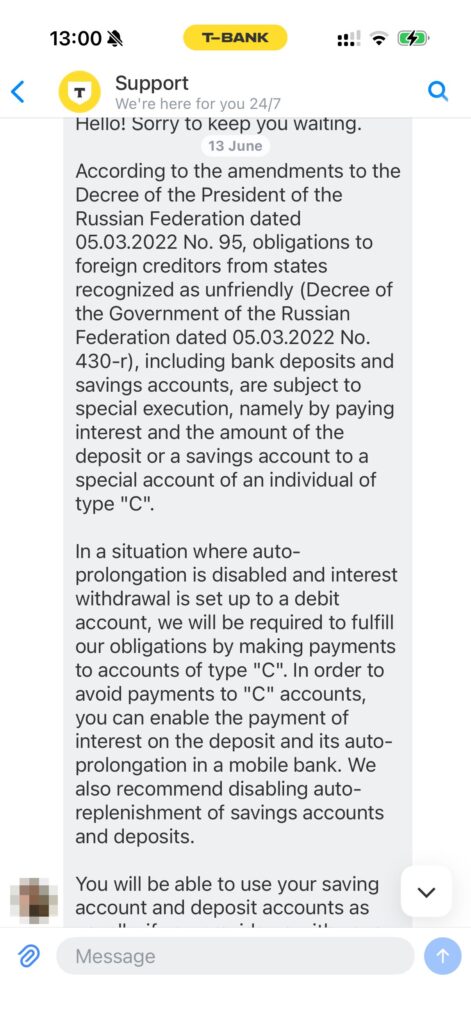
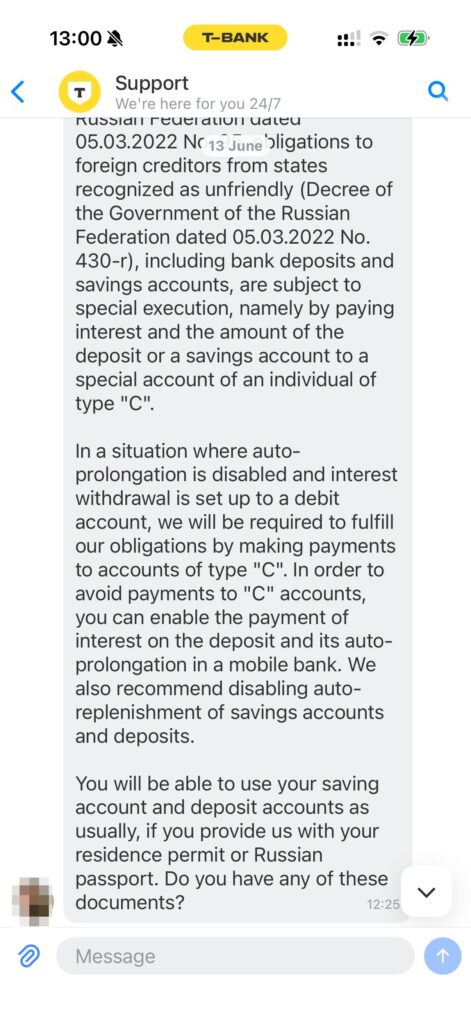
In the first message, support explains that, under the amendments to Decree 95 (that is, the new Decree 377), the deposits and savings accounts of foreigners from hostile countries are now handled through type C accounts, and asks him whether he has a residence permit or a Russian passport. Without one of those documents, there’s no way to use the money normally.
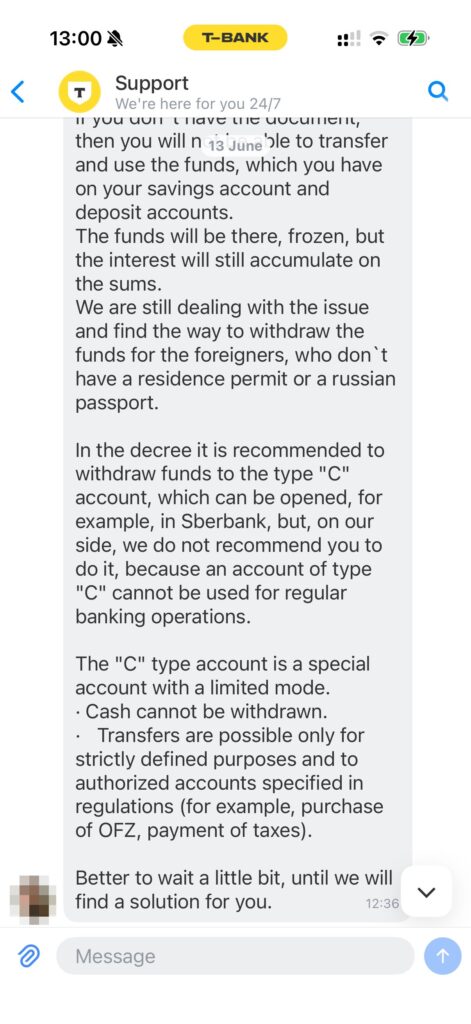
Then they explain the harshest part: if he doesn’t have those documents, the funds stay frozen (although they keep generating interest), and they recommend he not move them to a type C account because it’s even more restrictive. The bank’s advice for keeping the money from automatically falling into a C account is:
- Keep the interest inside the deposit (don’t send it to the debit account).
- Turn on the automatic renewal of the deposit.
- Turn off the automatic top-up.
Translation: as long as the money doesn’t “leave” the deposit, it stays yours and keeps earning… but you can’t touch it. The moment you try to withdraw it, it gets blocked. The bank wraps up with a “better wait, we’re looking for a solution.” For now, there isn’t one.
Had a small deposit frozen? You can dispute it
If your deposit is below those 10 million rubles a month and the bank has moved it (or wants to move it) into a type C account, after the July 14 clarification you have arguments:
- With the bank: ask support to review your case in light of the Bank of Russia’s official clarification No. 1-OP, of July 14, 2026, which sets the 10 million limit per account holder, not per bank.
- With the Bank of Russia: if the bank doesn’t correct it, you can file a complaint directly with the regulator. You can rely on the text of the official clarification.
- As a last resort, there’s the court route.
I can’t promise the unfreezing will be immediate or automatic —each bank moves at its own pace—, but now the rule is on your side.
What you can do if you have money in a Russian bank
I’m neither a financial advisor nor a lawyer, and the rule is very recent, so take this as information for you to decide for yourself. Here’s what’s being recommended among travelers and what I would do myself:
- If you have money in a deposit or savings account, consider moving it to your debit card as soon as possible. You lose the interest, but you keep access to your money.
- Don’t keep more money in a Russian bank than you’re going to spend on the trip. For stashing savings, a Russian institution is no longer a good idea if you’re a foreigner without residency.
- If you only need to pay during the trip, a MIR card loaded with just enough —or simply cash in rubles— remain the safest option.
- If you need to send money to Russia (to family, for example), use the methods that still work instead of piling up a balance in Russian accounts.
Frequently asked questions
Does Decree 377 affect my Russian debit card?
In principle no. The decree affects term deposits and interest-bearing savings accounts, not ordinary debit card accounts.
Will I lose the money I have in a deposit at T-Bank?
You don’t lose it in the strict sense: it stays yours and keeps generating interest, but it’s frozen and you can’t withdraw or use it while the measure is in force.
Am I affected if I have a Russian residence permit?
No. If you have a residence permit (РВП or ВНЖ) or a Russian passport you’re a currency resident and your accounts work normally.
Is it true that it only applies above 10 million rubles?
It depends on the date. Until July 2026 banks calculated that threshold per bank and froze small amounts too. But on July 14, 2026 the Bank of Russia clarified that, for deposits, the 10 million rubles are counted per account holder and per month. If your deposit doesn’t exceed that figure, it shouldn’t be blocked.
What is a type C account?
It’s a special blocked account: it doesn’t allow cash withdrawals, only permits very specific operations (such as buying Russian government bonds or paying taxes), and withdrawing funds requires permission from a government commission.