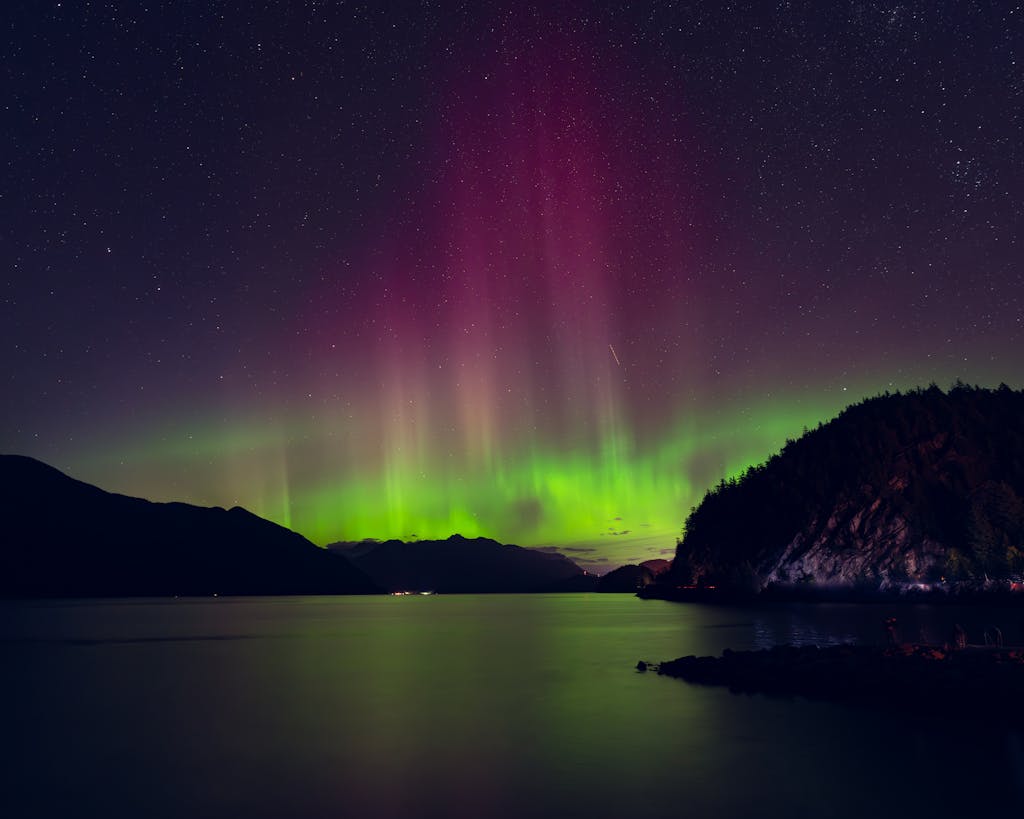
Murmansk is, alongside Tromsø in Norway and Rovaniemi in Finland, one of the three best places on the planet to see the northern lights. It sits at 69° north, right under the auroral oval, and from late August through mid-April the sky lights up almost every clear night with curtains of green, purple and red. It’s the largest city in the world above the Arctic Circle, which means you’ll chase the aurora with every urban comfort within reach: hotels, restaurants, taxis and organised tours.
And there’s an extra reason to go now: we’re at the peak of the solar maximum of Cycle 25, which is expected to extend through 2026. Solar activity is the highest it has been in a decade, which translates into more frequent, brighter and more colourful auroras. After the peak comes the declining phase, and you won’t see a moment like this again for another eleven years. In this guide I’ll walk you through, step by step, when to travel, how to get there as a foreigner, where to watch the lights and everything you need to organise the trip.

Why Murmansk is one of the best places in the world to see the aurora
Murmansk brings together four things that rarely go hand in hand in the Arctic: high latitude, tourist infrastructure, relatively mild weather and low prices. Its magnetic latitude of 69.2° places it squarely inside the zone where auroras appear with a KP index of 2 or 3, while destinations such as Stockholm or southern Iceland need a KP of 5 or higher. In practice that means a single clear night and minimal solar activity are enough for the lights to show up.
The climate helps a lot: counter-intuitive as it sounds, Murmansk has relatively mild winters for its latitude, thanks to the Gulf Stream, which keeps the port ice-free all year round. January averages hover around −10 °C, against the −20 °C typical of equivalent areas in Siberia or Yakutia. And prices are a fraction of what you’d pay in Tromsø or Reykjavík: an aurora-hunting night tour costs between 3,000 and 7,500 rubles per person (€30–75), and a hotel room in the centre between 4,000 and 8,000 rubles (€40–80).
The trickier part is that Murmansk isn’t on Russia’s classic tourist circuit, and now with the geopolitical situation and sanctions in place you have to plan the trip knowing that Visa and Mastercard cards don’t work inside Russia and that parts of the Kola Peninsula are off-limits to foreigners without an FSB permit. All of it has a workaround, but you need to know it in advance.
When to travel: the best time to chase the northern lights
The season runs from late August to mid-April, the months when the night is dark enough to see the show. Before September the days are too long (in midsummer there’s midnight sun and it never gets dark), and from mid-April onwards the sky no longer dims enough. But within that window there are important differences.
The best month: February (and March)
The best month is February. It’s the sweet spot: nights last 18–20 hours, the sky is stable (Arctic high pressure systems give you many cloudless days), snow covers the landscape and adds contrast for your photos, and the full menu of winter activities is still on (skiing, husky sledding, snowmobiling, banya). March follows close behind: the days start to lengthen a little, temperatures climb (it can reach −5 °C, almost spring-like for the Arctic) and the equinoxes trigger higher geomagnetic activity, which means more frequent aurora sightings.
December and January are also good, but they have two drawbacks: the extreme cold (it can drop below −25 °C in cold snaps) and the polar night, which lasts about six weeks (from 2 December to 11 January), during which the sun doesn’t rise at any point. The polar night is a unique experience, but solar activity tends to be lower in those weeks and the cold limits how long you can stay outside. November, September and October are the transition months: less snow, fewer winter activities, but still good chances of seeing the lights.
When the auroras come out
The window of highest probability runs from 22:00 to 03:00 local time. The aurora can appear earlier or later, but that’s the period of greatest statistical activity. Think of the hunt as an all-nighter: have dinner early, try to nap in the late afternoon, and be ready to be outside for 4 to 6 hours with coffee and a hot tea flask within reach. It’s not unusual to spend an hour with an empty sky and, suddenly, watch the whole atmosphere explode into green curtains for 20 minutes.
Catch the solar maximum before it ends
The sun follows an 11-year activity cycle. We’re at the peak of Cycle 25, known as the solar maximum, which will run through 2026. After that, activity will start to drop and, although there will still be auroras (there always are at Arctic latitudes), they’ll be less frequent and less intense until the next maximum, around 2036. The 2025–2026 and 2026–2027 seasons are, statistically, the best for seeing the northern lights for what’s left of the decade.
How to get to Murmansk
This is where the logistics get a little complicated. Murmansk has an international airport (code MMK), but because of the sanctions no direct flights from Western Europe or North America are operating. The only realistic way in is to fly first to Moscow or Saint Petersburg and then catch a domestic flight.

Flights to Murmansk from Moscow and Saint Petersburg
There are daily flights from both capitals with Aeroflot, Pobeda, Smartavia and Red Wings. From Moscow it’s about two and a half hours; from Saint Petersburg, two hours. Prices range from 4,000 to 12,000 rubles per leg (€40–120) depending on the season and how far in advance you book. The problem isn’t finding a flight, it’s paying for it: Russian airlines don’t accept foreign Visa or Mastercard on their websites. The fix that works in 2026 is to book through international intermediaries that do accept Western cards. I explain how in detail in the guide to buying flights to Russia with a foreign card.
You can also reach Murmansk by train: Moscow–Murmansk takes around 30 hours and Saint Petersburg–Murmansk about 26 hours. It’s a beautiful trip if you have the time — you cross Karelia and watch the vegetation change as you head north. Lastochka trains and overnight sleepers (platzkart or kupé) leave daily. To buy train tickets with a foreign card you’ll need to use an intermediary.
From the airport to central Murmansk
MMK airport is 30–40 minutes by car from the centre. The cheapest option is bus 106, which costs 110 rubles and links the airport with the central bus station in about an hour. A taxi runs 1,500–2,000 rubles (€15–20), but with one caveat: Yandex Go (the Russian Uber) works without problems. If you don’t have a MIR card, pay the driver directly in cash rubles.
Crossing by land from Norway (Storskog–Borisoglebsk)
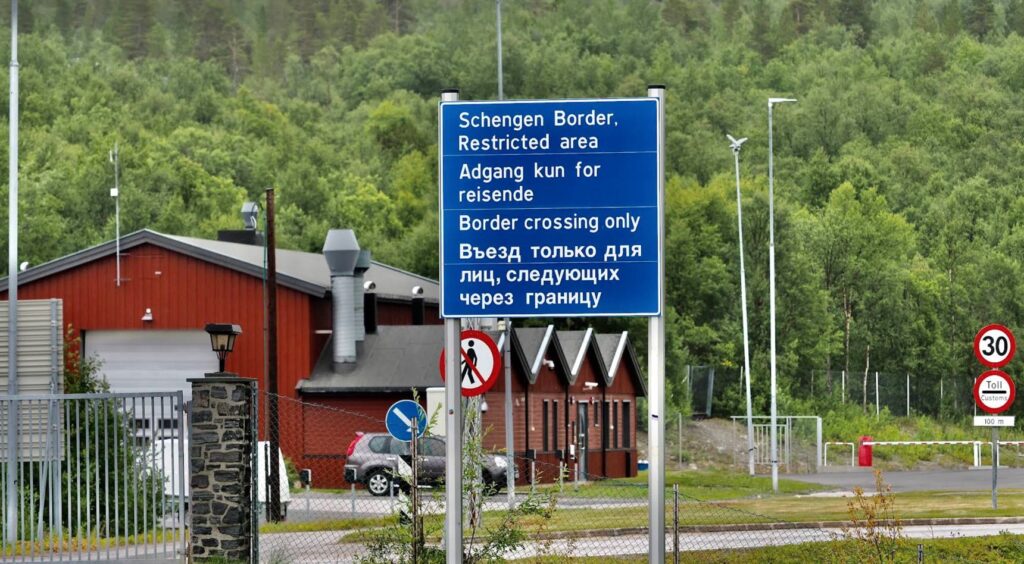
The other way into Murmansk is overland from Norway, crossing the Storskog–Borisoglebsk border post, 15 km east of Kirkenes. This is now the northernmost land crossing between the Schengen Area and Russia (the Finnish crossings have been closed since December 2023). Here the eVisa is not valid: you need a regular paper visa issued by a consulate. The crossing is usually quick (around 30 minutes in total) and operates every day from 08:00 to 15:00 Norwegian time.
The usual route is to fly to Kirkenes via Oslo (~2h 15m) and from there take a direct minibus to Murmansk with Borodin Bus or Avtoekspress (3.5–5 hours, €50–72 per leg; book 1–2 days in advance because they’re 8–12 seat minivans). You can’t cross on foot. Everything (timetables, paperwork, what the checks actually look like) is covered in the Storskog–Borisoglebsk crossing guide.
Where to see the northern lights: the 5 best spots
The rule is simple: the further from the city lights, the better. Murmansk’s light pollution isn’t on the scale of Moscow’s but even so it kills the contrast of the aurora and makes the lights look washed out. These are the five best spots in the region to see them at their full intensity.
1. Murmansk city (for a first night)
The city isn’t ideal, but it is possible to see the aurora from within it if solar activity is strong. Murmansk is built on hills (sopki in Russian), and from some of the higher points you get well away from the street lights. Three spots that work:
- Alyosha Monument: a colossal statue to the Soviet defenders of the Arctic, sitting on top of Green Cape Hill (Zelyonyy Mys). One of the best views over the city and Kola Bay. Reachable by public transport (stop Proezd Ivana Khalatina, a 10-minute walk away).
- Sopka Gorelaya: an ecological trail that starts on Kapitana Orlikovoy street. You leave the residential neighbourhood through the woods and climb until the light pollution drops off.
- Sopka Mishukova: 70 km from the centre, the highest point in the area (348 metres). There are organised tours that take you up with all the kit included.
2. Teriberka (the most famous spot, 120 km)
Teriberka is a fishing village on the shores of the Barents Sea, part of the Arctic Ocean, that became globally famous after Andrey Zvyagintsev’s film Leviathan. Today it’s the region’s star destination, and almost every northern lights tour passes through or overnights here. The reasons are several: the road is open all year, there’s accommodation (glampings and small hotels), basic tourist infrastructure, and the daytime landscape is spectacular: the “dragon eggs” beach (perfectly spherical rocks), the sunken-ships graveyard, the Malye Batareiskoye waterfall and the famous cliff-edge swing.
For aurora hunting it’s ideal because it’s far from any urban light and the horizon over the sea is huge. The downside is that in high season it fills up: in February and March you need to book accommodation several weeks ahead. If you go as part of an organised group, the tour usually includes dinner at a local restaurant (try the Kamchatka king crab, a regional speciality) and a full night of aurora chasing.

3. Khibiny and Kirovsk (mountains, 3–4 hours)
The Khibiny (Хибины) are a mountain range south of Murmansk, one of the oldest on the planet (350 million years). The peaks reach 1,200 metres and the altitude brings two advantages: practically zero light pollution and, because of the elevation, the aurora can take on a rare reddish tint that’s spectacular to watch. The Bolshoy Vudyavr ski resort is also here, along with the small mining town of Kirovsk with hotels and restaurants.
Getting there takes time: 4 hours by car from Murmansk, or a train to Apatity or Hibiny stations (also around 4 hours). There’s also a small airport near Kirovsk with direct flights from Moscow and Saint Petersburg, so you can plan it as a standalone destination: fly to Kirovsk, ski by day and chase the aurora by night.
4. Lovozero (Sámi culture, 166 km)
Lovozero is the main centre of Sámi culture in Russia — the indigenous people of the European Arctic who also live in Norway, Sweden and Finland. It’s about 3 hours by car from Murmansk along the E-105 highway, in the middle of nowhere, which makes it one of the best places in the region to see the aurora without any light pollution. It has an extra plus: you can pair the nightly hunt with daytime visits to the Sam-Syyt Sámi village, reindeer sled rides, the ethnographic museum and excursions onto the Lovozero tundra.
The village is small but has hotels, shops and cafés, so you can stay overnight. If you’re going independently, the most convenient option is to rent a car in Murmansk; for public transport, marshrutkas (minibuses) leave a couple of times a day from Murmansk’s central bus station.
5. Pechenga (the least touristy option, 120 km)
120 km northwest of Murmansk, almost on the border with Norway. It’s the least crowded spot for aurora viewing because most tourists head to Teriberka. Light pollution is minimal and by day you can visit the Pechengsky Monastery (the world’s northernmost) or the Valley of Glory memorial from the Second World War.
Warning: part of this area is restricted territory for foreigners without an FSB permit. Specifically, the zones closest to the border and to military bases can’t be visited without prior authorisation, which can only be obtained in Murmansk. If you’re going independently, stick to Pechenga and the authorised surroundings; if you’re with an organised tour, the guide knows the limits. Never go near military infrastructure or border areas without a permit — the fines and legal problems are serious.
How to chase the aurora: KP index, apps and forecasts
The northern lights can’t be predicted with full precision days in advance, but there are tools that let you keep close track of them.
Apps and websites for forecasts
- Hello Aurora: the best iOS and Android app, with real-time forecasts, push alerts and sighting reports from other users
- My Aurora Forecast: similar, with a good visualisation of the auroral oval on the map
- SpaceWeatherLive.com: website with all the scientific data and 3-day forecasts
- NOAA Space Weather Prediction Center: the official US source, free and very accurate, and the data backbone of many apps
- Aurora Forecast from the Geophysical Institute of Alaska: scientific forecast with auroral-oval visualisation
Telegram channels
On the Russian side there are Telegram channels with live sightings and alerts when activity is strong: @murmansk_travel posts aurora photos almost every night with details on where they were spotted, and @murmansk is the general city channel — useful for finding out about roads closed by snow or storms. There are also local aurora-hunter groups that share real-time alerts.
How many nights to book
A minimum of 3 nights, ideally 4 or 5. With 3 nights you already have a buffer for a bad one (cloudy or no solar activity) and an exceptional one. With 5 nights you almost guarantee seeing the lights at least once. If you do a quick 1–2 night trip, it’s Russian roulette: you may hit the jackpot, or you may leave Murmansk without seeing anything and with the feeling that you flew 3,000 km to watch the rain.
What to pack for the Arctic: clothing, gear and photography
Chasing the aurora means standing still outdoors for several hours at temperatures that can drop below −20 °C. Arctic cold isn’t the same as a winter day in London or New York: it’s dry, it goes through you, and above all it gets in through your feet if your footwear isn’t right. This is the list I recommend, based on personal experience and advice from local guides.
Layer up
- Base layer: technical underwear in merino wool or polypropylene. No cotton — it traps moisture and you’ll get cold the moment you sweat.
- Mid layer: a thick fleece or wool jumper
- Outer layer: a long down jacket reaching down to your thighs, ideally with natural down fill (700+ fill power)
- Trousers: thermals underneath and ski or snow trousers on top
- Boots: rated to −30 °C, with non-slip soles. Brands like Sorel, Baffin or Salomon Toundra do the job.
- Socks: thick merino wool, two pairs if needed
- Hat and neck warmer: covering ears and neck completely
- Mittens: better than gloves because fingers share warmth; wear thin gloves underneath so you can use your camera or phone without exposing bare skin
If you arrive in Murmansk without the right gear, there are shops on Lenin Street where you can buy everything you need (Sportmaster, Helly Hansen, local brands). Many tour operators also lend out extra down jackets for the night — ask when you book.
Beyond the clothing
- Thermos with a hot drink: tea with honey or broth. No alcohol — it cools you down in the long run, even though it feels like the opposite at first
- Chemical hand and foot warmers: 50 cents at any shop, lifesavers on −20 °C nights
- Power bank: cold drains your phone in minutes. Charge it and carry it in an inside pocket, against your body
- Head torch with red light: white light blinds you to the aurora and stops your eyes from adjusting to the dark
- Calorie-dense food: bread with butter, chocolate, nuts. Your metabolism burns through calories at a rate you wouldn’t expect
- Folding crampons: to fit over your boots. On roads and footpaths covered in snow there are invisible ice patches — falls are a classic
Photography gear
If you want to take decent photos, you need more than a phone. The basics: a camera with manual mode (DSLR or mirrorless), a fast wide-angle lens (14–24 mm, f/2.8 or wider), a sturdy tripod, spare batteries (batteries drain shockingly fast in extreme cold — keep them in an inside pocket against your body) and a remote shutter release or timer.
With a modern smartphone you can take decent shots in night mode with long exposure, especially if you brace the phone on something solid (no shake is the key). Apps like NightCap (iOS) or Pro Cam X (Android) give you full manual control. If you go with an organised tour, they almost always include a professional photographer who takes portraits of you under the aurora and sends the shots the next day — it usually pays off.
Organised tours to chase the aurora
If you go independently, bear in mind that you need a rental car (chasing the aurora on public transport is very impractical because it locks you to a single spot), the skills to move around the region in winter without getting lost in the snow, and awareness of the FSB restrictions in the area. That’s why most travellers go for organised tours, which have three big advantages: the guide decides where to head based on real-time cloud forecasts, they usually include professional photos of the group under the aurora, and they know the region better than any GPS.
The platform with the widest range of options is Sputnik8, which gathers certified local guides from Murmansk. They run several formats: small-group night aurora hunts (with minivan, photographer and thermoses), full-day Teriberka trips with an aurora night, outings into the Khibiny mountains, visits to the Sámi village with a reindeer sled ride, and multi-day 4×4 safaris on the Rybachy Peninsula (these require an FSB permit that they handle for you). Prices range from 3,000–7,500 rubles per person in a group (€30–75) up to 15,000–25,000 rubles for private 3–4 person groups (€150–250).
The problem, once again, is payment: Sputnik8 doesn’t accept foreign Visa or Mastercard. Your options are paying with a MIR card (the Russian one) or booking one of the tours that allow cash payment on arrival to the guide.

Accommodation in Murmansk and Teriberka
Murmansk has plenty of options: from 4-star hotels (Azimut Hotel Murmansk, Park Inn Polyarnie Zori) down to hostels and tourist apartments. Most are on Lenin Street (the main artery) and the surrounding blocks. Prices climb noticeably in high season (February–March): a decent hotel costs 5,000–9,000 rubles a night (€50–90). Book in advance, especially for weekends in February.
Booking.com and Airbnb stopped operating in Russia back in 2022, so the platform to use is Ostrovok, the main Russian booking site, which accepts foreign cards and MIR without problems. I explain how to use it in the guide to booking hotels and apartments in Russia with a foreign card.
In Teriberka the options are far more limited: glampings (heated modern yurts), small hotels with 8–12 rooms and private homes. In high season you’ll want to book two or three weeks ahead. Prices range from 6,000 to 15,000 rubles a night (€60–150) depending on the property. Some hotels have an “aurora alarm”: they call your room when the sky lights up so you can step outside and watch.
Restricted areas: what you can’t visit without a permit
The Kola Peninsula is heavily militarised — historically the home of the Russian Northern Fleet, including nuclear submarine bases. The practical consequence is that several localities and areas are off-limits to foreigners without an FSB permit. The main ones:
- Severomorsk: the main base of the Northern Fleet, north of Murmansk. Completely closed — no entry even with a permit except in very exceptional cases.
- Polyarny, Snezhnogorsk, Skalisty, Gadzhiyevo, Vidyayevo, Zaozyorsk: closed towns (ZATO in Russian jargon) that require a specific military permit.
- Rybachy Peninsula: requires an FSB permit, processed in Murmansk several days in advance. Certified tour operators can sort it out for you, usually charging a supplement.
- Border zone with Norway and Finland: a restricted strip 25–50 km deep. Don’t go near it without a local guide who knows the exact limits.
The FSB runs random checks in these areas, especially on vehicles carrying foreigners. The consequences for entering without a permit range from a fine and deportation to more serious legal proceedings. If you’re going independently, check the up-to-date map of restricted zones before setting out and don’t approach military infrastructure, antennas or installations marked with fencing. If you’re with a tour, don’t worry — the guide has it covered and will let you know if you need to turn back at any point.
Frequently asked questions
Can northern lights be guaranteed in Murmansk?
No, no destination in the world can guarantee the aurora 100%, because it depends on two uncontrollable variables: solar activity and cloud cover. What can be said is that Murmansk is among the places with the highest statistical probability on the planet. With 5 nights in season (September to March) and the mobility to chase clear skies, the probability of seeing them at least once is over 90%.
What’s the best month to see the aurora in Murmansk?
February is the best month overall: very long nights, stable skies, a snowy landscape for photos and a full lineup of winter activities still on. March follows close behind, with the bonus that the equinoxes trigger higher geomagnetic activity. December and January are also good, but extreme cold and the polar night limit some activities.
How much does an aurora-hunting tour cost?
In a small group (5–8 people), a nightly aurora hunt from Murmansk costs between 3,000 and 7,500 rubles per person (€30–75). Full-day Teriberka trips with a nightly aurora hunt run 4,000 to 5,000 rubles. Private tours for 3–4 people range from 15,000 to 25,000 rubles in total (€150–250). The payment problem is that Russian platforms don’t accept foreign Visa or Mastercard; you’ll have to pay with a MIR card or in cash on arrival.
Is it very cold in Murmansk in winter?
Less than its latitude suggests, thanks to the Gulf Stream. The January average is around −10 °C, far less extreme than Siberia or Yakutia. It can drop below −25 °C in cold snaps, but typical winter temperatures range between −5 °C and −15 °C. With proper layered clothing and thermal boots, it’s perfectly bearable.
Do I need a rental car in Murmansk?
Only if you plan to explore the region independently. To move around within Murmansk, taxi (Yandex Go) and public transport are enough. To reach Teriberka, Lovozero or the Khibiny on your own you do need a car, but most travellers opt for organised tours because they include guide, transport and — most importantly — smart decisions on where to chase the aurora based on the cloud forecast.
How many nights do I need to book at minimum?
A minimum of 3 nights, ideally 4 or 5. With fewer than 3 nights, the weather roulette is too risky: you could hit a streak of three cloudy nights or no solar activity. With 5 nights, the probability of seeing the aurora at least once in season is over 90%.
Do Visa or Mastercard work in Murmansk?
No. Visa, Mastercard and American Express cards issued outside Russia haven’t worked at any Russian establishment or ATM since 2022. You have three alternatives: bring cash (euros or dollars) and exchange to rubles at currency offices, open a Russian MIR card on arrival (T-Bank is the most accessible option for foreigners), or send money in advance through services like SendNOW and pick it up in cash.