
Trains in Russia: Types, Classes and Travel Experience
 By Irena Domingo
Updated on
In This Article
Russian trains are, in my opinion, the best way to get around the vast Russian territory. They’re safe, reasonably priced given the distances they cover, and the experience itself is part of the trip: carriages with their own character, provodnitsas serving tea in metal-holder glasses, long conversations with cabin companions, and landscapes that change every hour through the window.
In this guide I’ll walk you through everything you need to know about Russian trains: the different types, the most famous services (Sapsan, Red Arrow, Rossiya and the Trans-Siberian…), the wagon and seat classes you can pick, and what the experience on board is actually like.
This is step 3 of my guide to planning a trip to Russia in 10 steps, where you’ll find everything else in order.
A quick heads-up before we start: buying tickets from abroad has become trickier since 2022 because of the international sanctions. There’s a workaround — I explain all four viable options in a separate article to keep this one focused. I’ll link it at the end, once you have a clear idea of which train you want.

Russian trains and RZD
I’ve traveled on many long-distance trains across Russia and I can tell you from experience that they’re very safe, reasonably priced and comfortable. In my view, they’re the best way to get around the vast Russian territory.
The two busiest routes are the Moscow–Saint Petersburg run and the Trans-Siberian route, which continues all the way into Mongolia and China. But you can reach many other places by train, including Murmansk — the largest city in the world north of the Arctic Circle. The map below shows the main routes:
Clicking loads Google Maps, which may set cookies. Open in Google Maps
Russian trains are operated by the state company RZD, one of the largest railway companies in the world. It was created in 1992 as the successor to Soviet Railways after the breakup of the Soviet Union. It belongs to the Russian government and holds a monopoly on rail transport throughout the country.
There are basically three types of long-distance regular trains in Russia: daytime high-speed trains, overnight trains (some of them luxury), and more economical regular services. Let’s take them one at a time.
High-speed trains
Russian high-speed trains meet European standards and can reach up to 250 km/h. They’re comfortable, with a restaurant car and frequent departures, and they’re the best option for connecting major cities without flying. These are the main ones.
Sapsan
The Sapsan (or peregrine falcon) is the flagship of Russia’s high-speed fleet. It runs daily between Moscow and Saint Petersburg with 5 to 10 departures a day depending on the season (more frequent in summer), covering the route in just four hours with a couple of intermediate stops.
The current sets have been in service since December 1, 2013 and reach 250 km/h. They carry numbers 751 to 780. Inside, it feels more like a European high-speed train than a Russian one: airline-style seats, individual screens in business class, a bistro car and a dining car, and power outlets in the higher classes.


Lastochka
The Lastochka (swallow) entered service in 2013 and tops out at 160 km/h. It runs many regional routes: Saint Petersburg–Veliky Novgorod, Saint Petersburg–Vyborg, and some frequencies on the Moscow–Saint Petersburg corridor. It’s a more modest high-speed service than the Sapsan, designed for short and medium-distance trips.

Strizh
The Strizh (swift) has been running since June 1, 2015 and reaches 200 km/h. It’s a Spanish Talgo train with articulated carriages. It operates the Moscow–Nizhny Novgorod route (via Vladimir, Kovrov and Dzerzhinsk) in about three and a half hours.
⚠️ The Strizh’s Moscow–Berlin route (which ran via Smolensk, Minsk, Brest and Warsaw) has been suspended since 2022 due to sanctions and border closures. Only the Russian domestic route is still operating.

Nevsky Express
Running since 2001, the Nevsky Express covers the Moscow–Saint Petersburg route in just over four hours. It carries numbers 747 and 748. It’s not as modern as the Sapsan but tends to be slightly cheaper. It reaches 200 km/h. It has few weekly departures, so for most travelers the Sapsan is still the go-to option on this corridor.
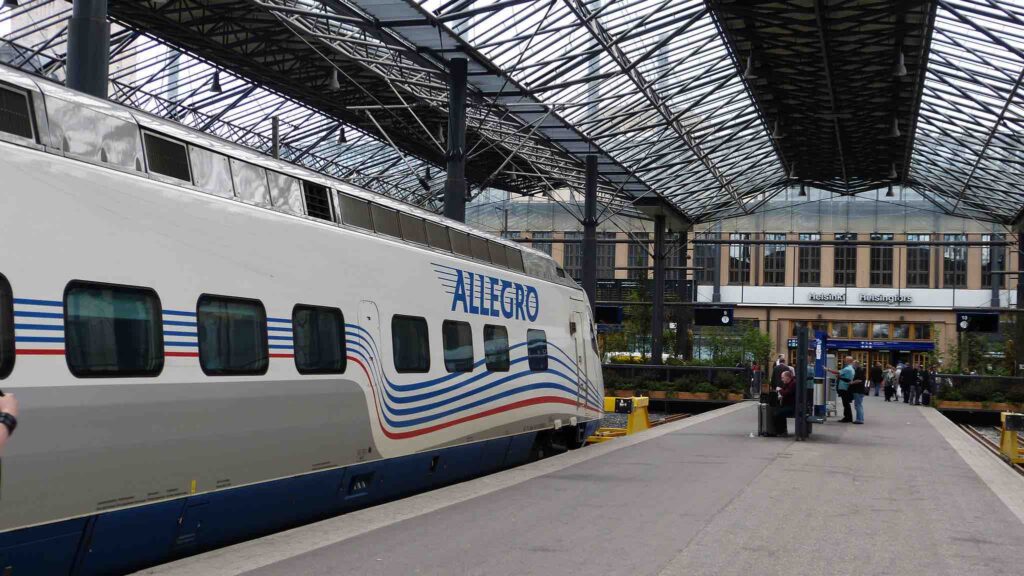
Allegro (currently suspended)
The Allegro ran between Saint Petersburg and Helsinki from 2010 with four daily trains. At a top speed of 220 km/h, it connected the Finnish capital with Saint Petersburg in about three and a half hours. It carried numbers 781 to 788.
⚠️ The Allegro service has been suspended since March 2022 due to the conflict in Ukraine. Tickets are no longer sold on either the Russian RZD site or the Finnish VR site. There is currently no direct train between Finland and Russia.
Seat classes on high-speed trains
Russian high-speed trains (mainly the Sapsan) sell several ticket types with real differences in space, services and price:
Economy Class. The cheapest ticket. Food isn’t included, but you can order it on board.

Bistro Car. Slightly more expensive, includes light snack-style food.

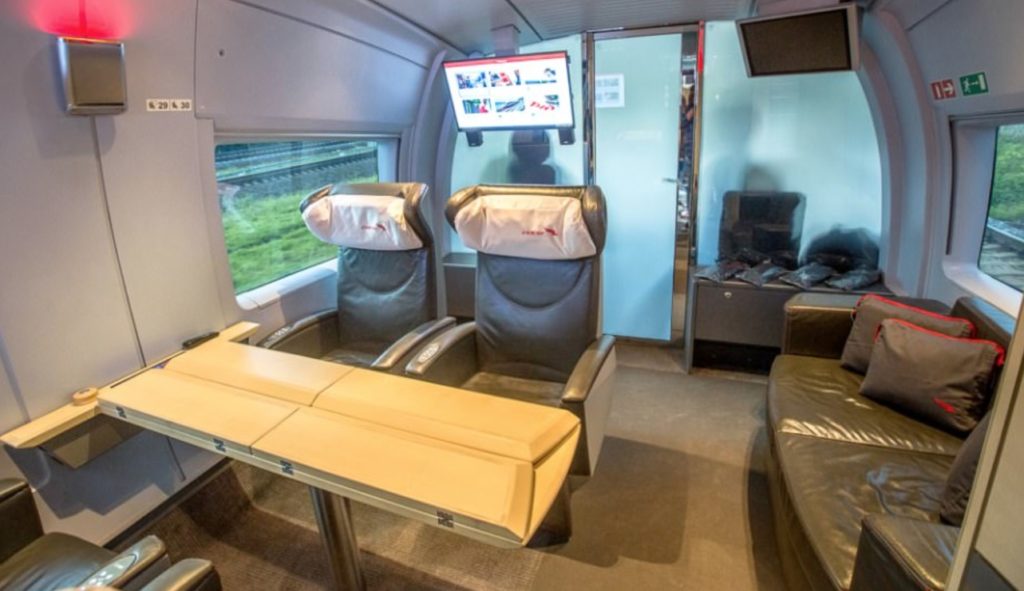
Business Class. Roomier seats, power outlets for your phone or laptop, a hot meal and press. The equivalent of business class on a flight.

First Class. All the business class services plus even wider seats, pillows, toiletry kit, internet, and so on.

Conference Compartment. A four-seat compartment with a meeting room and all the trimmings. Designed for business travel in small groups.
Overnight trains: the most iconic
Given the enormous distances you’ll cover in Russia, overnight trains are an institution. You can cross the country over two, three or even seven days without leaving your berth, with a dining car, showers on the more modern sets, and a passenger community that feels closer to a small village than to a means of transport.
The most luxurious overnight trains have their own names. The best known run between Moscow and Saint Petersburg or along the Trans-Siberian route. They offer meals, a dining car, the full attention of a provodnitsa, and round-the-clock hot tea.
Krasnaya Strela (Red Arrow)
The Red Arrow is a symbol of RZD. It could be called the most classic train on the Russian network. This luxury overnight service started running in 1931 and has only ever been suspended once, for two years between 1941 and 1943, during the Siege of Leningrad.
Painted in deep red, it offers an unforgettable experience with Soviet-style interiors. The redesigned carriages introduced in 2007 gave it a modern touch while keeping the classic aesthetic.
It runs between Moskovskaya station in Saint Petersburg and Leningradskaya station in Moscow. There’s only one departure per day, shortly before midnight, arriving at destination around 8 am. These are trains 001A and 002A.


Grand Express
In 2001 Russian railways went through a major shake-up when the government encouraged private companies to enter passenger rail. The Grand Express was the first Saint Petersburg–Moscow train to come out of that reform and it’s still operated by a private company today.
The Grand Express is arguably, alongside the Red Arrow, the most luxurious regular train in Russia. The overnight run between Moscow and Saint Petersburg takes about eight hours, with one departure per day. These are trains 003A and 004A.
Tickets can be bought on either the RZD site or the private operator’s site, at the same price on both.


Moscow–Saint Petersburg (double-decker)
This service, simply known as the ‘Saint Petersburg (double-decker)’, is a modern two-level overnight train that covers the route in about eight hours (22:50 to 6:47). It’s significantly cheaper than the Red Arrow or the Grand Express, with excellent value for money. These are trains 005A and 006A.


Arctic
The Arctic train (Арктика) is literally the train that takes you to the Arctic. It runs between Moscow and Murmansk, a port city in northwestern Russia close to the borders with Norway and Finland, in the Lapland region. The journey takes around 35 hours. These are trains 015А and 016А.
The train also stops in Saint Petersburg, so it’s another option for the Moscow–Saint Petersburg route (departs Moscow at 00:41, arrives in Saint Petersburg at 9:13). It’s much cheaper than the Red Arrow or the Grand Express — just don’t fall asleep if you don’t want to end up in the Arctic Circle.


Tolstoy
Named after the great Russian writer Leo Tolstoy, this overnight service began in 1975 as the first overnight train to run above 120 km/h. Today it offers modern compartments and excellent service. Its numbers are 031A and 032A. It stops in Saint Petersburg, so it can also be used for the Moscow–Saint Petersburg route.
⚠️ The Tolstoy’s international Moscow–Helsinki route has been suspended since March 2022. The train still runs with a stop in Saint Petersburg, but the continuation into Finland is not currently on sale.


Rossiya (Trans-Siberian)
The Rossiya train, which runs the Trans-Siberian route, is arguably the best choice if you’re after an authentic experience rather than a cruise-style tour. Before private luxury trains came along, the Rossiya offered the best service on the week-long run between Moscow and Vladivostok.
This is a regular train, not a tourist one: you share the carriage with Russian families, soldiers and students. If you’re after the authentic Trans-Siberian experience, this is your train.


Wagon classes on overnight trains
Russian overnight trains offer several compartment and carriage types, which determine the price as well as the level of privacy and comfort. These are the main ones:
Luxury (deluxe compartment). A compartment for two with private bathroom, shower, TV and all the amenities. You’ll only find it on the most luxurious trains, like the Red Arrow or Grand Express, and the price is significantly higher than the rest.


1st class (SV, Sleeping). A closed compartment with two beds, more comfortable than 2nd class. The bathroom is shared with the rest of the carriage. An excellent choice for couples or anyone who wants privacy without paying Luxury prices.
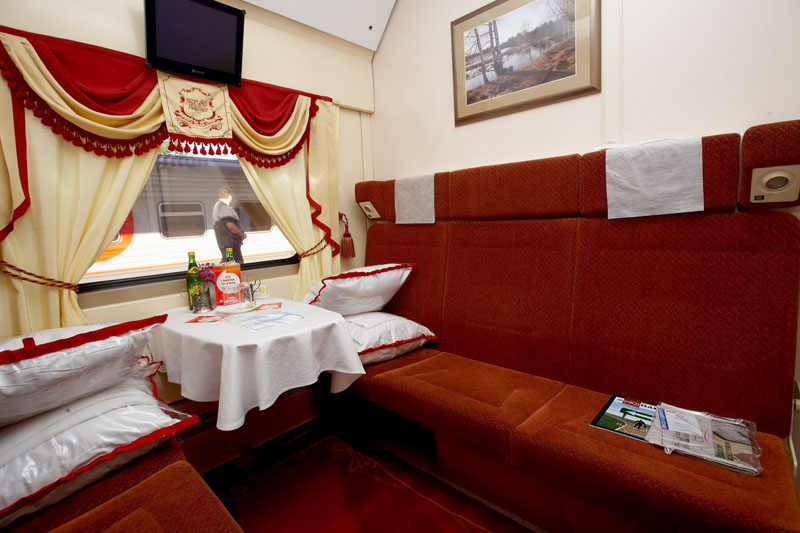
2nd class (Kupé). Standard closed compartments for four people, with two lower bunks and two upper bunks. The bathroom is shared. This is the most popular option and the best value for money: you have privacy from the corridor but share the space with other passengers.

3rd class open sleeping (Platskart). Unlike first and second class, which use closed compartments, third class is an open carriage with 54 beds arranged in blocks, without doors or curtains. It’s the choice for those who want the cheapest ride and don’t mind much about comfort or privacy. It’s also where you’ll interact most with Russians: the social atmosphere is far more intense than in kupé.

Sitting. Gives you access to a standard seat only, no berth. Used on medium-length overnight routes where you don’t actually need to sleep.

Women-only compartments. On many overnight trains there are compartments reserved for women. When booking, look for the ‘Gender’ icon on the compartment layout. If you book a seat there, the remaining seats can only be purchased by other women. A good option if you’re traveling solo and prefer a 100 % female environment.

Private luxury trains: Imperial Russia
So far I’ve talked about regular trains, which are what most travelers take. But there’s also one private luxury train still operating in Russian territory: Imperial Russia, run by the RZD travel agency (RZD Tour Co. Ltd).
This is a ‘cruise on rails’ package: a private compartment, organized excursions at each stop, meals included in a luxurious dining car, and so on. The whole thing is a closed package.
It’s a good option if you don’t want to deal with the logistics yourself and you’re willing to pay for a premium all-inclusive experience.
⚠️ Other private luxury trains like the Golden Eagle (operated by a British company) have stopped offering routes within Russia following the 2022 international sanctions. Only Imperial Russia, operated directly by RZD, is still active on Russian territory.
What it’s like to travel on a Russian train
Traveling by train in Russia has little to do with taking a TGV or an ICE. There’s a very particular railway culture here, with its own rituals and small customs worth knowing about.
Arriving at the station
I recommend getting to the station about 30 minutes before departure, especially if you’re traveling from a larger station. You’ll need to go through a security check similar to an airport’s (less strict but with a luggage scanner), then walk to your carriage — which can be a long way on long-distance trains. Boarding is generally allowed 40 minutes before departure.
When you arrive, the first thing to do is check the electronic schedule board to confirm your train, time and platform. More details on station services in my guide to train stations in Russia.

The carriages are numbered on the first or last window of each car. At the door of your carriage, the attendant (provodnik or provodnitsa) will be waiting to check your ticket and your passport before letting you board.
The provodnitsa
The provodnitsa (or provodnik if it’s a man) is a key figure on Russian trains. Every carriage has its own, and she’s responsible for keeping order, cleaning, serving tea, taking food orders and helping you with anything you need during the journey. Provodnitsas don’t usually speak English, but they’re friendly and resourceful. A greeting and a smile open a lot of doors.
Once you’re in your compartment, the provodnitsa will bring you the menu in case you want a drink or want to order dinner or breakfast. On overnight trains she’ll also bring you the folded bedsheets (sometimes included in the ticket, sometimes charged separately, around 200 rubles).
Russian tea in the podstakánnik glass
Russians love to order tea when they board a train. It’s served in glass cups with a metal holder (подстаканник, podstakánnik), a traditional item that on some classic trains still carries the RZD logo engraved on it. Trying it is practically compulsory — it’s one of those small rituals that makes the trip special.

Toiletry kit, breakfast and meals
The standard second-class ticket on long overnight trains usually includes a basic toiletry kit: toothbrush and toothpaste, comb, wipe, and so on.
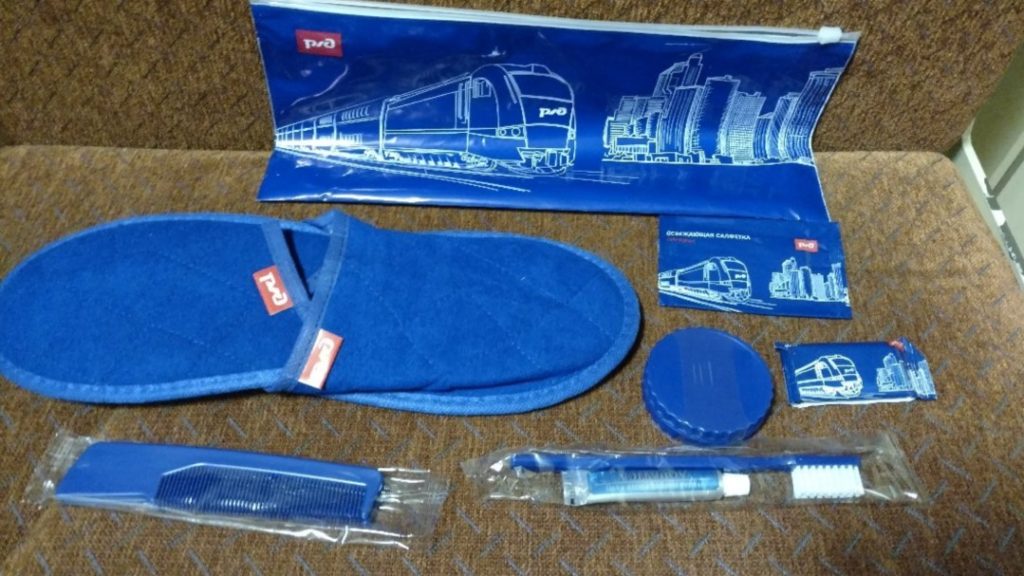
Plus a basic breakfast (water, juice, a pastry or a piece of fruit).

If you want, you can order an upgraded hot breakfast, a dinner (standard, vegetarian or children’s menu) or other services for an extra charge. You can do this when booking or directly once you’re on the train.

Luggage
The standard ticket lets you carry a suitcase of up to 36 kg per person in the same compartment, where there’s dedicated space for bags (under the seats and above the corridor). If you’re carrying more than that, or special luggage (pets, bicycles, wheelchairs), you’ll need to book additional transport when buying the ticket.
How to buy tickets
Buying train tickets in Russia from abroad has gotten harder since 2022. The official RZD website (rzd.ru) no longer accepts Visa or Mastercard, and it’s blocked in many countries, so you need a VPN to access it.
Even so, there are four viable options: RussianTrain (an intermediary agency with an English-language website and foreign card payment), Belarusian Railways (RW.by) (selling Russian tickets at near-official prices), RZD.ru directly if you have a MIR card, or the station ticket offices once you’re in Russia.
On when tickets go on sale: on the RZD website they appear 90 days in advance (or even 120 days for some trains).

In high season, if you want a better price, it pays to book as early as possible — prices rise with demand, just like flights. Most electronic tickets can be cancelled ahead of the trip with a small penalty.
I cover all four options — pros, cons, prices and the step-by-step for each — in my guide to buying Russian train tickets despite the sanctions.
Frequently asked questions
What’s the fastest train between Moscow and Saint Petersburg?
The Sapsan is the fastest train between the two cities, covering the route in about four hours at a top speed of 250 km/h. It runs 5 to 10 times a day, with more frequencies in the high season.
Is it safe to travel on Russian overnight trains?
Yes, Russian trains are very safe. The closed kupé and SV compartments lock from the inside, the staff (provodnitsas) keep an eye on the carriage throughout the journey, and stations have security checks at the entrance. On top of that, many trains have women-only compartments if you’re traveling solo and prefer that.
What’s the difference between kupé and platskart?
Kupé (2nd class) is a closed compartment for four people with a door, two lower bunks and two upper bunks. Platskart (3rd class) is an open carriage with many beds, no doors and no curtains. Platskart is cheaper and the social atmosphere is more intense, but you have less privacy. Kupé is the option most foreign travelers pick.
Are there showers on Russian trains?
On the more modern trains and in Luxury compartments, yes. In 1st and 2nd class on most overnight trains there are only washbasins. On very long journeys like the Trans-Siberian on the Rossiya, there are shared showers in the more recent carriages.
How far in advance can I book tickets?
Russian train tickets go on sale 90 days in advance. For some specific trains, like the Moscow–Saint Petersburg high-speed services, tickets go on sale 120 days in advance. In high season it pays to book early because prices rise with demand.
Can I bring large suitcases on the train?
Yes. The standard ticket allows up to 36 kg of luggage per person at no extra cost. There’s space for suitcases under the seats and in the overhead compartment along the corridor. If you’re carrying more than 36 kg or special luggage (pets, bicycles), you’ll need to book additional transport when making the reservation.
In This Article
Was this useful? I'll tell you when something changes in Russia
One short email a month with what has changed for travellers (visas, payments, border crossings, apps), based on what readers report to me from Russia. More than 4,000 of us already. No spam: if you ever lose interest, unsubscribing is one click.
Irena DomingoAbout Me
I was born in Russia. I grew up between two worlds: my father was Russian, my mother Spanish — a descendant of the "Children of Russia", the Basque children evacuated to the USSR during the Spanish Civil War. I've worked as a translator, interpreter and Russian teacher for over 30 years, and since 2013 I've been writing this blog to help travellers discover Russia with practical, always up-to-date information. Author of the Russiable Guide. If this blog has helped you plan your trip, you can buy me a coffee ❤️.
 Bus to Saint Petersburg from Tallinn and Riga: Companies, Routes, Prices and Tickets
 Should I indicate nights on the train in the application for an invitation letter or Russian visa?
 Traveling by Bus in Russia: How to Buy Tickets Online with a Foreign Card