
Taking medicines to Russia: what you can bring, when you need a prescription and how to declare them
 By Irena Domingo
Updated on
In This Article
Here it is in one sentence: the vast majority of medicines you can take to Russia with no paperwork at all. Painkillers, cold and flu remedies, anti-inflammatories, vitamins, antibiotics, blood-pressure or stomach pills… you put them in your suitcase —ideally in their original box— and that’s it. There’s nothing to declare.
The problem lies with one specific group: medicines that contain narcotic, psychotropic, potent or toxic substances. Those do require medical documents, a sworn translation into Russian and, in many cases, a customs declaration on arrival. And here’s the key point: that controlled substance can be hiding in medicines that look harmless, like a cough syrup with codeine, a muscle relaxant with tramadol or some sleeping pills. In this guide I’ll explain how to tell which group your medication falls into and what to do in each case.
This is step 9 of my guide to planning a trip to Russia in 10 steps, where you’ll find everything else in order.

The quick rule: the three groups of medicines
So you don’t get lost, hold on to this classification. Everything you’ll read afterwards boils down to knowing which of these three groups your medicine falls into.
| Group | Examples | What you have to do |
|---|---|---|
| 1. Common medicines | Paracetamol, ibuprofen, antibiotics, antihistamines, vitamins, blood-pressure pills, insulin, contraceptives | Nothing. Take them in their original packaging and in a reasonable amount. No declaration. |
| 2. With narcotics or psychotropics | Codeine, tramadol, benzodiazepines (diazepam, alprazolam…), strong sleeping pills, methylphenidate, opioids | Medical report + sworn translation into Russian + mandatory customs declaration (red corridor). |
| 3. With potent or toxic substances | Some anabolic steroids, certain muscle relaxants, phenobarbital | A document proving the prescription. Exception: if they are registered and sold without a prescription in Russia, it isn’t needed. |
If your medication is in group 1 —which is the most likely scenario—, you can skip almost the entire rest of this article. If it’s in group 2 or 3, read on carefully.
General tips for any medicine
Whether you have to declare or not, these four tips will save you trouble at the checkpoint:
Bring them from home
If you depend on a specific medication, bring it from home and don’t count on buying it there. Many medicines do exist in Russia, but others aren’t sold or require a Russian prescription, which you won’t be given as a tourist. This is especially important if you have a heart or circulatory condition, if you’re being treated for HIV or if you need insulin every day.
In their original packaging
Carry your medicines in their original box, with the label and the leaflet. Avoid pill organisers and little bags: besides keeping the pills less well, they raise suspicion at the checkpoint, because the officer can’t verify what you’re carrying. And a pill organiser with loose tablets can indeed end up confiscated.
In your hand luggage
Keep the essentials in your backpack or hand luggage, not in the checked suitcase. That way you have them at hand to declare them or to take them during the trip. Three practical notes:
- Liquid medicines you need during the flight are exempt from the 100 ml rule, but you’ll have to present them separately at the security check, outside the transparent bag for the other liquids.
- If you carry syringes, needles, insulin pens or ampoules, you need a medical report justifying their use, and it’s a good idea to warn the security staff before the check.
- Insulin and other temperature-sensitive products shouldn’t go in the checked suitcase: the hold can get too cold. Keep them in the cabin.
In a personal-use amount
Bring just enough to cover your stay plus a few days’ margin. As a rule of thumb, on international trips you’re allowed to bring up to about five boxes of the same medicine without declaring it. If you need more because it’s a chronic treatment, that’s fine: just bring the medical report that justifies that amount. What has to be clear is that it’s for you, not for resale.
Step 1. Check your medicine’s active substance
As a foreigner you can bring almost any medicine to Russia for personal use —even one that isn’t registered there— on one condition: that it doesn’t contain controlled narcotic, psychotropic, potent or toxic substances. If it does, you’ll need a translated prescription and to declare it.
Watch out for a key detail: the name of the controlled substance doesn’t match the brand name of the medicine. That’s why the first thing to do is look at the active ingredient on the leaflet and check whether it appears in either of the two lists Russia controls:
- Narcotics, psychotropics and precursors: the list is set by Decree 681 of the Russian Government, updated frequently. It has three schedules: Schedule I (fully banned, not even sold in Russian pharmacies) and Schedules II and III (limited circulation, obtainable there only with a Russian prescription).
- Potent and toxic substances: these are covered by Decree 964, for the purposes of Article 234 of the Russian Criminal Code. They aren’t narcotics, but they also require documentation, unless the medicine is registered and sold without a prescription in Russia.
Both lists are in Russian. You can run them through your browser’s translator, but to save you the work, these are the medicines a traveller most often carries that are controlled:
- Codeine: found in many cough syrups and in some combination painkillers.
- Tramadol: a very common strong painkiller.
- Benzodiazepines: diazepam, lorazepam, alprazolam (Xanax), clonazepam, bromazepam, midazolam… (anxiety medication and sleeping pills).
- Other sleeping pills: zolpidem, zopiclone.
- Methylphenidate (Ritalin, Concerta) and amphetamines for ADHD.
- Pregabalin (Lyrica) and some antiepileptics.
- Pseudoephedrine and ephedrine: decongestants in some cold and flu remedies.
- Strong opioids: morphine, oxycodone, fentanyl, buprenorphine, methadone.
- Phenobarbital: watch out, it’s in very popular Russian heart drops like Corvalol or Valocordin (especially relevant when leaving the country).
- Anabolic steroids and ketamine.
If your medicine contains any of these substances —or you’re in doubt—, treat it as group 2 or 3: you’ll need a translated prescription and, in the case of narcotics and psychotropics, to declare it at customs.
Step 2. Get the prescription and its sworn translation into Russian
The legal basis in force is Decree 853 of 2021, together with Federal Law No. 61 on the circulation of medicines. Under these rules, to enter with a medicine containing these substances you need documents proving that you need it, with the name and quantity of the prescribed medicine. If they are in another language, a Russian translation legalised by a notary must be attached.
In practice, this is what you should bring:
- The original prescription or medical report, stating the condition being treated, why you need that substance, the name of the medicine and the quantity needed for the treatment. It must make clear that it’s for you and for personal use. Ask your doctor for it before you travel.
- A sworn translation into Russian of that prescription or report. It’s done by a sworn translator or a translation agency; online you’ll find plenty that handle it remotely.
An important warning: you can’t carry controlled medication for another person. It has to be in your name and for your own treatment.
Step 3. Declare them at customs (red corridor)
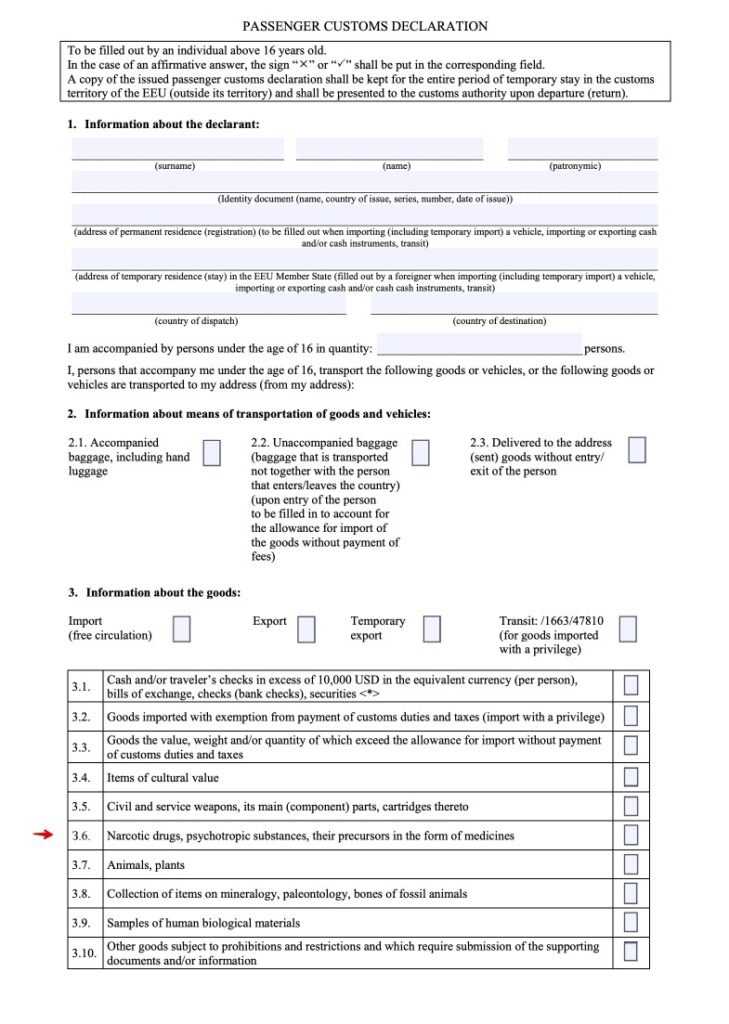
If you’re carrying a medicine with narcotics or psychotropics, on arrival in Russia you have to go through the red corridor and fill in the Passenger Customs Declaration.
On the form, tick “Yes” in box 3.6 (“Narcotic drugs, psychotropic substances, their precursors in the form of medicines”) and, in the goods information section, list the medicines you’re carrying. You can fill it in electronically before you travel (you need a VPN to access it) and print it, so you arrive with everything ready.
The customs officer will check your medicines and your documents and, if everything is in order, will stamp your declaration as approved. Keep that form: when leaving the country you’ll have to go through the red corridor again so they can check how much you’re taking back.
Many people go through the green corridor without declaring, even when they have the documents. It’s a risk I don’t advise: if they open your suitcase, they can confiscate your medication for not declaring it and even complicate your entry to or exit from the country.
What happens if you don’t declare what you should have
This isn’t a minor formality. Importing medicines with narcotic or psychotropic substances without the documents and without declaring them can lead to administrative liability and, in the most serious cases, criminal liability. The Russian consular website itself warns of this explicitly. For a few minutes in the red corridor with your translated prescription, it’s not worth the risk.
And what about taking medicines out of Russia?
On the way out it’s the same in reverse. Medicines without controlled substances you can take out with no problem within personal-use limits. But those containing narcotic, psychotropic or toxic substances require authorisation and a declaration. Beware of a classic mistake: buying Corvalol or Valocordin (which contain phenobarbital) at a Russian pharmacy and taking them out of the country just like that, because they fall into that category. And before you leave, also check that your medication is allowed in your destination country.
Before you close your suitcase
To be 100% sure, the best thing is to confirm your specific case with your doctor, with the Russian embassy or consulate and with the official list from the Russian Federal Customs Service. I know consulates don’t always give detailed information, which is why I’ve tried to gather the essentials here. If you’re travelling with several medicines, take a look as well at the guide on what to pack for Russia.
Frequently asked questions about taking medicines to Russia
Do I need a prescription to take paracetamol or ibuprofen to Russia?
No. Painkillers, anti-inflammatories, cold and flu remedies, antibiotics, vitamins and most common medicines you can take without a prescription or declaration. Just keep them in their original packaging and in a reasonable amount for personal use.
How many boxes of the same medicine can I bring without declaring them?
As a rule of thumb, on international trips you’re allowed to bring up to about five boxes of the same medicine without declaring it. If you need more for a chronic treatment, bring a medical report justifying that amount.
Does a cough syrup with codeine have to be declared?
Yes. Codeine is a controlled substance in Russia, even if it’s in a seemingly harmless medicine. You need a prescription or medical report with a sworn translation into Russian, and you must declare it at customs through the red corridor.
Can I travel with insulin to Russia?
Yes. Insulin is a common medicine and doesn’t require a declaration. Carry it in your hand luggage and not in the checked suitcase, because the hold can get too cold. It’s a good idea to have a medical report justifying the syringes or insulin pen.
Does the prescription have to be translated into Russian?
Only if your medicine contains narcotic, psychotropic, potent or toxic substances. In that case you need a sworn translation into Russian, legalised by a notary, of the prescription or medical report.
Where do I declare medicines when I arrive in Russia?
At the red corridor of customs, filling in the Passenger Customs Declaration and ticking box 3.6 of the form. You can fill it in electronically before travelling and print it. Keep the stamped form to show it again when leaving the country.
In This Article
Was this useful? I'll tell you when something changes in Russia
One short email a month with what has changed for travellers (visas, payments, border crossings, apps), based on what readers report to me from Russia. More than 4,000 of us already. No spam: if you ever lose interest, unsubscribing is one click.
Irena DomingoAbout Me
I was born in Russia. I grew up between two worlds: my father was Russian, my mother Spanish — a descendant of the "Children of Russia", the Basque children evacuated to the USSR during the Spanish Civil War. I've worked as a translator, interpreter and Russian teacher for over 30 years, and since 2013 I've been writing this blog to help travelers discover Russia with practical, always up-to-date information. Author of the Russiable Guide. If this blog has helped you plan your trip, you can buy me a coffee ❤️.
 Essential tourist maps of St. Petersburg (PDF and JPG)
 Official Tourist Maps of Moscow in PDF – Free Download
 How to Get the Mandatory OSAGO Insurance for Driving into Russia with Your Car